Posts with «mega» label

Play like a spy with L.E.A.P. Engine


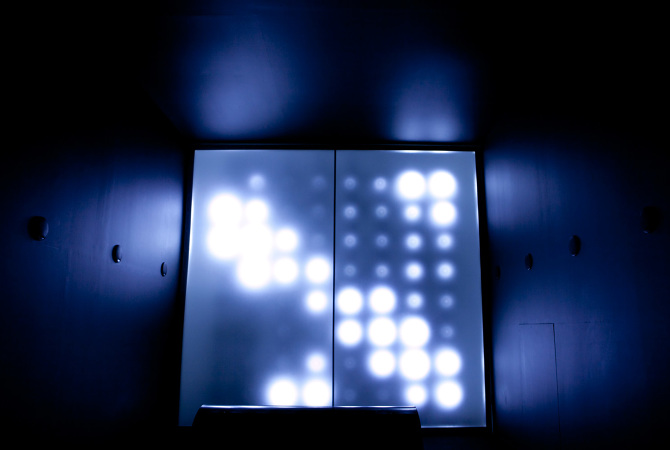
Toronto-based collaborative duo Hopkins Duffield created a gaming environment running on Arduino Mega in which the player battles a laser wielding A.I. security system gone awry. It’s like being in an action movie, walking in a pitch black room filled with the hollow sound of a machine breathing and a series of red laser fences slicing through the fog-filled air!

Laser Equipped Annihilation Protocol (The L.E.A.P. Engine) is a an installation that :

explores the personality of a snarky and mysterious game sentience who has infected a room with technological systems that challenge players and collect data. With a limited amount of time, the player must pass through a complicated series of changing and alternating laser patterns without tripping any of the lasers in order to deactivate the system and win the game. If the player trips a laser or if the timer runs out, it’s game over.

The gaming installation uses Max 6, Max For Live, an Arduino Mega 2560 R3 and custom electronic circuits. They also used a special modification of Lasse Vestergaard’s and Rasmus Lunding’s ArduinoInOutForDummies designed to allow communication between Arduino 2560 and Max 7. In Max, laser patterns are written using MIDI.

Take a look at the video to discover how they made it:

Arduino Blog 26 Aug 11:17

Xbee and Arduino sent to space by NASA

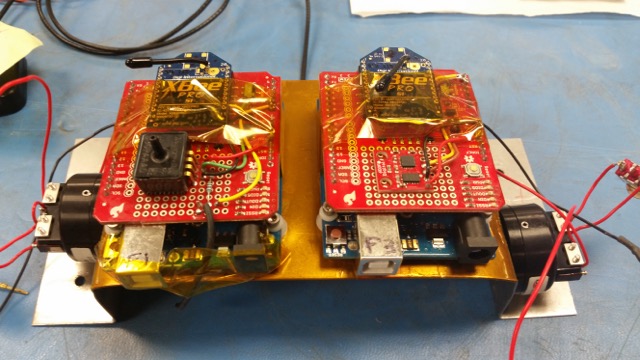
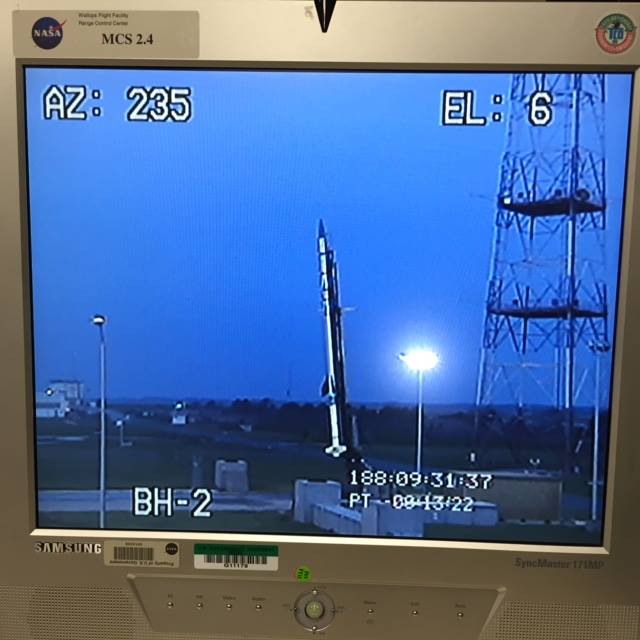
Last July 7 at Wallops Flight Facility, NASA launched Black Brant IX , a suborbital sounding rocket to test “wireless-in-space” with XBee and Arduino :

Onboard the rocket was an experiment testing Exo-Brake technology. XBee was used to collect sensor data including temperature, air pressure, and 3-axis acceleration parameters. NASA is considering Exo-brakes as a possible solution for returning cargo from the International Space Station (ISS), orbiting platforms or as possible landing mechanisms in low-density atmospheres. This was one of many tests used to analyze its effectiveness, but the first to incorporate an XBee connected sensor network. If you would like to read more about the Exo-brake, check out this article.

As part of a program to determine potential applications of wireless technologies in space, NASA chose XBee® ZigBee modules and Arduino Mega  explaining that:

Wireless sensor technology allows measuring important parameters such as aerodynamic pressure and temperature at the apex of the Exo-Brake during re-entry. It is very difficult to instrument a deployable parachute like the Exo-Brake, and wireless sensor modules provide the means for this type of measurement where it is difficult to run wires,” said Rick Alena, computer engineer at NASA Ames.

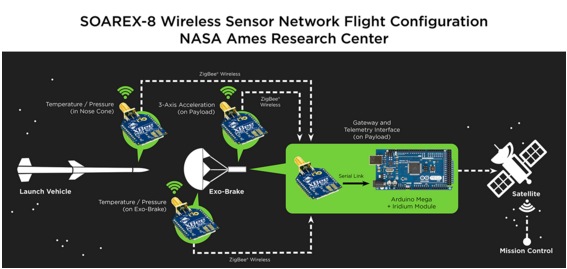
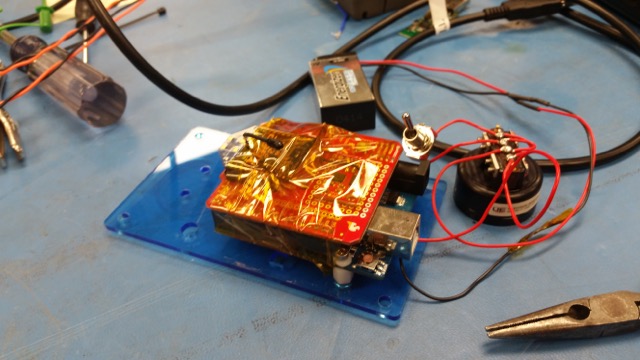
The NASA team constructed a gateway using an Arduino Mega, XBee, and Iridium module. The Arduino Mega was used to manage communications between the local XBee wireless network and the long-range Iridium satellite uplink. It was chosen as part of a NASA initiative to use commercial off-the-shelf components where possible, and to employ rapid prototyping tools to efficiently explore new ideas.

See the diagram below to get a detailed view into how the network was configured.


Arduino Blog 31 Jul 17:20
arduino mega  featured  mega  space  xbee  

Measure time like an egyptian with an Arduino hourglass

Todo is the italian design consultancy and creative agency taking care of Arduino and Genuino brand identity and interviewed in this previous blogpost.

Last year, among other projects, they worked on an unconventional communication campaign to narrate the re-opening of the well-known Turin’s Egyptian Museum, displaying a collection of over 30,000 ancient pieces.

The campaign’s goal was to hold people’s attention over six months before the official opening of the Museum and be able to speak to a broad national and international audience.

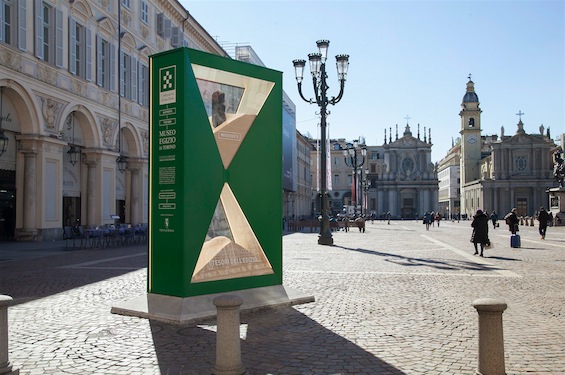
TODO created an open air installation composed by an almost-4-meter-tall hourglass (with a hidden mechanism running on Arduino) that had to work day and night, for six months and over the winter. According to Wikipedia, this hourglass could be the 4th biggest of its kind in the world!

The main challenge was that they had to make sure that the very last grain inside the hourglass would fall on the day of the Museum’s inauguration.

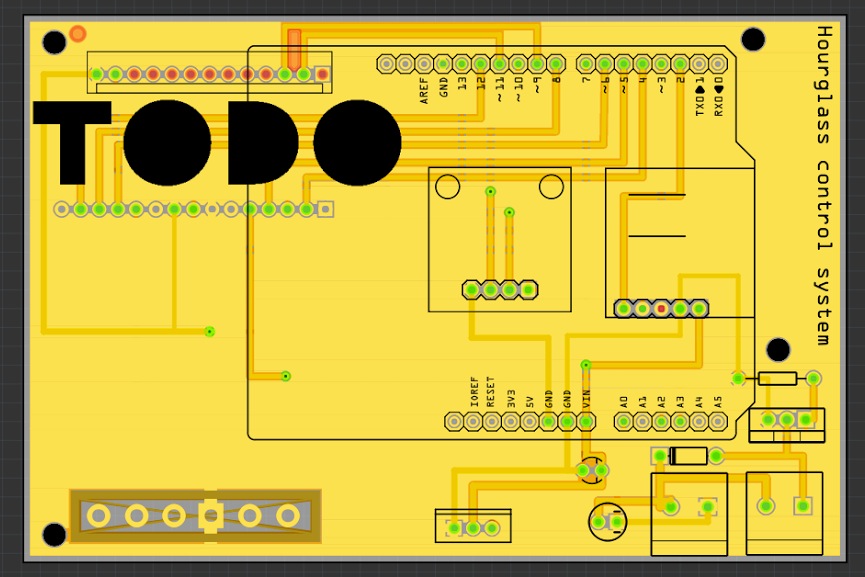
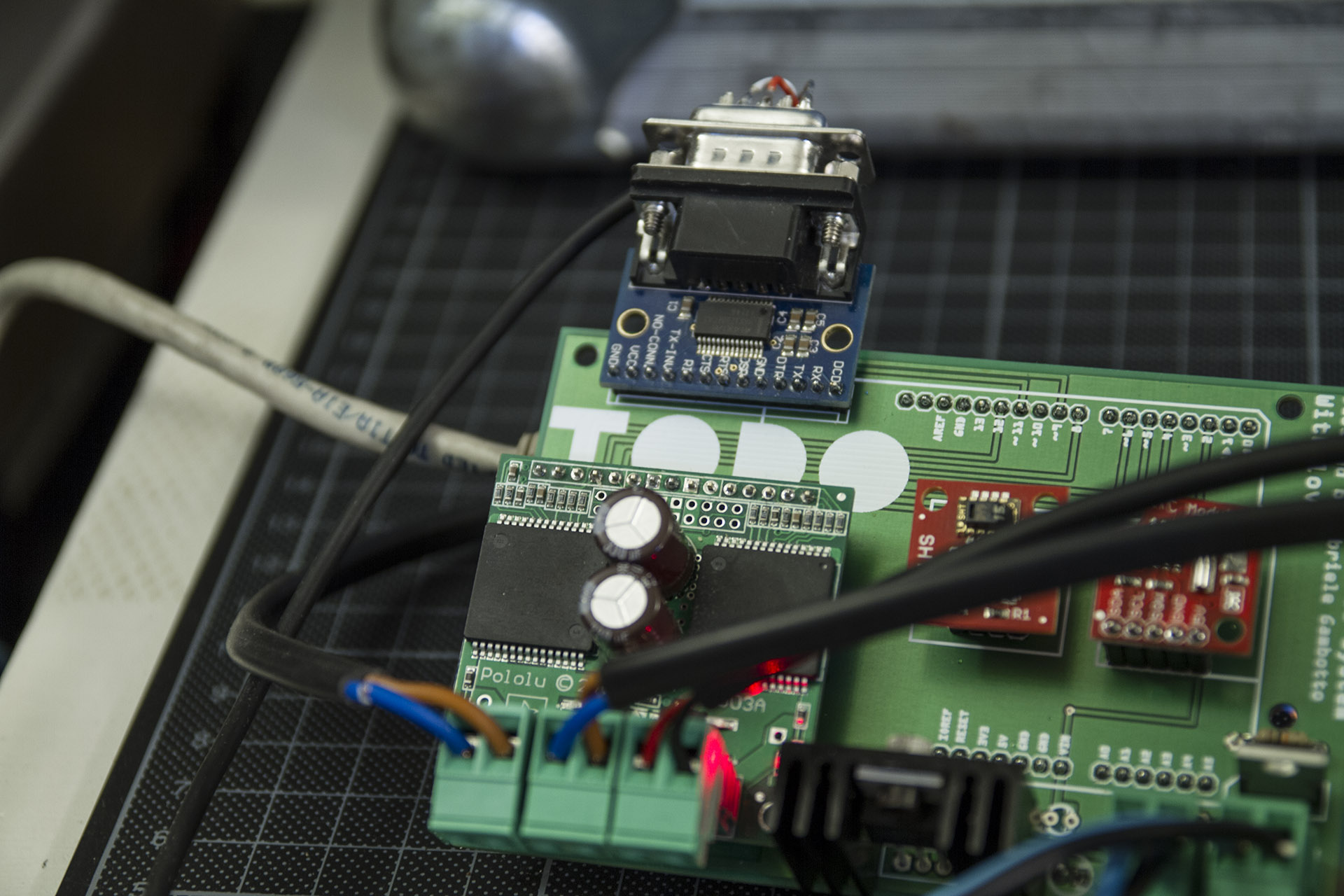
The installation was created thanks to many collaborators among which Gabriele Gambotto who developed the electronic part based on the Arduino Yún on which they added a custom shield ( See pic below), connected to various sensors and a precision scale. The sand-like material passed through a valve and a long screw conveyor controlled by a mot

Take a look at the video of the ‘Hourglass Countdown’ and to see it in action:

In an indoor area of the museum an interactive display case was the other face of the campaign revealed to the audience:

A series of replicas of ancient Egyptian finds were covered in sand, and users could interact with the system by choosing the spot they wished to unveil, blowing into a microphone, and having their breath converted by a small robot arm, which placed itself in the exact spot, blew away the sand and revealed part of the find.

The experience came to life in two different contexts. Locally, a roadshow with several stops made the display case accessible all around the city. Online, through the campaign’s website, you could blow away the sand from anywhere in the world, seeing the live streaming video of the robot moving and unveiling the find.


The installation was running on a ROS system, Arduino Mega, using blow sensors and controller, and an iPad to allow interaction with the visitors of the museum.


Check the video to see the amazing expression of people discovering ancient objects below the sand:

Arduino Blog 27 Jul 21:39

A self-driving vehicle using image recognition on Android

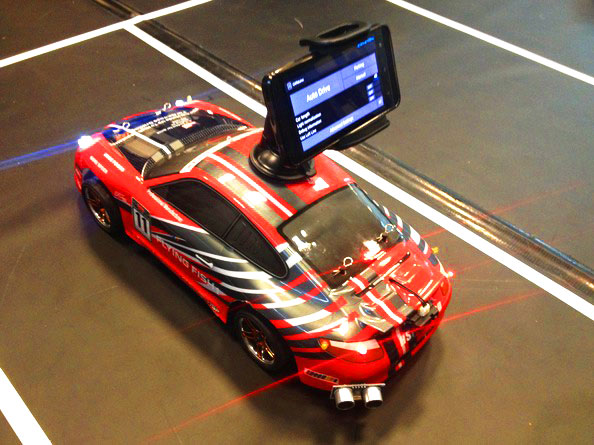
Dimitri Platis is a software engineer who’s been working with his team on an Android-based self-driving vehicle which uses machine vision algorithms and techniques as well as data from the on-board sensors, in order to follow street lanes, perform parking manoeuvres and overtake obstacles blocking its path:

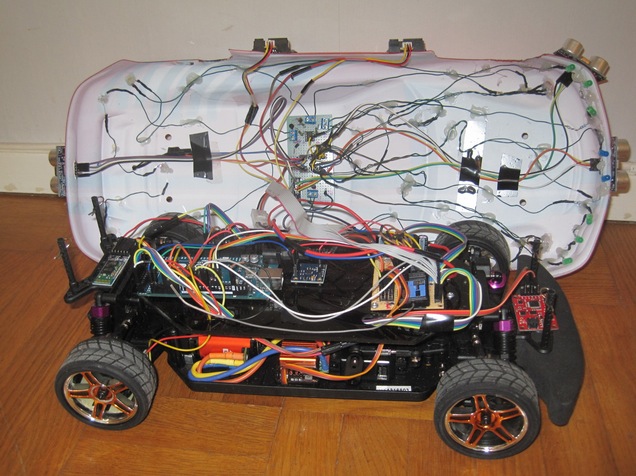
The innovational aspect of this project, is first and foremost the use of an Android phone as the unit which realizes the image processing and decision making. It is responsible for wirelessly transmitting instructions to an Arduino Mega, that controls the physical aspects of the vehicle. Secondly, the various hardware components (i.e. sensors, motors etc) are programmatically handled in an object oriented way, using a custom made Arduino library, which enables developers without background in embedded systems to trivially accomplish their tasks, not caring about lower level implementation details.

[...]

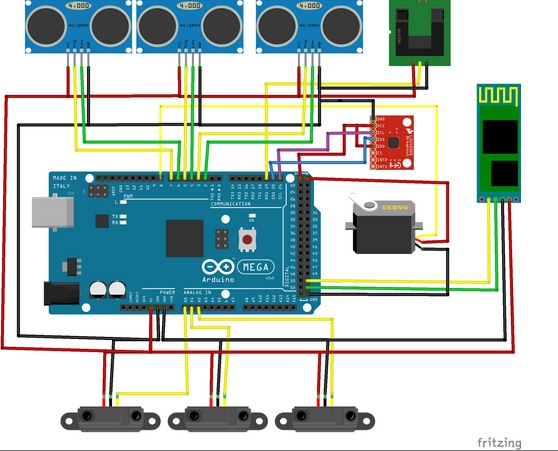
On the software dimension of the physical layer, an Arduino library was created (based on a previous work of mine [1], [2]) which encapsulated the usage of the various sensors and permits us to handle them in an object oriented manner. The API, sports a high abstraction level, targeting primarily novice users who “just want to get the job done”. The components exposed, should however also be enough for more intricate user goals. The library is not yet 100% ready to be deployed out of the box in different hardware platforms, as it was built for an in house system after all, however with minor modifications that should not be a difficult task. This library was developed to be used with the following components in mind: an ESC, a servo motor for steering, HC-SR04 ultrasonic distance sensors, SHARP GP2D120 infrared distance sensors, an L3G4200D gyroscope, a speed encoder, a Razor IMU. Finally, you can find the sketch running on the actual vehicle here. Keep in mind that all decision making is done in the mobile device, therefore the microcontroller’s responsibility is just to fetch commands, encoded as Netstrings and execute them, while fetching sensor data and transmitting them.


Check the Arduino library on Github, explore the circuit below and enjoy the car in the video:

Here’s the essential bill of materials:

  • Electronic Speed Controller (ESC)
  • Servo motor (Steering wheel)
  • Speed encoder
  • Ultrasonic sensors (HC-SR04, SRF05)
  • Infrared distance sensors (SHARP GP2D120)
  • Gyroscope (L3G4200D)
  • 9DOF IMU (Razor IMU)
Arduino Blog 15 Jul 10:01

“I am a maker in the making”

Moushira Elamrawy is an Egyptian multidisciplinary designer and technologist based in the city of Cairo and founder of Rishalaser, a new concept for laser cutters that is opensource, portable, DIY, and easy to use. She wrote a piece on iAfrikan about becoming a maker and discovering Arduino. It’s an inspiring text and we want to share it on this blog.

——–

Confession: I used to be an architect (possibly still am!), and then I started tinkering with things.
The architecture engineering school I graduated from did not have a workshop space. The first time I met a CNC router in real life was three years after i graduated.

It is hard to discover what you don’t know even exists. Which is somehow, why I had zero imagination of how those awesome Theo Watson installations could possibly work.

I had no business fiddling with electronics whatsoever. My coding and programming skills were limited to some knowledge of ActionScript, some C, and that was about it.

I read about Openframeworks, installed it, went through examples, tutorials and thought “Nice, I can change parameters that in return would change behavior, fantastic..but ..then..what?!”

By that time, I was an architect working in Morocco, between an office that was based in Fez and a construction site based in a beautiful small southern village close to the Algerian borders, called Mhamid ElGhizlane. It normally took me a little over a day and a half to travel from Fez to the construction site.

I had a radio, which I considered my companion in those interesting border areas. Before Morocco, I was living in Sinai mountains, working on a similar desert development project, where the radio would normally catch signals of Saudi Arabia, Israel, and Jordan. The Moroccan Sahara, on the other hand, got me signals from Algeria, with lots of different dialects. Radio feels like travelling within time within places. It makes you really feel the distance you crossed.

[...]

In May 2012, I attended a beginners workshop for Arduino, lead by Bilal, who was visiting Egypt. During the workshop, I controlled an LED via Arduino.

It was magical.

I never used the board before, I barely understood any syntax, yet in 15 min, I did something cool . . that actually works. Arduino: I am in Love, I thought.

It is easy. It is just that starting alone isn’t easy. Going back home, I went through some examples and I felt oh..I can do stuff. I can do all these stuff actually. Oh, wait, there is also: Processing!

By September 2012, I moved to Barcelona for my masters, which started by a fabrication course in Fablab. I was Alice in wonderland. Then physical computing course started, and Alice’s wonderland was getting more vast.

Everything was awesome. The exact skill set that I wanted to learn. But I needed more, a lot more, time to absorb this whole new world. I thought of taking a gap year, but then, week after week, it turned out that once the ball gets rolling everything is accelerated.

Thanks actually to my sister for pushing me to trust that the ball will get rolling. She herself was moving from translation to graphics design one year before me. It is a family thing.

Arduino was THE treasure.

At the end of the day, all those fantastic surreal systems that I was fascinated by could be done with some components and an Arduino. The amount of associated open source resources is tremendous. The forum is awesome and people actually respond.

Through Arduino, I learned more about microcontrollers, I could program standalone circuits. Then the ball kept rolling, I learned eagle, I can mill some boards, I can solder (err, that was troublesome!), I can interface stuff, I can build sensors, I can work with data, I can build RF sensors, then I became obsessed with antennas, signal processing, and RFID.

I am still learning and learning, but it is much easier now.

Coming from this background, I always go back with time 4 or 5 years ago and recall how I used to react to a “closed box” new technology?

How life would have changed if machine interaction have been made easier, or basically how my life would have changed if machines had the opportunity to step out of their labs and talk to more people.

Making technology more portable and more accessible, is one reason why I started the mobile operated laser cutter project last year, of course, the project would have never been realized without the team that continued with enthusiasm.

Another wonderful project that I just co-started is Jebaleya Talks, with the hope of giving voice to women of Saint Katherine village in Sinai, by introducing them to smart textiles! Well, lets see how this will evolve..

While working in the desert in Sinai, the project foreman was my mentor, his words of wisdom still echo in my ears

“Everything comes along..with patience. If you could just wait”.

Apparently, he had a point!

E-mails are a distraction.

Meetings are boring.

Regular jobs suck your inner clock.

Take a sabbatical and learn what you want to learn and start anew.

At least try.

Oh, and during your sabbatical, give Arduino a try, it might change your life as well.

Let’s just hope that Arduino founders will keep embracing the same energy they started the project with, and that the big whales leave Arduino alone, so that it stays, open and libre just as how it helped liberate many creative energies and minds.

Keep reading on iAfrikan

What if kids could hack a ball? (Prototyped with Arduino!)

Hackaball is a smart and responsive ball that children can program to invent and play games. It was recently backed by more than 1000 people and reached the goal!

As many other projects on Kickstarter, Hackaball was initially prototyped with Arduino using sensors that detect motions like being dropped, bounced, kicked, shaken or being perfectly still.


We got in touch with its team and asked them to tell us a bit more about the creation process:

Our early versions of the ball worked with the Arduino Uno board, progressing to a breadboard Arduino and then making our own SMD designs with the Uno. In the latests prototypes we used the Arduino Leonardo and our current version runs on the Arduino Mega. Our production version will run on an ARM chip.

We hope to offer Arduino Compatibility as one of our stretch goals in the Kickstarter, so that people can buy a board and put their own code on it using the Arduino software, effectively moving one step up from the app in terms of hacking the ball and making it do what you want it to do. We also believe many adults would love an interactive ball that they can control and design their own interactions – its packed full of features! Hopefully it will also allow kids who’ve outgrown our app to experiment with our technology in a more challenging way, bringing longevity to the product.

We’ve approached the kids who’ll play with Hackaball as the future Makers. The idea of hacking and getting close to technology starts with how the ball first arrives in your home. Kids open the packaging to find the ball is broken: Hackaball has crash-landed on earth and needs to be put back together again. After their first achievement, making the ball, kids are challenged to play games, change existing ones, fix broken games and create new ones from scratch.

We specifically designed the ball and packaging to be gender neutral – making it feel accessible to both boys and girls from the very beginning. We also expanded on the ability of the ball to include both hard and soft skills – from the tactile and linear computational thinking, to the storytelling and imagination-driven game creation, teaching a new generation of Makers to combine technology and creativity. We think that the kids who play with Hackaball would move on to Arduino in their teens!


You still have some days to back the project and help them reach the stretch goals, making Hackaball even more hackable!

Arduino Blog 19 Mar 20:54

Every word is like an unnecessary stain on silence

« Every word is like an unnecessary stain on silence and nothingness » is a sentence from Samuel Beckett but also the title of Eugenio Ampudia’s last artwork created and installed with the support of Ultra-lab  and running on Arduino Mega and GSM Shield:

The exhibition room has in its center a rectangular mirror made of water that reflects the room and the visitors. The perfect still water, metaphor of silence, is broken by the irruption of sporadic waves. These movements, the stain on silence, are provoked by the visitors’ interactions. In the heart of the water tank, a dispositive is able to receive calls and to open a valve. To each visitor’s call, so a series of movements is generated and break the calm.

Ultra-lab realized the technical part of the artwork thanks to an Arduino Mega, the Arduino GSM shield and various valves open and close by the Arduino Mega when a call is received by the shield. The dispositive is particularly interesting for its adaptation in a water context and for connecting valves.

Thanks to it, the artwork succeed to express beautifully the paradox between a destructive attraction for words and communication to which it’s hard to resist in order to prefer a finally inaccessible contemplation.

The work can be visited in the exhibition room Abierto X Obras in in the Spanish art center Matadero Madrid until the 17th of May 2015 and below you can watch a video interview with the artist:

Arduino Blog 09 Mar 20:01

Captain Hermano’s Mystery Box is Full of Puzzles

[Raffi] needed a birthday present idea but he wanted to do something extra special. He realized that a big part of gift giving is the anticipation and excitement of opening the present. In order to prolong this experience, [Raffi] built an electronic puzzle box. The box contains the final gift, but first a series of puzzles must be solved in order to open the box.

The project runs on an Arduino Mega. This is hooked up to several sensors, including a temperature sensor, GPS unit, and CO sensor. There is also an LCD screen and numeric keypad for user input and output. The project page contains a flow chart that shows all of the puzzles and their solutions. One of the more interesting puzzles requires the user to blow tobacco smoke into a tube. The CO sensor detects the smoke and unlocks the next puzzle.

Some of the puzzles require interacting with outside systems. For example, one puzzle requires the user to send an email to the fictional Captain Hermano’s email address. If the correct keyword is included in the email, the user will receive a reply with the code to enter into the box. Another puzzle requires the user to call a particular phone number and listen for another riddle. We’ve included the video demonstration below.

This isn’t the first puzzle box we’ve seen, but each one has its own special flair. This one is very well made and looks like a lot of care was put into it. We’ve seen another that uses only discrete components. We’ve seen yet another that uses Morse code.

[Thanks Simon]


Filed under: Arduino Hacks
Hack a Day 28 Dec 18:01

Experiencing the solar flux with an interactive installation

Dmitry Morozov shared with us a new interactive installation called  Solarman at the Polytech Museum in Moscow. 2014 and It’s a work he created with Julia Borovaya and Edward Rakhmanov using 64 ultra bright LEDs, 12-channel sound system and 8 electrical nerve stimulation electrodes controlled by Arduino Mega :

Data on power of X-radiation flux from the Sun is received in real time from the satellite GOES15 which is tracking solar activity. It is being converted into streams of sound, light and electric discharges, thus allowing a spectator to experience in more intensive and evident way the influence of the main luminary of the solar system.

The data, which is measured in watts per square meter, come with a frequency of once per minute. A special computer algorithm transforms it in sound waves, distributed by 12 channels in the space. The radiation power directly controls the height of tones and spectral changes in the sound. The speed of sound displacement in the space is also dependent on these parameters. Light is generated by algorithmic transformation of X-ray emission into physical modeling of light particles, which also affect the muscle stimulators in the chair to produce weak electric discharges.

Check the video below to see the power of the sun:

Arduino Blog 09 Dec 19:57

Experience sound multi-sensorially with Ocho Tonos

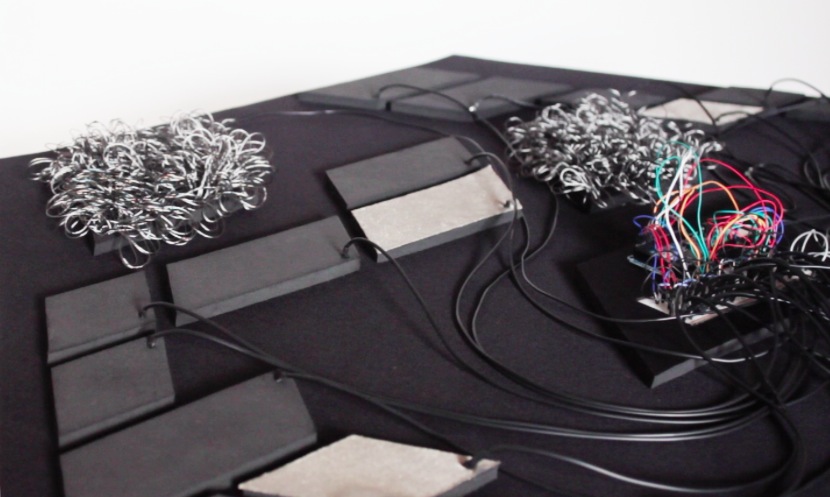
Some of you may have noticed that words like rhythm, texture, pattern, can be used both to describe fabrics, as well as sound. Focused on building an interface as a whole, using mostly textiles, OCHO TONOS invites the user to interact through touch, and experience sound in a multi-sensorial way. Ocho Tonos is an interactive installation by EJTech duo (Esteban de la Torre and Judit Eszter Kárpáti) I met last July during etextile summer camp while they were working on this experimental textile interface for tactile/sonic interaction by means of tangibles:

Exploring the relation between sound and textile and experimenting with the boundaries of our senses whilst changing the way we perceive fabric, surfaces and their manifestation as sound. Recontextualizing our tactile interaction with textile acting as an interface, where each element triggers, affects and modifies the generated sound’s properties. Creating a soundscape through sensor technology enticing audiophiles to interact and explore with reactive textile elements.The nexus of the body, the senses and technology.
OCHO TONOS is a symbiosis of the unique hand-crafted traditional textile techniques and the immaterial digital media.

Thanks to Arduino Mega ADK , all inputs coming from the touch of the user on the soft sensors are translated into a digital platform, parsed and filtered through MaxMSP, in order to control the generation of a soundscape in Ableton Live.

Ocho Tonos was chopped, spiced and cooked at Kitchen Budapest. Sounds used are samples from the working machinery at  TextielLab.