What is an ATMEGA328P
I'm about to start my first robot using Arduino, and I wonder what that long rectangular chip is. I later find out it is called the ATMEGA328P. What is it? Is it like a data storage for the code? If not, what does it do?


I'm about to start my first robot using Arduino, and I wonder what that long rectangular chip is. I later find out it is called the ATMEGA328P. What is it? Is it like a data storage for the code? If not, what does it do?
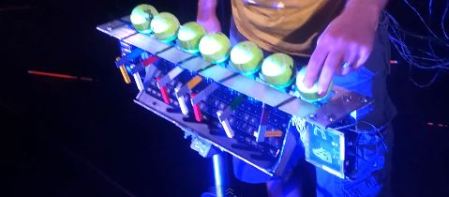
We’ve seen a lot of interesting MIDI controllers, but this one uses some unconventional materials. The World’s Coolest Keystroke, built by [Audiobody], is made from a combination of tennis balls, Lego bricks, servos, and switches.
When a tennis ball is lifted up, a Lego arm is actuated. It looks like a servo is used to move the Lego arm so it hits a switch. An Arduino is used to detect this and send a message to their computer.
They use the device to control Ableton Live and play different clips depending on which tennis ball was removed. It’s an interesting way to control sound with a tactile interface, and it looks pretty nifty.
After the break is a short video of the device in action, but [Audiobody] says that they will be releasing more information soon. We’re looking forward to seeing other interesting controllers that they have in the works.
[Via Make]



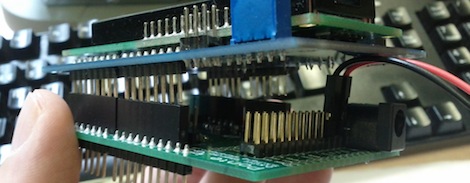
A few months ago, [Omer] sent in a Raspberry Pi to Arduino bridge he’s been working on called Ponte. Now that he’s gotten a few assembled, he can actually test out his ideas for combining the powerful Raspi with the ubiquitous Arduino.
Ponte revision 0 used a pair of 12-bit analog to digital converters, but during the soldering and debugging phase of development [Omer] discovered a few things were wrong with his original design. The FETs on the fabricated boards had the drain and source pins mixed up, but that problem was easily solved with a bit of board surgery.
The worst problem was the mechanical design of Ponte rev. 0 – the power jack on the Ponte is directly above the Raspi’s USB port, meaning it’s impossible to plug the Ponte into the Pi.
[Omer] is working on these problems and should have the revised boards completed shortly. A few people have asked where they can get a Ponte, but right now there are no plans to assemble and ship boards. That may change, but for now if might be worth bugging [Omer] to put his new and improved Ponte (with an 8-port I2C port expander!) up on SeeedStudio



Fans of Douglas Adams will no doubt catch the reference to The Hitchhiker’s Guide to the Galaxy in the title of Becky Stern’s latest project, The Babel Fish Language Toy. This sound- and RFID-enabled Arduino project with a crafty enclosure helps you learn foreign languages with RFID flash cards. When you bring a flash card near the fish’s tongue, you’ll hear the pronunciation of the word, which comes from .WAV files that you pre-load onto the SD card. And naturally, a full how-to writeup and video will help you along the way should you decide to make your own. Xie xie Becky!


Controlling an Arduino with a standard RC transmitter/receiver
There are many ways to remote control an Arduino, Xbee, RF link, IR…
I decided to try and use something I had laying around and that is common among large group of hobbyist : RC transmitter and receiver pair
Interface between MATLAB and Arduino microcontroller to calibrate servo.
The Seeeduino Mega 1280 is used in this case.
Problem:Servo does not center accurately and extends beyond 180 degrees.
Solution:Identify error margin and apply correction in MATLAB
Resources used:
http://www.mathworks.com/matlabcentral/fileexchange/27843
http://arduino.cc/en/Reference/map
For more projects, please visit: http://retardokiddo.blogspot.com/
Components:
1x Arduino Duemilanovue
The capacitor across the leads of the sharp did little to rectify K-9's behaviour, so I'm on to the next idea, which is to average the last ten or so readings of the sensor. The problem is that it seems that Arduino's QueueList library doesn't let you push and pop through different iterations of the main loop-the whole queue is defined each time (so in other words, I'd still have to code a queue by hand if I wanted to average the values read through each iteration of the last ten loops.) Am I reading that wrong or is there a way around this?



Mirco Segatello’s Robot Shield is optimized for servo control and has a built-in ultrasonic sensor. Instant robot!
The idea behind this post is to bring together some robot designs and trasform them in a new device with new hardware and standard software (arduino of course) and so easier to use. These robots have three things in common: a mechanical structure, the hardware and the software. While the mechanical part is necessarily different, we wanted to understand if there was a hardware board that could be common, with a unique development system. The choice, quite obviously, has the Arduino board, which with its development environment is perfect to create similar projects. The first consideration that came to our mind is like the Arduino board can manage a large number of servos, eight in the case of the robot SPIDER. Arduino can be powered through the plug with a voltage between 6 to 12 volts, his voltage regulator provides the 5 V stabilized, necessary for the operation of our shield. We could power our robot with rechargeable batteries. A standard servo requires a supply voltage of 4.8 to 6 volts, easily obtainable with four batteries in series, at full charge, provide 1.5 x 4 = 6 volts but towards the complete discharge provide just 1.0 x 4 = 4 volts. We are not in optimal conditions for the servos. Throughout this reasons we decided to create a special shield, already prepared for all these functions, it is easy to install and use.
[via Adafruit]


