Posts with «arduino» label

Self-balancing unicycle using Arduino and Sparkfun IMU

Here’s proof that you can build cool stuff with simple tools. This self-balancing unicycle uses an Arduino and a five degree of freedom IMU from Sparkfun to keep the rider upright. Well, it’ll keep you upright as long as you have good side-to-side balance. But that’s true of any unicycle, right?

The Raptor was built by [Nick Thatcker] who is no stranger to self-balancing transportation. A few years back he built a Segway clone and the same type of geared motor used in that project also went into this one. I connects to the wheel with a chain, allowing him to keep the motor hidden in the saddle. He gets between 90 and 120 minutes of used on one charge with a top speed of 10 MPH. The motor could move you along faster but he has limited this in firmware to ensure it has enough power to ‘catch up’ if you lean too far forward.

Don’t miss the demo after the break. If you like this unicycle there are several others worth looking at.


Filed under: transportation hacks

Webmote: control anything with web-based remote

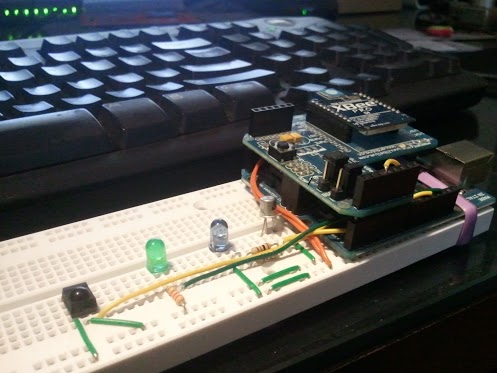
We’ve seen a lot of projects that let you control all of your devices from a smartphone. But this universal web-based remote control system looks like the most versatile we’ve seen yet. The project is called Webmote as the controls are served up as a web interface so that you’re not limited to say an Android device. The UI can be customized by choosing what buttons you will use and where to place them on the display. You can get a good feel for this by viewing this G+ album. Setup is made a bit easier thanks to an add-on system that has predefined layouts for common things like controlling XBMC.

The hardware seen above is the business end of Webmote. It’s an Arduino with an IR receiver, IR LED, and an XBee module. For your common home entertainment devices you can teach the system your codes using the IR receiver. The IR LED is used to transmit those codes back, and the Xbee gives you the ability to control X10 (home automation) devices. Right now the setup requires the hardware be connected to a server via USB, but it shouldn’t be hard to set up some type of wireless alternative.


Filed under: home entertainment hacks

iPacemaker with Arduino

When we say “there are no limit for  Arduino”, here we have a project,  sent by [ladvine] in wich Arduino meets biomedic tech. The WiFi shield is the real application when they speak about Arduino. There is a long paper about it on this [website] that I suggest to visit to understand more this important project.

iPacemaker is an reprogrammable implant pacemaker with wireless connectivity.
A user friendly embedded web interface helps in changing every parameters of the implantable pacemaker. The important feature is the WiFi alliance complaint hardware which supports every wireless device to establish connection with the IMD. GSM connectivity can be used in absence of WiFi in remote areas helping in Telemetry.
Wireless protection in case of WiFi is enabled through WPA2 security with AES Encryption and Java Web interface which has inherent security capabilities. Shielding the GSM and WiFi antennas helps reduce unwanted patient radiations.

Arduino Blog 14 Dec 17:21

Eco Albero with Arduino


Arduino meets Ecology and Christmas. This integrations uses Arduino as a Twitter trigger for the lights, so if you tweet one of the keywords: PACE, AMORE, SERENITA’, FRATELLANZA, TOLLERANZA, GIOIA, SPERANZA, SOLIDARIETA’, FELICITA’, PEACE, LOVE, BROTHERHOOD. This is an Italian Project and the Tree can be found in  Lonate Pozzolo near Varese.

A big ( 12 mt tall ) Christmas Tree build with 34.626 plastic bottles and “powered” by Arduino and Paraimpu, feeded via twitter and site-pushbuttons. Tweet your keyword with special hastag #ecoalbero and light up a light on the tree.

More information ( in Italian) can be found in the [website]. There is also the full description of the project, the purpose and the materials used to build it up.

Arduino Blog 14 Dec 10:54
albero  arduino  bottles  eco  gallery  gullp  lonate  paraimpu  plastic  pozzolo  tree  

Sensing Hot and Cold with Weekend Projects

Combine an Arduino, an ultransonic distance sensor, and some common components to build a classic "hot/cold" project. Once assembled, we'll walk through the software "sketch" loaded onto our Arduino, and experiment with three variations of the "hot/cold" theme, all the while using the same circuit.

Read the full article on MAKE

Physical Equalizer Gamifies Audio Mixing

The Physical Equalizer is built upon a set of homemade flex sensors. When blocks are stacked on top of them, the volume of different instruments in the loop changes.

Read the full article on MAKE

MAKE » Arduino 13 Dec 20:00
ableton  arduino  equalizer  fader  itp  max  mixer  mixing  msp  music  

Arduino-Controlled Split-Flap Game

Richard from the Netherlands built this split-flap game as a gift to his niece. Actually, the gift is inside, but you have to win the game to get it! The wooden box and all the components for the Split-flap display were made on my CNC machine. I used 2mm thick [...]

Read the full article on MAKE

MAKE » Arduino 13 Dec 17:30
arduino  gaming  gifts  

[#arduinotour] Matera Report, Prossima Puntata: Reggio Emilia

Ecco un piccolo video report della puntata dell’Arduinotour a Matera (c’é anche un set su Flickr). Questa edizione del tour é stata caratterizzata dalla partecipazione di un ragazzo francese (partito dalla Bretagna e volato per un week-end a Matera – Grande Baptiste!) che ha condiviso con noi la sua esprienza di sviluppatore di open energy monitor, un framework open source per la visualizzazione di consumi online, di cui parleremo presto in una intervista ad hoc. (il blog di Arduino ha trattato precedentemente questa storia, vai al post).

Causa maltempo il workshop é stato ospitato presso le Monacelle, un bed & breakfast poco l’ontano dall’Incubatore, all’interno dei Sassi. Un grazie a Sviluppo Basilicata per il supporto e l’aiuto nell’organizzazione dell’evento.

Per chi si stesse chiedendo quando e dove si farà il prossimo workshop #arduinotour, eccovi serviti: Reggio Emilia a fine gennaio (26-27), presso il neonato Fablab ospitato all’interno dello Spazio Gerra.

Se volete portare l’#arduinotour a casa vostra riempite questo form. Se volete spargere il verbo fate il like sulla pagina dell’arduinotour su facebook.

Arduino Percussion Car


The user [selcukartut] sent us a project full integrated with Arduino boards. Filika (Istanbul) designed and produced an Interactive Percussion Playing Car for Volkswagen’s breathtaking pickup Amarok. Several sensors were implemented on the board, so that the participants were able to trigger percussion sounds via tapping their hands on the car.

Technically speaking, there were two types of sensors to gather user interaction data. Force Resistive Sensors were placed on the front panel and piezzo sensors were placed on the sides of the car’s body. Received user interaction was mapped onto a code via customized Arduino Board. Arduino code was commuicating with a sound patch that was built in MaxMSP/Jitter, and finally delivered into Ableton Live as Midi Data. In sum when a person taps onto a sensor that hides under the car’s surface, that interaction was turning into a percussion sound. There were tons of cables, sawing, soldering, coding and etc…

On the [website] there are some videos that show the project in action. Unfortunately all the text are in Turkish, we hope for an English, more international, version.

Arduino Blog 13 Dec 11:40

Mobiton - Robotic Smartphone Shell

Primary image

What does it do?

Uses a smartphone to operate. It can be an assistant, pet, or a telepresence device. Can be anything depends on the mobile app you write.

Hey Guys,

I know, I didn't post for a while. Didn't have time to post some of the projects, sorry about it.

Alright, so here is our new project, we plan to go commercial with it. It is called Mobiton. It is a robotic shell for mobile devices (android currently). You can dock your phone on the device, an application written for the robot pops up and it brings the robot to life.


Cost to build

$150,00

Embedded video

Finished project

Complete

Number

Time to build

Type

URL to more information

Weight

read more