Posts with «arduino» label

Arduino Zero now available for purchase!

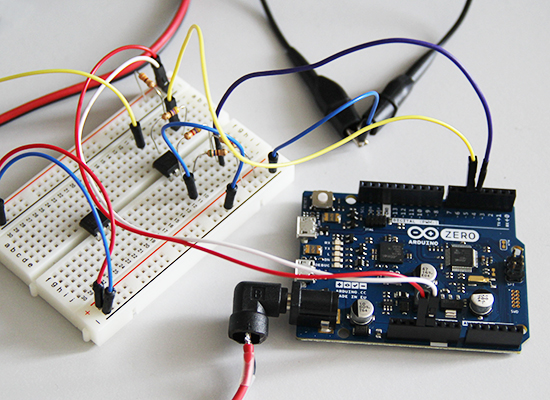
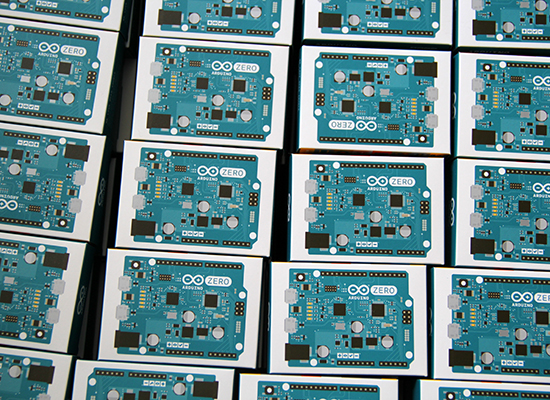
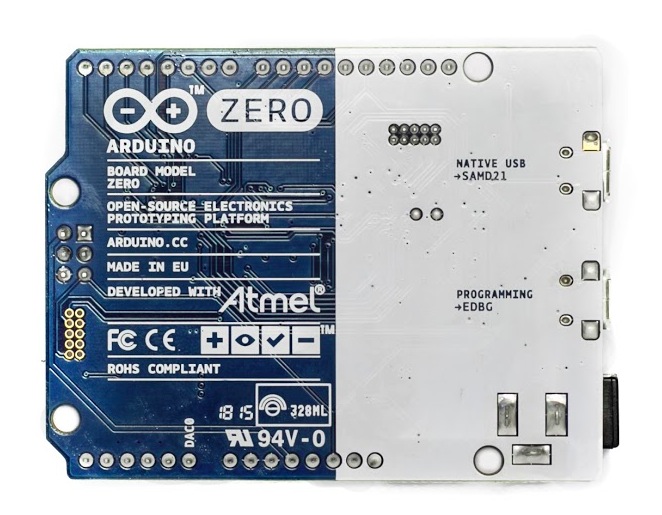
One year ago Arduino and Atmel unveiled the new Arduino Zero. Today, after some months of beta-testing, we are happy to have the board finally available for purchase on the US Store.

Arduino Zero is a simple and powerful 32-bit extension of the well-known Arduino UNO. It allows creative individuals to realize truly innovative ideas especially in areas like smart IoT devices, wearable technology, high-tech automation, and robotics. Arduino Zero acts also as a great educational tool for learning 32-bit application development.

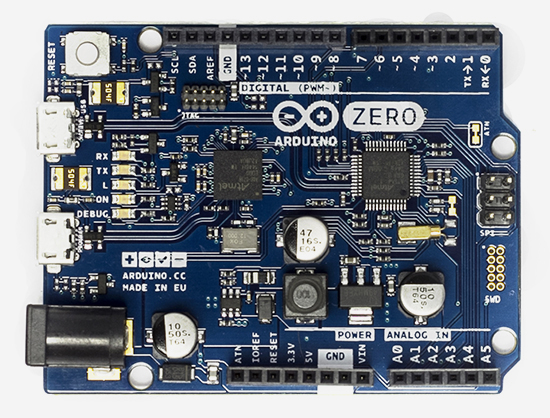
Powered by Atmel SAMD21 MCU, Arduino Zero features a 32-bit ARM Cortex® M0+ core. One of its “most wanted” features is the Atmel Embedded Debugger (EDBG), which provides a full debug interface without the need for additional hardware.

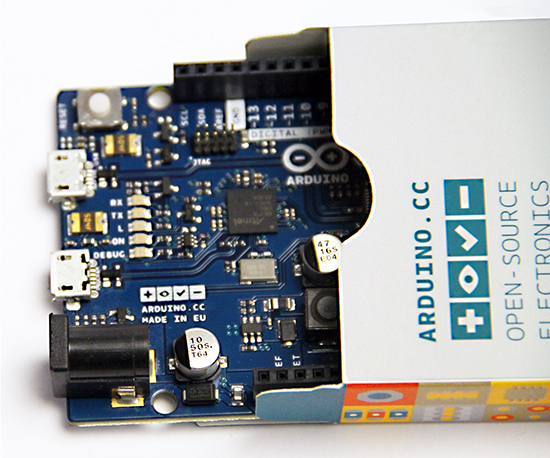
Arduino Zero’s silk has an additional graphic element: the Genuino logo. Genuino is the Arduino sister brand from the Arduino founders (M. Banzi, D. Cuartielles, T. Igoe, D. Mellis), team and community. We added the Genuino logo to the Arduino Zero to stress its authenticity, and to make it easier for the Arduino community to spot original boards. We are going to include this logo to all genuine Arduino boards from now on.

To start using the board you need to download the latest version of the IDE (1.6.5), which comes with a set of great improvements:

  • a new modern editor (thanks @ricardojlrufino)
  • serial monitor stays open while you upload a new sketch (thanks @avishorp and @Wackerbarth)
  • File > Open Recent menu shows the last 5 opened sketches
  • Tons of fixes and improvements: the list is available here. They are 470 issues closed since previous version, 1.6.4: massive!

Learn more about the Arduino Zero and get started with it at the following links:

Updated Arduino Zero product page

Getting Started Page

Github repository

Interact in the Arduino Forum

And if you are one of the lucky ones and have Arduino Zero in your hands, start practicing its features with the following tutorials:

- Arduino Zero Low Power Overview

It shows the low power characteristics of the Arduino Zero thanks to a low power microcontroller using the 32 bit ARM Cortex M0+ architecture.

Simple Audio Feature

It shows how to experiment with sound starting to play a wave file stored on the SD card.


Arduino Zero now available for purchase!

One year ago Arduino and Atmel unveiled the new Arduino Zero. Today, after some months of beta-testing, we are happy to have the board finally available for purchase on the US Store.

Arduino Zero is a simple and powerful 32-bit extension of the well-known Arduino UNO. It allows creative individuals to realize truly innovative ideas especially in areas like smart IoT devices, wearable technology, high-tech automation, and robotics. Arduino Zero acts also as a great educational tool for learning 32-bit application development.

Powered by Atmel SAMD21 MCU, Arduino Zero features a 32-bit ARM Cortex® M0+ core. One of its “most wanted” features is the Atmel Embedded Debugger (EDBG), which provides a full debug interface without the need for additional hardware.

Arduino Zero’s silk has an additional graphic element: the Genuino logo. Genuino is the Arduino sister brand from the Arduino founders (M. Banzi, D. Cuartielles, T. Igoe, D. Mellis), team and community. We added the Genuino logo to the Arduino Zero to stress its authenticity, and to make it easier for the Arduino community to spot original boards. We are going to include this logo to all genuine Arduino boards from now on.

To start using the board you need to download the latest version of the IDE (1.6.5), which comes with a set of great improvements:

  • a new modern editor (thanks @ricardojlrufino)
  • serial monitor stays open while you upload a new sketch (thanks @avishorp and @Wackerbarth)
  • File > Open Recent menu shows the last 5 opened sketches
  • Tons of fixes and improvements: the list is available here. They are 470 issues closed since previous version, 1.6.4: massive!

Learn more about the Arduino Zero and get started with it at the following links:

Updated Arduino Zero product page

Getting Started Page

Github repository

Interact in the Arduino Forum

And if you are one of the lucky ones and have Arduino Zero in your hands, start practicing its features with the following tutorials:

- Arduino Zero Low Power Overview

It shows the low power characteristics of the Arduino Zero thanks to a low power microcontroller using the 32 bit ARM Cortex M0+ architecture.

Simple Audio Feature

It shows how to experiment with sound starting to play a wave file stored on the SD card.


Two New Dev Boards That Won’t Make Your Wallet Hurt-So-Good

If you’ve been keeping up with the hobbyist FPGA community, you’ll recognize the DE0 Nano as “that small form-factor FPGA” with a deep history of projects from Oldland cpu cores to synthesizable Parallax Propeller processors. After more than four years in the field though, it’s about time for a reboot.

Its successor, the DE0 Nano SoC, is a complete redesign from multiples perspectives while doing it’s best to preserve the bite-size form factor and price that made the first model so appealing. First, the dev board boasts a Cyclone V with 40,000 logical elements (up from the DE0’s 22K) and an integrated dual-core Arm Cortex A9 Processor. The PCB layout also brings us  3.3V Arduino shield compatibility via female headers, 1 Gig of external DDR3 SDRAM and gigabit ethernet support via two onboard ASICs to handle the protocol. The folks at Terasic also seem to be tipping their hats towards the “Duino-Pi” hobbyist community, given that they’ve kindly provided both Linux and Arduino images to get you started a few steps above your classic finite-state machines and everyday combinational logic.

And while the new SoC model sports a slightly larger form factor at 68.59mm x 96mm (as opposed to the original’s 49mm x 75.2mm), we’d say it’s a small price to pay in footprint for a whirlwind of new possibilities on the logic level. The board hits online shelves now at a respectable $100.

Next, as a heads-up, the aforementioned Arduino Zero finally makes it’s release on June 15. If you’ve ever considered taking the leap from an 8-bit to a 32-bit processor without having to hassle through the setup of an ARM toolchain, now might be a great time to get started.

via [the Arduino Blog]


Filed under: hardware, Microcontrollers

Arduino Controlled Air Conditioner

Now that summer is coming, it’s time to break out the Air Conditioners! There are some old AC units out there that still work just fine, but nowadays we are used to everything being remotely controlled and automatic. [Phil] had an old window-mounted AC unit that still worked but was installed in a not-so-convenient place. To access the AC’s controls, one would have to climb over a large desk. This is a perfect opportunity to use the plethora of widely available hobby electronics to make an automatic AC controller retrofit.

First things first, there needs to be a way to turn the current control knob on the AC. [Phil] modeled up a 3D bracket to hold an RC car servo to the AC control panel. Attached to the servo horn is a slotted cylinder sized appropriately to fit the shape of the control knob. An Arduino measures the temperature of the room via a DS18B20 temperature sensor which then has the servo turn the control knob to the appropriate position, on or off. The Arduino sends temperature data back to a PC via MegunoLink Pro which graphs past data and also displays current temperature data. Using MegunoLink Pro, the min/max temperature points can also be set without uploading a new sketch to the Arduino.

From the temp vs time graph, it looks like the room temperature stays a consistent 23 +/- 1 °C. [Phil] did us summer-swelterers a favor and made all his design files available. This is a great idea but wonder if leaving the air conditioner unit switch in the ‘on’ position and turning the unit on/off via a relay connected to the 120vac line would work just as well.


Filed under: home hacks

Astoundingly Great $60 3D Printer called Chimera Bests Your Printer

When most people think of 3D printing, they think of Fused Deposition Modelling (FDM) printers. These work by heating a material, squirting it out a nozzle that moves around, and letting it cool. By moving the nozzle around in the right patterns while extruding material out the end, you get a part. You’ve probably seen one of the many, many, many FDM printers out there.

Stereolithography printing (SLA) is a different technique which uses UV light to harden a liquid resin. The Chimera printer uses this technique, and aims to do it on the cheap by using recycled parts.

First up is the UV light source. DLP projectors kick out a good amount of UV, and accept standard video inputs. The Mitsubishi XD221u can be had for about $50 off eBay. Some modifications are needed to get the focus distance set correctly, but with that complete the X and Y axes are taken care of.

For the Z axis, the build platform needs to move. This was accomplished with a stepper motor salvaged from a disk drive. An Arduino drives the motor to ensure it moves at the right rate.

Creation Workshop was chosen as the software to control the Chimera. It generates the images for the projector, and controls the Z axis. The SLA process allows for high definition printing, and the results are rather impressive for such a cheap device. This is something we were just talking about yesterday; how to lower the cost of 3D printers. Obviously this is cheating a bit because it’s banking on the availability of cheap used parts. But look at it this way: it’s based on older technology produced at scale which should help a lot with the cost of sourcing this stuff new. What do you think?


Filed under: 3d Printer hacks
Hack a Day 10 Jun 22:01

Arduino Zero available for purchase in US on June 15th

We’ve been waiting for this moment for months and today we confirm that Arduino Zero will be available for purchase from the Arduino Store in US on Monday June 15th at  $49.90.

At the same time we are going to release Arduino IDE 1.6.5 with a bunch of new features and the support for the Arduino Zero. The new IDE keeps the serial monitor open while uploading, lists the last 5 opened sketches in the “Open Recent” menu, and many other features you’ll discover next week.

Our team stumbled upon a last minute software bug which moved the launch date by a bit  but everything is almost ready, they really worked hard to ensure the best experience of use.

We love this product as it shows our great collaboration with Atmel, and we know a lot of people in the Arduino community are looking forward to put their hands on it.

Stay tuned!

Arduino Zero available for purchase in US on June 15th

We’ve been waiting for this moment for months and today we confirm that Arduino Zero will be available for purchase from the Arduino Store in US on Monday June 15th at  $49.90.

At the same time we are going to release Arduino IDE 1.6.5 with a bunch of new features and the support for the Arduino Zero. The new IDE keeps the serial monitor open while uploading, lists the last 5 opened sketches in the “Open Recent” menu, and many other features you’ll discover next week.

Our team stumbled upon a last minute software bug which moved the launch date by a bit  but everything is almost ready, they really worked hard to ensure the best experience of use.

We love this product as it shows our great collaboration with Atmel, and we know a lot of people in the Arduino community are looking forward to put their hands on it.

Stay tuned!

On Your Phone While Driving an Electric Skateboard

Skateboards are fun, but you have to do all that pesky kicking in order to get anywhere. That’s why [Nick] decided to build his own electric skateboard. Not only is the skateboard powered with an electric motor, but the whole thing can be controlled from a smart phone.

[Nick] started out with a long board deck that he had made years ago. After cleaning it up and re-finishing it, the board was ready for some wheels. [Nick] used a kit he found online that came with the trucks, wheels, and a belt. The trucks have a motor mount welded in place already. [Nick] used a Turnigy SK3 192KV electric motor to drive the wheels. He also used a Turnigy electronic speed controller to make sure he could vary the speed of the board while riding.

Next [Nick] needed some interface between a smart phone and the motor controller. He chose to use an Arduino Nano hooked up to a Bluetooth module. The Nano was able to directly drive the motor controller, and the Bluetooth module made it easy to sync up to a mobile phone. The Android app was written using MIT’s App Inventor software. It allows for basic control over the motor speed so you can cruise in style. Check out the video below for a slide show and some demonstration clips.

It’s a popular project, and eerily similar to the one we saw a couple months back.


Filed under: Arduino Hacks

Building a quadcopter running on Arduino Yún

Comelicottero is a quadcopter based on Arduino Yún created during the Master in Computer Science at the Universita’ degli Studi of Milan (Italy) by Simone Castellani, Giovanni Intorre and Andrea Toscano:

The idea was to build a drone able to be controlled through WiFi from any PC, tablet or smartphone . Comelicottero is equipped with an accelerometer and a gyroscope for the stability obtained by a PID-based control system. Since Servo library is too slow for the quadcopter dynamics, an hardware PWM was implemented to obtain a 400Hz PWM signal.

The communication between the ground station on a PC and the quadcopter relies on WiFi and, in order to get better results, Bridge library was replaced with an efficient python script on OpenWRT-Yun. On top of that all the code was written to maximise Arduino Yún capabilities. The Navigation System has been designed, simulated on PC, implemented and tested. The autonomous navigation is going through an additional testing due to magnetometer interferences with motors’ magnetic field.

The user can control and monitor data coming from the drone using a gamepad attached to a laptop with a custom software installed.

The sketch and all the documentation will be soon available on GitHub and released with GNU license. In the meanwhile follow their Youtube Channel for updates.


Arduino Blog 08 Jun 20:59

New Project: Build a Motion Sensing Alarm You Can Disable with a Resistor

I designed a DIY motion-sensing alarm that is controlled by a resistor. When an intruder is detected, a siren sounds that can be deactivated by touch.

Read more on MAKE

The post Build a Motion Sensing Alarm You Can Disable with a Resistor appeared first on Make:.