Posts with «arduino» label

Wrapping up Maker Faire with [Ben Heck], giant Arduinos, and an Apple Lisa
All good things, and apparently our coverage of Maker Faire, must come to an end. Here’s a few more things we saw in New York this last weekend that piqued our interest:

A 10x scale Arduino

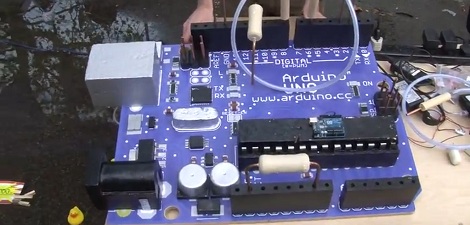
[Robert Fitzsimons] of Part Fusion Electronics made a gigantic Arduino. It wasn’t quite functional, but [Robert] did manage to make a few 10:1 scale LEDs (with built-in circuit protection), 1 inch pitch headers, and a few other miscellaneous components out of foam and paint.

Since he’s from Dublin, Ireland, [Robert] didn’t want to take this giant board home with him. He graciously gave it to me in the hopes of turning it in to a proper working Arduino. I’ll do my best, [Robert].

There are hundreds of Lisas buried in a landfill in Utah.

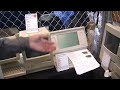
Tekserve, an indie Apple store located in the heart of Manhattan, really knows how to put on a good show. For the entirety of their stay at Maker Faire, they had people showing off one of the first digital cameras, Apple Newtons, and an awesome collection of vintage Macs. No, your eyes do not deceive you; that’s a real Lisa there in the bunch.

Sadly, they didn’t have the boot disk to turn any of these on. Pity.

Yes, there were celebrities at Maker Faire

Well, celebrities to the Hackaday crowd, at least. [Ben Heck] showed off the electronic automatic sunglasses he built. It’s a pair of lensless glasses, a servo, light detector, and a pair of clip-on sunglasses. When [Ben] is out in daylight, the sunglasses swivel down. Inside, the amount of light received by the detector decreases and the shades rotate up.


Filed under: misc hacks

Arduino-Controlled Vocal Effects Box

Amanda Ghassaei built this sweet vocal effects box:

This effects box uses an Arduino to sample incoming audio at 40kHz with 8 bit precision, the audio data is then digitally pitch shifted and distorted to produce a wide variety of effects. To minimize the amount of computation required by the Arduino, I used a technique called granular synthesis to perform the audio processing. Essentially, as audio comes into the Arduino it gets cut up and stored as small (millisecond or microsecond sized) samples called “grains.” These grains are then individually manipulated and played back; they may be lengthened or shortened, stretched or compressed, played back in reverse, copied several times, or mixed with other grains.

Hear her remix of Over the Rainbow! [via Arduino]


Filed under: Arduino, DIY Projects
MAKE » Arduino 04 Oct 19:00

The Arduino Hour at World Maker Faire New York

In this video from World Maker Faire New York 2012, Massimo Banzi updates the audience on all the latest hardware and software developments in the Arduino platform. He talks about the new 32-bit ARM-based Due board and David Mellis explains how the IDE has been upgraded under the hood to accomodate these new boards while keeping the user experience consistent. The Arduino team then turns it over to Alf-Egil Bogen (who is one of the inventors of AVR at Atmel) to talk about the chips at the core of Arduino.


Filed under: Arduino, Maker Faire
MAKE » Arduino 04 Oct 17:30

A custom Pi shield or an Arduino?

As more and more people get a Pi they are asking how to interface it to their robot. I do not own a Pi but I looked at the GPIO pins available for interfacing. Apart from general digital I/O pins you have I2C, SPI and Serial interfacing available. I assume there is a library or something that allows these pins to be easily access from within the Linux operating system.

So the question becomes do you just use another MCU such as an Arduino to provide the necessary I/O functionality or do you use a custom shield?

read more

Let's Make Robots 04 Oct 13:38
arduino  i2c  ideas  interface  pi  raspberry  serial  shield  spi  

Finally, an ARM-powered Arduino

Far removed from the legions of 3D printers featured at this year’s Maker Faire in New York was a much smaller, but far more impressive announcement: The ARM-powered Arduino DUE is going to be released later this month.

Instead of the 8-bit AVR microcontrollers usually found in Arduinos, the DUE is powered by an ATSAM3X8E microcontroller, itself based on the ARM Cortex-M3 platform. There are a few very neat features in the DUE, namely a USB On The Go port to allow makers and tinkerers to connect keyboards, mice, smartphones (hey, someone should port IOIO firmware to this thing), and maybe even standard desktop inkjet or laser printers.

The board looks strikingly similar to the already common Arduino Mega. That’s no mistake; the DUE is compatible with existing shields, so connecting a RAMPS board for your 3D printer should be a snap.

Here’s a PDF the Arduino and Atmel guys were handing out at their booth. A few DUE boards have already made it into the hands of important people in the Arduino community, including 3D printer guru [Josef Prusa]. Sadly, the folks at Arduino didn’t think media personalities needed a DUE before its release, so you’ll have to wait until we get our hands on one later this month for a review.


Filed under: arduino hacks, Microcontrollers

Arduino Starter Kit is here to Rock

We are eager to announce the launch of the official Arduino Starter Kit! We have been working hard together in developing a complete selection of 15 projects that will let you become a true arduino tinkerer!

But that’s more:

The new starter kit has been developed together with a series of ten video tutorials hosted by Arduino co-founder Massimo Banzi, which can be viewed at www.rs-components.com/arduino. Ideally used in conjunction with the videos, the kit provides an open-source electronics prototyping platform based on flexible, easy-to-use hardware and software. It contains all of the essential components required to start programming with the Arduino Uno board, and a guidebook featuring 15 different projects, which are designed to evolve the user from beginner to professional level. Comprising a motor, servomotor and driver, the kit also offers particular benefits to users wishing to apply mechatronics to their designs.

read through for the whole components and projects list

We are aware this kit will let a lot of people step in the Arduino world: for this reason we opened a brand new category of the arduino forum. You can buy the Kit on RS Components and will soon be available on the Arduino Store and the other distributors [notify me when this happen]


Controlling your webcam with an old Guitar Hero pedal

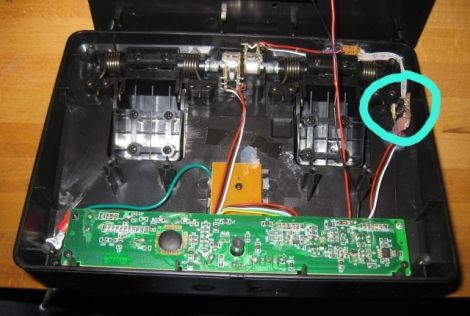
Hackaday reader [Tom Price] often uses Skype to communicate with family near and far, but he was getting tired of adjusting his webcam each time his kids moved out of frame. While the solution he came up with isn’t fully automated, it is hands-free, which is good enough for his purposes.

[Tom] was looking around for an electronic foot pedal of some sort when he came across a wireless 3rd party Guitar Hero peripheral that happened to fit the bill. Using an Arduino library created by [Bill Porter], he was quickly able to get the toy to communicate with an Arduino-flashed Atmega8, but things kind of fell flat when it came time to relay signals back to his computer. Using another Atmega8 along with the PS2X library, he was able to emulate the Guitar Hero controller that his foot pedal was looking for.

With the pedal portion of his project wrapped up, he focused on his webcam. [Tom] mounted the camera on a small servo, which he then wired up to the receiving end of his foot pedal rig. As you can see in the video below, he can now pan his camera across the room with a tap of his foot, rather than leaning in and manually adjusting it.


Filed under: arduino hacks, news, playstation hacks
Dry erase marker opens all hotel room doors

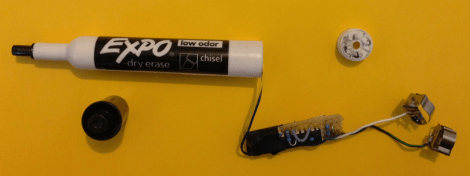
If you’re carrying around an exposed circuit board and a bunch of wires people are going to notice you. But a dry erase marker won’t turn any heads. And this one holds its own little secret. It acts as a master key for hotel room door locks.

This is really more of a repackaging hack. The exploit is already quite well-known. The Onity brand of key card locks most commonly used in hotels have a power jack on the bottom that doubles as a 1-wire communications port. The first published proof of concept used an Arduino board and a simple adapter to unlock any door in under one second. Now that hardware has been reduced in size so that it fits in the hollow shell of a dry erase marker. Even better, the felt tip has been replaced with the appropriately sized barrel jack. Check out the ultra-fast and inconspicuous use of it after the break. We think using this is no more obvious than actually having the key card.


Filed under: arduino hacks, security hacks

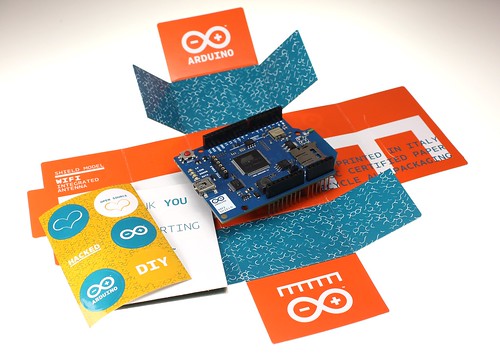
Arduino Wifi Shield is bask on the store!

We’re happy to announce the Arduino Wifi Shield being back on the Arduino Store. Since we launched it back in August we had an overwhelming request for the product that ended up in solding it out.

Welcome back, bro.

Arduino Blog 02 Oct 15:08
arduino  shield  store  wifi  wireless  

Fantastic programming makes this Arduino gaming device something special

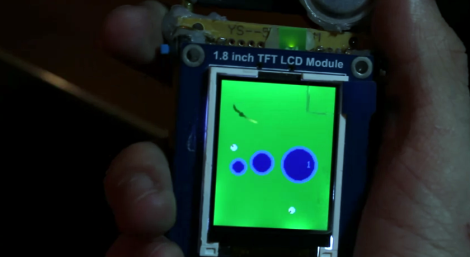
The hardware that went into this Arduino gaming console is just fine. But the coding that produced this game called Twisted SNAKE is beyond compare. [Rodot] has programmed several games for the hardware, which uses an Arduino, 160×168 TFT screen, a 3 axis accelerometer, and two input buttons. If you’re interested, there is a forum thread in which he talks a bit more about the hardware design. But you’re not going to want to pass up either of the two videos embedded after the break.

The first clip shows off a bouncing-ball platforming game. The accelerometer moves the ball back and forth, and the top scrolling level brings more ledges into play. This in itself is a great game. But the Twisted SNAKE game shown off in the second video makes our own ARM-based Snake game look like a 3-year-old programmed it. [Rodot] filled up all of the program memory of the ATmega328 chip to  make this happen. There’s a menu system which allows for color themes and difficulty selection. The game play itself lets the snake travel anywhere it wishes with the tail following behind in graceful curves. Wow!


Filed under: arduino hacks, handhelds hacks