Posts with «arduino» label

An Arduino hydrogen blimp… oh the humanity!

This sort of flying contraption seems more suited for indoor use. Well, except for the fire hazard presented by building an Android controlled hydrogen blimp. The problems we often see with quadcopters come into play when a motor wire comes loose and the thing goes flying off in a random direction. Loosing a motor on this airship will be no big deal by comparison.

Because the build relies on the buoyancy of the gas, light-weight components are the name of the game. The frame of the chassis is built from balsa wood. It supports two tiny DC motors which are almost indistinguishable in the image above. An Arduino nano and wireless receiver monitor commands from the transmitter and drive the propellers accordingly.

You may have noticed that we categorized this one as a chemistry hack. That’s because [Btimar] generated the hydrogen himself. He used an Erlenmeyer flask with a spout for the chemical reaction. After placing several heat sinks and other scraps of solid aluminum in the flask he poured on the lye solution. This generates the H2 but you need to keep things cool using ice to keep the reaction from getting out of control. We’re going to stick with helium filled blimps for the time being!

See this beast flying around [Btimar's] living room in the clip after the break.


Filed under: chemistry hacks
Hack a Day 19 Jan 16:01

Prossimi eventi: Workshop Base e Maker Faire – The European Edition

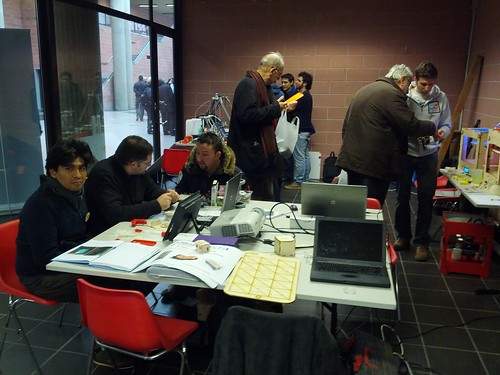
Al periodico appuntamento con l’elettronica amatoriale presso Modena Fiere, che oggi e domani (19-20 Gennaio) ospita Expo Elettronica, i makers e gli hobbysti emiliano-romagnoli non possono rimanere delusi per il calibro degli ospiti in programma. Officine Arduino, assieme ai ragazzi del FabLab di Reggio Emilia, offrono un’occasione unica per confrontarsi con il mondo dei makers e con la prototipazione DIY, grazie a numerose varianti di stampanti 3D esposte e funzionanti, assieme alla possibilità di provare e “toccare con mano” alcune delle novità più interessanti del mondo Arduino, come l’Arduino DUE.


Lo stand del FabLab di Reggio Emilia.

Alcune delle novità più interessanti riguardano i prossimi eventi in programma, fra cui troviamo l’importante “Makre Faire – The European Edition”, che verrà ospitata per la prima volta in Italia nei giorni 3-6 Ottobre 2013 a Roma e che vedrà coinvolta l’intera comunità di makers provenienti da tutta Europa. Fra gli eventi in programma vi saranno conferenze, workshop hands-on e numerosi speech, in aggiunta alla fiera “vera e propria” che si terrà nel week-end.

Per partecipare come espositori, a partire dal 18 Febbraio si aprirà una “Call for makers” alla quale chiunque sia interessato potrà inviare la propria candidatura e i propri progetti, che verranno accuratamente selezionati per costituire il programma delle numerose esposizioni previste. Stay tuned sull’home page della fiera per i prossimi aggiornamenti!

Costantino e Davide presentano la Maker Faire di Roma.

Fra gli imminenti eventi in calendario elenchiamo il prossimo Workshop Base di Arduino che si terrà i giorni 26-27 Gennaio a Reggio Emilia, presso il FabLab “Spazio Gerra”. Le iscrizioni sono ancora aperte, ma i posti ancora disponibili sono limitati! Accorrete numerosi!

Mintduino Game Pack – Learning Arduino from the Ground Up

Want to learn about Arduino from the ground up? The Mintduino Game Pack teaches you all about basic electronics, breadboarding and programming piece by piece. When you finish, you'll have a fun, two player game to play with a friend and a firm grasp in the world of microcontrollers.

Read the full article on MAKE

RasPi and Arduino-Controlled Weather Station

José Amores, also known as UC4FUN, built this cool weather station that features sensors and a RTC module plugged into an Arduino, connected via XBee to a Raspberry Pi with an SD card storing data and a wifi connection to the Internet, allowing José to publish the data online. [via [...]

Read the full article on MAKE

Arduino based RGB LED

The RGB led glows in 7 colors and at 2 different rates. Hope you like it......Cheers......

LED cloud lamp in any color you can image

This lamp which [Bablondeemu] built will add a little whimsy to your home decor. The project started as coursework for a Digital Art and Installations class. But the remote controlled color changing cloud ended up being a pretty neat gift for his little brother.

The prototype uses an Arduino, breadboard, and a collection of LEDs to perform its tasks. [Bablondeemu] admits the next revision should have a standalone circuit board. The electronics are housed in a clear plastic container which was then adorned with Polyfill stuffing which would commonly be found inside a decorative pillow. The polyester fibers do a great job or filtering and diffusing the light. But they don’t seem to interfere with the incoming IR signals from the remote control.

If you like the idea of creatively shaped diffusers you should take a look at this giant LED lamp. It’s molded to look like a through-hole package with the leads hiding the power cord.


Filed under: led hacks
Hack a Day 17 Jan 18:01
arduino  cloud  led  led hacks  rgb  

Fifth day of circuits class

I feel pretty good about today’s lecture, though things got a little rushed at the end.
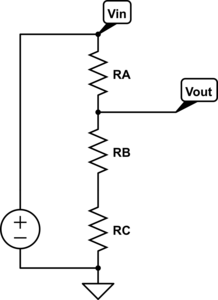
Three-resistor voltage divider for the first question.

I started with a “do now” question, similar to the one from Monday. Actually, I started with 2 questions. The first just asked what the output voltage would be for a 3-resistor voltage divider. The second repeated the question from Monday, but with the additional constraint that the power supply was 5 volts:

You have sensor whose resistance varies from 1kΩ to 4kΩ with the property it measures and a 5v power supply.  Design a circuit whose output voltage varies from 1v (at 1kΩ) to 2v (at 4kΩ).

Several students realized that the first question was a hint for the second one and that the variable resistor had to be RB or RC, and could set up the equations and solve for RA and RC.  This is a better performance than on Monday’s “do now”, but only about 1/3 of the class got it completely, and several of them were not confident of their results, so we again took time to go over the whole solution. I think that everyone (or almost everyone) understood the design process and how to set up and solve the equations by the end of the presentation, which I drew out of the students as much as possible.  I also mentioned that we could have solved the problem with a different circuit (putting RC in parallel with RB instead of in series), but did not further elaborate on that point.

The do-now plus going over the solution took about 33 minutes, which is a little more time than I’d like to be spending on these questions.  It would be good to get the time down to 15 minutes, but I don’t see how to do that without losing half the class.  If the problems are easy enough that everyone gets them, then there is no point to taking up any class time with them, and if they are hard enough that 1/3 to 2/3 of the class don’t get them, then they need to be gone over in class.

After the do-now, we spent a little time discussing the “fit” command of gnuplot, since the students have to fit models to the data they collect tomorrow, and I’m not providing them a script this time (though they can modify the script that was provided in the first lab).

Finally, we got to the theoretical meat of the class—we discussed what sound was (ending up with variations in pressure for a fluid, though we discussed briefly transverse and shear waves in solids).  Then I introduced microphones as transducers, trying to get the students to remember their elementary mechanics, so that we could do pressure→force→displacement→1/capacitance→voltage for electret mics.  The hardest part was getting students to remember that a spring-mounted object had force proportional to displacement (a lot remembered the energy was somehow related to displacement squared and got stuck on that formula).  I suspect that the local physics department would not be seeing a high score on the Force Concept Inventory for students coming out of their physics classes, as a lot of them seem to have concentrated on cramming formulas rather than learning fundamental concepts.  Someone did remember Q=CV and someone else could reason from wanting voltage proportional to displacement to needing constant charge which let me introduce both conventional capacitance microphone (with a large resistor to voltage source) and electrets.  I also explained that the electret had an enormous resistance, so we couldn’t get any measurable current out of it, and we needed an FET transistor to convert the voltage to a current.

Because both the do-now and extracting vague memories of physics from the students took longer than I had planned, we were a bit rushed for the last part of the lesson, which was a simple model of Ids vs Vds for the FET output stage of the electret mic. I asked for advice on drawing the plots for resistors and for current sources, and got the appropriate straight lines.  I then drew a smooth transition between them and claimed that the simple FET models usually consisted of a linear region at low voltage (which my co-instructor refers to as the “triode” region, a usage I’ve seen in some other presentations) and a saturation region at high voltage, and that we usually try to stay out of the sublinear region in between.

I also said that the saturation region is not really constant, but has a slight upward slope, since they will be measuring the I-vs-V characteristic of the electret microphones tomorrow, and they will certainly be observing that.  The lab handout gives them 4 models to fit: linear, constant current, an empirical blend of the two, and a model that allows current increase in the saturation region.  Neither the 3rd nor the 4th model match the ones usually used in circuit simulators, but I had trouble fitting parameters to those models, even with voltage-modulated channel lengths, so I gave up and produced simple models with few parameters that can be fit pretty easily. We’ll be revisiting FETs again before the power-amp lab (where they’ll use pMOS and nMOS power FETs to make a class-D amplifier). Somewhere around then, I’ll have to give them some usable models for how saturation current varies with gate voltage, which I deliberately did not cover in this lecture.

I’m a bit worried about how big tomorrow’s lab is.  There are again 2 parts:

  • the DC characterization of the mic using the Arduino to gather data (plus a few hand-collected points for higher voltages than we can subject the Arduino to)
  • designing a pull-up resistor to bias the mic into its normal operating range (in the saturation region) and observing the microphone output on the oscilloscope.  I also asked students to hook up their loudspeakers to the signal generators, to provide known inputs to the mic, and some other little stuff, but I’ll probably be happy if everyone gets the first part done and manages to observe waveforms on the scope.

On Friday, most of the lecture will be standard EE stuff by my co-instructor (probably current sources, Thévenin equivalents, and Norton equivalents).  I may have a do-now question at the beginning of the class, if I can come up with one that I think is pedagogically useful.


Filed under: Circuits course Tagged: Arduino, circuits, course design, electret microphone, teaching, voltage divider

Fifth day of circuits class

I feel pretty good about today’s lecture, though things got a little rushed at the end.

Three-resistor voltage divider for the first question.

I started with a “do now” question, similar to the one from Monday. Actually, I started with 2 questions. The first just asked what the output voltage would be for a 3-resistor voltage divider. The second repeated the question from Monday, but with the additional constraint that the power supply was 5 volts:

You have sensor whose resistance varies from 1kΩ to 4kΩ with the property it measures and a 5v power supply.  Design a circuit whose output voltage varies from 1v (at 1kΩ) to 2v (at 4kΩ).

Several students realized that the first question was a hint for the second one and that the variable resistor had to be RB or RC, and could set up the equations and solve for RA and RC.  This is a better performance than on Monday’s “do now”, but only about 1/3 of the class got it completely, and several of them were not confident of their results, so we again took time to go over the whole solution. I think that everyone (or almost everyone) understood the design process and how to set up and solve the equations by the end of the presentation, which I drew out of the students as much as possible.  I also mentioned that we could have solved the problem with a different circuit (putting RC in parallel with RB instead of in series), but did not further elaborate on that point.

The do-now plus going over the solution took about 33 minutes, which is a little more time than I’d like to be spending on these questions.  It would be good to get the time down to 15 minutes, but I don’t see how to do that without losing half the class.  If the problems are easy enough that everyone gets them, then there is no point to taking up any class time with them, and if they are hard enough that 1/3 to 2/3 of the class don’t get them, then they need to be gone over in class.

After the do-now, we spent a little time discussing the “fit” command of gnuplot, since the students have to fit models to the data they collect tomorrow, and I’m not providing them a script this time (though they can modify the script that was provided in the first lab).

Finally, we got to the theoretical meat of the class—we discussed what sound was (ending up with variations in pressure for a fluid, though we discussed briefly transverse and shear waves in solids).  Then I introduced microphones as transducers, trying to get the students to remember their elementary mechanics, so that we could do pressure→force→displacement→1/capacitance→voltage for electret mics.  The hardest part was getting students to remember that a spring-mounted object had force proportional to displacement (a lot remembered the energy was somehow related to displacement squared and got stuck on that formula).  I suspect that the local physics department would not be seeing a high score on the Force Concept Inventory for students coming out of their physics classes, as a lot of them seem to have concentrated on cramming formulas rather than learning fundamental concepts.  Someone did remember Q=CV and someone else could reason from wanting voltage proportional to displacement to needing constant charge which let me introduce both conventional capacitance microphone (with a large resistor to voltage source) and electrets.  I also explained that the electret had an enormous resistance, so we couldn’t get any measurable current out of it, and we needed an FET transistor to convert the voltage to a current.

Because both the do-now and extracting vague memories of physics from the students took longer than I had planned, we were a bit rushed for the last part of the lesson, which was a simple model of Ids vs Vds for the FET output stage of the electret mic. I asked for advice on drawing the plots for resistors and for current sources, and got the appropriate straight lines.  I then drew a smooth transition between them and claimed that the simple FET models usually consisted of a linear region at low voltage (which my co-instructor refers to as the “triode” region, a usage I’ve seen in some other presentations) and a saturation region at high voltage, and that we usually try to stay out of the sublinear region in between.

I also said that the saturation region is not really constant, but has a slight upward slope, since they will be measuring the I-vs-V characteristic of the electret microphones tomorrow, and they will certainly be observing that.  The lab handout gives them 4 models to fit: linear, constant current, an empirical blend of the two, and a model that allows current increase in the saturation region.  Neither the 3rd nor the 4th model match the ones usually used in circuit simulators, but I had trouble fitting parameters to those models, even with voltage-modulated channel lengths, so I gave up and produced simple models with few parameters that can be fit pretty easily. We’ll be revisiting FETs again before the power-amp lab (where they’ll use pMOS and nMOS power FETs to make a class-D amplifier). Somewhere around then, I’ll have to give them some usable models for how saturation current varies with gate voltage, which I deliberately did not cover in this lecture.

I’m a bit worried about how big tomorrow’s lab is.  There are again 2 parts:

  • the DC characterization of the mic using the Arduino to gather data (plus a few hand-collected points for higher voltages than we can subject the Arduino to)
  • designing a pull-up resistor to bias the mic into its normal operating range (in the saturation region) and observing the microphone output on the oscilloscope.  I also asked students to hook up their loudspeakers to the signal generators, to provide known inputs to the mic, and some other little stuff, but I’ll probably be happy if everyone gets the first part done and manages to observe waveforms on the scope.

On Friday, most of the lecture will be standard EE stuff by my co-instructor (probably current sources, Thévenin equivalents, and Norton equivalents).  I may have a do-now question at the beginning of the class, if I can come up with one that I think is pedagogically useful.


Filed under: Circuits course Tagged: Arduino, circuits, course design, electret microphone, teaching, voltage divider

Trials and Tribulations of Making a 3D Printer

          —(MORE TO BE ADDED AS THE BUILD PROGRESSES)—

read more

Let's Make Robots 16 Jan 21:55

Hacking grandfather clock accuracy while it’s still ticking

[Keith] got his hands on a few grandfather clocks. Apparently the price tag is greatly reduced if you are able to get them second-hand. The mechanical timepieces require weekly winding, which is a good thing since you’ll also need to correct the time at least that often. But this drift got [Keith] thinking about improving the accuracy of these clocks. He figured out a high-tech way to adjust the timepiece while it’s ticking.

The first thing he needed was a source of super-accurate time. He could have used a temperature compensated RTC chip, but instead went the more traditional route of using the frequency of mains power as a reference. The next part of the puzzle is to figure out how to both monitor the grandfather clock and make small tweaks to its pendulum.

The answer is magnets. By adding a magnet to the bottom of the pendulum, and adjusting the proximity of a metal plate positioned below it, he can speed up or slow down the ticking. The addition of a hall effect sensor lets the Arduino measure the rate of each swing and calculate the accuracy compared to the high voltage frequency reference.


Filed under: clock hacks