Posts with «arduino» label

DFRobot Encourages the Open Hardware Community

DFRobot is a Shanghai-based open source hardware facilitator whose mission is to encourage people to develop their own products and simply enable more rapid project creation. We caught up with Hector Saldana of DFRobot to find out more about the company’s offerings. Saldana notes one of their main focuses of […]

Read more on MAKE

The post DFRobot Encourages the Open Hardware Community appeared first on Make:.

DrumPants 2.0 is open source, still turns your pants into drums

That crazy DrumPants wearable tech we first saw in '07 -- the same one that raised 75 grand on KickStarter and was featured on Shark Tank in 2014 -- is back. Its creators have now turned to Indiegogo to fund the mass production of DrumPants version 2.0, which they claim is faster and stronger than its predecessor. Plus, it's now open source. The wearable, for those who've only just heard of it, isn't actually a pair of pants with drums (sorry to disappoint). It's a set of accessories comprised of two elongated drum pads and two foot pedals you can use to play different kinds of instruments, along with a knob that lets you choose between samples and musical scales. You can wear them over your clothes, or under, like the jamming dude in the GIF above.

Via: The Creators Project

Source: Indiegogo

Engadget 21 May 14:41

DrumPants 2.0 is open source, still turns your pants into drums

That crazy DrumPants wearable tech we first saw in '07 -- the same one that raised 75 grand on KickStarter and was featured on Shark Tank in 2014 -- is back. Its creators have now turned to Indiegogo to fund the mass production of DrumPants version 2.0, which they claim is faster and stronger than its predecessor. Plus, it's now open source. The wearable, for those who've only just heard of it, isn't actually a pair of pants with drums (sorry to disappoint). It's a set of accessories comprised of two elongated drum pads and two foot pedals you can use to play different kinds of instruments, along with a knob that lets you choose between samples and musical scales. You can wear them over your clothes, or under, like the jamming dude in the GIF above.

Filed under: Misc

Comments

Via: The Creators Project

Source: Indiegogo

Engadget 21 May 14:41

DrumPants 2.0 is open source, still turns your pants into drums

That crazy DrumPants wearable tech we first saw in '07 -- the same one that raised 75 grand on KickStarter and was featured on Shark Tank in 2014 -- is back. Its creators have now turned to Indiegogo to fund the mass production of DrumPants version 2.0, which they claim is faster and stronger than its predecessor. Plus, it's now open source. The wearable, for those who've only just heard of it, isn't actually a pair of pants with drums (sorry to disappoint). It's a set of accessories comprised of two elongated drum pads and two foot pedals you can use to play different kinds of instruments, along with a knob that lets you choose between samples and musical scales. You can wear them over your clothes, or under, like the jamming dude in the GIF above.

Engadget 21 May 14:41

New Project: Minecraft Activated Arduino Alarm

You’ve amassed a small fortune in diamonds, wood, coal, iron, food, and the other resources you need. You’ve spent hours building the perfect Minecraft fortress to stockpile your goods. But who will watch your stash while you’re on another server? In this project guide, you’ll learn to use Arduino coding […]

Read more on MAKE

The post Minecraft Activated Arduino Alarm appeared first on Make:.

New Project: Minecraft Activated Arduino Alarm

You’ve amassed a small fortune in diamonds, wood, coal, iron, food, and the other resources you need. You’ve spent hours building the perfect Minecraft fortress to stockpile your goods. But who will watch your stash while you’re on another server? In this project guide, you’ll learn to use Arduino coding […]

Read more on MAKE

The post Minecraft Activated Arduino Alarm appeared first on Make:.

Students bring new ideas and innovation at CTC Castilla

Creative Technologies in the Classroom* gives us a lot of joy whenever we visit students’ fairs. Each iteration of CTC (Madrid, Castilla, Barcelona and so forth) has its own technology fair and it is meant to award and congregate students and their projects. Arduino Verkstad, teachers, school and government representatives join as well to celebrate and share what students have learned along the program.

This year is the third edition of CTC Castilla and the fair had 140 projects, 936 students and 70 teachers. We have noticed that:

  • Teachers learned along with the students since they are not reproducing the CTC projects as the final projects, they have innovating by bringing new ideas
  • We got told that teachers are forced by the students to open the labs late after school hours because they want to spend more time working on their projects
  • Students have become pretty good at pitching projects, not only their production is excellent, but also their presentation skills

Some of the most impressive projects are:

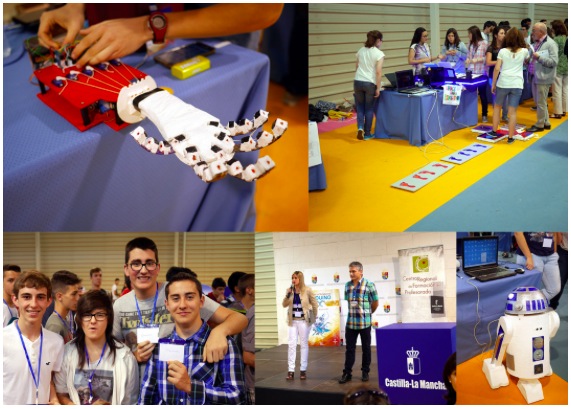
robotic hand controlled from a phone that even had an app with the sign language alphabet so that the hand would “talk” for you, and an R2D2 made of recycled materials. All the pictures and many videos of the projects can be seen here. Thanks to Centro Regional de Formación del Profesorado, Castilla La Mancha and congratulations to all CTC participants!

*Creative Technologies in the Classroom (CTC) is a collection of experiments aimed at transforming the way technology is taught in schools around the world. These experiments introduce basic concepts in programming, electronics, and mechanics.

(The news was originally posted on Arduino Verkstad blog by Laura Balboa)

Manipulate your voice with Mimic Monster and Intel Edison

It’s time to introduce you to another great tutorial made for  Intel Edison.  Mimic Monster is a project allowing you to record soundbites and playing them back manipulated.
In this step-by-step project, everyone who is interested in audio features and mods , can find useful information on how to manipulate audio files and create amazing effects from your voice.

Grawr! It’s a mimic monster! What did you say? Grawr! It’s the mimic monster!

Having landed on Earth, this little alien needs you to teach it how to speak. Speak into its audio antenna and it will repeat your words back. Press a button and change its pitch. In this tutorial, you will learn in more detail, how to work with a USB sound card, a microphone, and a speaker.


Before you begin, make sure you’ve followed through Intel® Edison Getting Started guide, and our previous tutorial, the Intel® Edison mini-breakout Getting Started Guide.

 Check the other tutorials of the series.

Adafruit And The Arduinos At Maker Faire

The apparent lull on the Arduino front the last few weeks was just the calm before the storm that is the Bay Area Maker Faire (BAMF). Both companies claiming the Arduino name were there over the weekend, with news and new products in tow. Ironically, you could see from one booth straight over to the other. Small world.

Perhaps the biggest news from Arduino LLC is that hacker-friendly Adafruit is now going to be making officially-licensed boards in the US. Competing with this news, Arduino SRL brought its new boards, including the Yun Mini and ARM-powered Arduino M0. And [Massimo Banzi] and Arduino LLC seem to be taking an end-run around the Arduino SRL trademark by announcing the “Genuino” brand for European production. For all the details, read on!

The Adafruit Connection

As announced by [Massimo] in his “State of the Arduino” keynote speech at the BAMF, Arduino is licensing Adafruit to produce a range of the “most-requested” Arduino boards at their factory in New York. So those of you looking to support Arduino LLC with your purchases also get to help line [Ladyada]’s pockets at the same time. That’s a big win in our book.

Photo: Atmel

It’s not a complete surprise that Adafruit should get tapped as a US fab for Arduino.cc. They’ve been selling the boards and producing copious Arduino-related tutorials since their beginnings in 2005. More recently, Adafruit partnered with Arduino LLC to create the Gemma board, which is basically an ATTiny85-based Arduino-a-like in a tiny round, wearable-friendly board. (If you’re familiar with the Adafruit lineup, it’s essentially a Trinket in the round format of a LilyPad Arduino.)

Indeed, after the deal is done and the dust has settled, it’s a bit surprising to us that this hasn’t happened earlier, what with both Adafruit and Sparkfun producing licensed boards and Arduino LLC looking for new manufacturers. Anyway, good job Adafruit and Arduino (LLC)!

(New) Hardware from Arduino SRL

Arduino SRL had its Yun Mini, which is essentially a smaller version of the Yun — a mashup of an Arduino Leonardo with an OpenWRT-capable router chipset. We’ve reported on these previously but it’s fun to see them in the flesh.

The M0 is interesting. Before the troubles began, Arduino designed an ARM-M0+ based board with Atmel. Now Arduino LLC has it listed on their website as the Arduino Zero, but still hasn’t got any for sale yet. Arduino SRL has the boards on their website as the Arduino Zero Pro, with a different name, but is now touting this version as the “M0 Pro”. What’s in a name? Not much. The circuit layouts and parts appear identical.

The Portal Battle

Both of the Arduino companies are working on getting your Arduino development into “the cloud”. (Conscience compels us to note that “the cloud” is actually just other people’s computers.) Anyway, this essentially means new web-based and browser-based versions of the IDE that tie into web services. Interestingly enough, the two companies have different takes on what that entails.

According to their Maker Faire press release, Arduino SRL will be launching a web portal for makers to “promote and distribute their products” and share code and ideas. Located at my.arduino.org (which currently seems to be password-access only), the idea seems to be to create a mini-Tindie for Arduino-based products. This couples with their “Arduino IDE-alpha”, a JavaScript-based IDE that will run in the browser.

Meanwhile, Arduino LLC displayed previously announced their alternative development platform, Arduino Create. Arduino Create lets you write, compile and upload sketches “directly from the browser with the Arduino Web Editor”, and store your code in the “Arduino Cloud”. Arduino Create looks slick: certainly a lot better than the homely Java IDE that we’re all used to. It’s too early to tell what this “cloud” is all about, but it looks like it will include code sharing, schematic and wiring hookup storage, and easy sharing among users.

We already use blogs, Hackaday.io (shameless plug!), Github, and other “cloud” services to store our projects and code, so we’re not entirely sure what either of these portal offerings will bring to the table. It’s 2015, is anyone still hurting for project hosting space on the web?

Cynically, we note that both of these companies are in a battle to “own” the Arduino community and that getting people to host code and projects on their servers is an obvious strategy, and providing a web-based IDE to facilitate this capture is the tactic.

And before we leave “the cloud”, we should note that both Arduinos are late to the game. codebender has been around and programming Arduinos on the web since 2012.

New Names

Photo: Making Society

Finally, as if it weren’t bad enough with Arduino LLC and Arduino SRL, [Massimo Banzi] also announced that licensed boards for the European market will be sold under the new “Genuino”.

Actually, this is a pretty cagey maneuver, because it side-steps the European trademark issues (which [Massimo] referred to as “the bullsh*t” in his talk) and is a cute name to boot. “Genuine”, get it?

Our take? As [Massimo] almost said in this video interview with Make, “a rose by any name would smell as sweet.” If Arduino LLC loses the trademark lawsuit in Italy, they’ll not be allowed to sell boards using the “Arduino” name. The best way to limit the damage in the future is to make the switch now, while everyone is watching, and give the market time to adapt.


Filed under: Arduino Hacks, cons

Large Seven-Segment Clock Build Takes Time To Perfect

[Kevin Rye] built a discrete TTL based seven-segment clock, and he wasn’t too happy with the ugly insides compared to the nice enclosure he built for it. He embarked on creating another large seven-segment clock to put inside that enclosure.

Clocks, and specifically seven-segment based ones, aren’t anything new to write about. This particular project, which is still work in progress, is interesting. [Kevin] is an experienced hacker, but the problems he encountered and resolved along the way could prove useful to a fellow hacker someday.

To start with, he tried rectifying his old build. But in his own words “You can polish a turd, but it’s still a turd.” Five years later, he’d had enough. He’s built a lot of other clocks, but rather than repurposing them, he decided to start from scratch. He quickly breadboarded an Arduino, some displays and drove them using the Multiplex7seg library. That library supports only four characters, so he was back to the drawing board. With a fresh start, his design is now moving along nicely. For now, he’s designed three boards for the display, two boards for the colons between digits, the main Arduino-clone controller board and a 3D printed front frame to hold the displays. It will be nice to finally see that enclosure receive some fitting occupants and bring this build to closure.


Filed under: clock hacks