Posts with «science» label

Watch a fin-propelled underwater robot prototype

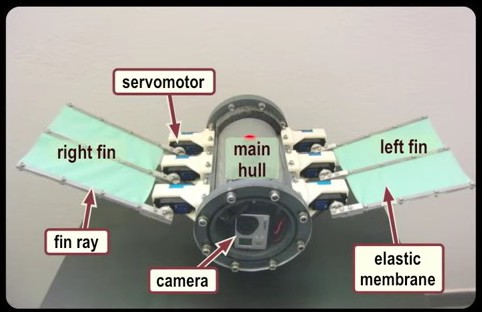
The robotic prototype swimming under water propelled by fins, it was developed at the Control Systems and Robotics Laboratory of the Technological Educational Institute of Crete, in Heraklion (Greece) and it’s controlled by an Arduino Mega:

Each fin is comprised of three individually actuated fin rays, which are interconnected by an elastic membrane. An on-board microcontroller generates the rays’ motion pattern that result in the fins’ undulations, through which propulsion is obtained. The prototype, which is fully untethered and energetically autonomous, also integrates an IMU/AHRS unit for navigation purposes, a wireless communication module, and an on-board video camera. The video contains footage from experiments conducted in a laboratory test tank to investigate closed loop motion control strategies, as well as footage from sea trials.

the Arduino runs a custom-developed real time firmware that implements two Central Pattern Generator (CPG) networks to generate the undulatory motion profile for the robot’s fins. The robot  contains a  7.4V lipo battery powering also a Bluetooth module for wireless communication and a video camera to record footage of the missions.


Build Your Own Arduino Weather Station

An easy to set up and program digital weather station you can build for around $50

Read more on MAKE

The post Build Your Own Arduino Weather Station appeared first on Make: DIY Projects, How-Tos, Electronics, Crafts and Ideas for Makers.

Eye-Tracking Wheelchair Control Design Wins Hackaday Prize

Eyedrivomatic uses the same technology utilized for text-to-speech in order to build a motorized wheelchair you can move with your eyes.

Read more on MAKE

The post Eye-Tracking Wheelchair Control Design Wins Hackaday Prize appeared first on Make: DIY Projects, How-Tos, Electronics, Crafts and Ideas for Makers.

OpenBCI Launches New, Hackable Brain Computer Interface

For Connor Russomanno and Joel Murphy, designing a brain-computer interface is not the stuff of science fiction, it is their day job.

Read more on MAKE

The post OpenBCI Launches New, Hackable Brain Computer Interface appeared first on Make: DIY Projects, How-Tos, Electronics, Crafts and Ideas for Makers.

5 Life-Changing Accessibility Inventions Made in 72 Hours

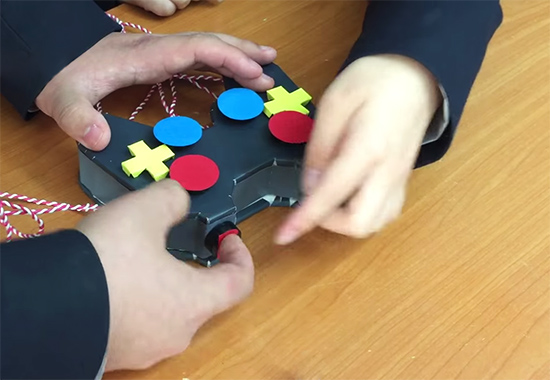
Makers hacked real problems faced by people with special needs to create tools that will help improve mobility, independence, and comfort.

Read more on MAKE

The post 5 Life-Changing Accessibility Inventions Made in 72 Hours appeared first on Make: DIY Projects, How-Tos, Electronics, Crafts and Ideas for Makers.

Having fun with music in a science class

A science teacher at Bundang management high school 20 kilometers southeast of downtown Seoul, South Korea, involved his students in an Arduino Music project running Arduino Uno, Sparkfun Music Instrument Shield and Makey Makey.

Students started studying the principles of sensors and then built their own music instruments using recycled materials. Finally they played them as you can see from the video he shared with us:

See more pictures and videos at this link.

Arduino Blog 24 Mar 20:16
arduino  diy  education  featured  kids  music  science  

An open hardware quartz crystal microbalance for ultra high mass sensitivity

Marco Mauro is a physicist currently employed as Scientific Coordinator at Novaetech, the first Spin-off Company of the National Institute for Astrophysics (INAF) in Italy. He shared with us all the info about a project he’s been working on  and based on Arduino Micro.

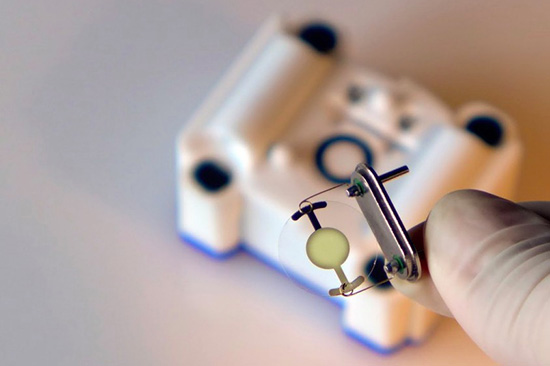
OpenQCM is a fully open source scientific microbalance capable of weighing mass deposition down to 1 billionth of gram:

The sensing core of the microbalance is a piezoelectric quartz crystal oscillator. The deposition of a very tiny mass on the surface causes the variation in the quartz frequency. openQCM belongs to a new generation of innovative smart sensor which boast high resolution and ultra high mass sensitivity. The open source strategy made the creation of openQCM available at low cost which represents a bit fraction of the cost of similar scientific products.

openQCM was built keeping in mind the emergent principles of the open source hardware movement. The open source hardware gives people the freedom to control their technology through the open exchange of all the project features, 3D design, electronics and software. The open hardware potentiality is even greater when it comes to hardware for scientific applications.

openQCM is exactly something like that, the first open hardware quartz crystal microbalance with applications in a wide range of scientific fields, such as chemical and biological sensing, material science.

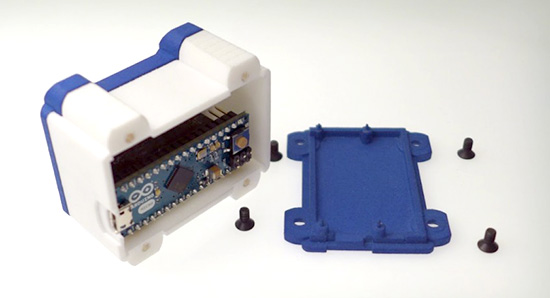
openQCM has an Arduino Micro board inside at heart. By hacking the timer counter of the AtMega32U4 Arduino microcontroller, it is possible to measure the quartz crystal frequency variations using the 16 Mhz microprocessor clock. openQCM team has designed an Arduino Micro shield with an embedded quartz crystal oscillator driver circuit and a temperature sensor. The output of the quartz crystal oscillator driver is fed to the Arduino Micro timer counter and the analog value of the temperature sensor is fed to the analog pin of the board. This configuration allow you measure the quartz crystal frequency with a resolution of 1 Hz, which roughly corresponds to a mass resolution of 700 pg over the entire quartz surface in air.

One of the major challenge of an open hardware project is that such devices require funding to prototype and manufacture. That’s why the openQCM team have selected the 3d printing technology to keep high quality and low cost. Using 3d printing to print out the prototypes via the SLS process from OS Formiga P100, P110, P395, and P730, the openQCM team created the device’s parts, which required a precision down to 60 µm.

The open source concept made openQCM publicly available so that anyone (scientists, technology enthusiast, makers, hobbyist …) can study, modify, and develop the hardware based on the original design. openQCM is now working and ready to win the heart of the scientific community and more.

Go and make one yourself!
MIT's light-up robot garden teaches you how to code

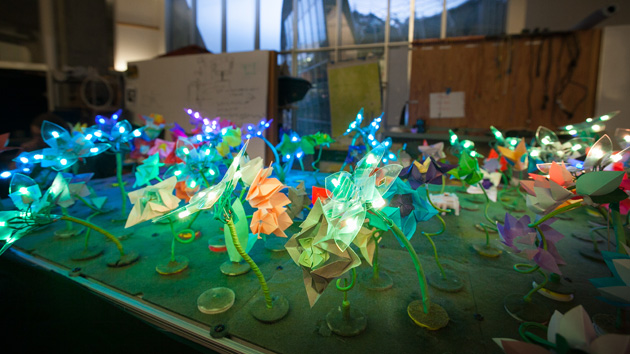
If you're teaching kids how to code, what do you do to show that software makes an impact in the real world? MIT has a clever idea: a robot garden. The project lets you control a grid of Arduino-linked "plants" through programming that makes them blossom and light up in pretty (and occasionally mesmerizing) ways. It'll even teach the virtues of distributed computing -- you can tell these leafy robots to bloom or change color in algorithm-driven sequences. The garden is just a demo for now, but it'll eventually turn into an easy-to-replicate curriculum for students who'd otherwise have to settle for seeing their results on-screen.

[Image credit: Jason Dorfman, CSAIL]

Filed under: Science, Software

Comments

Source: MIT News

Tags: algorithm, arduino, code, distributedcomputing, education, garden, kids, mit, programming, school, video

Engadget 18 Feb 21:58
science  software  

MIT's light-up robot garden teaches you how to code

If you're teaching kids how to code, what do you do to show that software makes an impact in the real world? MIT has a clever idea: a robot garden. The project lets you control a grid of Arduino-linked "plants" through programming that makes them blossom and light up in pretty (and occasionally mesmerizing) ways. It'll even teach the virtues of distributed computing -- you can tell these leafy robots to bloom or change color in algorithm-driven sequences. The garden is just a demo for now, but it'll eventually turn into an easy-to-replicate curriculum for students who'd otherwise have to settle for seeing their results on-screen.

[Image credit: Jason Dorfman, CSAIL]

Filed under: Science, Software

Comments

Source: MIT News

Tags: algorithm, arduino, code, distributedcomputing, education, garden, kids, mit, programming, school, video

Engadget 18 Feb 21:58
science  software  

MIT's light-up robot garden teaches you how to code

If you're teaching kids how to code, what do you do to show that software makes an impact in the real world? MIT has a clever idea: a robot garden. The project lets you control a grid of Arduino-linked "plants" through programming that makes them blossom and light up in pretty (and occasionally mesmerizing) ways. It'll even teach the virtues of distributed computing -- you can tell these leafy robots to bloom or change color in algorithm-driven sequences. The garden is just a demo for now, but it'll eventually turn into an easy-to-replicate curriculum for students who'd otherwise have to settle for seeing their results on-screen.

[Image credit: Jason Dorfman, CSAIL]

Filed under: Science, Software

Comments

Source: MIT News