Posts with «arduino» label

Slap my zombie hand for internet fame!

Halloween time is a great moment to explore nice interactive projects and get inspired for installations for other selfie occasions. To spice up the office Donnie Plumly, a creative technologist, decided to make and share with us a molded zombie arm that takes pictures and post them to Twitter.

He used a silicone arm (molded on his own hand ), a custom steel mount to clip to an office partition, and a vibration sensor hooked up to an Arduino Uno. Once the arm is slapped a photo will be taken using an IR Led and passed to the Eye-Fi card in the camera.

The photo is then saved into a Dropbox folder and, using If This Then That (IFTTT), posted to Twitter on the account @ZombieSelfie.

Donnie created also a very useful tutorial  on Instructable to make it yourself!

This Cereal-Stealing Robot Will Swipe Your Breakfast

One Maker’s experiment in robotics results in an insatiable cereal transport system using Arduino, 3D printing, and Rice Krispies.

Read more on MAKE

The post This Cereal-Stealing Robot Will Swipe Your Breakfast appeared first on Make: DIY Projects, How-Tos, Electronics, Crafts and Ideas for Makers.

Tricking an Ancient Protocol To Play Tunes

A lot of technological milestones were reached in 2007. The first iPhone, for example, was released that January, and New Horizons passed Jupiter later on that year. But even with all of these amazing achievements, Volvo still wasn’t putting auxiliary inputs on the stereo systems in their cars. They did have antiquated ports in their head units though, and [Kalle] went about engineering this connector to accommodate an auxiliary input.

The connector in question is an 8-pin DIN in the back, which in the days of yore (almost eight years ago) would have been used for a CD changer. Since CDs are old news now, [Kalle] made use of this feature for the hack. The first hurdle was that the CD changer isn’t selectable from the menu unless the head unit confirms that there’s something there. [Kalle] used an Arduino Nano to fool the head unit by simulating the protocol that the CD changer would have used. From there, the left and right audio pins on the same connector were used to connect the auxiliary cable.

If you have a nearly-antique Volvo like [Kalle] that doesn’t have an aux input and you want to try something like this, the source code for the Arduino is available on the project page. Of course, if you don’t have a Volvo, there are many other ways to go about hacking an auxiliary input into various other devices, like an 80s boombox or the ribbon cable on a regular CD player. Things don’t always go smoothly, though, so there are a few nonstandard options as well.


Filed under: car hacks, digital audio hacks

CNN Shows Adafruit Part During Bombing Segment

A sharp-eyed Twitter user noticed that during a breaking news segment about the crash of the Russian Metrojet Flight 9268 in Egypt this week, CNN briefly displayed an Adafruit Industries component while discussing the possibility that an Isis bomb might have brought down the aircraft. Adafruit is an open-source hardware company that sells Arduino, […]

Read more on MAKE

The post CNN Shows Adafruit Part During Bombing Segment appeared first on Make: DIY Projects, How-Tos, Electronics, Crafts and Ideas for Makers.

Give me your number and get a unique micro-noise piece

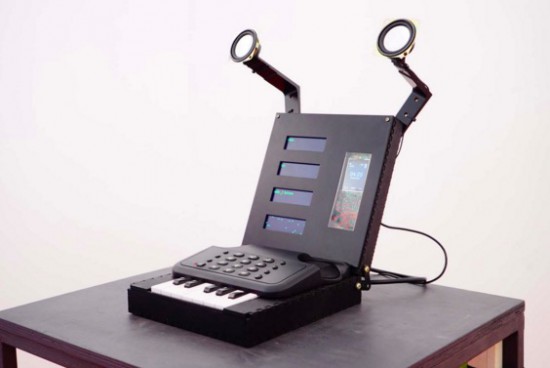
Prankophone  is the new interactive installation by Dmitry Morozov (his amazing projects have been featured on this blog ).  This time he created  a sound object, a hybrid of synthesizer, telephone and logic module:

The main principle of the object’s functioning is as follows: depending on the current mode, the apparatus calls to random or pre-defined recipients and plays them algorithmic melodies created from their phone numbers. The speakers transmit both the synthesized sounds and the sound from answering person. The common sound layer is involving a random recipient who doesn’t suspect anything. The person who answers the phone can’t hear any other sounds except for the synthesized ones.

You can play with it in 4 different modes:

Autonomous mode –  it generates the numbers by itself and tries to reach them, and play them the sounds.
Manual mode – when you dial any number by pressing standard phone keys it gets automatically transformed into sounds.
Keyboard mode – mode of dialing the number on the one-octave keyboard where 10 keys correspond to 10 digits.
Live mode – the number is defined by any of the previous methods, but the sounds are reproduced not automatically but from the keyboard, thus the user may “communicate” through sound with the person who answered.
It runs on Arduino Mega and you can listen to its sounds on the following video:

Automatic Cat Feeder Dispenses Noms, Wants Cheezburger

[Domiflichi] likes his cats, but not the drudgery of feeding them. So, like any good engineer, this simple problem became his next project: building an automatic cat feeder. Based on an Arduino, his creation beeps to let the cats know that it is dinnertime, then dispenses food into a number of bowls. There are also buttons for manual control. This lets him give individual cats a separate feeding. Rounding out the feature set, a DS1307 RTC tracks the feeding times.

One of the most interesting parts of his build is the transfer from breadboard to protoboard. This usually involves taking apart a working version, then putting it back together and trying to figure out why it doesn’t work anymore. [Domiflichi]’s problem (detailed in a follow-up post) was figuring out how to program the real-time clock module to set the time, because it looses the time when you disconnect the power. Rather than use the Arduino to program the RTC,  he used the battery backup feature of the RTC chip, programming it on his computer and then soldering it onto the board. He went on to remove the backup battery after the chip was in place. That’s a solution that will no doubt have many readers waving their fingers disapprovingly, but it worked.

It may seem overly complicated, but his project is worth checking out to see how he approached some of the engineering challenges. The food hoppers themselves are off-the-shelf cereal dispensers. We’ve seen other designs bootstrap this mechanism with 3D printed augers.


Filed under: Arduino Hacks, home hacks
Hack a Day 05 Nov 12:01

Making beyond the Wall: get to know chinese makers

Last June Arduino partnered with Seeedstudio to manufacture Genuino boards for the chinese market and during Maker Faire Rome Massimo Banzi took part to an interesting panel to promote  4 chinese delegates from business, education, design and research domains presenting their work and discussing what does it mean to be a maker in China. (in the pic from left to right, Lin, Massimo, Alessio, Jin, Chenille & Flamingo).

The panel titled Making beyond the Wall and moderated by Alessio Jacona tried to address the growing maker movement in China which is not so visible to the European community while the hype of manufacture in Shenzhen, the Chinese Silicon Valley, is gaining more and more international media attention.

Flamingo was the first presenter of the session. Indeed he was also the first person to use Arduino boards in China back in 2007. As an evangelist, he taught physical interactions in China Central Academy of Fine Arts and even started the digital firm K1ND Beijing with Ogilvy China, which focus on interactive design with open source technologies for business projects.

He introduced LightBot (watch video on youku) made in collaboration with Jun Huang, an architect based in China. It’s an installation using LEDs as a brush to draw on light-sensitive canvas. The material on the wall glows after being exposed to light, particularly ultraviolet light, and fades away after some time. Lightbox is powered by an Arduino controlling 1024 LED lights installed on the pallet and stepper motors to control the movement.

Then it was the turn for  Jin  introducing Minibuilder and Candy Project (we featured her work in our blog earlier) created during her fellowship at Iaac. With her international background, Jin explained how she realized how the culture of making in China is focusing more on hardware startups with strong potential to accelerate thanks to great manufacturing opportunities. Whereas in the West, people see it more as a hobby or prefer to explore the conceptual development in a lab environment.  Nowadays she is implementing a new VR projects in China.

Later Lin explained his work as a tutor at the University of Science and Technology in Beijing and also his commitment as a community manager of mechanics and robotics in arduino.cn forum, the community of Arduino fans who also participated to Arduino Day. He worked on various projects and applied Arduino in hemiplegia rehabilitation equipment through sensor feedback and in a gearbox to detect malfunctions through vibration, temperature and stress.

Last but not least, Chenille talked about how he wrote the first book about Arduino in China and more recently, translated the third edition of Getting started with Arduino book into Chinese. He’s now working on a brainwave-controlled music player.

The panel was a good chance to present to an european crowd real experiences from the voice of chinese makers and sharing good practices for future collaborations.

Are you based in China and  want to share a project made with an Arduino or Genuino board? Submit it to the blog, we’d like to feature it and tell your story!

Arduino Software Update Introduces Command-Line Tool, Serial Data Plotter

Arduino releases version 1.6.6 of their IDE software, adding new tools and features for programming Arduino-compatible microcontrollers.

Read more on MAKE

The post Arduino Software Update Introduces Command-Line Tool, Serial Data Plotter appeared first on Make: DIY Projects, How-Tos, Electronics, Crafts and Ideas for Makers.

Makeblock: A Construction Set for the 21st Century

Makeblock founder, Jasen Wang, talks about the growing role of the Maker Movement in China.

Read more on MAKE

The post Makeblock: A Construction Set for the 21st Century appeared first on Make: DIY Projects, How-Tos, Electronics, Crafts and Ideas for Makers.

OpenBCI Launches New, Hackable Brain Computer Interface

For Connor Russomanno and Joel Murphy, designing a brain-computer interface is not the stuff of science fiction, it is their day job.

Read more on MAKE

The post OpenBCI Launches New, Hackable Brain Computer Interface appeared first on Make: DIY Projects, How-Tos, Electronics, Crafts and Ideas for Makers.