Posts with «arduino» label

Real-world 'Pong' might just beat the video game

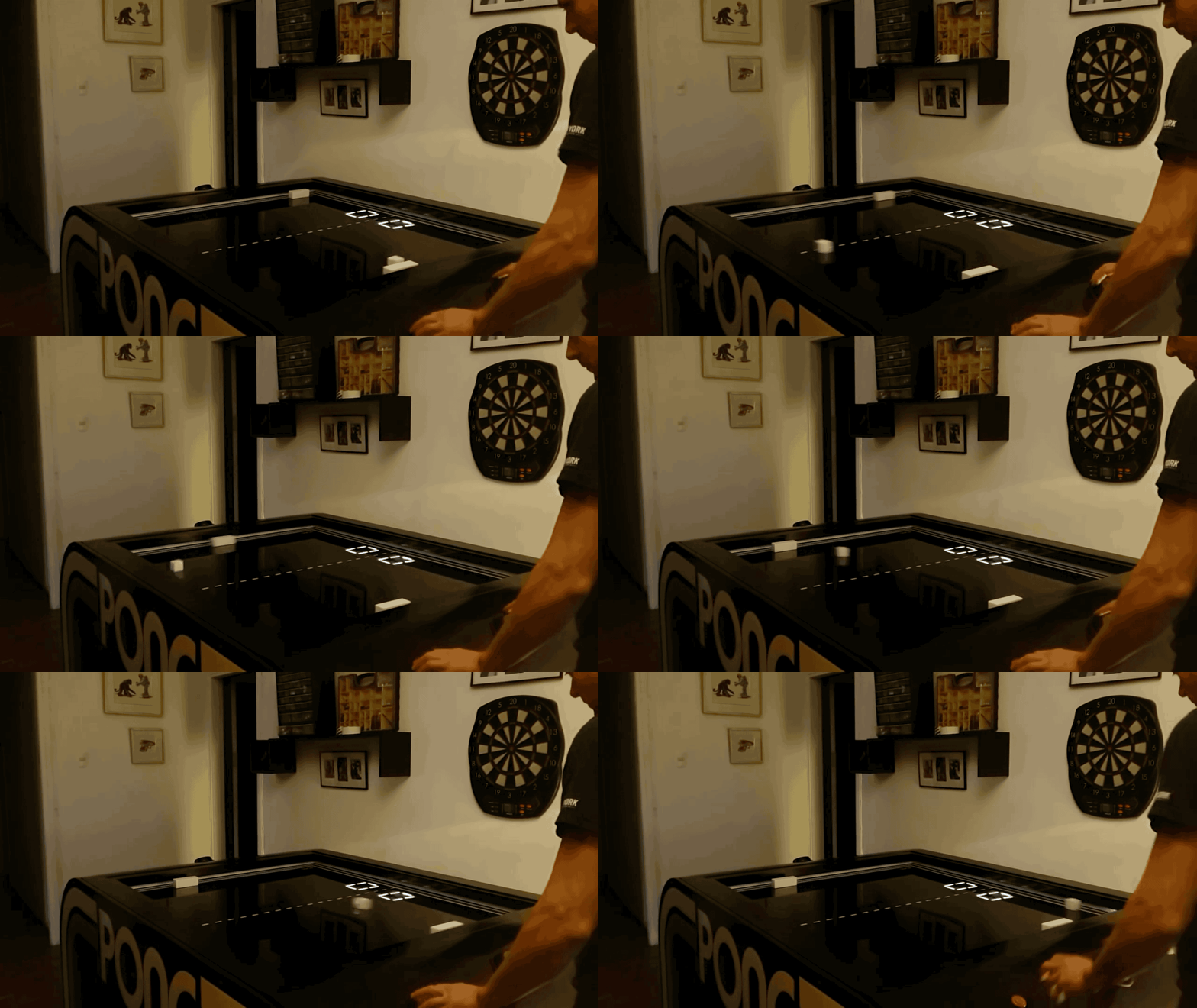
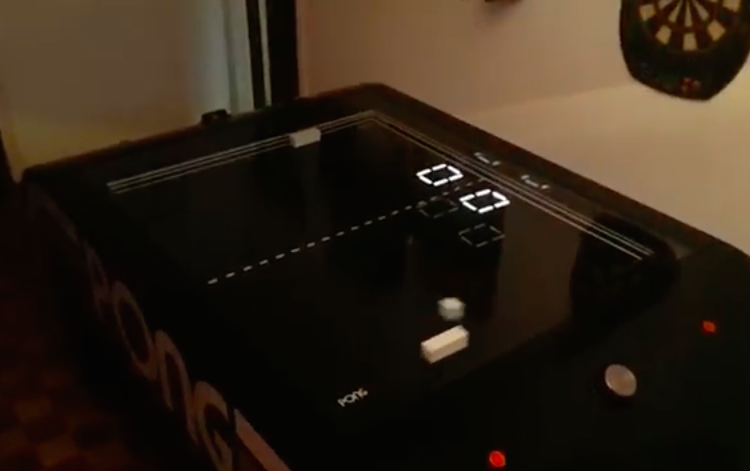
If you miss the days of playing Pong with old-school dial controllers but would rather not track down a vintage console or arcade cabinet, today's your lucky day. Daniel Perdomo and crew have built a real-world Pong machine that replicates the pioneering game with physical parts. Despite what it looks like, it's not just an Atari-themed air hockey table. Instead of letting physics take over, the machine maps virtual ball and paddle movements to objects. All the eccentricities of Pong gameplay are intact, just in a more tangible (and arguably, far more immersive) form. LEDs track the score, while the controllers are rejiggered hard drives.

Engadget 30 May 18:00
arduino  gadgetry  gadgets  games  gaming  gear  pong  video  videogames  

Real-world 'Pong' might just beat the video game

If you miss the days of playing Pong with old-school dial controllers but would rather not track down a vintage console or arcade cabinet, today's your lucky day. Daniel Perdomo and crew have built a real-world Pong machine that replicates the pioneering game with physical parts. Despite what it looks like, it's not just an Atari-themed air hockey table. Instead of letting physics take over, the machine maps virtual ball and paddle movements to objects. All the eccentricities of Pong gameplay are intact, just in a more tangible (and arguably, far more immersive) form. LEDs track the score, while the controllers are rejiggered hard drives.

Via: Gizmodo, Popular Mechanics

Source: Daniel Perdomo (YouTube)

Engadget 30 May 18:00
arduino  gadgetry  gadgets  games  gaming  gear  pong  video  videogames  

iPad Control for Guitar Pedals

[gutbag] is a guitarist. And guitarists are notorious knob-twiddlers: they love their effects pedals. But when your music involves changing settings more than a few times in the middle of a song, it can get distracting. If only there were little robot hands that could turn the knobs (metaphorically, sorry) during the performance…

Tearing into his EHX Pitch Fork pedal, [gutbag] discovered that all of the external knob controls were being read by ADCs on the chip that did all of the processing. He replaced all of the controls with a DAC and some analog switches, coded up some MIDI logic in an ATmega328, and built himself a custom MIDI-controlled guitar pedal. Pretty slick, and he can now control it live with his iPad, or sequence the knobs with the rest of their MIDI system.

This wasn’t [gutbag]’s first foray into pedal automation, however. He’d previously automated a slew of his pedals that were already built to take control-voltage signals. What we like about this hack is the direct substitution of DAC for potentiometers. It’s just hackier. (Oh, and we’re envious of [gutbag]’s lab setup.)

This isn’t the first time we’ve covered [gutbag]’s band, Zaardvark, either. Way back in 2013, we featured an organ-pedal-to-MIDI hack of theirs. Keep on rockin’.


Filed under: musical hacks

Pong In Real Life, Mechanical Pong

[Daniel Perdomo] and two of his friends have been working on a mechanical version of Pong for the past two years. We can safely say that the final result is beautiful. It’s quite ethereal to watch the pixe–cube move back and forth on the surface.

[Daniel] has worked in computer graphics for advertising for more than 20 years. However, he notes that neither he nor his friends had any experience in mechanics or electronics when they began. Thankfully, the internet (and, presumably, sites like Hackaday) provided them with the information needed.

The pong paddles and and pixel (ball?) sit onto of a glass surface. The moving parts are constrained to the mechanics with magnets. Underneath is a construction not unlike an Etch A Sketch for moving the ball while the paddles are just on a rail with a belt. The whole assembly is made from V-groove extrusion.

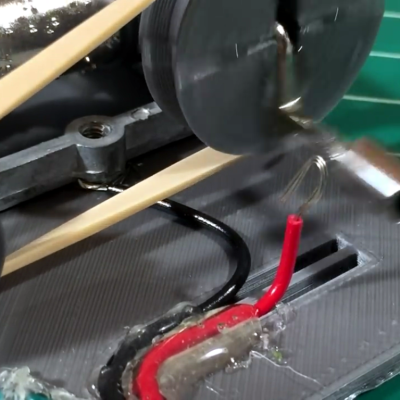
Our favorite part of the build is the scroll wheel for moving the paddle back and forth. For a nice smooth movement with some mass behind it, what’s better than a hard-drive platter? They printed out an encoder wheel pattern and glued it to the surface. The electronics are all hand-made. The brains appear to be some of the larger Arduinos. The 8-bit segments, rainbow LEDs, etc were build using strips glued in place with what looks like copper foil tape connecting buses. This is definitely a labor of love.

It really must be seen to be understood. The movement is smooth, and our brains almost want to remove a dimension when watching it. As for the next steps? They are hoping to spin it up into an arcade machine business, and are looking for people with money and experience to help them take it from a one-off prototype to a product. Video after the break.


Filed under: classic hacks, Virtual Reality

DIY Air Quality Meter And Emissions Tester

Handheld measuring devices make great DIY projects. One can learn a lot about a sensor or sensor technology by just strapping it onto a spare development board together with an LCD for displaying the sensor output. [Richard’s] DIY air quality meter and emissions tester is such a project, except with the custom laser-cut enclosure and the large graphic LCD, his meter appears already quite professional.

For his build, [Richard] used a Sharp GP2Y1010AU0F dust sensor. This $11 device has a little hole, through which airborne dust particles can pass. On the inside, an infrared LED and a photodiode are arranged in a way that allows no direct light, but only light reflected by the passing by dust particles, to reach the photodiode. An accurately trimmed amplifier within the sensor package translates the diode’s photocurrent into an analog output voltage proportional to the dust density. With a bit of software wizardry, it’s even possible to differentiate between house dust and smoke by analyzing the pulse pattern of the output voltage.

The development board used in this project, a PDI-1 (which stands for Programmable Device Interface) is [Richard’s] own design. Manufactured in the UK, it isn’t the cheapest, but it’s the part that makes this build a breeze. It’s basically an Arduino Nano with a lot of onboard peripherals, including a large graphic LCD, some buttons, a speaker, plenty of H-bridges, and a few more.

After bodge-wiring the dust sensor to the board and taking the enclosure out of the laser cutter, the hardware side of this project was almost done. A little fan was added to ensure airflow through the sensor. Eventually [Richard] wrote a basic firmware to display a graph of sensor readings on the LCD. A first test in the exhaust stream of his car, cycling through idling and revving as shown in the title image, suggests that the meter works as intended. Of course, air quality and emission testing depend on more parameters than just dust density, but if you want to replicate and extend this build, [Richard] provides you with all the Arduino compatible source files.


Filed under: Arduino Hacks, misc hacks

Pong Project is a tabletop version of the classic game

Released in 1972, Pong was one of the earliest arcade video games to hit the scene and has since claimed its place in pop culture history. Whereas the Atari classic took the sport of tennis and brought it into the virtual world, a team of Makers led by Daniel Perdomo are taking it back to into the real world with an air hockey-like tabletop version.

As you can see in the video below, the “Pong Project” uses knobs similar to familiar arcade controls to move the paddles, which just like in the original, change the ball’s trajectory as it makes its way over to the opponent. The only difference is that it’s happening on a table instead of a screen. From the looks of it, there may even be a single-player mode with the other paddle seemingly moving all by itself.

To pay homage to the game, its creators gave the Pong Project some ‘70s flair with the iconic logo and play area, as well as neon lights along the sides that illuminate whenever the ball bounces off. Score is kept on seven-segment displays, while it would appear that at least a pair of Arduino boards are helping to drive the system. The team is currently seeking a hardware incubator and other Makers who may be interested in turning this into a final product. You can follow along with the project’s progress on Facebook.

Arduino Blog 27 May 16:34

Arduino MetroPhones will help keep you and your bag safe

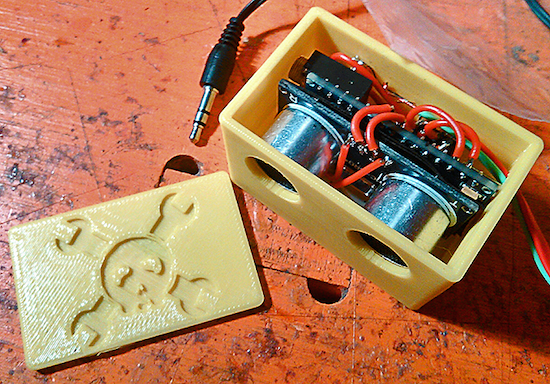
Walking the streets of a highly-populated city, or even a crowded event for that matter, comes with certain risks like pickpocketing. Mindful of this, Maker TVMiller has come up with a clever system to prevent bag thieves from unknowingly creeping up behind you. Called the “Arduino MetroPhones,” the device consists of a Nano, an ultrasonic sensor, a digital potentiometer, a coin-cell battery, and a few other components, all housed inside a 3D-printed case.

The metropolitan in its natural habitat; unaware, oblivious, purposefully deafened and subsequent prey. To increase perception thus safety, we wed an Arduino Nano and ultrasonic sensor to regulate volume to proximity to someone behind you; easily deactivated per environment and rechargeable. Beyond this proof of concept, intention for apparel or accessory (purse, back pack) embedding is ideal.

This prototype of a prototype is a mono-version. A stereo version would merely require dual channels. Thus, imagine, you plug your head phones in to your purse strap which is embedded with a MetroPhone with Bluetooth that streams to your smartphone..

Blind Arduino Project Proves You Don’t Need to See to Build Electronics

William Gerrey and Dr. Joshua Miele made the Blind Arduino Project to help those in the blind community expand their STEM and Maker education.

Read more on MAKE

The post Blind Arduino Project Proves You Don’t Need to See to Build Electronics appeared first on Make: DIY Projects and Ideas for Makers.

And the last winner of our Instagram giveaway is…

Congratulations to Geoff Seawright for the following photo showing a cute dog getting angry with four-legged Arduino spider. He’s the last winner of our MKR1000 giveaway, which kicked off back on Arduino Day! Thanks to all the participants sharing their pics and mentioning our new official Arduino Instagram account!

Dog getting angry with 4-legged arduino spider…possibly it will replace him #arduinoD16 @Arduino.cc

A photo posted by Geoff Seawright (@geoffseawright) on


Cloud lamp/speaker combo brings thunder into your living room

The Cloud” is an interactive lamp and speaker designed to mimic a thunderstorm in terms of appearance and entertainment. Created by Richard Clarkson, it not only provides users with an Arduino-powered, motion-triggered lightning and thunder performance, but serves as a music-activated visualizing speaker as well.

The Cloud employs embedded motion sensors to create unique lightning and thunder shows while providing entertainment value and inspiring awe. This is a kind of magic, not based on illusions and trickery, but on sensors and code. Featuring a powerful speaker system, The Cloud allows its beholder to stream music via any Bluetooth-compatible device and can adapt to any desired lighting, color and brightness.


The hybrid installation is suspended from the ceiling, and consists of hypoallergenic polyester fiberfill with a sponge casing that holds the Arduino, lights, sensors, speakers and other components. Users can control the Cloud through a small, wireless remote.

Clarkson tells The Creators Project:

“Acting as both an immersive lighting experience and a speaker with visual feedback, this hybrid lamp/speaker introduces a new discourse for what a light fixture could be. Advances in physical computing and interaction design hardware over recent years have created a new breed of smart-objects, which are gaining more and more traction in the design world. These smart-objects have the potential to be far more interactive and immersive than ever before.”

Seem awfully familiar? If it does, that’s because development of the project dates back 2012. Whereas the original model had subtle reactive light and sound elements, the latest iteration boasts a more robust design with a larger speaker system. And what’s even cooler is that multiple units are able to communicate with each other, creating a connected network of clouds right in your living room, office or wherever else it’s hanging.

You can check out Clarkson’s page to learn more about the Cloud, or even purchase your own for a few thousand dollars. You’ll also find cheaper versions with less functionality on the site, too.

(Photos: Richard Clarkson)