Posts with «arduino» label

Alternator Becomes Motor for This Electric Go-kart

Growing up in the 70s and 80s, a go-kart was a quick ticket to coolness, second maybe to a mini-bike. In both cases, a welded steel tube frame and a cast-off lawnmower engine were all that stood between you and neighborhood glory. Looks like a couple of engineering students caught the retro juvenile delinquent bug and built this electric go-kart for their final project.

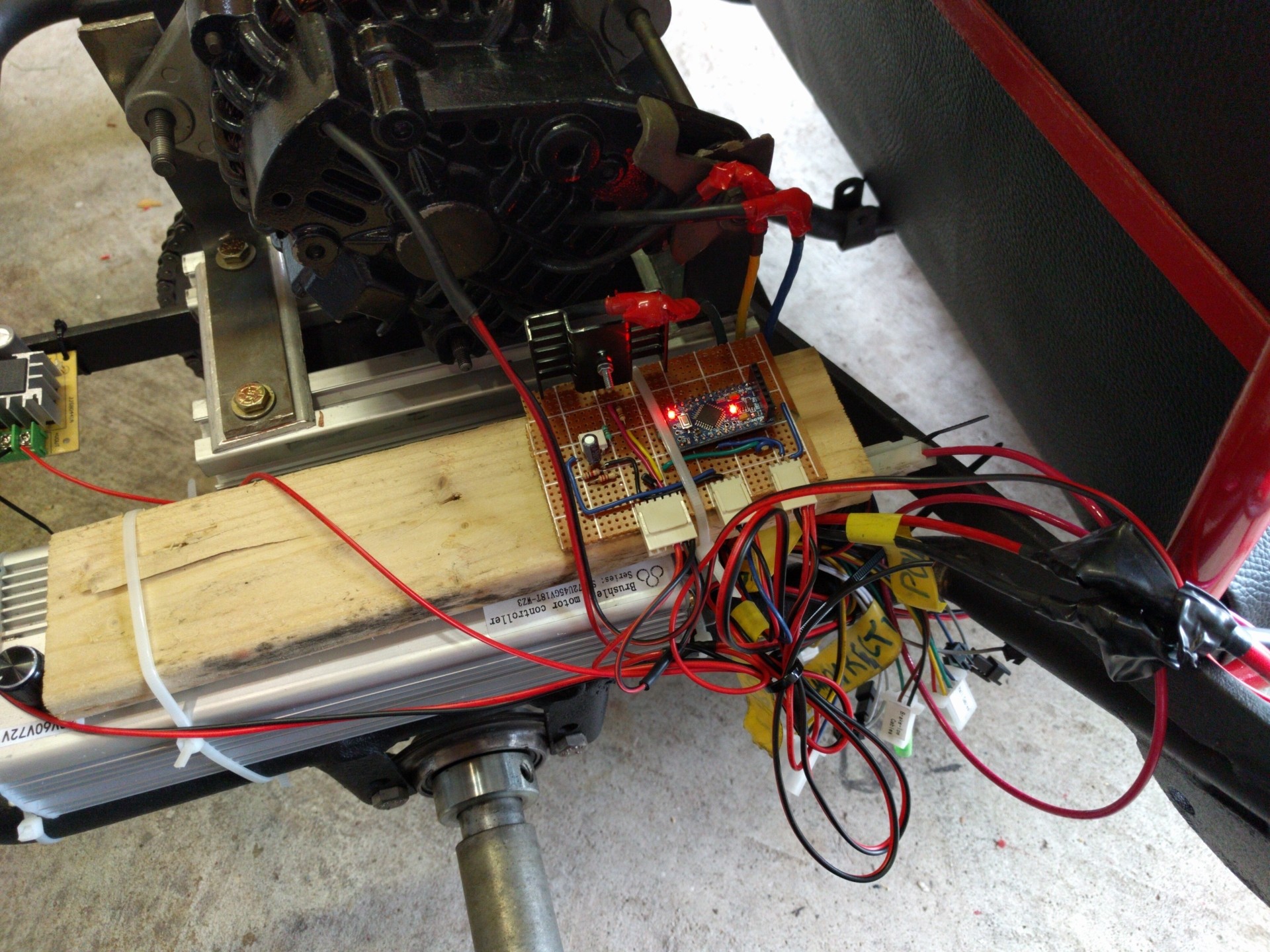
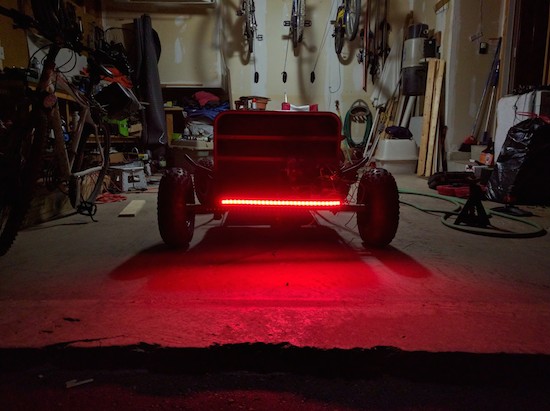
While the frame for [Adrian Georgescu] and [Masoud Johnson]’s build was a second-hand find, the powertrain is all custom. They targeted a power output of 3 kW but found no affordable motors in that range. So, in true hacker fashion, they rolled their own motor from a used Subaru alternator. The three-phase motor controller came from an electric scooter, three LiPo packs provide the juice, and a pair of Arduinos takes care of throttle control, speed sensing, and sending data to the virtual dashboard on an Android phone. Some lights and a snappy red and black paint job finished off the build. While the video below shows that the acceleration isn’t exactly neck-snapping in the Tesla style, the e-kart can build up to a good speed – 53 km/h. Not too shabby, and no deafening engine right behind your head.

If you’ve got the e-kart bug, best check out some of our previous posts, like this kart built from off-the-shelf components, or this four-wheel-drive mini-kart. Any way you build it, you’ll rule the cul-de-sac.


Filed under: transportation hacks

These Arduino bots move plants to sunny and shady spots

What do you do when you want your plants to grow but you lack a green thumb? Give them wheels and the ability to seek out sunny and shady spots on their own. This was media artist Kathleen McDermott has done.

The aptly named Sunbot and Shadebot are robots that help houseplants tour the outside world. Sunbot uses photocell (light) sensors to look for sunny places to rest, while Shadebot employs the same sensors to locate shadowy spots.

Both platforms are made out of a recycled fan case and wood, along with an Arduino, DC motors, rechargeable batteries and solar panels.

See them in action below!

Arduino Blog 12 Aug 21:21

Build a simple VU meter with an Arduino Uno and LEDs

If you’ve been looking for a simple audio Arduino project, you may want to check out this VU meter from YouTuber RZtronix. The Maker built the device using an Uno along with some LEDs, a couple wires, a breadboard, a sound sensor, and a 5V power supply.

Maker Spotlight: Miriam Langer

Miriam, a Professor of Media Arts & Technology, started using Arduino in 2008 to bring new possibilities to her interactive exhibits.

Read more on MAKE

The post Maker Spotlight: Miriam Langer appeared first on Make: DIY Projects and Ideas for Makers.

Throwback: Machine pours a drink every time the U.S. wins a medal

What do you get when you combine the Olympics, alcohol, and Arduino? An awesome machine that automatically pours a shot whenever your country wins a medal. Although a throwback, we can’t see why this project can’t be replicated for Rio!

It all began four years ago when a bunch of Makers were given early access to the SmartThings platform. To coincide with the London 2012 Summer Games, the team developed a device that would celebrate a U.S. victory by dispensing one of three different drinks–Goldschläger for gold, Jose Cuervo for silver, and Jack Daniels for bronze–while waving the American flag, turning on a strobe light, and playing the national anthem.

An Arduino is connected to a SparkFun XBee shield and the ZigBee network links it to the SmartThings platform online. The Arduino controls the servos responsible for releasing the liquid into the glass, and the relays that switch the power strip on/off for the party effects. Of course, you can always just pour a drink manually by selecting the appropriate medal on the accompanying SmartThings Medal app.

With the 2016 Games now underway, check out the entire build below to help get you started on a machine of your own!


Arduino Blog 11 Aug 21:43

Pimoroni Wash Their Hands Of Arduino

One of the big stories of last year was the fracture of the official Arduino supply into two competing organisations at daggers drawn, each headed by a different faction with its origins in the team that gave us the popular single board computers. Since then we’ve had Arduinos from Arduino LLC (the [Massimo] Arduino.cc, arguably the ‘original’, and Arduino trademark holder in the United States) and Arduino SRL (the [Musto] Arduino.org, and owner of the Arduino trademark everywhere except the US) , two websites, two forks of the IDE, and “real” Arduino boards available under a couple of names depending on where in the world you live due to a flurry of legal manoeuvres. Yes. it’s confusing.

Today came news of a supplier throwing its hands up in despair  at the demands imposed on them as part of this debacle. Pimoroni, famous as supplier of Raspberry Pi goodies, has put up a blog post explaining why they will henceforth no longer be selling Arduinos. They took the side of Arduino LLC, and the blog post details their extensive trials and delays in making contact with the company before eventually being told they would have to agree to purchase substantial stocks both Arduino and Genuino branded versions of identical products and agree to sell them through separate supply channels for both Europe and the rest of the world before they could proceed. This is not a practical proposition for a small company, and the Pimoroni people deliver a very pithy explanation of exactly why towards the bottom of their post.

We’ve covered the Arduino versus Arduino debacle extensively in the past, this is simply the latest in a long line of stories. Pimoroni have hit the nail on the head when they make the point that the customers and suppliers really don’t care about spats between the various inheritors of the Arduino legacy, they just want an Arduino. And with so many other Arduino-compatible boards available they don’t have to look very hard to find one if the right shade of blue solder-resist or the shape of the map of Italy on the back isn’t a special concern. Can we be the only ones wishing something like this might knock a bit of sense into the various parties?


Filed under: Arduino Hacks, news
Hack a Day 11 Aug 21:00

Fun Audio Waveform Generator Is More Than The Sum Of Its Parts

[Joekutz] wanted to re-build an audio-rate function generator project that he found over on Instructables. By itself, the project is very simple: it’s an 8-bit resistor-ladder DAC, a nice enclosure, and the rest is firmware.

[Joekutz] decided this wasn’t enough. He needed an LCD display, a speaker, and one-hertz precision. The LCD display alone is an insane hack. He reverse-engineers a calculator simply to use the display. But instead of mapping each key on the calculator and typing each number in directly, he only taps the four 1, +, =, and clear keys. He can then enter arbitrary numbers by typing in the right number of ones and adding them up. 345 = 111 + 111 + 111 + 11 + 1. In his video, embedded below, he describes this as a “rather stupid” idea. We think it’s hilarious.

The meat of the project is the Arduino-based waveform generator, though. In the second video below, [joekutz] walks through the firmware in detail. If you’d like a simple introduction to DDS, check it out (or read up our more in-depth version).

He also makes custom detents for his potentiometers so that he can enter precise numerical values. These consist of special knobs and spring-clips that work together to turn a normal pot into a rough 8-way (or whatever) switch. Very cool.

So even if you don’t need an R-2R DAC based waveform generator, go check this project out. There’s good ideas at every turn.


Filed under: Arduino Hacks

Control an LED display with your electric guitar!

Have you ever wanted to have a light show that reacts to what you play through you’re favorite electric instrument? Georgia Tech grad student Wil Roberts has, and so he created a guitar-controlled LED display–an impressive project that combines both his Maker and musical chops.

To accomplish this, Roberts used an Arduino Uno along with an Adafruit 16×32 RGB LED matrix panel that responds to the guitar’s signal. The bottom rows are always blue, while the top ones progress from green to red the louder he shreds. The top rows remain red depending on the length of the note being played.

Want one of your own? Roberts has made all of the display’s circuitry and code available on Instructables. In the meantime, be sure to see it in action below!

Star Track: A Lesson in Positional Astronomy With Lasers

[gocivici] threatened us with a tutorial on positional astronomy when we started reading his tutorial on a Arduino Powered Star Pointer and he delivered. We’d pick him to help us take the One Ring to Mordor; we’d never get lost and his threat-delivery-rate makes him less likely to pull a Boromir.

As we mentioned he starts off with a really succinct and well written tutorial on celestial coordinates that antiquity would have killed to have. If we were writing a bit of code to do our own positional astronomy system, this is the tab we’d have open. Incidentally, that’s exactly what he encourages those who have followed the tutorial to do.

The star pointer itself is a high powered green laser pointer (battery powered), 3D printed parts, and an amalgam of fourteen dollars of Chinese tech cruft. The project uses two Arduino clones to process serial commands and manage two 28byj-48 stepper motors. The 2nd Arduino clone was purely to supplement the digital pins of the first; we paused a bit at that, but then we realized that import arduinos have gotten so cheap they probably are more affordable than an I2C breakout board or stepper driver these days. The body was designed with a mixture of Tinkercad and something we’d not heard of, OpenJsCAD.

Once it’s all assembled and tested the only thing left to do is go outside with your contraption. After making sure that you’ve followed all the local regulations for not pointing lasers at airplanes, point the laser at the north star. After that you can plug in any star coordinate and the laser will swing towards it and track its location in the sky. Pretty cool.


Filed under: Arduino Hacks, cnc hacks, news, solar hacks

This LED skirt will take your outfit to infinity and beyond

Redditor SexyCyborg–who you may recall from her Hikaru Skirt last year–is back with another Arduino-driven, open-source wearable project. Inspired by traditional Chinese armor, the aptly named Infinity Skirt features an array of LED-lit mirror tiles that together form a flexible, reconfigurable matrix. Safe to say, she’ll certainly turn some heads at this October’s Maker Faire Shenzhen.

Every tile measures 66mm on each edge, and has four magnetic electrical conductors that can link it to it’s neighboring tile. So long as each row and column gets power, there is endless variations that can be tried. With an Arduino and LED matrix controller, each individual tile can be controlled so complex patterns can play across the surface. This is just a first prototype though so all the lights get power continuously and there is no matrix control.

You can find more pictures of her build on Imgur, download all the skirt’s 3D files on Thingiverse, as well as read Adafruit’s original article here.