Posts with «arduino» label

Galaga revived as a 4/5 scale MAME machine
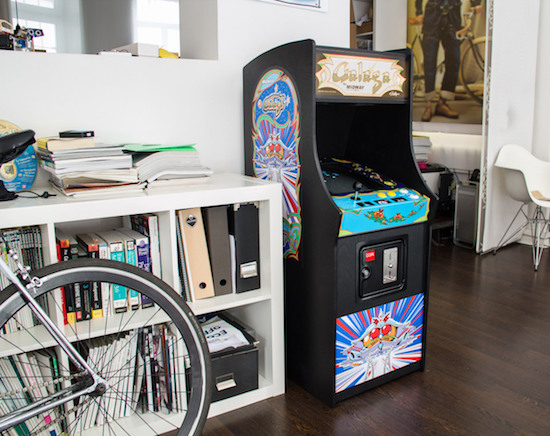
This arcade machine helps creator Alex Weber relive arcade memories, but is slightly easier to move than a full-sized “cab!”

Galaga is one of Weber’s–and many others’–top five arcade games. Easy to learn, but difficult to master, it was just asking to accept your money and time! Now though, using a Raspberry Pi and MAME software, you can have this and other old-school games at your disposal. Weber built a cabinet for this purpose around an old CRT television slightly smaller than original size.

In order to keep from having to fool with the TV every time it switched on, he made an automated remote control with an Arduino and IR LED that sends signals to turn it on and switches the TV to AV mode.

I have a soft spot for 8-bit arcades… I saw these for the first time. At least it felt like that. All machines where running. All coin doors were open! Somebody saw me standing in front of them with huge eyes and showed me how to trigger the switch to get credits for free. BAM! I was hooked.

You can see the full build on Weber’s tinkerlog site as well as Hackaday’s writeup here.
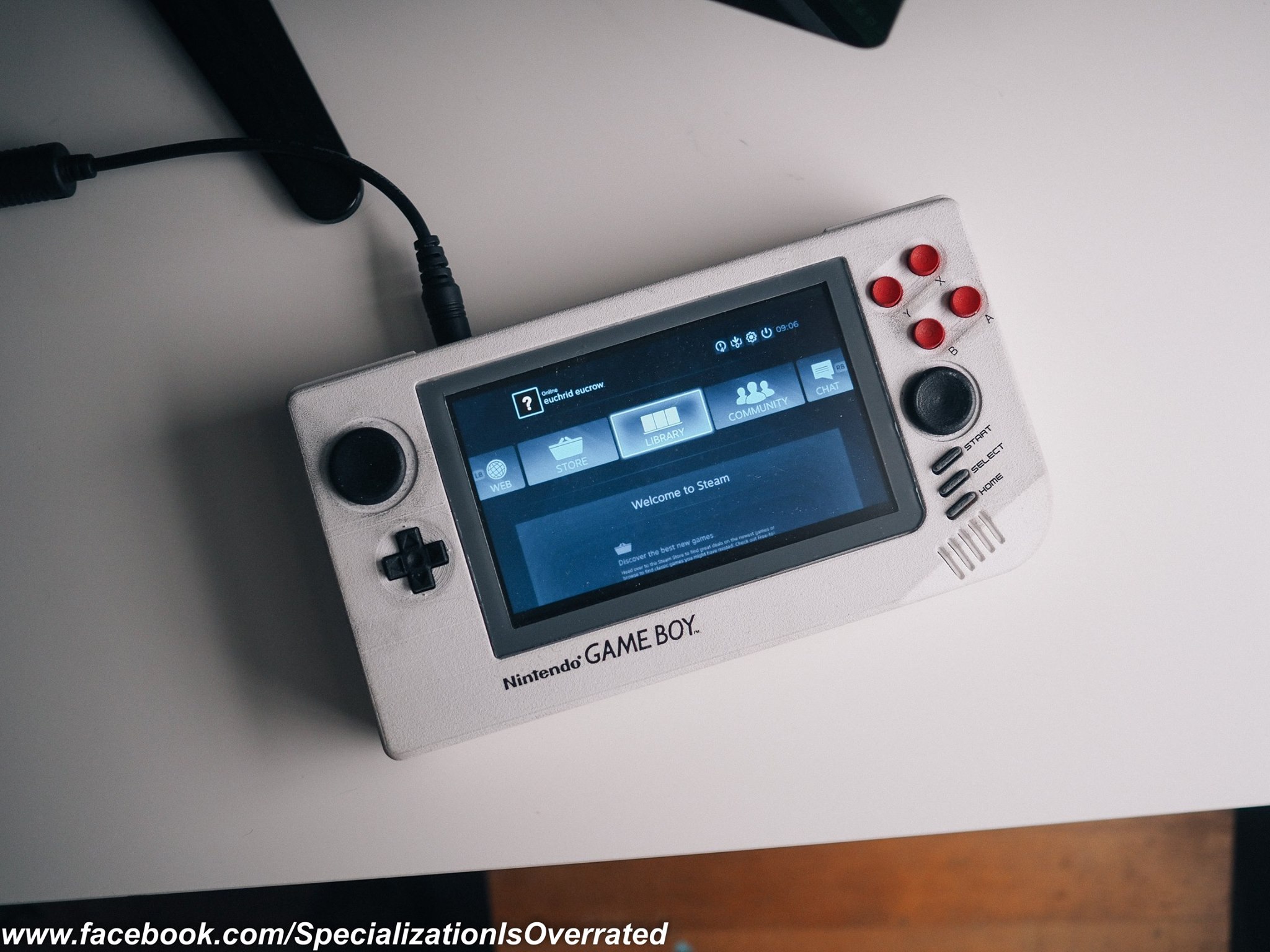
A 3D-printed reimagined Game Boy prototype

With a shape reminiscent of a Game Gear, revised controls and hardware, Anthony Campusano’s rig looks extremely fun!

As reported on 3DPrint.com, Campusano’s Game Boy-inspired prototype was quite the crowd-pleaser at World Maker Faire in New York. Although wider than it is tall (like most portables to follow), and with many more buttons, this handheld console still screams “original Game Boy.” Perhaps this is because of its color scheme, or even the angle of the buttons.

Hardware consists of several platforms, including an Arduino to handle tasks such as status lights and battery level. The idea was inspired by Florian Renner’s similar concept, though he replaces the ideal of separate game cartridges with an SD card for storage.

I’m a trained architect, though I have industrial designer envy. In terms of electronics, I’m self-taught. When it comes to machine specs, the handheld is based on an Intel Core M. Controls are Teensy-based, and the status lights and battery level, etc. are run from an Arduino. Estimated battery life is about 3hrs +/- depending on the game.

You can see more photos of Campusano’s project on his Facebook page, and read all about it on 3DPrint.com.

Keep your cat entertained with an automated laser tower

As any cat owner can tell you, our feline friends love chasing the uncatchable dot of a laser pointer. Unfortunately, though, there is only so much time in the day that you can spend playing with them and catering to their natural instincts… so why not automate the process?

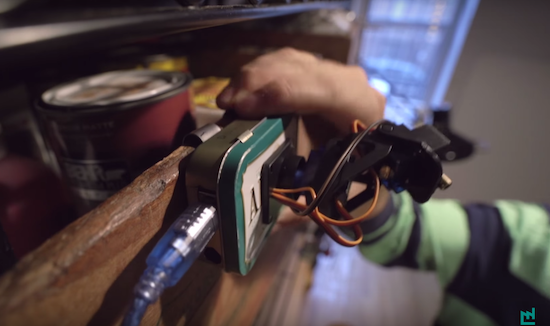
This is exactly what La Fabrique DIY decided to do using an Arduino Uno, two servos, a pan/tilt camera mount, and an Altoids tin to house the electronics. With some programming, the tower moves the laser “pseudo-randomly” to mimic the behavior of an insect.

So if you, like La Fabrique DIY, have a cat in a small apartment with not much room to hunt, head over to the project’s Imgur page to start building a distraction device for yourself!

Hackaday Prize Entry: Head-up For High Voltage

[Alain Mauer] wanted to build something like a Google Glass setup using a small OLED screen. A 0.96 inch display was too large, but a 0.66 inch one worked well. Combining an Arduino, a Bluetooth module, and battery, and some optics, he built glasses that will show the readout from a multimeter.

You’d think it was simple to pull this off, but it isn’t for a few reasons as [Alain] discovered. The device cost about 70 Euro and you can see a video of the result, below.

The video shows a common problem and its solution. You are probing a mains circuit and have to look away to read the voltmeter. With the glasses, you don’t have to look away, the voltage floats in your field of vision.

These reminded us of Pedosaglass which we covered earlier. Of course, it used a different optical solution. We’ve also seen Google Glass knockoffs as part of our Hackaday prize entries.


Filed under: Arduino Hacks, The Hackaday Prize, wearable hacks

A sheet metal Arduino MP3 alarm clock

Wake up to your favorite tunes using this beautiful sheet metal alarm clock!

If you need to get up for work, class, or simply to avoid wasting the day away, setting an alarm is the obvious solution. Sure, you could buy a clock or just use your phone, but if you build Dejan Nedelkovski’s Arduino-based device, you can be reminded of your awesome Maker skills every morning.

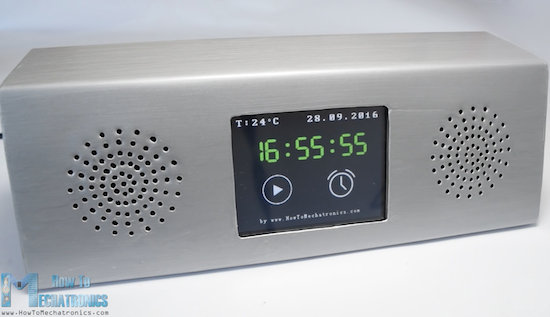
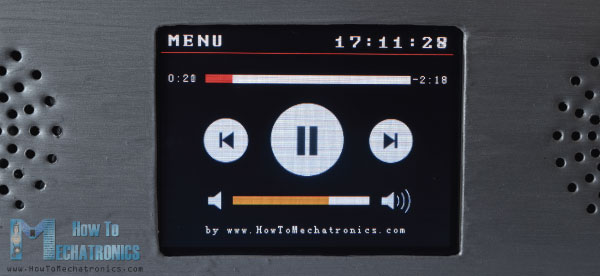
The clock is equipped with an Arduino Mega, an MP3, and an RTC module to play music and display the time and current song on a nice 3.2-inch touchscreen. The case, which was designed in SolidWorks, is made out of aluminum sheet metal. Considering that he used an improvised bender and hot glue to put it together, the results look fantastic!

In this project, I will show you how you can make an Arduino touchscreen MP3 music player and alarm clock. The home screen features a big clock, date and temperature information, as well as two buttons…

Want one of your own? Check out Nedelkovski’s “How to Mechatronics” website for code, schematics, and even a 3D model of the alarm itself.

Build your own electronic drum kit using an Arduino Mega

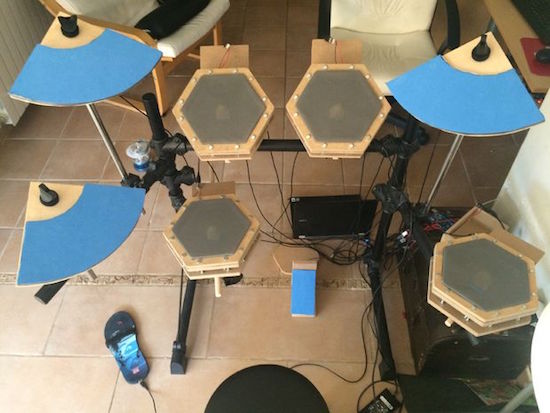
If you’d like to save some money on a drum kit, this one is made using an Arduino Mega, MDF, and even a left sandal!

Drum kits can be quite expensive, Maker Victor Herrero has created his own nine-piece set with readily-accessible components. Arduino code was modified from another project by Evan Kale, and is available for download. Although electronics is discussed, the Instructables article focuses on how to physically make the set, mostly out of MDF.

The results are something that looks quite different than a “normal” drum set, with hexagonal drum pads and a flip-flop for hi-hat control! You can find the project on Instructables here, and the code that you’ll need on its GitHub page.

An electro-mechanical drawing machine driven by music

We’ve been waiting to see what ::vtol:: (a.k.a. Dmitry Morozov) would come up with the next! The Moscow-based hacker artist has now created an electro-mechanical drawing machine.

The Electropollock, which pays homage to influential American painter Jackson Pollock, is driven by the sound of music. A special algorithm analyzes the tunes and then controls the electric valves, servo motors with brushes, and the special fan intended for spray painting. The intensity of ink supply, the rate of the moving paper, and the activity of the brushes all depend on the frequency and amplitude of the peaks in the music.

The machine features an old printer mechanism, an Arduino Uno, and is programmed using Pure Data. You can see how it works in the video below!

Deltu is a gaming robot with a personality

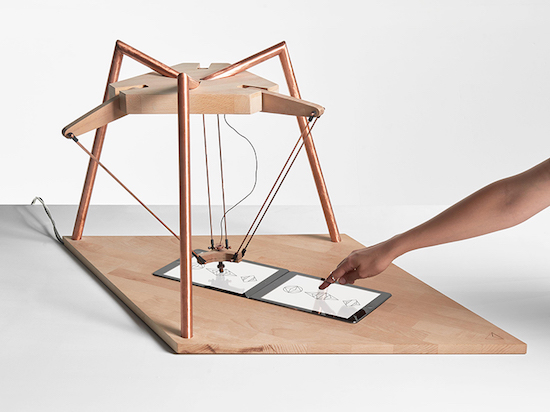
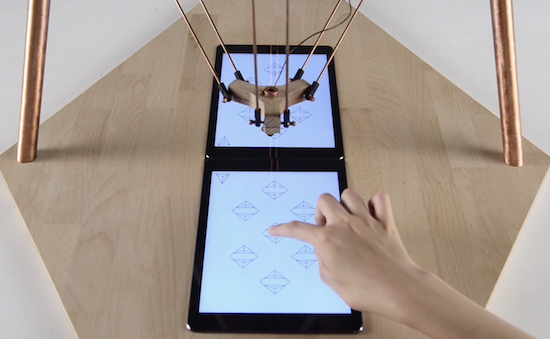
Interactive designer Alexia Léchot has built a delta robot with a ‘personality’ that interacts with humans through iPads. Deltu uses three moving arms, a couple Unity3d applications, and Arduino to play simple mimicking games.

According to Creative Applications:

The system uses two Unity3d applications where the application of the human sends HTTP request to the computer. There is also a Python server that sends the string through the serial to the Arduino which controls the robot.

The other player must precisely copy Deltu’s movements because it “is very demanding.” If not, it might change its mind and will shake its arms in a side-to-side motion that appears to simulate frustration. From there, Deltu leaves the game and opens the camera app instead, snapping selfies and posting them to Instagram.

As you can see in the video below, the robot even takes a few moments to browse the social network’s explore section and follow a new account, as well as choose some tunes on SoundCloud.

Depending on its mood, it plays with the user who is faced with an artificial intelligence simulation, who appreciates the small pleasures of life, sometimes too much. The relationship we have with robots/AI that have been created to enhance our performance, but have become a source of learning, is unique and exciting. The android’s place in ociety has not yet been defined and remains to be determined; for me it is the best source of inspiration.

Intrigued? You can see Deltu in action below, and read more about the project on the Daily Mail.

Arduino Blog 04 Oct 14:40

Hacking a Nokia Phone into a New Smartwatch

Daniel Davis wanted to see if he could turn his "dumb" nokia phone and turn it into a smartwatch.

Read more on MAKE

The post Hacking a Nokia Phone into a New Smartwatch appeared first on Make: DIY Projects and Ideas for Makers.

MAKE » Arduino 03 Oct 13:30

Arduino Vs. Arduino: Arduino Won

For the last two years, Arduino LLC (the arduino.cc, Massimo one) and Arduino SRL (the arduino.org, Musto one) have been locked in battle over the ownership of the Arduino trademark. That fight is finally over. Announced at the New York Maker Faire today, “Arduino” will now to Arduino Holding, the single point of distribution for new products, and a non-profit Arduino Foundation, responsible for the community and Arduino IDE.

Since early 2015, Arduino — not the Arduino community, but the organization known as Arduino — has been split in half. Arduino LLC sued Arduino SRL for trademark infringement. The case began when Arduino SRL, formerly Smart Projects SRL and manufacturers of the Arduino boards with a tiny map of Italy on the silk screen, began selling under the Arduino name. Arduino LLC, on the other hand, wanted to internationalize the brand and license production to other manufacturers.

While Arduino and Arduino have been tied up in court for the last few years, from the outside this has look like nothing else but petty bickering. Arduino SRL forked the Arduino IDE and bumped up the version number. Later, an update from SRL was pushed out to Amazon buyers telling them Arduino.org was the real Arduino. Resellers were in a tizzy, and for a time Maker Faires had two gigantic Arduino booths. No one knew what was going on.

All of this is now behind us. The open source hardware community’s greatest source of drama is now over.

I spoke with Massimo after the announcement, and although the groundwork is laid out, the specifics aren’t ready to be disclosed yet. There’s still a lot to work out, like what to do with the Arduino.org Github repo, which TLD will be used (we’re rooting for .org), support for the multitude of slightly different products released from both camps over the years, and finer points that aren’t publicly visible. In a few months, probably before the end of the year, we’ll get all the answers to this. Now, though, the Arduino wars are over. Arduino is dead, long live Arduino.


Filed under: Arduino Hacks, news