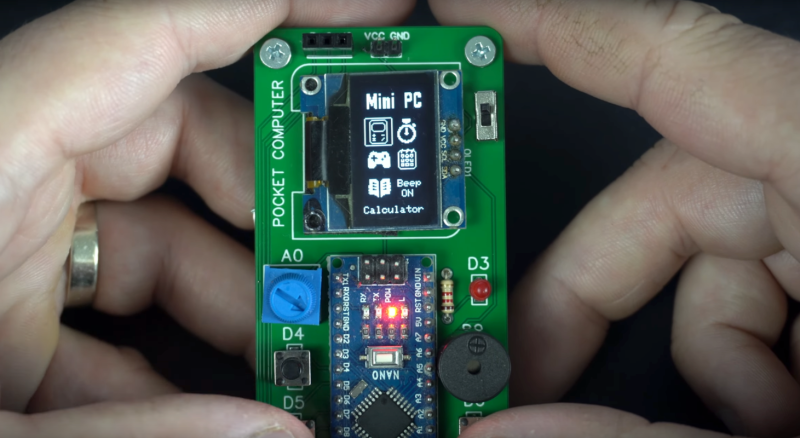
Before smartphones exploded on the scene in the late 00s, there was still a reasonable demand for pocket-sized computers that could do relatively simple computing tasks. Palm Pilots and other PDAs (Personal Digital Assistants) were all the rage in the ’90s and early ’00s, although for cutting-edge tech from that era plenty of these devices had astronomical price tags. This Arduino-based PDA hearkens back to that era, albeit with a much more accessible parts list.
The build is based around an Arudino Nano with an OLED screen and has the five necessary functions for a PDA: calculator, stopwatch, games, phonebook, and a calendar. With all of these components on such a small microcontroller, memory quickly became an issue when using the default libraries. [Danko] uses his own custom libraries in order to make the best use of memory which are all available on the project’s GitHub page. The build also includes a custom PCB to keep the entire pocket computer pocket-sized.
There are some other features packed into this tiny build as well, like the breakout game that can be played with a potentiometer. It’s an impressive build that makes as much use of the microcontroller’s capabilities as is possible, and if you enjoy projects where a microcontroller is used as if it is a PC take a look at this Arduino build with its own command-line interface.
The much-delayed remaster of the classic Blade Runner adventure game is finally here. As Polygonreports, Nightdive Studios has released Blade Runner: Enhanced Edition for Windows PCs (via Steam) as well as PlayStation, Switch and Xbox consoles. The modernized version runs at 60 frames per second instead of the original's 15FPS, complete with updated animations and models. Improved in-game tools help you work with clues as you track down hostile replicants, and gamepad support is available on all platforms.
Westwood's 1997 game pushed the boundaries of both gameplay and graphics at the time. Instead of the usual fixed plot, Blade Runner changed the replicant with each playthrough while offering branching storylines, different outcomes and characters that operate on their own timetables. You couldn't just cut to the chase and 'retire' the android at the start. And instead of relying on either 2D art or crude 3D, the title used voxels (pixels with 3D attributes) that allowed far more visual detail for the era, including volumetric lighting that mimicked the Ridley Scott movie's gritty atmosphere.
You'll still notice the limitations from 25 years ago. This won't control as elegantly as present-day games, and Westwood's budget limited it to only some voices from the movie cast (including Sean Young and James Hong) and recreated music from Vangelis' score. Even so, this remains the closest you'll get to filling Deckard's shoes in a game while preserving the 1982 film's atmosphere.
A Plague Tale: Requiem — the sequel to the 2019 game that features a pair of siblings fleeing Spanish Inquisition soldiers (as well as plague-ridden rats) — will arrive on October 18th. Publisher Focus Entertainment and developer Asobo released a lengthy trailer today that features over ten minutes of gameplay through the brutal world of a war-torn France from several centuries ago. Siblings Amicia and Hugo are now a few years older and more skilled at getting out of tough scrapes. The game follows the pair as they fight their way through mercenary bands, ambushes, murderous soldiers and disease-ridden rodents.
Xbox Gamepass subscribers should note that the game will be available on the service on the same day of its launch, a nice perk that Microsoft continues to do with more titles (Asobo is also the developer of Microsoft Flight Simulator, which is also on Game Pass). Nintendo Switch owners can also look forward to a cloud version of Requiem. And of course, the game will be available for purchase on Xbox Series X/S, PS5 and PCs.
In a blog post, the game’s lead writer Sébastien Renard shed more light on what fans can expect in the sequel. Hugo, the younger sibling, has magical powers that are developing throughout the game and the elder sister Amica has honed her fighting skills. But even greater and more daunting obstacles lay ahead for the pair. “Our heroes will face their inner conflicts together with external ones. To begin with, they will discover a new part of France, Provence, which will offer new sights and sensations, leading them to believe in a kind of paradise. Unfortunately, the harsh medieval reality inevitably catches up, and their hopes vanish before they can get too comfortable,” wrote Renard.
You can get a closer look at Requiem in the trailer below.
Toyota's US launch of the unpronounceable bZ4X EV is off to a rough start with the automaker announcing on Thursday a broad recall of the vehicle barely two months after its debut, due to a potentially deadly situation that could lead to the vehicle's wheels separating while driving at speed.
Some 2,700 of the electric crossovers are subject to the recall — 2,000 destined for the European market, 260 to the US, 110 to Japan and 20 to Canada. The company implores owners to park their vehicles immediately and not resume driving them until a more "permanent" solution can be devised.
"No one should drive these vehicles until the remedy is performed," Toyota said in the Thursday notice. "After low-mileage use, all of the hub bolts on the wheel can loosen to the point where the wheel can detach from the vehicle. If a wheel detaches from the vehicle while driving, it could result in a loss of vehicle control, increasing the risk of a crash. The cause of the issue and the driving patterns under which this issue could occur are still under investigation."
Subaru has issued a similar recall for about 2,600 Solterra EVs. These EVs are functionally identical to the bZ4X and are produced on the same lines at Toyota's Motomachi facility. There's no word yet on when Toyota engineers might have a solution for the issue.
Many medical exosuits are built to improve walking, but researchers at ETH Zurich might have a solution to improve your arm strength. They've developed the Myoshirt, a wearable arm exomuscle that can compensate for conditions and injuries affecting the upper body. The combination of vest and cuff uses sensors to detect your intended movements and cue a motor that shortens a cable running alongside your muscles. Effectively, you're getting a supplemental tendon that provides additional power and endurance for whatever you're doing.
Early tests have been positive. A dozen volunteers could perform exercises for much longer than usual, with endurance increasing 60 percent for a person with muscular dystrophy and a whopping three times for someone with a spinal cord injury. Even uninjured people lasted 30 percent longer, scientists said.
You aren't about to wear one. The Myoshirt's actuator and bulky external control box weigh about 8.8lbs. The team plans to narrow the focus to shoulder support to make the design small and light enough to wear under clothing. This won't give you exceptional strength or support like some full-fledged exoskeletons.
ETH is working with the spinoff company MyoSwiss to refine the exomuscle, though, and the practical applications are clear. Hospitals could supply Myoshirts to patients who need to perform exercises at home without ungainly (not to mention costly) therapy devices. The technology could also be useful for making day-to-day tasks noticeably easier.
If you visited arcades in the late ‘80s or early ‘90s, you surely remember the golden age of beat-em-up games. Cabinets like Teenage Mutant Ninja Turtles, The Simpsons, X-Men and more followed a fairly simple formula: take a popular franchise and have its characters cut through swaths of bad guys, throw in some environmental challenges to keep the levels from getting too repetitive, and top it off with a big boss battle at the end. But the real draw was multiplayer — these games let four or even six friends (or strangers) play simultaneously, a totally chaotic but thrilling shared experience.
Given the popularity of the TMNT franchise, it’s no surprise that both the original arcade game and its sequel Teenage Mutant Ninja Turtles: Turtles in Time were both ported to the NES and SNES, respectively. As a pre-teen, my best friend and I spent untold hours playing these ports, as well as the arcade games on the too-rare occasions that we could get to the mall.
I clearly have a lot of nostalgia for these games, and I’m not alone. Last year, developer Tribute Games announced Teenage Mutant Ninja Turtles: Shredder’s Revenge, a brand-new beat-em-up title inspired by the arcade games of yesteryear. The game features retro pixel-art, two different game modes, online and local multiplayer (up to six players online), and seven playable characters, including the four turtles, Master Splinter, April O’Neil and Casey Jones. On the surface, it seems to have everything you could ask for in a modern version of an arcade classic, and Tribute’s comments prior to the game’s release showed a deep love for the source material.
After a week playing Shredder’s Revenge on the Xbox Series S, PlayStation 5 and Nintendo Switch, I can confirm that Tribute absolutely nailed its mission of bringing the classic TMNT experience into the modern era. It all starts with the art style and music, both of which are spot-on for this franchise; it feels like a natural evolution of the original two arcade games, both of which were largely based on the 1987 cartoon (rather than the comic books, live-action films, or more recent animated shows). The music immediately sets the tone – the score by Tee Lopes immediately brings to mind classic 16-bit tunes, Mike Patton performs the opening theme, and Raekwon and Ghostface Killah contribute as well. While the music isn’t quite as compelling as the soundtrack from Turtles in Time (which is an absolute banger), it evokes the essential mood of playing in an arcade with your friends in the early ‘90s.
The gameplay essentials from earlier games are all intact here — each playable character has different strengths and weaknesses like range and speed, but they’re not so different that you’ll feel thrown by switching players. The core gameplay is still mostly accomplished with two buttons: attack and jump.
Tribute
But, there are a lot more moves than in earlier games, including a variety of throws, slides, aerial attacks and dodges. Dashing lets you pull off different slide and charge attacks, you can grab enemies and throw them right towards the TV screen (just like you do in Turtles in Time), there’s a dodge button that lets you dance out of trouble and there are a host of different aerial moves. And unlike older games, Shredder’s Revenge has unique animations for every move each character in the game can pull off. Even though gameplay between each character isn’t radically different, the distinct visuals for all four turtles and their friends keeps things looking fresh.
As with any good beat-‘em-up, each character has their own special move, too. Unlike in old arcade games, where using a special would usually take a chunk out of your health, these moves are tied to a power bar that fills up as you string together longer and longer hit combos. When it’s full, you can unleash a special move or save it for later use. It’s a good way to make it so players can’t just use special attacks constantly and adds a bit of strategy to the otherwise chaotic melee.
Another way Tribute makes Shredder’s Revenge feel more modern is the game’s story mode. You’ll be able to level up your character over time, which unlocks more health, extra lives and new special attacks. You’ll also eventually get the ability to stack multiple special moves — when you fill up your bar and bank one move, you can keep filling it up and hold two and eventually three in reserve — or you can blow all three at once in a frenzied super-attack. Story mode also lets you re-enter levels to find hidden items or meet the achievement goals for each stage (things like take out 10 enemies with a special attack, or make it through without taking damage). And you can switch your character between levels, rather than stay locked to one turtle for the entire game.
Arcade mode, on the other hand, is for old-school fans who want a tougher challenge. The game is simple: pick a character, and fight through all of the game’s dozen-plus levels before you run out of lives and continues. You get the advantage of having your health bar extended to its max capacity and all your special moves are unlocked — but given the number of stages in this game, it won’t be easy, especially on the intense “gnarly” difficulty level.
Tribute
This all makes for a fun single-player experience, but — just like the arcade games from the ‘90s — Shredder’s Revenge really shines in multiplayer mode. You can have up to four player on local co-op, or an insane six-players online. It’s a glorious amount of chaos, but it’s managed surprisingly well. The game scales up in difficulty depending on how many people you’re playing with; that usually just amounts to more enemies and bosses that can take more damage.
Unfortunately, cross-play isn’t supported for now — Xbox and PC players can team up, but PlayStation and Switch players will need to play the same version as their friends if they want to work together. The good news is that it’s also not hard to get a game going with strangers. It’s not quite as much fun as playing with people you know, but the game definitely feels more alive when you have at least a pair taking on Shredder and the Foot clan.
This all adds up to a game that’s a lot more fun to play than even I expected. Nostalgia goes a long way, but Shredder’s Revenge manages to work as a love letter to games of the past while still feeling fresh. There’s just something incredibly satisfying about teaming up with a few friends and mowing down a never-ending swarm of enemies; that was true in the ‘90s, and it’s still true today.
Of course, it helps if you have some affection for the TMNT franchise, but even if you don’t, the tight gameplay, addictive soundtrack and great co-op features should be enough to enjoy Shredder’s Revenge. And if you grew up playing the arcade games or their home console counterparts, this new adventure is a must-play. That’s especially true if you have friends to play it with, either IRL or online.
Netflix has laid off around 300 people in its latest round of job cuts. Most of the layoffs were in the US, according to Variety, and a number of departments were affected.
“Today we sadly let go of around 300 employees,” a Netflix spokesperson told the publication. “While we continue to invest significantly in the business, we made these adjustments so that our costs are growing in line with our slower revenue growth. We are so grateful for everything they have done for Netflix and are working hard to support them through this difficult transition.”
Netflix laid off 150 employees, along with many part-time workers and contractors, back in May. It also let go 10 or so staffers from its in-house news site, Tudum, in April. The company has around 11,000 employees around the globe.
The layoffs follow a steep drop in Netflix’s share price, which has fallen by around 70 percent since the beginning of the year. In the first quarter of 2022, the company’s subscriber count dropped for the first time. It fell by 200,000, in large part because Netflix pulled out of Russia and lost 700,000 subscribers there. In its latest earnings report, Netflix said it expects to lose as many as 2 million subscribers in the current quarter too.
Along with cost cutting, Netflix is looking at more ways of generating revenue. These include ad-supported plans and extra fees for those who share their accounts with people living in other households.
The company still plans to invest heavily into content, though. It has earmarked around $17 billion for that purpose this year. News of the layoffs comes the week after Netflix announced a reality competition series based on its all-conquering drama,Squid Game. The winner will take away $4.56 million.
Google is rolling out Chrome OS version 103, which includes features that will make it easier for users to share things between Chromebooks and Android devices. For one thing, as the company announced at CES, Phone Hub is getting an upgrade. From your Chromebook, you'll instantly be able to access the latest photos you took with your phone, even when you're offline.
When you take a picture with your phone, it will automatically show up in the Recent Photos section of Phone Hub (which allows you to control some of your mobile device's features from your laptop). You'll need to click on the image to download it, though it's a more elegant option than going to the Google Photos website or emailing yourself a photo.
Google
Also new is a way to get a Chromebook connected to the internet more quickly. If you're trying to link your laptop to a WiFi network that's already saved on your Android phone, you can use Nearby Share. Go to the WiFi network tab in the internet settings on your phone. After you select the Share option, you can tap the Nearby button and choose the Chromebook you want to get online. The Chromebook should then automatically gain access to the internet and save the login credentials.
In addition, Google revealed the Chrome OS Screencast app it announced earlier this month will start rolling out this week. You can use that to record, trim and transcribe video.
Later this summer, Chromebooks will gain fast pairing support for hundreds of Bluetooth headphone models including, of course, Pixel Buds. Fast Pair will save the headphones to your Google account, so both your Chromebook and Android phone can connect to them swiftly.
Google said it will roll out more features to make Chromebooks and Android devices play more nicely with each other later this year. The company is looking to take a page out of Apple's playbook with updates like these. Apple has long offered deep integration between its devices, including features such as WiFi password sharing and iCloud photo syncing, which helps it get people more invested in its ecosystem.
LG has finally released the 2022 soundbars it introduced in January, and it won't surprise you to hear that you'll pay a hefty price for the attention-getting flagship model. The 9.1.5-channel S95QR (pictured above) costs $1,799 (already on sale for $1,499 at Amazon and LG) and stands out with an up-firing center channel as well as similarly vertical wireless rear speakers. A subwoofer is included, too. In theory, you'll have a better "perspective" with Dolby Atmos and DTS:X audio as well as clearer dialog. You can also expect HDMI 2.1 passthrough (with variable refresh rate and auto low-latency mode for gamers) as well as larger woofers and greater distances between speakers than previous models.
You don't need to spend that much to get some of the benefits. The 3.1.3-channel S80QY ($899) and 5.1.3-channel S90QY ($1,199) also pack the upward-firing center speaker, and you can tack on a $200 SPQ8 kit if you want rear speakers. The $599, 3.1.2-channel S75Q is available if you're fine with a more conventional up-firing speaker layout, and you can pay a relatively modest $399 for the S65Q ($250 at Amazon and LG) if you're willing to skip vertical audio entirely.
Every soundbar offers Meridian Audio tuning, and most are compatible with Alexa and Google Assistant. WiFi-connected models (from the S80QY up) also support a Wowcast audio dongle that provides wireless uncompressed 7.1.4-channel sound.
These aren't the most affordable options at their official prices. On sale, though, they should compete well against some of the best soundbars in their respective categories. Just think carefully about the S95QR. While LG does have a center vertical speaker in its favor, Samsung's comparable HW-Q950A packs an 11.1.4-channel setup at a similar price.
If you store all your passwords on Chrome and use an iPhone, signing into your various accounts is about to get easier. The latest release of the browser for iOS (version M104) will bring the ability for you to set Chrome as your Autofill provider. It'll also add new "enhanced safe browsing" and Chrome Actions to the app on iPhones and iPads.
Many of this features are already available in the Android edition of Chrome, like the Password Manager, which uses data you've elected to store in the browser to sign into apps on your phone. Enhanced Safe Browsing, when activated on your iPhone or iPad, will check if websites you're visiting are dangerous. Also, "Chrome warns you if your username and password have been compromised in a third-party data breach" when you enter your credentials into a website. It'll then urge you to change them everywhere.
Something that's not yet available on Android is the first page when you re-open Chrome after awhile. According to Google's blog post, "We're making it easier for you to discover new content or start a fresh search in Chrome for iOS when you've been away for awhile." This is supposed to make "it easier to browse content, start a new Search or easily get back to your most frequently visited sites" while still letting you locate your recent tabs. Google added that this "will also come to Android soon."
Those who rely on Chrome's built-in translation tools might find the updated language identification model helpful. Google says this new on-device version will help you "accurately figure out the language of the page you're visiting, and whether it needs to be translated to match your preferences."
Meanwhile, Chrome Actions will make doing things like clearing your browsing data or opening an incognito tab easier on iOS. You won't have to go into the three-dot menu to hunt for those options anymore — you can just type a search term for the setting into the URL bar. "Delete history," for example, will bring you to the page to clear your browsing data. And if you were looking for info on that setting online, you'll still see the suggested search results below the suggested Action.
Finally, Google also tweaked the three-dot menu "to be scannable and to highlight the most important destinations, such as your history, passwords and settings. The company said "your most commonly used destinations will be available at the top of the menu" and actions like creating Bookmarks or adding stuff to Reading List will be located higher up in the vertical menu.