Former Twitter CEO Jack Dorsey says company-wide layoffs are his fault

Jack Dorsey says he can “understand” if current and former Twitter employees blame him for the state of the company under Elon Musk. The co-founder and former CEO of Twitter took to the platform on Saturday to say he was to blame for the situation. “Folks at Twitter past and present are strong and resilient. They will always find a way no matter how difficult the moment,” Dorsey said on Saturday. “I realize many are angry with me. I own the responsibility for why everyone is in this situation: I grew the company size too quickly. I apologize for that.”

Folks at Twitter past and present are strong and resilient. They will always find a way no matter how difficult the moment. I realize many are angry with me. I own the responsibility for why everyone is in this situation: I grew the company size too quickly. I apologize for that.

— jack (@jack) November 5, 2022

Dorsey went on to add he was grateful to everyone who had ever worked at Twitter. “I don’t expect that to be mutual in this moment… or ever… and I understand,” he wrote. Dorsey posted the apology after The New York Post published a story earlier in the day claiming he is now “hated at Twitter.” Many employees reportedly “blame” him for Musk’s takeover and the company-wide layoffs that will see about 50 percent of Twitter’s workforce cut.

The thread marks Dorsey’s first public comment on Twitter since Musk closed his $44 billion deal to buy the company on October 27th. When the SpaceX founder first announced the takeover, Dorsey put his support behind it. “Elon is the singular solution I trust,” he said at the time. “This is the right path… I believe it with all my heart.” Dorsey was quiet after Musk attempted to renege on the acquisition, but in texts that became public in September, it became clear that he had wanted Musk to take a more active role at Twitter for some time.
Twitter's $8 per month Blue subscription with paid account verification arrives on iOS

Twitter has begun rolling out support for the new, more expensive version of its Blue subscription. As of Saturday, the company’s iOS app now reflects the fact users can pay $8 per month to obtain a verified account. The changelog notes people who sign up for Twitter Blue will receive a checkmark, “just like the celebrities, companies, and politicians you already follow.”

Twitter shipped its new Blue subscription for verification ahead of Musk’s Monday deadline given to employees. I updated and verified accounts are now the first tab of notifications. pic.twitter.com/xfTl3b3GYk

— Alex Heath (@alexeheath) November 5, 2022

However, it looks like Twitter is still rolling out the necessary backend changes to support the change more broadly. There are reports of users not seeing a blue checkmark on their account even after signing up for the new subscription. Additionally, Twitter has yet to update its Android app, and the other perks Elon Musk promised would be part of the revamped Twitter Blue, such as the ability to post longer videos, are listed as “coming soon.” What the updated iOS app does include is a tweaked notification tab that features a column dedicated to displaying tweets solely from verified users.

It’s unclear when all the elements Musk promised will be in place, but he reportedly gave employees working on making verification a paid feature until November 7th to complete the work or else lose their jobs. On Friday, the company began laying off about 50 percent of its workforce, leaving entire teams gutted.

Ukraine lost access to 1,300 Starlink terminals over a funding issue

As recently as October 24th, Ukraine’s military suffered a partial internet outage after 1,300 Starlink terminals went offline due to a funding shortage, reports CNN. The blackout occurred amid ongoing talks between SpaceX and the Department of Defense that continue despite Elon Musk having said his company would continue to foot the bill for the country’s Starlink usage.

“Negotiations are very much underway. Everyone in our building knows we’re going to pay them,” a senior Pentagon official told the network, adding that the Defense Department wants to get something in writing “because we worry he’ll change his mind.”

In September, SpaceX sent a letter to the Pentagon, asking the Defense Department to take over paying expenses related to Ukraine’s usage of its Starlink internet service. On October 15th, following public outcry, Musk appeared to backtrack on the decision to ask the US government for assistance. “To hell with it… we’ll just keep funding Ukraine govt for free,” Musk tweeted, later telling The Financial Times the company would do so “indefinitely.”

According to CNN, last month’s outage was a “huge problem” for Ukraine’s military. In March, the country purchased the 1,300 terminals from a British company. SpaceX reportedly charged Ukraine $2,500 per month to keep each unit operational. The country eventually couldn’t afford to pay the $3.25 million monthly bill anymore and asked for financial aid from the British Ministry of Defence. After some discussion, the two agreed to prioritize other military expenses.

“We support a number of terminals that have a direct tactical utility for Ukraine’s military in repelling Russia’s invasion,” a British official told CNN. “We consider and prioritize all new requests in terms of the impact contributions would have in supporting Ukraine to defend its people against Putin’s deplorable invasion.”

Should SpaceX and the US Department of Defense eventually sign an agreement, it’s unclear if the Pentagon will have greater control over Starlink service in Ukraine. The company currently decides where Ukrainian troops can use the terminals.

Programming ATtiny85 using UNO R3 (By Ashish Choudary Dec 2020)

Programming ATtiny85 using UNO R3 (By Ashish Choudary Dec 2020) David Sat, 11/05/2022 - 22:39

First may I thank Ashish Choudary for a very good, clear, set of instructions for programming the ATtiny85. I have followed them, the ArduinoISP loaded without any errors, the ATtiny85 Support was installed. However when it came to upload the "Blink" sketch (having made sure that the ATtiny85 board was selected) the upload failed with the mesages:-

Circuit Digest 05 Nov 18:09

The Great Resistor Embiggens the Smallest Value

With surface-mount components quickly becoming the norm, even for homebrew hardware, the resistor color-code can sometimes feel a bit old-hat. However, anybody who has ever tried to identify a random through-hole resistor from a pile of assorted values will know that it’s still a handy skill to have up your sleeve. With this in mind, [j] decided to super-size the color-code with “The Great Resistor”.

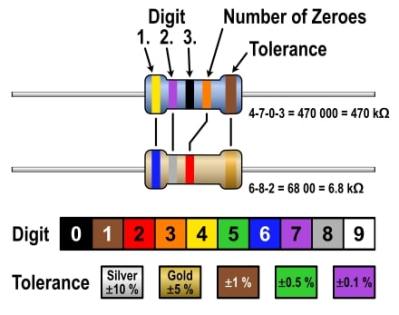
How the resistor color-code bands work

At the heart of the project is an Arduino Nano clone and a potential divider that measures the resistance of the test resistor against a known fixed value. Using the 16-bit ADC, the range of measurable values is theoretically 0 Ω to 15 MΩ, but there are some remaining issues with electrical noise that currently limit the practical range to between 100 Ω and 2 MΩ.

[j] is measuring the supply voltage to help counteract the noise, but intends to move to an oversampling/averaging method to improve the results in the next iteration.

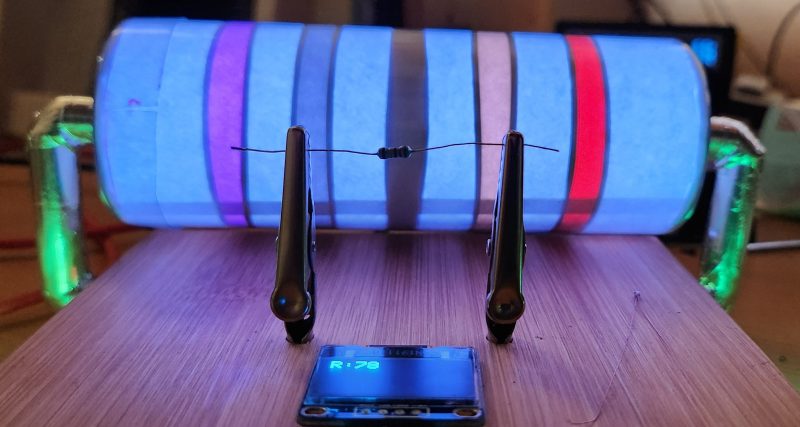
The measured value is shown on the OLED display at the front, and in resistor color-code on an enormous symbolic resistor lit by WS2812 RGB LEDs behind.

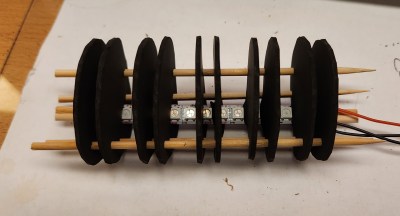
Inside The Great Resistor, the LEDs and baffle plates make the magic work

Precision aside, the project looks very impressive and we like the way the giant resistor has been constructed. It would look great at a science show or a demonstration. We’re sure that the noise issues can be ironed out, and we’d encourage any readers with experience in this area to offer [j] some tips in the comments below. There’s a video after the break of The Great Resistor being put through its paces!

If you want to know more about the history of the resistor color code bands, then we have you covered.  Alternatively, how about reading the color code directly with computer vision?

Apple is reportedly building a live TV advertising network as part of its MLS deal

Expect to see a fair number of ads when Apple begins streaming Major League Soccer games next year. According to Bloomberg, the company is building an advertising network to support its 10-year agreement with the league. Apple has reportedly held talks with MLS sponsors about airing ads during games and accompanying programming the company has planned for next season.

It also sounds like diehard fans won’t be able to escape commercial breaks by paying more. Bloomberg reports the company currently plans to air spots across all three tiers of the partnership, meaning you’ll see ads whether you pay for a dedicated package, access the games through your existing TV+ subscription or catch the occasional free match on the company’s TV app.

The move is part of a broader push by Apple to increase how much it earns from advertising. The company’s ad unit currently generates about $4 billion in annual revenue. Todd Teresi, the head of the division, has reportedly pushed to increase that number to $10 billion and above. To that end, Apple recently began showing more ads in the App Store and is testing search advertisements within its Maps app.

HBO cancels sci-fi drama 'Westworld' after four seasons

It's time to bid farewell to the androids of Westworld. HBO has cancelled the sci-fi title after four seasons, even though showrunners Jonathan Nolan and Lisa Joy were hoping for a fifth to reach the ending they had in mind. Nolan and Joy were trying to negotiate for a last season as recently as October, but their discussions clearly did not pan out. In a statement, HBO said:

"Over the past four seasons, Lisa and [Jonathan] have taken viewers on a mind-bending odyssey, raising the bar at every step. We are tremendously grateful to them, along with their immensely talented cast, producers and crew, and all of our partners at Kilter Films, Bad Robot and Warner Bros. Television. It’s been a thrill to join them on this journey."

Westworld used to be one of HBO's tentpole projects, with 54 Emmy nominations and even a win for Thandiwe Newton as Outstanding Supporting Actress. Its ratings and viewership have plummeted over the years, however, and it never quite recovered. For fans, the fact that the show hadn't been renewed immediately after the latest season ended was already a bad sign.

As The Hollywood Reporter notes, approximately 12 million viewers tuned in to watch the show's critically acclaimed first season across platforms. And, while we thought that Westworldreturned to form in its third season, its numbers kept on tumbling until only 4 million viewers stuck around to watch the latest episodes. That's most likely not enough for HBO to justify a renewal. Apparently, the fourth season cost the network $160 million for eight episodes, which is more than what it spent on House of Dragons. The Game of Thrones prequel had ten episodes and averaged 29 million viewers for each one. 

The Seven-Segment Display That’s Also an Input Device

We’re used to seeing all manner of seven-segment displays, be they mechanical, electronic, or something in between. But what all these displays have in common is that they’re, you know, displays. Using them as inputs would just be crazy talk, right?

Perhaps, but we like where [Dave Ehnebuske] is going with “InSlide,” the seven-segment input device. The idea for this comes from the “DigiTag” display, which we covered back in October, and divides a standard seven-segment character into three vertical strips — two skinny ones for the outside vertical segments, and one wide strip holding the horizontal elements. By sliding these strips up and down relative to each other, the standard nine digits, plus a few other characters, can be composed.

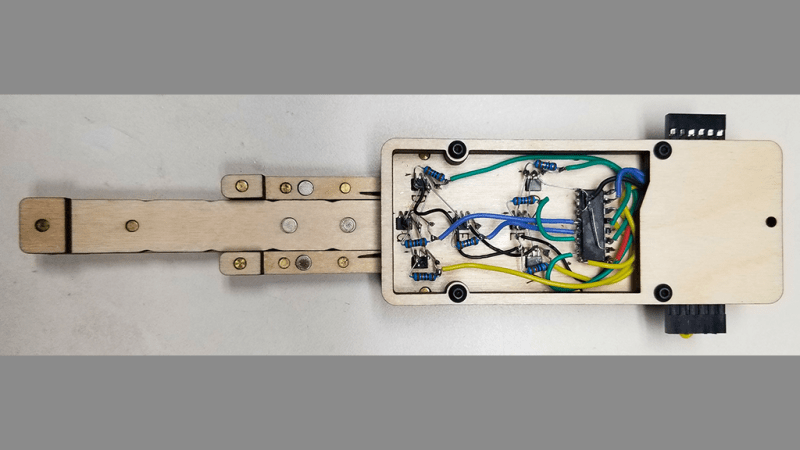
[Dave]’s take on this theme started by building his display from laser-cut plywood pieces, which is a nice choice because of the good contrast between the white wood and the engraver segments. Next, he embedded rare earth magnets in the slides and installed seven Hall effect sensors in the frame. The sensors are connected to an Arduino Nano via a 74HC165 parallel-load shift register, which lets multiple modules be daisy-chained together. He also built an Arduino library to read the current state of the segments; it supports the full hexadecimal character set, or even duodecimal if you like.

[Dave] has shared the library, and it looks like you can get the build files for the mechanism from the original project. That’s good, because this looks ripe for hacking. It looks like it would be pretty easy to motorize a display like this by adding rack-and-pinion gearing and steppers — something like that could make an interesting clock.

Feds charge former MoviePass execs with securities and wire fraud

The former executives in charge of MoviePass have been indicted in what the Justice Department calls "a scheme to defraud investors." Ex-MoviePass CEO J. Mitchell Lowe and Theodore Farnsworth, who used to be the chairman of the service's former parent company Helios and Matheson Analytics (HMNY), have been charged with one count of securities fraud and three counts of wire fraud. Federal authorities accuse them of making materially false and misleading claims regarding MoviePass' business in press releases, interviews and even SEC filings in a bid to artificially inflate HMNY's stocks and entice new investors. 

According to the newly unsealed court documents, Farnsworth and Lowe allegedly knew from the start that the business' $9.95 "unlimited" plan was a temporary gimmick to attract new subscribers and, hence, artificially inflate HMNY's stock prices. They also falsely claimed that the business model was tested to be sustainable and that it was possible to become profitable on subscription fees alone, the feds said. 

In addition, the executives allegedly claimed that HMNY had "big data" and AI technologies that could be used to generate revenue for the company by analyzing data collected from MoviePass subscribers. The indictment accuses them of making the claim even though they knew that HMNY did not have the technology or the capability to monetize subscriber data. 

Another allegation against the executives is that they'd made false representations that MoviePass was earning considerable money from multiple revenue streams. The business did not have a non-subscription revenue stream that would make it self-sufficient or offset its losses, according to authorities. Farnsworth and Lowe were also accused of implementing various tactics to prevent certain subscribers from being able to use their "unlimited" service. If you'll recall, MoviePass had to settle with the FTC in 2021 over allegations that it invalidated subscriber passwords on purpose to give it sufficient reason to freeze accounts of frequent users. 

In a statement made to The Verge, the spokesperson for Farnsworth said: "The indictment repeats the same allegations made by the Securities and Exchange Commission in the Commission's recent complaint filed on September 27th against Mr. Farnsworth, concerning matters that were publicly disclosed nearly three years ago and widely reported by the news media. As with the SEC filing, Mr. Farnsworth is confident that the facts will demonstrate that he has acted in good faith, and his legal team intends to contest the allegations in the indictment until his vindication is achieved."

The SEC sued MoviePass for fraud back in September and also accused the executives of misleading investors about the viability of the company's $9.95-per-month business model. Despite its tumultuous past and all the accusations the former people in charge still have to face, MoviePass is back. Stacy Spikes, its original co-founder, purchased it back after HMNY filed for bankruptcy. The service relaunched in September 5th and now charges subscribers $10 a month for up to three movies, $20 a month for up to four and $30 for a maximum of five movies a month. 

As for Farnsworth and Lowe, they're now facing a maximum penalty of 20 years in prison for each count of securities and wire fraud.

Twitter’s Head of Safety says election integrity is ‘top priority’ in spite of layoffs

Twitter’s top safety executive says election integrity is a “top priority” for the company even as the company has shed half of its staff in the last 24 hours. Yoel Roth, Twitter’s head of safety and one of the company leaders to survive mass layoffs, took to Twitter to downplay moderation concerns raised by activists and advertisers in recent days.

“Yesterday’s reduction in force affected approximately 15% of our Trust & Safety organization (as opposed to approximately 50% cuts company-wide), with our front-line moderation staff experiencing the least impact,” Roth tweeted. “With early voting underway in the US, our efforts on election integrity — including harmful misinformation that can suppress the vote and combatting state-backed information operations — remain a top priority.”

Roth’s comments come hours after the NAACP joined a coalition of activists and civil rights organizations to call for advertisers to suspend spending with Twitter. While Musk met with civil rights leaders earlier this week, those calling for a boycott said the company’s deep staff cuts undermined his promise to maintain Twitter’s election protection policies and its hate speech rules.

More than 80% of our incoming content moderation volume was completely unaffected by this access change. The daily volume of moderation actions we take stayed steady through this period. pic.twitter.com/rSGKtq0e3J

— Yoel Roth (@yoyoel) November 4, 2022

Roth, who is so far the only Twitter executive besides Musk to publicly weigh in on the company’s policies following Musk’s takeover, also tried to address reports about the impact staff cuts would have on safety.

“Last week, for security reasons, we restricted access to our internal tools for some users, including some members of my team,” he said. “Most of the 2,000+ content moderators working on front-line review were not impacted, and access will be fully restored in the coming days.” But while much of Roth’s Trust and Safety team may have been spared, numerous other teams whose work touches on safety issues were not.

As NBC News reported, Twitter’s curation team, which worked to counter misinformation on the platform, was axed entirely. Many engineering roles that deal with safety issues were also cut, as were numerous workers in policy and communications.

Again, to be crystal clear, Twitter’s strong commitment to content moderation remains absolutely unchanged.

In fact, we have actually seen hateful speech at times this week decline *below* our prior norms, contrary to what you may read in the press.

— Elon Musk (@elonmusk) November 4, 2022

On Friday, Musk said that the layoffs were necessary. “Regarding Twitter’s reduction in force, unfortunately there is no choice when the company is losing over $4M/day,” he tweeted, adding that employees were offered three months of severance. “Again, to be crystal clear, Twitter’s strong commitment to content moderation remains absolutely unchanged.”