Posts with «microcontrollers» label

New in the Maker Shed: Arduino Robot Shield Kit

My first hands-on experience with robotics and microcontrollers came from using a Parallax Boe-Bot kit with a Basic Stamp. I had no programming experience but using the included documentation and my PC, I was able to figure out how to build a robot that would react to obstacles and navigate its environment. Since then I’ve switched over to the Arduino but I still miss the experience I received from the Boe-Bot. Parallax must have read my mind because they released the Robotics Shield Kit for Arduino which is now available in the Maker Shed. They’ve taken their excellent Board of Education and transformed it into a shield (also available separately) which fits on top of an Arduino. The rest of the kit remains largely unchanged from the original Boe-Bot, which I consider a good thing.  Full documentation with over 40 activities is available online so you’ll be learning in no time. Simply add your own Arduino and a USB cable and enter into the fascinating world of robotics and Arduino!

Features

  • Board of Education Shield PCB
  • High-quality aluminum robot chassis, continuous rotation servos, and wheels
  • Boe-Boost Module
  • All the assembly hardware needed (nuts, screws standoffs)
  • Parallax screwdriver
  • Detailed online documentation and tutorials
  • All the electronic components and sensors needed for the tutorials
  • Note: Requires Arduino and USB cable

Homemade Satellites are Just Around the Corner


As a child, I always looked up at the stars and wondered how I could make it into space. Hopefully, I will live to see that day, but for now, a homemade satellite will have to do. The Nanosatisfi team has made it their mission “to provide affordable space exploration for everyone!,” and with ArduSat, they move one step closer to reality. ArduSat is a Arduino-controlled miniature 10cm cubic satellite, weighing 1 kg, which is roughly equivalent to half a store bought loaf of bread. Its size might not be impressive, but it packs over 25 sensors including: Myspectral’s open source spectrometer, inertial measurement unit, magnetometer, along the standard set, and many others. This impressive little machine boasts a camera to take photographs, it could send messages back to earth, or it can run your space experiments. With the ability to upload code directly to the ArduSat while in space, the possibilities are virtually limitless.

Be sure to check out their YouTube Channel for more technical details. You can also support their efforts via their Kickstarter page .


Embedded Linux meets Arduino with the Rascal Micro

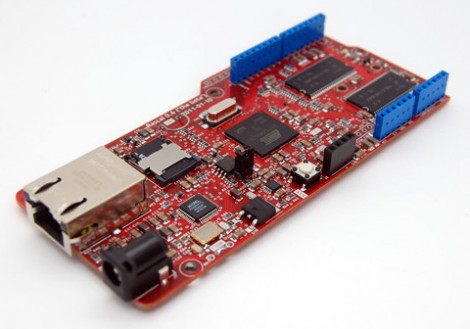
Behold the Rascal Micro. It’s running embedded Linux and has a dual-row of pin headers which probably seem pretty familiar. The idea here is to bring Arduino hardware (ie: shields) to a party with a powerful web server.

The image above is the beta version of the hardware. What’s being shown off in a recent Engadget demo is a version that slides two USB ports in between the barrel jack and the NIC. This makes it easy to jump over to wireless with the use of a USB dongle, or you can figure out what other peripherals you want to include in your project.

The novelty here is that the web server included a built-in editor. So not only can it serve you a webpage to control hardware or display sensor status, but it will let you edit the interface without needing to reflash anything.

The price rings in somewhere around $100-150, and like the popular Raspberry Pi board, you can’t get your hands on it right now.


Filed under: linux hacks, Microcontrollers

Insert Coin: Modkit Micro asks us if we're ready for six-year-olds coding Arduino boards

In Insert Coin, we look at an exciting new tech project that requires funding before it can hit production. If you'd like to pitch a project, please send us a tip with "Insert Coin" as the subject line.

What does microcontroller programming have in common with Tetris? Quite a bit if you're doing it with Modkit Micro from a Kickstarter project out of Cambridge, MA., which allows almost anyone to visually set up their hardware using graphical blocks to write the code. The partially-hooded trio behind it promises that the software is ideal for use with protyping boards from Arduino, Evil Mad Science, Lilypad, Seeed Studio, Wiring and SparkFun, and they even claim that elementary school students have used it to "take their projects from concept to reality in just a few hours." Purists should have no fear either: you can still get into a code view to see what's going on behind the scenes. A web-based Modkit Micro is being offered online starting June 1st for $25, and there'll be a desktop variant for Windows, OSX, and Linux as early as July if they reach their funding target. Check out the video after the break and then try to get your kids to wait for college before inventing version 2.0 of this.

Continue reading Insert Coin: Modkit Micro asks us if we're ready for six-year-olds coding Arduino boards

Insert Coin: Modkit Micro asks us if we're ready for six-year-olds coding Arduino boards originally appeared on Engadget on Tue, 29 May 2012 10:01:00 EST. Please see our terms for use of feeds.

Permalink | Email this | Comments

KegDroid dispenses beer with the help of a Xoom tablet and an Arduino board

Here's an instance of NFC technology that's more exciting than yet another tap-to-pay scenario. Google employee Paul Carff combined a Motorola Xoom running ICS with an Arduino microcontroller to create KegDroid, a friendly green beer dispenser. The Xoom acts as a gatekeeper to that brewed goodness, only letting the bot dispense drinks after users swipe an authorized badge. The badge is read by an NFC scanner on the bottom of the case and is then authenticated (or rejected) by the Arduino board. Once the system grants access, users can choose from two selections on tap via a custom Android application displayed on the Xoom's screen. As Android Community points out -- and as you'll see in the video below -- the KegDroid hasn't mastered a bartender-level pour (read: there's way too much foam). Still, this is oodles cooler than your average keg, wouldn't you agree?

Continue reading KegDroid dispenses beer with the help of a Xoom tablet and an Arduino board

KegDroid dispenses beer with the help of a Xoom tablet and an Arduino board originally appeared on Engadget on Mon, 30 Apr 2012 17:47:00 EST. Please see our terms for use of feeds.

Permalink | Email this | Comments

Environmental Sensing with the JeeLabs Platform

JeeLab’s Jean-Claude Wippler has been “rethinking the Arduino interface” since 2008, when he first attached an ISM band radio to a Modern Device Real Bare Bones Board. Three and a half years later he has built quite a library of sensors and breakout “plugs” for the JeeLabs Platform. The heart of the platform is the JeeNode (see below), which adds an inexpensive radio to an RBBB-style development board.

All of the pins of the Atmega328 are reorganized into four ports that have the same pinout: IRQ, Analog In, Regulated Power, GND, Digital In, Power In.

Sensor plugs can be small and all have the same interface; most communicate with the microcontroller using I2C (a common on-board option in a lot of sensor ICs). A set of Arduino libraries provides a consistent interface to the sensor plugs and the wireless module.

Jean Claude’s blog is worth setting aside some time to dig into. The latest posts are about analyzing supercap discharge rates, but some of the previous 1000 odd posts include an Oscilloscope buyer’s guide, the design process behind the various products, and lots of analysis of power usage of Atmega-based microcontroller projects.

JeeLabs will be represented at the 2012 Bay Area Maker Faire by his Stateside collaborator Modern Device.