Posts with «arduino» label

Mobile chicken coop includes wireless sensors

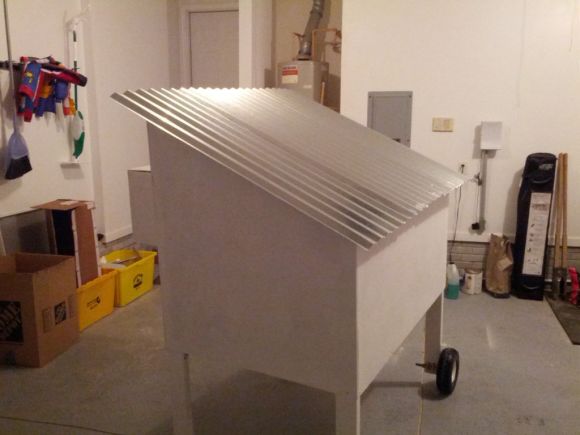
In and of itself this mobile chicken coop is a pretty nice build. There are some additional features lurking inside which you don’t find on most coops. [Neuromancer2701] built-in a set of sensors which can be accessed wirelessly. It makes it a snap to check up on the comfort of the hens without leaving the couch.

At the heart of the sensor system is an Arduino along with an Xbee module. The build isn’t quite finished yet, but so far three sensors have been implemented. A thermistor is used to read the temperature inside the coop. To make sure there’s enough water, two sheets of foil tape were applied to the water reservoir. The CapSense library measures the capacitance between these plates which correlates to the water lever (we’ve seen this type of water level sensor before). And finally, there’s a sensor that can tell if the door to the coop is open or shut.

He’s having trouble automating the door itself. This can be pretty tricky, especially if you go for a super complicated locking mechanism like this one.


Filed under: home hacks

robotic arm control with arduino nunchuck

Primary image

What does it do?

Pick things up . Manual control using Nunchuck

I found some micro servos lying around and thought of making this robotic arm. I had some broken blinds and got the bracket to use for the servos and some scrap plastics in my toolbox. Its a prototype for my upcoming bigger robotic arm with better servo. I added nunchuck control for manual control. In the future I will be adding sensors maybe mounting the arduino underneath the box . Im happy with the result and will be making more! I had more projects going on and this is one of them.

Didnt spend anything in building this. Hope you like it.

Cost to build

$0,00

Embedded video

Finished project

Complete

Number

Time to build

3 hours

Type

URL to more information

Weight

Plantoid Robot: Rimor Mundus, Terrapod v2

Primary image

What does it do?

Uses data based on the condition of a plant in a terraruim ecosystem to explore and react to the outer world.


Cost to build

$160,00

Embedded video

Finished project

Number

Time to build

8 hours

Type

legs

URL to more information

Weight

300 grams

read more

L33T - Personal service robot

Primary image

What does it do?

Personal assistance (Butler)

Time to make a formal reveal as to the project I am working on, L33T. The idea behind L3 is to be a personal service robot, to help out wherever he can and interact with people in the household, efectively being a robot butler. 

When thinking of what L3 should be and what it should look like I drew a lot of inspiration from R2, even the naming scheme is similar. R2 was able to manevour well in tight situations, he could 'talk' to and understand people, and was capable of performing bulter like tasks. 

Cost to build

$100,00

Embedded video

Finished project

Number

Time to build

Type

wheels

URL to more information

Weight

read more

High-Power Motor Controller

This looks intriguing, the Paragon, an Arduino motor controller designed to be robust enough even to control an electric car, evidently designed to run a Power Racing Series car. The maker, Alex McLees, is a founding member of Madison, WI hackerspace Sector 67. [via PPPRS]Filed under: Arduino

Read the full article on MAKE

Engine start button with fingerprint and remote webasto control

Engine start button with fingerprint and remote webasto control with original key from factory. Board based on the ATmega328, it controls engine start function, climate control, battery voltage, coolant fluid temperature, and so on. Fingerprint scanner BIOCODE Auto M10.

Theatrical electronics hero: Ben Peoples

Ever wondered about the extent of diversity in electronics? Been to a theatre and wondered at the sophistication of the live stage set? Welcome to the world of theatrical electronics. An exclusive inteview with this engineer in Arts – Ben Peoples

Priya: What is theatrical electronics? I always thought that theatres bought standard stuff off the shelves.
Ben: Theatrical electonics is a field of science where we try to rapid prototype electronic items on the stage to make things appear more real. Of course, it is a huge field. With 25 different theatres around the place where I live, my plates are generally full!

P: Interesting! How long have you been associated with electronics to capture such prototyping skills? What are the general tools that you use?
B: I have been prototyping electronics for over 20 years. I have been an ardent user of Arduino for the past 6. I loved the community so much that I even teach it to other people.

P: Oh teach too? Like classes for theatre prototyping? I would like more details on that.

B: (Smiles) Well not much, they are just getting started on how to rapidly put things together and program it using an Arduino to give it an “appearence” of more complex stuff like Time machine on stage.

P: Sounds fun. What are the theatre-specific whacky things that you teach them to build in the workshop? What are the general tools needed to attend your class?
B: I teach them to build Reed-candles, an elevator, wireless fireplace, wireless-dimmer, using Xbee radios for the lighting console and more things like that. I typically teach them inside a theatre wherein they need to bring their own laptops and software. They are seated inside a rehersal space so that they get the exact feel of designing things for a theatre. Other than that, its the usual arduino boards, gear motors, LEDs and of course, loads and loads of scotch tape! (Laughs)

P: Woah! How long does it take for you to teach them these?
B: 2-3 hours to teach math and the basics, 5 hours to explain the basic expriments and seeing them prototype their first objects. So yes, in total, 8 hours.

P: What according to you, is the advantage to pick electronic skill in the field of theatre?
B: There is theatre in colleges, the person could rise up to be a technical director, there is huge demand for lighting design, scenery design and of course in this age of television and movies, every drama theatre wants to stand out and do something extra. I see a huge future for it!

P: Okay one question that intrigues me after all this conversation is how different is theatre electronics from electronic arts?

B: Interesting question! For starters, Electronic Arts is very finished and polished. Theatrical electronics is well.. more raw and duct-taped at the back. They are two entirely different industries.

P: What are the things that interest you other than prototyping and what would be your ideal birthday present?

B: I love Ariel photography. Ideal birthday present is anything photography related. For work, I have to shoot digital, but for art I shoot 100% film, and just love it.

P: Any advice for youngsters?
B: Don’t be afraid to try anything new. Ship early, ship often.

(Ben can be contacted from his blog here. Also he is the author of a very cool book speaking on the same topic and yes, I contacted him via reddit. )

Light chasing autonomous rover

Primary image

What does it do?

Chases light source and avoids obstacles

I started 2 years ago with an autonomous rover that chases light and avoids obstacles. We're now 11 versions further and version 12 is almost ready! Eventually the rover must cruise around without hitting any objects and return to a charging station when the battery runs low. I'll show you the evolution of the rover, starting with version 2 (version 1 was crap)


Version 2

Cost to build

$250,00

Embedded video

Finished project

Number

Time to build

230 hours

Type

URL to more information

Weight

1500 grams

read more

Let's Make Robots 23 Jan 23:29

Lego plant watering robot

Primary image

What does it do?

Watering the plants while you're on holiday

This robot waters the plants while you're on holiday! You have to line up the plants and through a GUI in Microsoft Access you can input the water demands per plant (how many times per week the plant needs water and how much). The water reservoir contains a mixer and an aeration unit (through lego compressors) to avoid dead water. The only thing not lego about it is the water pump and the robot is controlled by an Arduino Duemilanove. I've used a selfmade multipurpose motor driver pcb so all the electronics visisble aren't used ;)

Cost to build

$100,00

Embedded video

Finished project

Complete

Number

Time to build

60 hours

Type

URL to more information

Weight

4000 grams

Vintage Kegerator

[Kerber] got his hands on a classic 1950′s General Electric fridge, and converted it into this classy vintage kegerator.

As his build log shows, it took an intensive restoration process to get this fridge back in shape. He completely stripped it down, scraping off the sixty year old insulation, fibreglass, and glue. Then the chassis was sanded down to a smooth finish and painted black. R-19 insulation was added to replace the old stuff.

Next up was electronics. An Arduino, DS18B20 temperature sensor, and a solid state relay were used to regulate the temperature and prevent frozen beer. There’s also a Guruplug server that reads data from the Arduino every minute. It makes this data accessible through a web page, so the temperature of the kegs can be monitored from anywhere. [Kerber] admits that this is overkill, but leaves room for future expansion.

The kegerator draws about 180 Watts, and runs for about 6 minutes per hour to keep the temperature regulated. This is pretty impressive considering the age of the fridge. The final restoration looks great, and serves up data along with the beer.


Filed under: beer hacks