Posts with «arduino» label

Arduino-Powered Alarm System Has All The Bells And Whistles

Put aside all of the projects that use an Arduino to blink a few LEDs or drive one servo motor. [IngGaro]‘s latest project uses the full range of features available in this versatile microcontroller and has turned an Arduino Mega into a fully-functional home alarm system.

The alarm can read RFID cards for activation and control of the device. It communicates with the front panel via an I2C bus, and it can control the opening and closing of windows or blinds. There is also an integrated GSM antenna for communicating any emergencies over the cell network. The device also keeps track of temperature and humidity.

The entire system can be controlled via a web interface. The Arduino serves a web page that allows the user full control over the alarm. With all of that, it’s hard to think of any more functionality to get out of this tiny microcontroller, unless you wanted to add a frickin’ laser to REALLY trip up the burglars!


Filed under: security hacks
Hack a Day 03 Sep 06:00

GPS Tracker Tracks Your Stolen Bike

Bikes are great for cruising through congested cities but there is a serious downside to pedaling your two-wheeler around… bike theft. It’s a big deal, for example, yearly estimates for stolen bikes in NYC are in the 60,000 – 100,000 range. Only an extremely small percentage of those are ever recovered. [stbennett] just got himself a halfway decent bike and is not too interested in having it stolen, and if it is stolen, he wants a way to find it so he built himself a GPS tracker for his bike.

The entire project is Arduino-based. It uses a GSM Shield and a GPS module along with a few other small odds and ends. A 2-cell LiPo battery provides the required power for all of the components. It’s pretty neat how this device maintains an extremely long battery life. The metal cable of the bike lock is used as a conductor in the circuit. When the cable is inserted and locked into the lock housing a circuit is completed that prevents electricity from passing through a transistor to the Arduino. In other words, the Arduino is off unless the bike cable is cut or disengaged. That way it is not running 24/7 and draining the battery.

The entire system works like this, once the bike lock cable is cut, the Arduino wakes up and gives a 15 second delay before doing anything, allowing the legitimate user to reconnect the bike lock and shut down the alarm system. If the bike lock is not re-engaged, the unit starts looking for a GPS signal. At that time it will send out SMS messages with the GPS location coordinates. Punching those numbers into Google Maps will show you exactly where the bike is.

Of course your other option is to park your bike where nobody else can access it, like at the top of a lamp pole.


Filed under: transportation hacks

Arduino Tour goes to London: 21st of September – Workshop on #Iot

Next 21st of September Arduino Tour is finally landing in London for a one-day workshop, starting at 10am at The Maker Works London, UK. (max. 18 people).

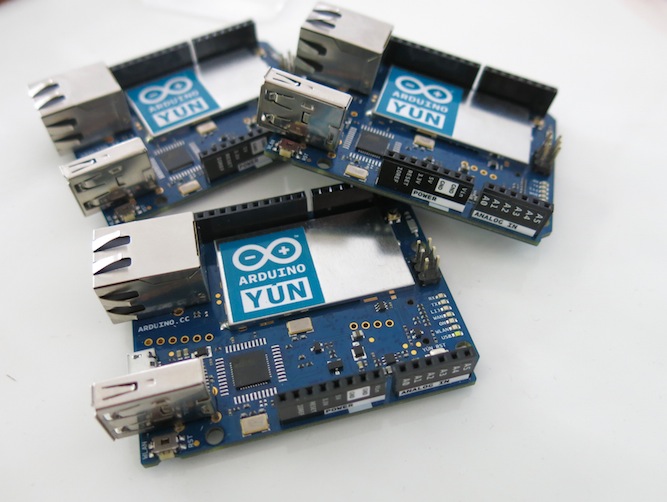
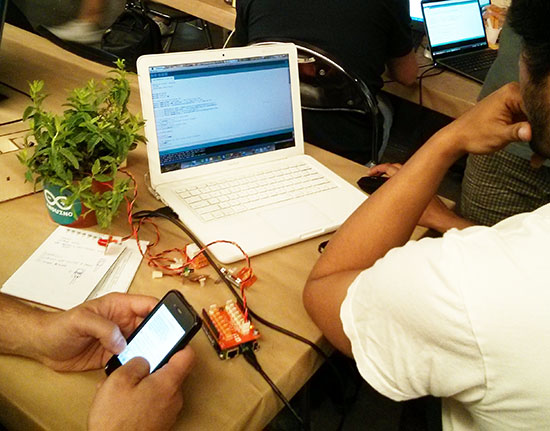
This edition of the official Arduino workshop is focused on the world of the Internet of Things and will allow participants to experiment with a botanical kit including an Arduino YÚN, plants and sensors. The workshop teaches you how to turn your plants and virtually any object into connected, responsive elements using Arduino YÚN.

Arduino YÚN is the combination of a classic Arduino Leonardo and a small Linux computer, able to connect to a network or Internet via Ethernet or WiFi. Arduino boards are able to read inputs – light on a sensor, a finger on a button, or even a Twitter message – and turn it into an output – activating a motor, turning on an LED, publishing something online.

Check the program and book your participation >>

Music and language skills get a boost with Toot

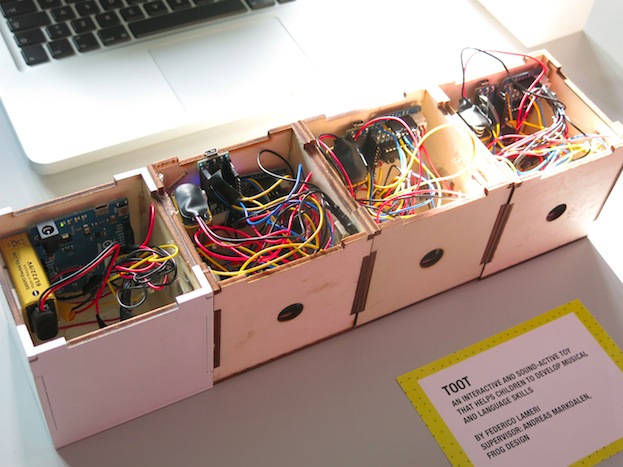
Toot is an interactive and sound-active toy designed for children aged between 3 and 6 years old that wants to enhance their auditory, music and language skills. It was developed by Federico Lameri as his thesis project of Master of Interaction Design at Supsi and prototyped using Arduino Leonardo.

The toy is composed by eight little cubical speaker boxes:

On each speaker children are able to record a sound. In order to listen back to the recorded sound the speaker must be shaken as if the sound was physically trapped into a box. After having recorded sounds on them, the speakers can be placed in a sequence after Mr.toot, and by tapping on his head it is possible to trigger the playback of the speakers in a sequence. toot is also matched with a mobile application that offers different kind of interactions and experiences. it allows to play some exercise that will teach children to listen, understand and catalog sound and melodies.

The app expands the possibilities of interaction, offering different exercises created with the help of musicians and educators from different areas of expertise,  some of them are also inspired by a Montessori sensorial activity.

Take a look at the video interview with Montessori educator Fanny Bissa:


Arduino Blog 01 Sep 18:20

Arduino-based LED Wedding Lights

[Rob] created these amazing Bluetooth controlled LED lights for his daughter’s wedding adding a colorful ambient glow to the ceremony. Each item held a Neopixel ring and an Arduino microprocessor with a wireless module that could be individually addressed over a ‘mini-network.’ The main master station would receive commands from a Windows Phone. Usually we see Arduino-based projects being run with Android apps, so it’s nice to see that Microsoft is still present in the maker community.

The enclosures and translucent vases that sit atop the devices were 3D printed. All eight of the matrimonial units synchronized with each other, and the colors could be changed by sliding the settings bar on the app.  [Rob] says that it was a lot of fun to build, and jokingly stated that it kept him “out of all the less important aspects of the ceremony. (food choice, decor, venue, who to marry etc etc).” The outcome was a beautiful arrangement of tabletop lighting for the wedding. A demo of [Rob]‘s setup can be seen in the video below.


Filed under: led hacks

Baby’s Room Gets a Palace with this CNC Castle Decoration

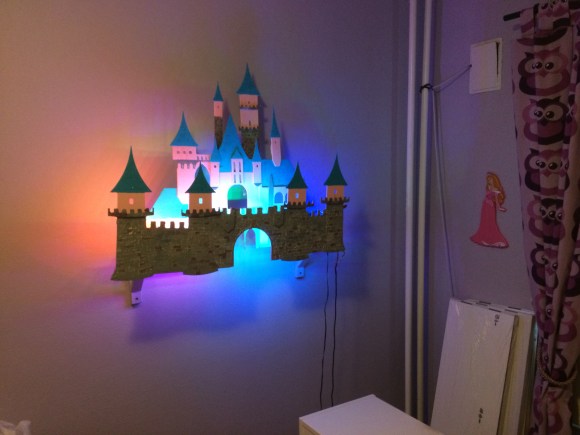
[Vegard] and his wife were expecting a baby girl, and decided to build a castle for their new daughter. As a prototyping geek with his own CNC machine in his apartment, he decided to take to Google Sketchup to design this well-crafted castle decoration for his daughter’s room.

The first challenge was figuring out what the castle would look like. [Vegard] had never been to Disney Land or World, and so had never actually seen any of the fairy-tale castles in real life. After experimenting with some paper versions, he settled on a design which incorporates multiple layers and can house lights within them.

The next step was to cut the final version on the CNC machine, then sand and paint the parts. After figuring out a way to mount the castle to the wall, some LEDs were added for effect, driven by an Arduino. The final version looks pretty good!

Hacking your kids’ room is great fun, and you get to keep making new stuff to remain age appropriate. We bet [Vegard] can’t wait until she’s old enough to enjoy a marble-run that wraps the entire room. In the mean time he can work on a classic robot stroller.


Filed under: cnc hacks
Hack a Day 01 Sep 03:01
arduino  baby  cnc  cnc hacks  

3D Printed Foldable Head Mounted Display

The $80 Head Mounted Display was made with 3D printed frames and component housing modules with the optics bought from eBay. They are fully adjustable and function with Android or Linux-based mobile devices.

Read more on MAKE

Rune wirelessly rocking Maker Faire Trondheim

Originally prototyped using an Arduino, Aalberg Audio's guitar delay pedal and Bluetooth LE remote control now looks like a product, not a prototype.

Read more on MAKE

Nepchune’s Noise Circus: Learning with Noise at Maker Faire Orlando

Chuck Stephens is an artist, musician, hardware hacker and small boat builder who specializes in the use of recycled, repurposed and salvaged materials. Exhibiting at Maker Faire Orlando as Nepchune’s Noise Circus, Chuck says noise circuits provided his Eureka! moment in electronics.

Read more on MAKE

ROVs and Long Boards at Maker Faire Trondheim

A group of electronics students from HiST brought two very different projects to the faire—an underwater ROV and a bunch of electric long boards.

Read more on MAKE

MAKE » Arduino 29 Aug 17:17