Posts with «arduino» label

This Car Lets You Fistbump to Unlock

In the dark ages, you had to use a key to lock and unlock your car doors. Just about every car now has a remote control on the key that lets you unlock or lock with the push of a button. But many modern cars don’t even need that. They sense the key on your person and usually use a button to do the lock or unlock function. That button does nothing if the key isn’t nearby.

[Pierre Charlier] wanted that easy locking and unlocking, so he refitted his car with a Keyduino to allow entry with an NFC ring. What results is a very cool fistbump which convinces your car to unlock the door.

Keyduinio is [Pierre’s] NFC-enabled project, but you can also use a more conventional Arduino with an NFC and relay shield. The demo also works with a smartphone if you’re not one for wearing an NFC ring. Going this round, he even shows how to make it work with Bluetooth Low Energy (BLE).

In the video below, you can see how he removed the car’s internal lock switch and modified the wire harness to take the connection to the Arduino. He’s also included all the code. About the only tricky part is doing the actual wiring in your car and finding a suitable source of power. That varies from car to car, so it isn’t easy to give specific instructions.

Opening doors of one kind or another is a popular project theme. While [Pierre’s] project might open the door on a coupe, we’ve seen another project that works on a coop.


Filed under: Arduino Hacks, car hacks, wireless hacks

Visualizing “data visualization” with Leds and bubbles

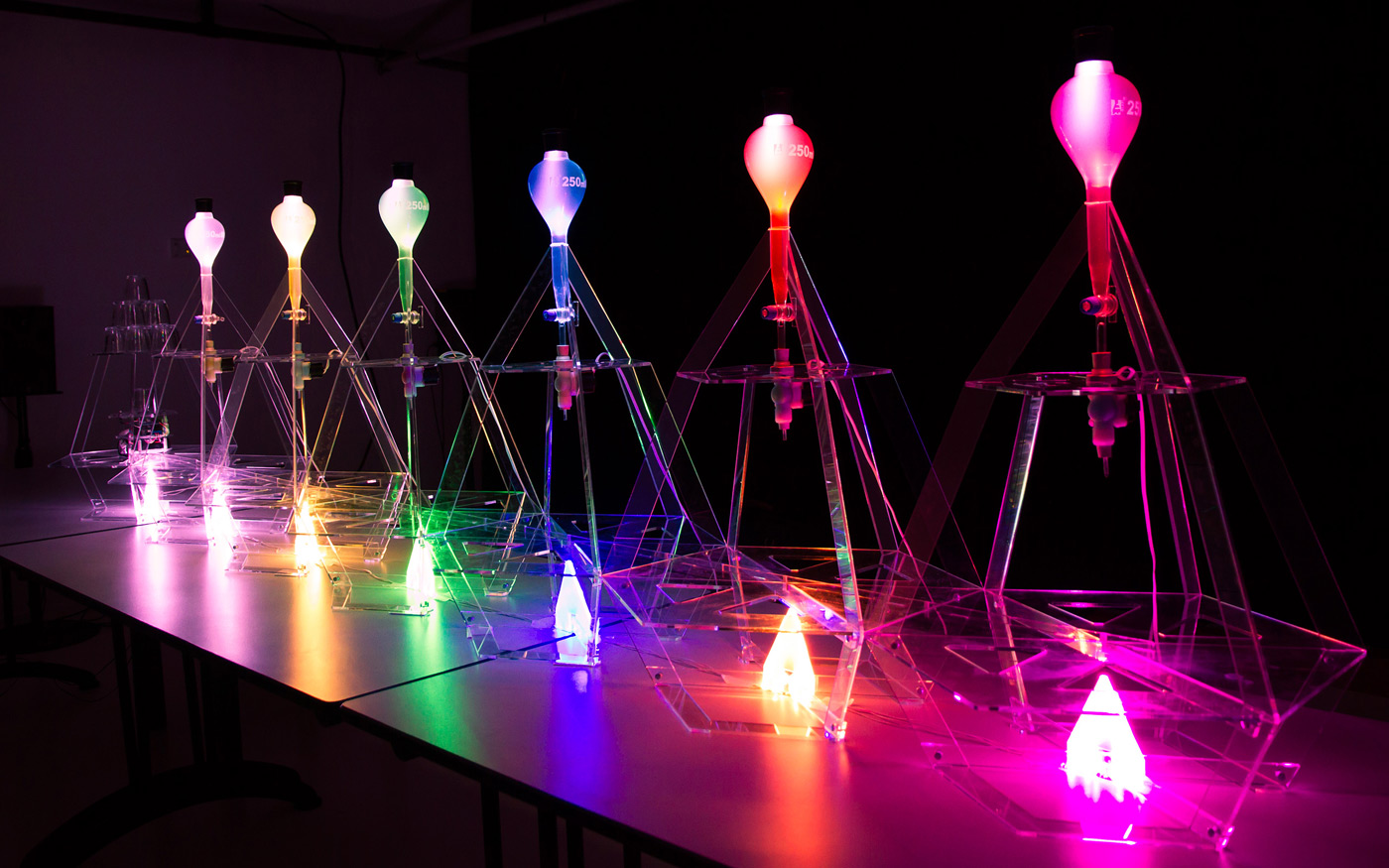
“Data transparency” is a project by Jiayu Liu, a designer and media artist, interested in physical data visualisation and interactive code. The installation runs on Arduino Mega: when the microphone senses a person’s blow, it transforms it in a Led animation and then activates the bubble machine for 8 seconds. The project is not aiming to visualize any specific data but “data visualization” itself:

In my point of view, data is not dissimilar to a conclusion of our past, and we need it for our future. When we see a data from a computer, it is something that has already happened. We use intelligent methods of computing science to analyze the data so that to predict the future. We are living in a world of data, and data is like a language objectively describing our past. In this work, I take more attention on rethinking and recalibrating the role of data in our lives, and the relationship between the virtual world we build as a main method of data storing, analyzing and visualization and ourselves.

Also, I am thinking of that it is better to make sense of the role of data visualization before really visualizing it. Finally, I found a good perspective to see how data connects with our lives, which is Time.
Therefore, the project is not aiming to visualize any specific data but what I am trying to visualize is the “data visualization” itself. I would like to bring a new experience to the viewer in different space. So I want to create a interesting play space and bubble game to the viewer . Let them have a really funny and relaxing experience.

Take a look at the “making of” video below to see it in action:

ICYMI: Cockroach torture, an app for Parkinson's and more

Today on In Case You Missed It: A cybernetic cockroach how-to describes how to use an Arduino to control where a cockroach goes, which makes all of us uncomfortable.

ICYMI: Cockroach torture, an app for Parkinson's and more

Today on In Case You Missed It: A cybernetic cockroach how-to describes how to use an Arduino to control where a cockroach goes, which makes all of us uncomfortable.

ICYMI: Cockroach torture, an app for Parkinson's and more

Today on In Case You Missed It: A cybernetic cockroach how-to describes how to use an Arduino to control where a cockroach goes, which makes all of us uncomfortable.

Pedal a Bike Through Virtual Reality for Under $100

Riding your bike on winter roads can be tough sometimes. Riding your bike through a virtual reality is easier and surprisingly affordable!

Read more on MAKE

The post Pedal a Bike Through Virtual Reality for Under $100 appeared first on Make: DIY Projects, How-Tos, Electronics, Crafts and Ideas for Makers.

autonomous bb-8 droid

hey guys im thinking of building a bb-8 droid at some point might be on kickstarter but instead of being rc like all the other boring ones it will be atonoumous with pixy cam will track my jacket and follow me and use voice to say hold this and robotic arm could come out and close until it senses grip on something!!! or could be any robot like my box bot but same functionality.

read more

Let's Make Robots 31 Jan 02:48
arduino  

The Flowing Pixels of Time Wait for No Man

The hourglass dramatically depicts the flow of time; gravity pulling grains of sand inevitably downward. So it is with the Bits of Time project by [Frank Andre]. The pixels drop, stopping only when the battery dies. Or, when your eggs are ready. (Pssst, it’s also on Hackaday.io.)

Look, Ma! No GIF!

The project starts with a couple of [Frank’s] PixBlocks. A processor is added to one PixBlock to serve as the controller for both after they are connected via the serial bus. A tilt switch, with a debouncing circuit, is connected to an IO pin. This tells the processor the orientation of the box and therefore which way the pixels should flow.

Two  switches set the duration of the timer in 15 second increments. A third starts the timer. When the box is rotated the pixels start flowing in the opposite direction. With code available on GitHub the system can be programmed for other effects such as changing colors, flickering, or even text display.

You’ll agree this is a bit less intimidating than the MacGyver-ish kitchen timer we covered last year.


Filed under: clock hacks, led hacks

Build a Dual Thermostat for Precise Preset Temperatures

You'd think there'd be something like a dual set point thermostat on the market already, but it doesn't look like there is. Guess you'll just have to make one.

Read more on MAKE

The post Build a Dual Thermostat for Precise Preset Temperatures appeared first on Make: DIY Projects, How-Tos, Electronics, Crafts and Ideas for Makers.

Learning Photosynthesis with an Interactive installation

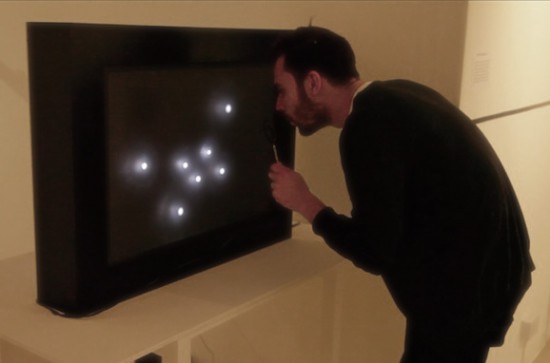
Photosynthesis is an interactive installation for primary school children created, designed and developed by Moritz von Burkersroda and exhibited at P3 Ambika, University of Westminster.

It’s a  learning  experience to understand the abstract process of photosynthesis in a hands-on way.  Thanks to a physical interaction  kids can easily understand what  plants convert light into chemical energy to fuel their activities.

The installation uses an Arduino to measure data from a photoresistor and a hacked Wii-remote to connect the objects with the video feedback on the screen triggered by a Processing sketch. On the page of the project you can download a Design Research Document about Contextual study theory to understand the relationship between interactivity, learning and educational institutions, like museums.