Posts with «arduino» label

Measure a magnet’s strength with this DIY Gauss Meter
You may know that a neodymium magnet is more powerful than something you usually find on a refrigerator, but by how much?

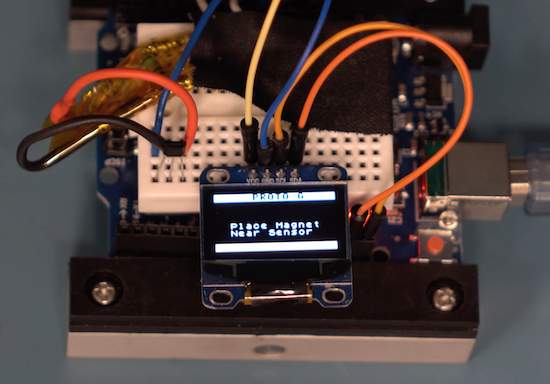
Most people, even those willing to harvest magnets from disk drives, accept that some magnets are stronger than others. This, however, wasn’t quite good enough for Anthony Garofalo, who instead converted a prototype voltmeter he made using an Arduino Uno and a tiny OLED display into something that displays the magnetic, or Gauss level. It also shows whether it’s observing the north or south pole of the magnet, which certainly could be useful in some situations.

Though full documentation isn’t available right now, Garofalo says that he’ll make it available once he repackages everything in a smaller format with an enclosure. If you’d like to see more of his work, including the voltmeter he based this off of, be sure to check out his Instructables page and some other neat stuff on his YouTube channel!

This 3D-printed bionic hand can replace or support a limb

3D-printed appendages are, as one might suspect, generally meant for those that are missing a limb. Moreover, there are many other people that might retain partial functionality of a hand, but could still use assistance.

Youbionic’s beautifully 3D-printed, myoelectric prosthesis is envisioned for either application, capable of being controlled by muscle contraction as if it were a real body part.

As seen in the video below, the Youbionic hand can manipulate many different items, including a small box, a water bottle, and a set of keys. Functionality aside, the movement is extremely fluid and the smooth black finish really makes it look great.

The device is currently equipped with an Arduino Micro, servos, various sensors, a battery pack, and a few switches. Even the breadboard appears to be very neat, though one would suspect the final version will use some sort of PCB.

You can learn more and order yours on Youbionic’s website.

RooBee One is an open-source SLA/DLP 3D printer

Aldric Negrier, a Portuguese Maker and owner of RepRap Algarve, has created an SLA 3D printer named RooBee One.

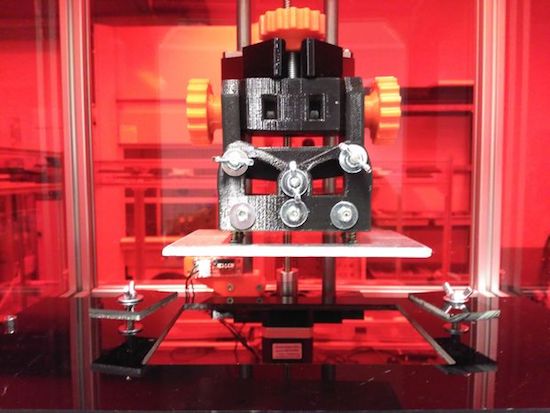
Most desktop 3D printers that you’ll see in Makerspaces or advertised for home use drop material onto a bed using a hot extrusion head. The open-source RooBee One, however, employs a DLP projector along with an Arduino Mega to light up each layer in a vat of resin. This causes each layer to solidify, thus making a complete object. You can see this process at around 0:30 in the video below.

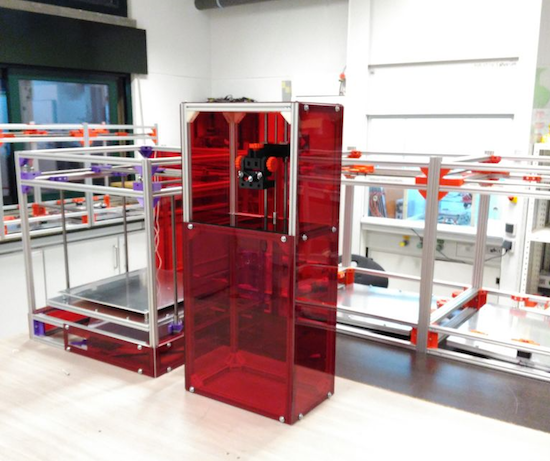
RooBee One features an aluminum frame with an adjustable print area of 80x60x200 mm, with up to a 150x105x200mm build volume. Aside from the Arduino, additional electronics consist of a RAMPS 1.4 shield, a NEMA 17 stepper motor, a microstepping driver, an endstop, and a 12V transformer. Negrier also installed a fan on top of the printer to help guide the toxic vapors outside and away from the machine’s operator.

This process may be unfamiliar to those used to “normal” 3D printers, as it “magically” pulls a complete part out of a bath. The project is fairly involved, but the resulting ruby-red machine looks quite impressive. You can find out how to build one on its Instructables page.

Raspberry Pi Project

Hey guys,

I'm starting out a project in which I want to build a Raspberry Pi Self Driving Robot. The basic tasks the robot will perform are:

  • Lane tracking using RPi Camera and OpenCV3 + Python
  • Obstacle detection with Ultrasonic sensor + input from RPi Camera(if possible)

The materials I currently plan to use in this project are:

read more

Let's Make Robots 01 Jan 15:42

Raspberry Pi Project

Hey guys,

I'm starting out a project in which I want to build a Raspberry Pi Self Driving Robot. The basic tasks the robot will perform are:

  • Lane tracking using RPi Camera and OpenCV3 + Python
  • Obstacle detection with Ultrasonic sensor + input from RPi Camera(if possible)

The materials I currently plan to use in this project are:

read more

Let's Make Robots 01 Jan 15:42

Raspberry Pi Project

Hey guys,

I'm starting out a project in which I want to build a Raspberry Pi Self Driving Robot. The basic tasks the robot will perform are:

  • Lane tracking using RPi Camera and OpenCV3 + Python
  • Obstacle detection with Ultrasonic sensor + input from RPi Camera(if possible)

The materials I currently plan to use in this project are:

read more

Let's Make Robots 01 Jan 15:42

Raspberry Pi Project

Hey guys,

I'm starting out a project in which I want to build a Raspberry Pi Self Driving Robot. The basic tasks the robot will perform are:

  • Lane tracking using RPi Camera and OpenCV3 + Python
  • Obstacle detection with Ultrasonic sensor + input from RPi Camera(if possible)

The materials I currently plan to use in this project are:

read more

Let's Make Robots 01 Jan 15:42

8 Festive Projects to Ring in the New Year

Ring in 2017 with some DIY projects made in the spirit of New Year's Eve.

Read more on MAKE

The post 8 Festive Projects to Ring in the New Year appeared first on Make: DIY Projects and Ideas for Makers.

Cheap Cat Feeder Enhances Sleep

We’ll admit it: we sometimes overcomplicate things. Look at [Peter Weissbrod’s] automated cat feeder, for example. It isn’t anything more than a bottle, a servo, some odds and ends, and an Arduino. However, it lets him sleep in without his cat waking him for service.

We looked at the code and thought, “This thing will just dispense food all the time! That’s not what you want!” Then we looked closer. [Peter] uses a common household timer to just turn the device on in the morning, let it run for a bit, and then turns it off. You can see a video of the mechanism, below.

Honestly, we have mixed feelings. As we are sure someone’s already quit reading to comment: you don’t really need an Arduino for this. If it were doing the timing, that might make it more justifiable. Or perhaps have it sense daylight to feed in the morning. Still, Arduinos are cheap (we just picked up some tiny Pro’s for about $3) and it is a more flexible arrangement than, say, a 555 driving the servo.

We have seen many cat feeders over the years. Some of them use custom components. Others use whatever you have on hand (including another kitchen timer). However you do it, one thing is clear: When the aliens come and observe life on Earth, they will doubtless conclude that the cats are in charge.


Filed under: Arduino Hacks, home hacks

Quad Walker

Primary image

What does it do?

Been working on a building a quad walker probably for a year now. What started of a coding project has now ended up with me learning how to 3d model and building a kit 3d printer.

Along with scope of the project, the size of walker also grew. It was originally planned to use small 9g servers and probably end up 20cm across in total. Though I moved to using standard r/c card servos and as a result each leg will be around 20cm. No idea how big the body will need to be to house everything else.

Cost to build

Embedded video

Finished project

Number

Time to build

Type

legs

URL to more information

Weight

read more