Posts with «nano» label

Wrist thrusters let you fly through the water effortlessly

These small arm-mounted propeller units can carry a skin diver through the water with minimal effort.

YouTuber “PeterSripol” had only a week to prepare for his trip to Hawaii. Rather than purchase a set of fins or a snorkel, he instead hooked up two T100 thrusters that he had lying around to wrist straps. In his setup, these thrusters are controlled by a button interfaced with an Arduino that allows the user to select one of three power levels.
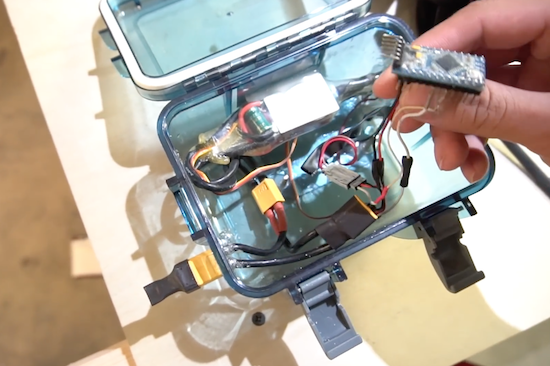
The required battery, as well as other control components are housed inside a waterproof box, and quite a bit of effort was put into making good (and hopefully waterproof) connections!

Unfortunately, the fun was cut short by a cut wire, but it looked awesome nevertheless! You can see the project in action below!
Making beats on a tiny Arduino DJ controller

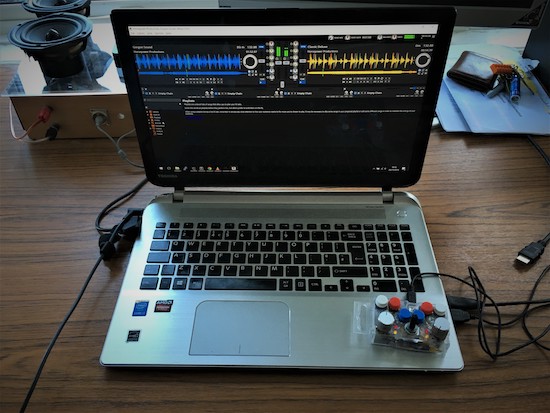
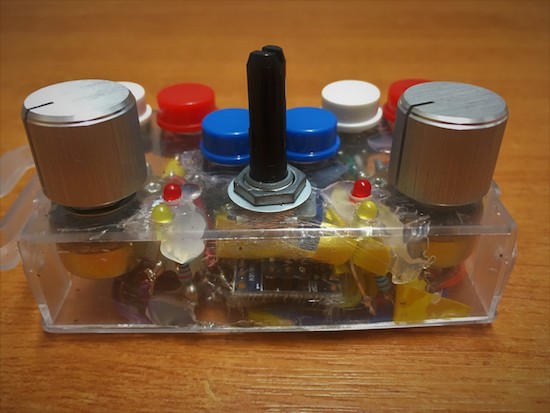
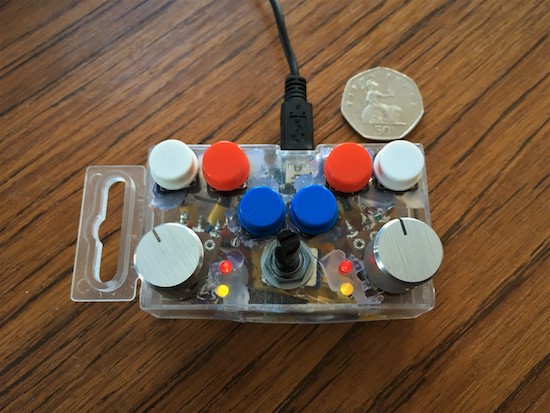
Electronic music seems to be ripe for hacking, as a new device can be fun as well as quite useful. Imgur user “fatcookies” decided to create a small DJ controller using an Arduino Nano, six push buttons, three potentiometers, and four configurable LEDs.

In this setup, each input is fed into the Arduino, then sent to a computer over USB to be used as a MIDI interface (with the help of a couple pieces of intermediate software). A neat build for sure, but what really sets this tiny beast apart is that it’s about the size of a notebook’s trackpad.

The electronics are all stored inside a transparent nuts and bolts storage box, while fatcookies rounded out the design with some arcade buttons and brushed aluminium knobs on two of the pots.

You can check out how to make one of these mini devices for yourself on the project’s Imgur page.

A 3D-printed lunar phase clock for your nightstand

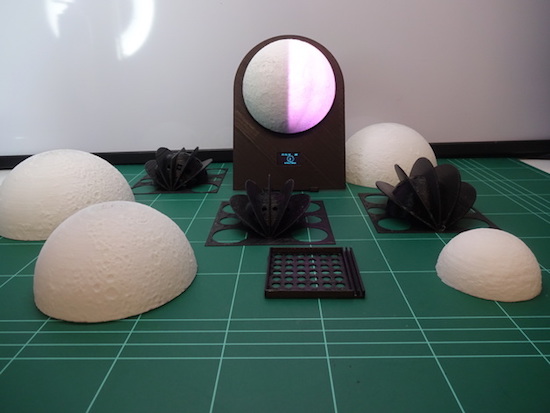
“Since there isn’t a supermoon everyday, make one for your bedside table!” This is exactly what G4lile0 set out to do using a 3D printer, an Arduino and some open-source tools.

The result was a moon phase clock consisting of a 3D-printed model and an LED strip to create the lunar phases. The lights are driven by an Arduino that precisely calculates which phase to show, as well as controls a 0.96″ OLED display revealing the date and time. Other electronics include an RTC module, a DTH11 sensor, a buzzer, and three push buttons.

The clock also features several modes, including an alarm, a wake-up light, a lamp, a thermometer, and a hygrometer. It can even help set the mood or start your next lunar rave with its relaxation and party-like special effects.

You can read all about this project on Thingiverse and find its code over on GitHub.

The Orbitalochka is a solar-powered satellite synth

This model satellite is both strange and mesmerizing with folding solar panels and a FM transmitter.

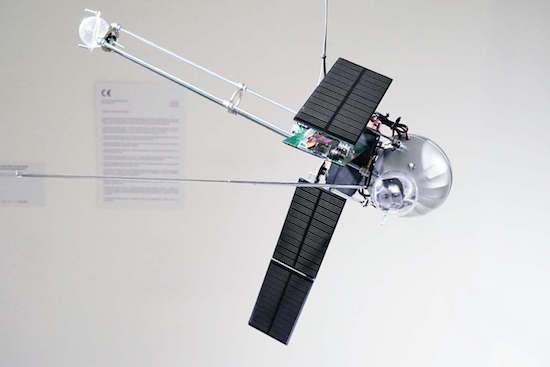
Media artist Dmitry Morozov, aka ::vtol::, is back with his latest kinetic sound object, this one resembling a satellite. The Orbitalochka hangs from the ceiling and broadcasts sound via an FM transmitter and a built-in speaker. These noises are based on the position of the satellite in space, and it can even transmit a pre-recorded lecture by Sergev Kasich, who appears to reside in the satellite’s clear bubble.

::vtol:: bases the sound signals on the generative sound processes created with Patchblocks, a modular mini-synth kit. The signals also react to a light intensity sensor, which responds to how the satellite’s position in space changes.

This happens due to mass redistribution as the solar cell changes location. The solar cells operate as sensors and produce CV (control voltage) to change sound program parameters.

Aside from its unusual sounds, what is really interesting about this synthesizer are the solar panels, which autonomously move around via four servo motors. The Orbitalochka is equipped with an Arduino Nano as well.

You can see the apparatus in action below, and read all about it on ::vtol::’s page here.

(Photos: ::vtol::)

The Synth Bike is a mobile music machine

With a speaker on the back and a drum machine on the front, what can possibly go wrong?

After riding his bike home after a synthesizer get together, Sam Battle decided to actually combine these two pursuits, transforming an iconic 1973 Raleigh Chopper into a mobile synthesizer. Though his first try was rather crude, using an Oyster card stuck between spokes to trigger a switch, his aptly named “Synth Bike 2.0” looks pretty awesome.

Featuring eight–yes eightArduino Nano boards, the music’s tempo can be controlled by how fast you pedal, or set up to use a built-in clock. Other electronics include a Sparkfun WAV Trigger, some analog synth circuitry, a sampler, a digital oscillator, and a Music From Outer Space Echo module.

Plenty of switches, dials, pads and knobs can be found on a control box mounted to the handlebars, while more pads are located on the bike’s top tube.

As awesome as it looks, all of this electronic gear seems to suck a lot of power, and it can only play for around 10 minutes at a stretch. A battery upgrade, however, is reportedly imminent!

Arduino Blog 09 Nov 15:24

Dtto is a 3D-printed, self-configurable modular robot

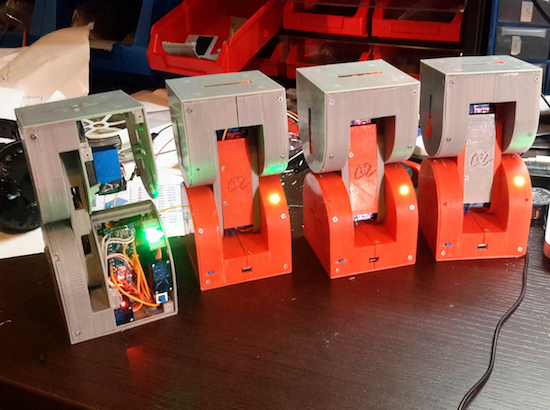
Congratulations to the winner of this year’s Hackaday Prize, Alberto Molina Perez! Inspired by Bruce Lee’s famous water quote, Dtto is a self-reconfigurable robot that can adopt any shape by simply changing the position and connection of its 3D-printed modules.

A coupling mechanism on both ends allows the sections to assemble themselves in various configurations and carry out complex tasks in unison. They can chain together to create a snake-like robot, turn into a wheel, or even form a bridge to get over a gap. Impressively, this is all accomplished autonomously. The goal is that, one day, Dtto’s versatility will enable it to perform rescue missions and explore unknown environments without any human intervention.

As Hackaday notes, each module consists of two boxes, rounded on one side, linked by a bar. One half houses all of the electronics, which includes an Arduino Nano, a Bluetooth chip, an NRF2401+ radio transceiver, two SG92R Tower Pro servos for hinging, and three Tower Pro SG90 micro servos for coupling, while the other leaves space for additional features, such as a camera, microphone and speakers, multiple sensors, actuators, or more batteries.

You can read more about the project on its Hackaday.io page, and be sure to check out its latest demo reel below!

Touchless MIDI: The Secret’s In the Mitten

MIDI is a great tool for virtually any musician. Unless you’re a keyboard player, though, it might be hard to use it live. [Evan] recently came up with a great solution for all of the wistful guitar players out there who have been dreaming of having a MIDI interface as useful as their pianist brethren, though. He created a touchless MIDI controller that interfaces directly with a guitar.

[Evan] set up an Arduino Nano to handle the MIDI interface to the computer. A detector coil from a previous project was installed onto the guitar can recognize how far away the guitarist’s hand is from the body of the guitar, giving the musician control over an effect of their choosing. The guitarist simply needs to be wearing a special mitten for use with the detector coil. [Evan] also added three tactile buttons, meaning that this MIDI usefulness can be extended to three different selectable effects.

Be sure to check out the video below for a demonstration of how the interface works. [Evan] has also made the schematics and Arduino code available if you decide to build your own. This isn’t [Evan]’s first MIDI rodeo, either. He’s also created a MIDI drum interface from a Rock Band drum set, too.


Filed under: musical hacks
Hack a Day 06 Nov 21:00

Wear the Stranger Things wall on your shirt

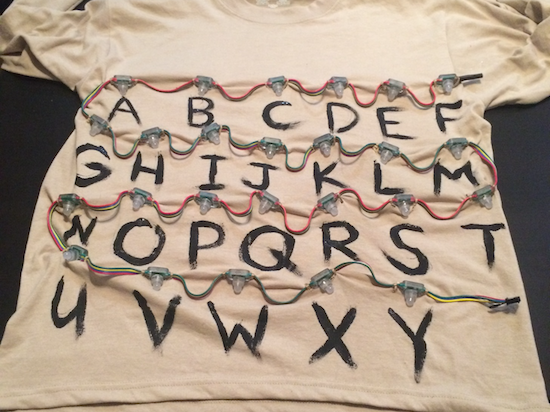
The Netflix series Stranger Things has become a fan-favorite for Makers, especially for those looking to recreate a light-up alphabet wall of their own. While we’ve seen some awesome attempts over the last couple of weeks, Imgur user “MrWalkway” has decided to create a more portable version in the form of his Halloween costume.

The show-inspired costume uses an Adafruit LED strand, an Arduino Nano, a Bluetooth receiver, a battery, and some other components to allow his shirt to accept different messages and light patterns. The instructions are sent from a Bluetooth terminal on his phone over a serial connection to the Arduino.

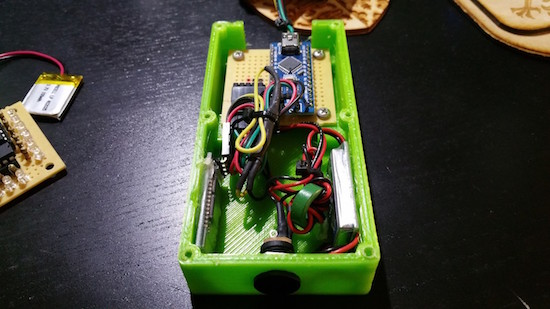
As you can see on the project’s Imgur page, the electronics are all housed within a 3D-printed control box that gets tucked away in his pocket while the 25 LEDs are stitched to the inside of the shirt.

A touchless MIDI controller for your electric guitar

If guitar effects pedals aren’t really your thing, perhaps Evan Kale’s touchless MIDI controller will fit the bill.

Using an Arduino, along with a Colpitts oscillator and some other electronics, Kale has come up with a rather unique interface for his guitar. Instead of using a foot pedal, he put a strip of aluminum foil inside of a fingerless glove, then attached a homemade metal detector coil and circuit to the back.

This allows him to strum the guitar, then change the sound by moving his hand away and toward the strings as a MIDI input. Very clever, and as always, Kale outlines everything in his own zany video style!

You can find the code for this project here and check out the schematic on Imgur. On the other hand, if this looks slightly familiar, he uses the same type of circuit for this MIDI controller as the metal detector previously covered on our blog.

A touchless MIDI controller for your electric guitar

If guitar effects pedals aren’t really your thing, perhaps Evan Kale’s touchless MIDI controller will fit the bill.

Using an Arduino, along with a Colpitts oscillator and some other electronics, Kale has come up with a rather unique interface for his guitar. Instead of using a foot pedal, he put a strip of aluminum foil inside of a fingerless glove, then attached a homemade metal detector coil and circuit to the back.

This allows him to strum the guitar, then change the sound by moving his hand away and toward the strings as a MIDI input. Very clever, and as always, Kale outlines everything in his own zany video style!

You can find the code for this project here and check out the schematic on Imgur. On the other hand, if this looks slightly familiar, he uses the same type of circuit for this MIDI controller as the metal detector previously covered on our blog.