Posts with «arduino» label

Toccata for ultra-conservative book organ

In an article on the New York Times Nick Bilton report us an impressive sentence pronounced by Paola Antonelli, senior curator in the Department of Architecture and Design at the Museum of Modern Art.  She said: “The two most important introductions for art  in the past 20 years have been the Arduino and Processing”.

Not all art projects we come across have precisely the characteristics of avant-garde art, but many are able to attract our attention and at least snatch us a smile.

That’s the case of  “Crush Limbaugh”.


The ultra-conservative book organ includes the autobiography of Sarah Palin, a thriller by Glenn Beck, the memoirs of Dan Quayle and a book-length rant by Rush Limbaugh, each repurposed into electronic triggers hooked up to a central Arduino microcontroller. The Arduino is programmed with a music-generating algorithm, and each hit of a book triggers a single note, or some other type of instruction within the program. Toccata for ultra-conservative book organ (“Crush Limbaugh”) is the name of both the program which generates the music and the interactive, semi-improvisational performance on this instrument.

The performers are Sangbong Nam, Charles Peck, and Benjamin Martinson.


Arduino and a Chinese 32 channel servo controller

I bought a Chinese USC 32 channel servo controller on ebay a month ago. Last weekend I finally found some time to try it out. But I can not get it to work with my Arduino Mega, actually I thought there was something wrong with the board, unitl I downloaded the Chinese software for it, which lets you test the board. I connected 2 servos and the sliders in the program let the servos move. So the board works when using USB.

This is the link with the manual: http://www.torobot.co/usc32-manual

read more

Simulate before you build.

I have found a somewhat "unique" way to simulate the electronics of a robot before I build one.

I like the program S4A (Scratch for Arduino) that connects a live, working Arduino to a ultra-simple block diagram programming language. How simple is it? Scratch is used by children! The Arduino becomes the I/O of the system.

read more

Let's Make Robots 11 Jun 17:06
arduino  avr  fritzing  s4a  scatch  

Intel's NUC mini-desktop said to cost around $400

Intel's Next Unit of Computing mini-desktop is reportedly going to cost around $400 when it arrives in the third quarter of the year. Designed for kiosks and digital signage setups, the weeny box has attracted so much interest from solder-wielding modders that the company expects it to go on general sale. The initial unit will include a Sandy Bridge Core i3, 4GB RAM and a 40GB SSD, while on the outside it'll come with three USB 2.0 ports and dual HDMI outputs. That high price might dampen the spirits of those hoping for an Intel-powered Arduino / Raspberry Pi, but we still expect to see it crop up in plenty of brilliant mods next year.

Intel's NUC mini-desktop said to cost around $400 originally appeared on Engadget on Mon, 11 Jun 2012 09:34:00 EST. Please see our terms for use of feeds.

Permalink | Email this | Comments

Tutorial: accurate ADC readings

Hardware Hacking guys propose this quick tutorial on how to improve the accuracy of Arduino’s ADC readings, by measuring the actual voltage rail used to supply the onboard microcontroller. At a glance, this can be done by measuring the internal 1.1V reference voltage (it is available for ATMega 168 and ATMega 328 only) and, then, by normalizing the ADC readings.

More details can be found here.

[Via: Hardware Hacking]

Smartphone controlled RGB lamp

We keep seeing a lot of RGB lamps, but they’re also constantly increasing in size and complexity. Take this rendition, which uses a lot of RGB LEDs and has smartphone control (translated).

The lamp itself uses 31 RGB LEDs arranged in a sphere that organizes them into three vertical rings. They’re all ganged together (not individually addressable) with one transistor per color. An Arduino board is responsible for control, and the build includes a Bluetooth module for incoming commands.

As you can see above, the Android app driving the device is really quite good. In addition to sliders for color mixing there is a separate window with a color picker. [Remick] included options like favorite color combos, color scrolling, and a timer that will shut the lamp off. We couldn’t embed it here, but you’ll find some demo video at the link above.


Filed under: led hacks
Hack a Day 08 Jun 12:01
android  arduino  lamp  led hacks  

DIY cyborg appendage is less exciting than it sounds (video)

When we envision our transhumanist future, it's a little more profound than simply adding a sixth finger... but we suppose you've gotta start somewhere. Instructables user and employee Frenzy gave himself a rather primitive extra digit as part of a project for an Electronics and Robotics class at San Francisco State University. Sadly he doesn't provide step-by-step instructions for building your own cyborg appendage, but it doesn't seem too difficult. Frenzy borrowed heavily from other projects, using EMG sensors to trigger a servo controlled by an Arduino, which he strapped to the back of a glove. Like we said, doesn't seem particularly hard, once you figure out how to get the microcontroller to play nice with the sensors. Obviously this is just one small step step for DIY cyborgs. Next, we need to graph on a few extra arms to make one-man liveblogging a much simpler endeavor. To see Primitive Transhumanism #2: Sixth Finger in action, head on past the break.

Continue reading DIY cyborg appendage is less exciting than it sounds (video)

DIY cyborg appendage is less exciting than it sounds (video) originally appeared on Engadget on Fri, 08 Jun 2012 02:32:00 EST. Please see our terms for use of feeds.

Permalink | Email this | Comments

Adding remote control to Klipsch surround system

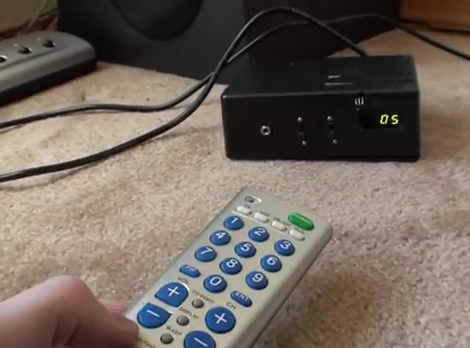
The speaker system [Zurcher] bought was made by Klipsch. It is a surround sound unit but it’s intended to be used with a computer so there’s no wireless remote for it. Instead, a wired unit sits on the desk and lets you select between the speakers or headphones, and has a volume adjustment knob. The thing is he uses them for his home theater system and had to add his own remote control hardware to adjust them from across the room.

He started with some web searches that helped a lot. It seems others have mapped out the hardware in the past and he was able to use that information to find the volume chip inside the controller. A bit of signal sniffing let him work out the control commands coming in over the i2c bus. This was the information he needed to build his own controller. He grabbed his Arduino board, and IR receiver to take commands from just about any remote, and a four-digit 7-segment display to provide settings feedback. You can seen him showing off the final build in the clip after the break.


Filed under: home entertainment hacks

Helping with a special friend with his first robot,

I am helping my friends first robot! He primaily wanted tractor treads and an Arduino "because he heard they were good" ( I didn't disagree with him. :-)

We decided on an inexpensive kit was a good starting point and then it can be expanded later.

Our choice was the BrutusBot and electronics package (looks like I get to solder 2 boards, lucky me...). It was fairly cheap.

He seems good in the programming and mechanical areas, he isn't so good with the electronics part (he does fine with some guidance).

read more

Let's Make Robots 06 Jun 11:58
arduino  avr  brutusbot  first robot  kit  simple  

Our dear Massimo Banzi with arduino Grande

I post this for the sheer delight on the face of Massimo

Our previous post about arduino Grande is here and more details of making it is here.

Arduino Blog 06 Jun 06:53