Posts with «arduino» label

Building an artificial moon for Burning Man

If you were lucky enough to score passes to this year’s Burning Man, be sure to keep a look out for [Laurence Symonds] and crew, who are putting together an ambitious fixture for the event. In reality, we’re guessing you won’t have to look far to find their giant moon replica floating overhead – in fact it will probably be pretty hard to miss.

They are calling the sculpture “Lune and Tide”, which of an 8 meter wide internally lit moon which hovers over a spinning platform that’s just as big across. The inflatable sphere is made up of giant ripstop nylon panels which are home to 36,000-odd sewn-in LEDs. The LEDs illuminate the sphere to reflect the natural color of the moon, though with a simple command, [Laurence] and Co. can alter the lighting to their heart’s content.

If Hack a Day’s [Jesse Congdon] makes his way out to the festival again this year, we’ll be sure he gets some footage of Lune and Tide in action. For now, you’ll have to satisfy your curiosity by checking out the project’s build log.


Filed under: arduino hacks, led hacks

A much larger rainbow board of many ping pongs

[George] started with an 8×8 grid, but just couldn’t help himself from upscaling to this 32×16 pixel ping pong ball display. That’s right, It’s a 512 pixel array of fully addressable RGB LEDs diffused with one ping pong ball each.

We featured the predecessor to this project back in January. That one was an 8×8 display using a Rainbowduino as the controller. [George] took what he learned from that build and expanded upon it. The larger display is modular. Each module starts as an 8×8 grid which connects back to the Arduino using a breakout shield with some Ethernet jacks used as quick connects. The LEDs are driven by 595 shift registers, with transistors which protect the logic chips from the currents being switched.

He had a lot of help soldering all the connections for the display and ended up bringing it to show off at the Manchester mini maker faire. See it in action in the video after the break.


Filed under: led hacks
Hack a Day 27 Jul 15:01

Tracked Telepresence Robot

A friend of mine (Dimos) from another site (www.GRobot.gr) started building a tracked robot that would be operated remotely.

read more

Arduino, resistor, and barrel plug lay waste to millions of hotel locks

The security flaws on this common hotel keycard lock are nothing short of face-palmingly stupid. Look closely at the picture above. This is a hotel room door swinging open. The device he holds in his hand is an Arduino connected to the OUTSIDE portion of the door lock. It takes approximately 200 milliseconds from the time an attacker plugs the device in, until the door can be opened. Yes, in less than 1/4 of one second an Arduino can open any of the millions of these locks in service.

The exploit in Onity programmable keycard locks was revealed by [Cody Brocious] at the Blackhat conference. Apparently the DC barrel jack on the outside of the lock serves as a one-wire protocol interface. Once communications are established a 32-bit sitecode can be read from any of the locks and immediately used to open the door. There is no authentication or encryption used to obfuscate this kind of attack. To make matters worse, you can even read out master key and skeleton key codes. These codes facilitate ‘magic’ keys used to open a variety of different doors through the system.

We’re no strangers to easy hotel beak-ins. But how can a digital lock possibly be sold with this type of vulnerability present? Really!?

Here’s the white paper on the exploit as well as the slides from his talk (PDF).

[via Reddit]


Filed under: cons, security hacks
Hack a Day 25 Jul 20:01

What is your favorite Arduino compatible board?

I do like a lot of controllers (and I am sure there are more to come!)

On the subject of the Arduino:

What is your favorite Arduino (program / form factor) compatible board???

Mine is: The Uno32 because it is a fast Arduino and can be so much more (has a PIC 32 bit chip)! I still wish it was a 5V I/O board, but 3.3V is here to stay...


Let's Make Robots 25 Jul 08:33
arduino  avr  compatible.  uno32  vote  

Hacker finds flaw in hotel locks, can ruin your vacation with $50 DIY gadget

Admittedly, the headline is designed to get your dander up. You're in no immediate danger of a technologically-gifted thief plugging a couple of wires into your hotel door and making off with your sack of souvenirs from the Mall of America. But that's not to say it's impossible. Cody Brocious, who was recently brought on by Mozilla to work on Boot to Gecko, is giving a presentation at the annual Black Hat conference in Vegas where he demonstrates a method for cracking open keycard locks with a homemade $50 device. The hack only works on locks made by Onity at the moment, and real life testing with a reporter from Forbes only succeeded in opening one of three hotel doors. Still, with between four and five million Onity locks installed across the country (according to the company), that is a lot of vulnerable rooms. The attack is possible thanks to a DC jack on the underside of the lock that's used to reprogram the doors. This provides direct access to the lock's memory, which is also home to the numeric key required to release the latch -- a key that is protected by what Brocious described as "weak encryption." Ultimately the source code and design for the Arduino-based unlocker will be published online alongside a research paper explaining how these locks work and why they're inherently insecure. The hope is that manufacturers will take notice and improve the security of their wares before the world's ne'er-do-wells perfect Brocious' technique.

Filed under: Misc. Gadgets

Hacker finds flaw in hotel locks, can ruin your vacation with $50 DIY gadget originally appeared on Engadget on Tue, 24 Jul 2012 18:34:00 EST. Please see our terms for use of feeds.

Permalink | Email this | Comments

Arduino Distributor Pre-order/Group Buy

Hi All,

read more

The Tank

Primary image

What does it do?

Avoid obstacles

This is the tank. One day, perhaps it'll earn itself a real name.

Being my first robot, it is of course a skid-steering obstacle avoider. Since I already had an Arduino and wanted to continue with it, I didn't follow the Start Here robot, but instead pretty much copied LarryBot. It is made of: a Tamiya 70097 twin-motor gearbox, a Tamiya 70100 track and wheel set, an Arduino Uno and an SN754410 H-bridge chip.

Cost to build

Embedded video

Finished project

Number

Time to build

Type

tracks

URL to more information

Weight

read more

Reading Sega carts off a breadboard

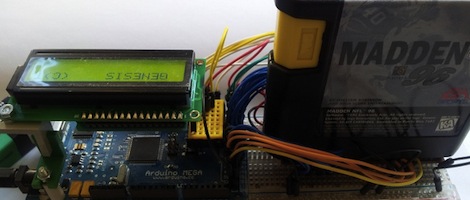
Golden Axe is great, and the Sonic 3/Sonic and Knuckles combo is one of the highest works of art from the 16-bit era, but for those of us without a working Genesis or Megadrive, we’ve had to make due with the ROMs others provide. [Lee] figured out an easy way to read the data off these old Sega cartridges using easily scavenged parts and an Arduino Mega, paving the way for an Arduino-based ROM dumper.

The connector on the bottom of a Sega Genesis cartridge has a 2×32 pinout, normally requiring 64 connections to actually read the card. These connectors aren’t readily available, but [Lee] did manage to find a few 2×31 pin connectors lying around in the form of old ISA sockets. The outer pins of a Genesis cart are used for grounds and a ‘cartridge insert’ slot, and after filing away the end of an old ISA connector, [Lee] found he could actually read the data on these old game cartridges.

There are 49 data and address pins on these old Sega carts, so an Arduino Mega needed to be brought into the mix to actually read some of the data on the ROM chip. As of now, [Lee] can read data from the cart but has only gotten so far as to read the licensing data stored at 0×80. Still, very cool and the first step towards an Arduinofied Sega cart dumper.


Filed under: arduino hacks, classic hacks

Wearable Fabric on the Arduino Store

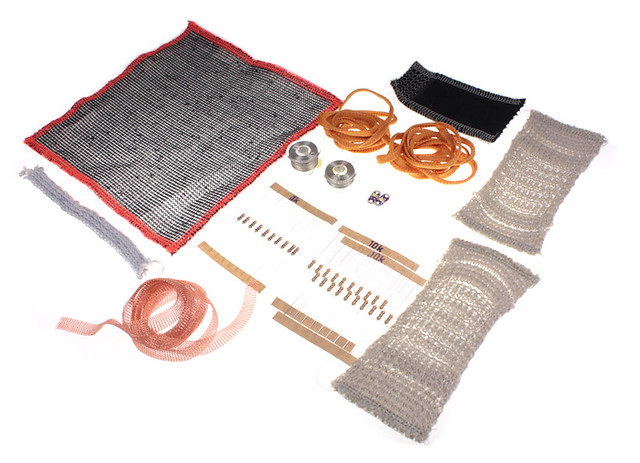
We are happy to announce the first wearable kit on the Arduino Store . This kit has been made by Plug’n'Wear specifically for us. All fabrics in this kit are produced in Italy, and strongly related to a textile family business. If you want to get deeper into the story of this product have a look at Riccardo Marchesi presentation (still in Italian, soon to be traslated!) at World Wide Rome 2012.

Read over for Kit’s features

This kit features:

  1. 1x Circular Stretch Sensor Designed by Hannah Perner-Wilson, this circular knit stretch sensor works perfect when you need to detect tension in many projects.
  2. 2x Textile push button to make easy digital inputs in cloth, scarfs o bags.
  3. 2x Spools of Conductive thread, ready to be hooked over a sewing machine
  4. 2x Soft potentiometer kit will let you import analog data into your wearable project: this kit includes 1 meter of knitted conductive tape and a metal ring. Watch it in action (see video)
  5. 10x 1k ohm resistor
  6. 10x 10k ohm resistor
  7. 1x Textile perfboard is going to change the way you think of wearable circuits. You can sew or even solder components (SMD & through-hole) on this . It can be easily cut or sewn with a standard sewing machine. Washable. Size: 15 cm x 15 cm (6″ x 6″) / Pitch: 2.54 mm (0.1″)
  8. 1x Knitted Coated Copper Tape. Small conductive tape made of coated copper fine wire (112 micron). Flexible, easy to cut, sewable with a standard sewing machine, It can be easily welded ( The coating will melt and tape will be soldered). The surface of this tape has a good insulation thrughout its lenght. Resistance: 107 Ohm/m. Width: 9 mm (0.35″)
  9. 1x Analog Textile Press Button, working with a resistive principle (resistance goes down when you press it). It works as a bend sensor as well. By connecting more sensors together it is possible to make a matrix analog switch. Sensitive area 40mm x 40mm (1.57″x1.57″)
  10. 2x LilyPad LED Bright White A simple, very bright, 250mcd, white LED LilyPad

source: [arduino store]