Posts with «arduino» label

Touchless MIDI: The Secret’s In the Mitten

MIDI is a great tool for virtually any musician. Unless you’re a keyboard player, though, it might be hard to use it live. [Evan] recently came up with a great solution for all of the wistful guitar players out there who have been dreaming of having a MIDI interface as useful as their pianist brethren, though. He created a touchless MIDI controller that interfaces directly with a guitar.

[Evan] set up an Arduino Nano to handle the MIDI interface to the computer. A detector coil from a previous project was installed onto the guitar can recognize how far away the guitarist’s hand is from the body of the guitar, giving the musician control over an effect of their choosing. The guitarist simply needs to be wearing a special mitten for use with the detector coil. [Evan] also added three tactile buttons, meaning that this MIDI usefulness can be extended to three different selectable effects.

Be sure to check out the video below for a demonstration of how the interface works. [Evan] has also made the schematics and Arduino code available if you decide to build your own. This isn’t [Evan]’s first MIDI rodeo, either. He’s also created a MIDI drum interface from a Rock Band drum set, too.


Filed under: musical hacks
Hack a Day 06 Nov 21:00

Harpsi-Gourd Gets You Into Thanksgiving Spirit

Halloween might be over, but for some of us there’s still another pumpkin-centric holiday right around the corner to give us an excuse to build projects out of various gourds. During a challenge at a local event, [Michael] came up with a virtual cornucopia of uses for all of the squashes he had on hand and built a touch-sensitive piano with all of them.

The musical instrument was dubbed the Harpsi-Gourd and makes extensive use of the Arduino touch-sensitive libraries. Beyond that, the project was constructed to be able to fit into a standard sized upright piano. While only 15 pumpkins are currently employed, the instrument can be scaled up to 48 pumpkins. Presumably they would need to be very small for the lid of the piano to still close.

The Harpsi-Gourd is a whimsical re-imagining of the original Makey Makey which can be used to do all kinds of things, including play Mario Bros. There are all kinds of other food-based musical instruments at your disposal as well, though.


Filed under: musical hacks
Hack a Day 06 Nov 18:00

Personal Compass Points to Your Spawn Point

A conventional compass points north (well, to magnetic north, anyway). [Videoschmideo]  wanted to make a compass that pointed somewhere specific. In particular, the compass — a wedding gift — was to point to a park where the newlywed couple got engaged. Like waking up in a fresh new Minecraft world, this is their spawn point and now they can always find their way back from the wilderness.

The device uses an Arduino, a GPS module, a compass, and a servo motor. Being a wedding gift, it also needs to meet certain aesthetic sensibilities. The device is in an attractive wooden box and uses stylish brass gears. The gears allow the servo motor to turn more than 360 degrees (and the software limits the rotation to 360 degrees). You can see a video of the device in operation, below.

The compass module may be hard to find, but you should be able to modify it to work with more readily available boards. Since you may not be able to find the exact gears used, your build will probably be a little different anyway.

The brass and wood are decidedly steampunk looking. It reminded us of this GPS project. If you have too much street cred to buy an off-the-shelf GPS, you could always roll your own.


Filed under: Arduino Hacks, gps hacks
Hack a Day 05 Nov 12:00

These Makers built a gesture-controlled robotic arm

Using a Kinect sensor with MATLAB/Simulink and an Arduino, B.Avinash and J.Karthikeyan made a robotic arm to mimic their every move.

If you need a robotic arm to follow your movements, the Kinect sensor is a great place to start. On the other hand, it’s a long leap programming-wise to go from sensor input to coordinated movement of servo motors. Through a toolchain stretching from the sensor itself, to a computer, and finally to an Arduino Mega controlling the servos directly, Avinash and Karthikeyan did just that.

For their process, the computer takes data from the Kinect sensor, then translates it into servo angles using the MATLAB and Simulink computer programs. Resulting data is then fed into the Arduino via a serial connection, which controls the robot’s movements appropriately with a slight delay.

Be sure to check out the project’s Instructables page to learn more about this awesome build!

A VR “glove” inspired by Ender’s Game

To complement his VR experience, Florian Mauer built a controller that could perhaps best be described as a “hand bracelet.”

As virtual reality applications begin to be implemented, one challenge will be finding an interface device, or combination of them that are unobtrusive, yet allow for versatile input. Mauer decided on a design inspired by the gravity control bracelet from the movie “Ender’s Game.” It can be worn similar to how a pistol is held (illustrated here with a virtual pistol), and reportedly doesn’t get in the way when using a keyboard or mouse–at least before the button was added.

The 3D-printed gadget features an IMU, Arduino Pro Micro, as well as a couple buttons for in-game actions. This helps the Leap Motion controller used here to recognize gestures that would be difficult for its camera to pick up otherwise.

In the 2013 adaptation of Ender’s Game, Harrison Ford’s character slips a metallic device over his hand to control gravity in the training room. This scene inspired me as I’ve been trying to imagine VR controllers that can be used alongside mouse+keyboards. The controller used by Ford seemed convenient to put on, offer a lot of finger freedom, and probably allow for throwing VR objects without falling off.

You can see more information on this promising project on Mauer’s website here.

Listen to the Eerie Music of This Handmade MIDI Pipe Organ

Pipe Organs may be out of vogue, but one makers MIDI-fied version definitely turned heads at the Orlando Maker Faire.

Read more on MAKE

The post Listen to the Eerie Music of This Handmade MIDI Pipe Organ appeared first on Make: DIY Projects and Ideas for Makers.

Turn mini Pringles cans into electronic drums

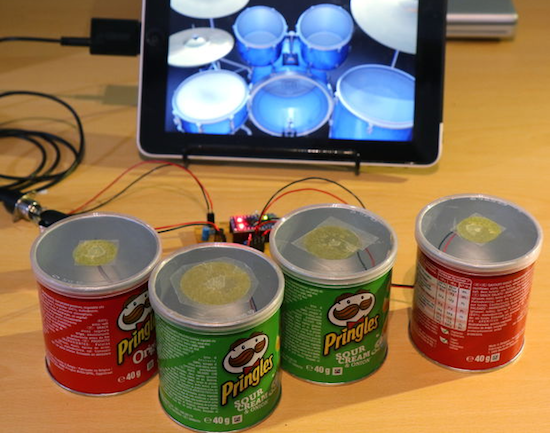
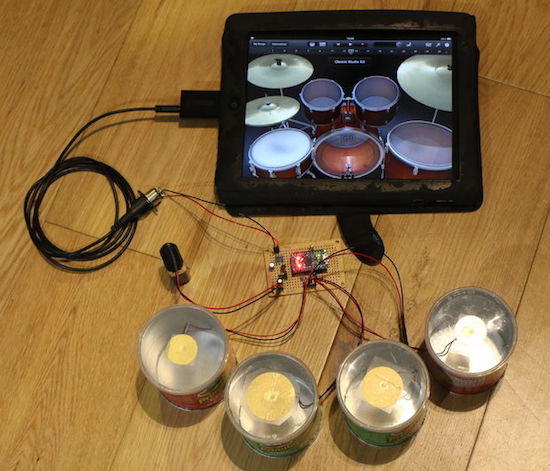
Ever find yourself drumming on Pringles cans with your fingers? This hack adds a MIDI output to make it sound awesome!

If you’re tired of playing virtual drums on an iPad or other device, and need some tactile feedback, snack-sized Pringles cans not only sort of resemble drums, but provide a nice “bounce” when hit by a finger or thumb. All that’s required, besides washing the lid and canister to remove grease, is the attachment of a piezoelectric sensor to the lid to detect taps. These impulses are then fed to an Arduino Micro, converting everything into a MIDI signal, which can be read by your favorite electronic instrument.

With a bit of luck, you can plug it straight in to a MIDI drum synth and start playing. The four pads transmit kick drum, snare, closed hi-hat and open hi-hat note values according to the General MIDI specification.

You can find more information on this excellent hack on its Instructables page, or check out the video below to see it in action!


A kinetic installation becomes a hyper-sensorial landscape

Interactive kinetic installations are always incredible to see in action, but they become even more awesome when they’re part of a performance. As in the case of Infinite Delta, which is the result of Boris Chimp 504 + Alma D’ Arame’s artistic residency at Montemor-o-Novo in Portugal.

Using Arduino boards, they built a physical structure comprised of triangular planes that swing back and forth like a pendulum, controlled by a series of servo motors. Light is projected onto the moving structures, creating patterns that are then reflected onto a nearby wall. Infinite Delta also modifies its shape in response to the movement and sound of the audience.

In Euclidean geometry any three points, when non-collinear, form a unique triangle and determine a unique plane. Nevertheless, in quantum physics the string theory proposes that fundamental particles may also have similarities with a string. It also states that the universe is infinite and in it all matter is contained. In this “multiverse”, our universe would be just one of many parallel existent universes. What would happen then if we multiply triangles infinitely? Could or would we have access to those parallel universes?

The performers augmented the physical world by overlaying it into the digital world to produce a new alternative, magic and hyper-sensorial landscape.

Minimal Arduino Clock

Making a clock with a common microcontroller like an Arduino isn’t very difficult. However, if you’ve tried it, you probably discovered that keeping track of wall time is difficult without some external hardware. [Barzok] has a very minimal clock build. It takes a handful of LED arrays with an integrated driver, an Arduino Nano, a real-time clock module, and a voltage regulator.

The software uses a custom 6×9 font and handles addressing the LEDs as one single display. Because the real time clock module is so accurate, there’s no provision for setting the time. [Barzok] says that twice a year he just hooks the Arduino up and reflashes the program with a new start time and that seems to be sufficient.

It wouldn’t be too hard, though, to add a few buttons to allow for setting the time or accepting other user input. Then again, this is a minimal build. It would be a good starter project for someone looking to get into building microcontroller projects.

If you want really minimal, you could go with a 4 LED clock (but you better know the resistor color code). Of course, an ESP8266 can serve as a simple clock and it gets set via NTP which is even better.


Filed under: Arduino Hacks, clock hacks
Hack a Day 03 Nov 03:00

Rotary Cell Phone: Blast from a Past that Never Was

The 1970s called and they want their rotary dial cell phone back.

Looking for all the world like something assembled from the Radio Shack parts department – remember when Radio Shack sold parts? – [Mr_Volt]’s build is a celebration of the look and feel of a hobbyist build from way back when. Looking a little like a homebrew DynaTAC 8000X, the brushed aluminum and 3D-printed ABS case sports an unusual front panel feature – a working rotary dial. Smaller than even the Trimline phone’s rotating finger stop dial and best operated with a stylus, the dial translates rotary action to DTMF tones for the Feather FONA board inside. Far from a one-trick pony, the phone sports memory dialing, SMS messaging, and even an FM receiver. But most impressive and mysterious is the dial mechanism, visible through a window in the wood-grain back. Did [Mr_Volt] fabricate those gears and the governor? We’d love to hear the backstory on that.

This isn’t the first rotary cell phone hybrid we’ve featured, of course. There was this GSM addition to an old rotary phone and this cell phone that lets you slam the receiver down. But for our money a rotary dial cell phone built from the ground up wins the retro cool prize of the bunch.

[via r/Arduino]


Filed under: Arduino Hacks, classic hacks