German semiconductor maker Infineon Technologies AG announced that it’s producing a printed circuit board (PCB) that dissolves in water. Sourced from UK startup Jiva Materials, the plant-based Soluboard could provide a new avenue for the tech industry to reduce e-waste as companies scramble to meet climate goals by 2030.
Jiva’s biodegradable PCB is made from natural fibers and a halogen-free polymer with a much lower carbon footprint than traditional boards made with fiberglass composites. A 2022 study by the University of Washington College of Engineering and Microsoft Research saw the team create an Earth-friendly mouse using a Soluboard PCB as its core. The researchers found that the Soluboard dissolved in hot water in under six minutes. However, it can take several hours to break down at room temperature.
In addition to dissolving the PCB fibers, the process makes it easier to retrieve the valuable metals attached to it. “After [it dissolves], we’re left with the chips and circuit traces which we can filter out,” said UW assistant professor Vikram Iyer, who worked on the mouse project.
The video below shows the Soluboard dissolving in a frying pan with boiling water:
“Adopting a water-based recycling process could lead to higher yields in the recovery of valuable metals,” said Jonathan Swanston, CEO and co-founder of Jiva Materials. Jiva says the board has a 60 percent smaller carbon footprint than traditional PCBs — specifically, it can save 10.5 kg of carbon and 620 g of plastic per square meter of PCB.
Infineon has produced three different circuit board prototypes using the Soluboard framework. The company is currently only using the dissolvable PCB for demo and evaluation boards, and it says around 500 units are now in use. However, it’s “exploring the possibility of using the material for all boards” with an eye on expanding adoption over the next few years. Based on the results of stress tests, it also plans to “provide guidance on the reuse and recycling of power semiconductors removed from Soluboards” to lessen the chances of the salvageable parts from future production models going to waste.
This article originally appeared on Engadget at https://www.engadget.com/water-soluble-circuit-boards-could-cut-carbon-footprints-by-60-percent-201845709.html?src=rss
Last spring, Amazon launched its long-rumored live audio-streaming platform, Amp. The pitch was to reinvent radio with “an infinite dial of shows.” Amp offers users access to a vast, built-in music library to create their own DJ sets with. No need to buy songs or flirt with the DMCA, just make a playlist, go live, talk in between tracks, follow the chat and even invite callers. When I wrote about it a year ago, it showed promise, but it was iOS only, light on users and had a limited feature set.
A little over a year later and Amp is reaching an important milestone: It’s finally available on Android. Amp is Amazon’s first home-grown streaming platform and the year-plus stint as an Apple exclusive meant it enjoyed a level of technical predictability and a self-imposed restriction on growth and user numbers. But as the doors open to the other half of the mobile universe, it’s about to be exposed to the full reality of competing in an already busy social-creator landscape.
Growing beyond iOS is an important move for Amp, even if the platform technically remains in beta (and US-only). But the wider reach of Google’s operating system — from TVs to Chromebooks and beyond — will be a decisive step in the process of Amazon proving it can build a viable streaming platform from the ground up (rather than acquire an already successful one).
You can, of course, find DJ sessions and internet radio in myriad places online. Whether it’s big platforms like YouTube and TikTok or more direct rivals like Stationhead or Tidal (via its Live Sessions feature) and even Amazon Music’s own DJ Mode, there are several destinations for live curated music streams. Of course, let’s not forget Amazon-owned Twitch, which is teeming with tune spinners. Oh, and there’s obviously FM radio, too. This obviously begs the question: What makes Amp unique?
Amazon
“It's very much like Sirius meets YouTube,” Zach Sang, one of Amp’s contracted creators, and former broadcast DJ told Engadget. “It's real life, legacy career broadcasters mixed with the future of those broadcasters. It's everybody coming together, it's radio democratized. It's a way that radio genuinely should be programmed: for people and not for profit,” he added. From a user’s point of view, Amp’s main differentiator appears to be its focus on radio and radio-style shows specifically. Plus that built-in music library (Stationhead, for example, requires you to have either Apple Music or Spotify at your own cost).
I asked user Christina “Criti” Gonzalez, who hosts her own daily show, how she’d describe Amp. “[It’s] a very unique, weird place where you're able to listen to all the music you've forgotten about, didn't know about and crave to hear, again with personalities and so many people of all different walks of life that have one common interest - music.”
Amp Co-Founder, Matt Sandler - who used to work at LA’s KROQ FM – explained that he felt all of the existing options weren’t quite giving listeners or creators what they wanted. “If you posted a job for KROQ and an on air position, you'd get hundreds and hundreds, if not thousands of submissions and people who wanted to curate music and talk to the community on air,” he told Engadget. “There have been lots of services built around live connection or music or community. One of the things that I think will drive the success of a business like this is really that balance between scale and connection.”
Amp signed deals with celebrities and established presenters such as Nicki Minaj, Joe Budden, Nick Cannon and the aforementioned Sang to give the platform some known-name appeal, and it’s done so without creating much of a barrier around them compared to regular creators. Your show can sit right next to Nicki Minaj’s in the listings. Although the roster covers large genres like hip-hop, sports, country and pop there’s not much in the way of alt/indie or electronic in that lineup right now.
Unlike Clubhouse, which enjoyed an early surge of popularity, Amp has largely gone under the radar since launch. “The thing we're maniacally focused on every day is making sure that the product is right before stepping out and bigger and bigger fashion,” Sandler said. But many people I’ve mentioned it to aren’t aware of it – and Amp’s not even included on the list of Amazon products/services Wikipedia page.
Amazon
The app is clearly a lot busier than when I wrote about it just after launch, but the average number of listeners for most shows remains frustratingly low for most shows (based on multiple user reports and other publicly visible data). But several users explained they weren’t discouraged. “The community that it has right now, it's a small enough space for people to feel like they're connected, even if they don't know each other.” Gonzalez said.
At the beginning, according to Sandler, even Amp's leadership was unsure in which direction the platform would unfold. There was the possibility that the big-name artists would dominate while regular users gravitated to being listeners. In reality, it’s the smaller, home-grown shows and the aforementioned community that has made Amp a nice place to hang out.
“The culture there is so inviting.” Gonzalez said. “I feel like other social media sites can turn negative quickly. I haven't had much experience with that on Amp and I appreciate that.” Adding, ”It's crazy what the experience on Amp has done, because I truly honestly say to anyone that's not an Amp to join it, because it really will change your perspective.”
One of the main complaints I had with Amp right after launch was that hosts needed at least one listener to be able to play a song and often that meant… waiting. There was also no way to communicate with any listeners you did have. Today the awkward waits are (mostly) gone and each stream has its own chat room which has switched it from a one-directional platform to the collection of friendly gatherings that it has become today.
Several creators and listeners have told me they’ve created genuine connections and friendships that have spilled over into real life. The chat rooms in shows are a rare mix of positivity, musical discourse and humor. Trolling and negativity is unusually rare and it’s obvious there’s a real sense of commitment to the app. But at some point it needs to expand to stop it becoming a circular economy where everyone is both a host and a listener.
Amp doesn’t share information about user numbers or demographics, but the typical host and listener right now, perhaps unsurprisingly, appears to mirror the generations that were brought up on mix tapes and burning albums to CD. Where sharing music was more tactile and a little bit slower. In the nicest possible way, the community energy often feels like the best bits of early internet chat rooms. Like many music-first spaces online, there’s little in the way of negativity, and while many creators may fall into a similar age group, a variety of backgrounds has been a defining factor since day one.
Amazon
The positive community is Amp’s to lose though. As it opens up to Android, the door to even more users opens, and with that the challenge of scaling up the platform while maintaining what keeps it special. And there’s also the matter of money. Right now, Amp pays out many of its hosts via an opaque creator fund. “One of the things that we're focused on is making sure that creators can earn through the service over time, not just through the fund, but through other mechanisms as well.” Sandler said. When I asked about subs, tipping and other Twitch-esque ways to earn money he added “Those are all things you could easily imagine in the service.”
For now, the creator fund is helping keep hosts motivated, but Amp will need to provide realistic alternative revenue streams to keep creators around (and, of course, lure in more). But perhaps the bigger investment Amp needs is in itself. It’s hard to find much in the way of outward promotion of the app and the best tool for promoting its best creators are its own social channels. If Amp can make itself more visible, it can grow the user base which in turn makes that creator economy, be it tipping, subs and beyond, more viable.
There are also occasional technical issues that remind you the app is still in beta, which an injection of new users, on a new operating system no less, might exacerbate. Mostly, it’s small annoyances like the chat swallowing your last message. Occasionally, it’s more dramatic like a stream crashing or a host being booted out of their own show.
“The glitchiness causes some frustration. And, sometimes that can change your experience doing the show and with others listening. So once those kinks get ironed out, I feel like the creators will feel more comfortable and less anxious while they're doing sets” Gonzalez said. Users have even coined the phrase “Amp be Ampin’” as a refrain to the inevitable quirkiness that happens every couple of weeks or after an update.
Where does the app go from here? “I think there's a big opportunity for amp specifically to move charts and culture around the world. And that means personalities, spinning music, having conversations and developing communities that exist in the app but that have social currency outside of the app as well.” Sandler said. Sang on the other hand thinks it’s a way to keep the spirit of radio going. “It's not like there's any major radio stars on the come up. So it's like, where are they going to come from? Let them come from Amp.”
Or, as Gonzalez was quick to point out, sometimes, it’s just about the music. “There are certain creators that talk through their experience or a memory or something like that. And it completely changes how I looked at the song to begin with” she said. “I love the community so much, but it's also just the variety, being exposed to certain genres. So I love that and ever since I've been really addicted.”
This article originally appeared on Engadget at https://www.engadget.com/amazon-amp-is-trying-to-reinvent-radio-194634553.html?src=rss
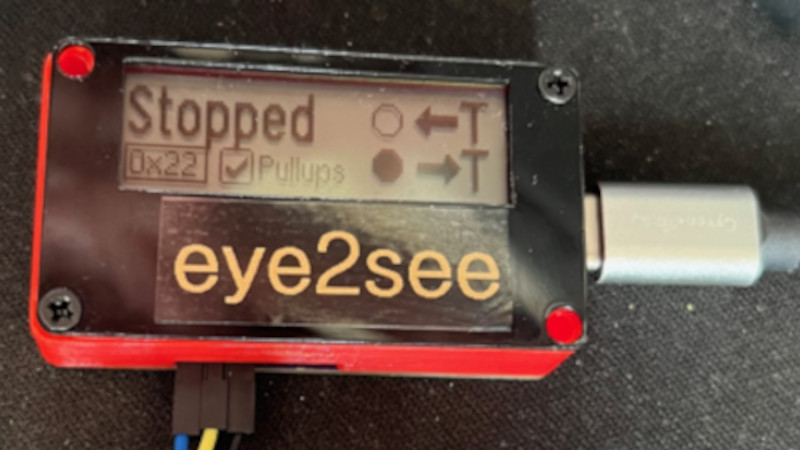
For as popular as the Arduino platform is, it’s not without its problems. Among those is the fact that most practical debugging is often done by placing various print statements throughout the code and watching for them in the serial monitor. There’s not really a great way of placing breakpoints or stepping through code, either. But this project, known as eye2see, hopes to change that by using the i2c bus found in most Arduinos to provide a more robust set of debugging tools.
The eye2see software is set up to run on an Arduino or other compatible microcontroller, called the “probe”, which is connected to the i2c bus on another Arduino whose code needs to be debugged. Code running on this Arduino, which is part of the eye2see library, allows it to send debugging information to the eye2see probe. With a screen, the probe can act as a much more powerful debugger than would otherwise typically be available, being able to keep track of variables in the main program, setting up breakpoints, and outputting various messages on its screen.
The tool is not without its downsides, though. The library that needs to run on the host Arduino slows down the original program significantly. But for more complex programs, the tradeoff with powerful debugging tools may be worth it until these pieces of code can be removed and the program allowed to run unencumbered. If you’d like to skip needing to use a second Arduino, we’ve seen some other tools available for debugging Arduino code that can run straight from a connected PC instead.
Mazda's MX-30 is a strange EV, and it appears the company knows this. The automaker is pulling the small crossover from the US market after the 2023 model year. The company says it's currently focused on "large platform" plug-in hybrids like the CX-70 and CX-90, and also offers conventional hybrids like the CX-50.
The MX-30 is Mazda's first and only mass-produced EV to date, and it came to the country in fall 2021 as a California-only model. From the start, its prospects were limited by a number of unusual business decisions. On top of its small size, it had just a 35.5kWh battery with an estimated 100-mile range. This was supposed to make it feel more like a gas car and limit the car's CO2 footprint, but the net result was a car that was both less exciting to drive and less practical than competing EVs costing significantly less than Mazda's $35,385 sticker. The outgoing current-gen Chevy Bolt costs $9,000 less while delivering more performance and over twice the range.
Sales were accordingly poor. Mazda has sold just 571 MX-30 units in the US over three years. In some countries, the company has reworked the machine as a plug-in hybrid with a rotary gas engine and an estimated 53 miles of electric-only driving.
Mazda is rethinking its EV strategy. It plans to introduce cars based on both an existing platform as well as a new framework. There are claims the company might use a future Toyota platform expected to deliver over 600 miles on a charge. The MX-30 discontinuation isn't the end, in other words — rather, it's an acknowledgment that the company needs to be more competitive.
Sony announced pricing and availability today for its high-end 2023 QD-OLED television that the electronics giant says offers its “best color ever.” The Google TV-powered Bravia XR A95L will ship in 55-inch, 65-inch and 77-inch models, starting at $2,800.
The Sony Bravia XR A95L has a QD-OLED panel that takes the best of OLED screens (deep blacks, rich contrast) while adding the superior brightness and colors you’d expect from QLED TVs. Earlier this year, Engadget’s Sam Rutherford found that the new TV “definitely did a better job at preserving details in shadows” than the rival LG C2. “The A95L was particularly impressive thanks to its QD-OLED panel and Cognitive Processor, with Sony claiming brightness that’s now two times higher than last year’s model.” The company also says the new set provides up to 200 percent color brightness compared to typical OLED TVs.
The Cognitive Processor XR powers the set’s color range and hues, essentially acting as a brain that manages details like color, contrast, clarity, adaptive noise reduction and auto HDR tone mapping. In addition, the TV includes a Bravia Cam in the box: The sensor acts as a webcam for video calls (including Zoom support) while optimizing the television’s picture and sound based on your location in the room.
Sony
The A95L runs Google TV software but includes a few new extras this generation. That consists of a Game Menu for managing gaming picture and assistance settings. (It even lets you add a persistent crosshair for first-person shooters.) It also has exclusive PS5-friendly features: Auto HDR Tone Mapping and Auto Genre Picture Mode to optimize the premium display for your favorite PlayStation games. The TV also includes a new Eco Dashboard to help you manage all its energy-saving settings in one place.
Sony’s new TV also has Acoustic Surface Audio+: actuators behind the TV that can “vibrate to produce audio from the entire screen,” helping make dialog clearer. The feature works with Sony Soundbars, as select models will sync with the television’s built-in vibrations to produce “fuller vocals” on the center audio channel. The company also synced its Soundbars to show their volume, sound field and other toggles directly in the TV’s Quick Settings menu.
The Sony Bravia XR A95L starts at $2,800 for the 55-inch model. The 65-inch variant will cost $3,500, while the 77-inch model will total $4,500. All three models will be available for pre-order from Sony authorized dealers starting on August 21st.
This article originally appeared on Engadget at https://www.engadget.com/sonys-latest-qd-oled-tv-is-significantly-brighter-than-last-years-models-175307553.html?src=rss
Meta’s consumer-facing generative AI tools based on its new Llama 2 model may not be far off. The company appears to be working on several new generative AI features for Instagram, including labels that allow creators to identify images “generated by Meta AI.”
That’s according to screenshots shared by reverse engineer Alessandro Paluzzi who often teases unreleased features from Meta’s apps. Paluzzi recently posted a screenshot that shows an in-app message detailing how posts created with generative AI tools may soon be labeled within Instagram. “The creator or Meta said that this content was created or edited with AI,” the message explains. Additional labels indicate it was “generated by Meta AI” and that “content created with AI is typically labeled so that it can be easily detected.”
Meta didn’t immediately respond to a request for comment, but the screenshot suggests that the company, like Google and others in the AI space, is interested in helping users discern when AI was used to create content. As generative AI tools have become more widely used, researchers and policymakers have raised concerns about how the technology could be used to aid the spread of misinformation or otherwise mislead people. Earlier this month, seven AI companies — including Meta — pledged to adopt a series of AI safety measures, like watermarks for AI-generated content.
While Meta so far hasn’t disclosed many details about its consumer-facing generative AI plans, Mark Zuckerberg has dropped several hints. “We're also building a number of new products ourselves using Llama that will work across our services,” the CEO said in a quarterly earnings call last week. “You can imagine lots of ways AI could help people connect and express themselves in our apps: creative tools that make it easier and more fun to share content, agents that act as assistants, coaches, or that can help you interact with businesses and creators, and more.”
Elsewhere, Paluzzi has spotted signs of other generative AI-powered tools for Instagram, including a “message summary” feature for summarizing long DMs, and new artistic tools for editing Stories.
This article originally appeared on Engadget at https://www.engadget.com/instagram-seems-to-be-working-on-labels-for-posts-generated-by-meta-ai-173427549.html?src=rss
The devs behind AI-based sample editing software Samplab are back with a free VST3 plugin that generates samples from text prompts. The appropriately-named TextToSample is a plugin that opens inside your DAW or as a standalone tool, allowing you to type, say, “bubbly synth melody” to create a, well, bubbly synth melody to do with as you see fit.
TextToSample utilizes Meta’s open-source AI-based sound generation toolset, MusicGen, and was trained using data provided by the algorithm. You can also drag and drop pre-existing sounds into the plugin and have it generate related samples, in addition to typing out commands.
The UI is extremely minimal and sparse, which makes it easy to use, but does present some inherent limitations. For instance, it doesn’t take pre-existing music on your track into account, so your first, second, and even third attempts will likely not match the tone you are going for. It also has trouble recognizing basic music concepts like keys, scales and BPM. Just like most AI-creation platforms, you aren’t going to get a perfect match right away. You’ll have to tweak, augment and provide further instructions, bit by bit, until satisfied.
However, when you get there, it’s pretty darn fun, creating the kinds of happy accidents you’d never stumble into on your own. Check out the demo video and that little flourish of guitar at the tail end of the sample as an example.
This is an AI tool in the year 2023, so there are some bugs. During experiments, we ran into issues like the plugin adding drums when we clearly stated that we didn’t want percussion. To that end, Samplab says the tool is not intended to “replace human musicians, which it’s not capable of doing anyway.” It’s free, though, so there's no harm in checking it out, and the technology should improve as more people use it.
This article originally appeared on Engadget at https://www.engadget.com/this-free-plugin-uses-ai-to-generate-music-samples-from-text-prompts-165058168.html?src=rss
A New York Times investigation uncovered earlier this year that the US government used spyware made by Israeli hacking firm NSO. Now, after an FBI investigation into who was using the tech, the department uncovered a confusing answer: itself, according to the New York Times on Monday.
Since 2021, the Biden administration has taken steps toward parting ways with NSO, given the firm's reputation for shady tools like Pegasus that lets governments discreetly download personal information from hacked phones without the user's knowledge. But even after the president signed an executive order banning commercial spyware in March, an FBI contractor used NSO's geolocation product Landmark to track the locations of targets in Mexico.
The FBI had inked a deal with telecommunications firm Riva Networks to track drug smugglers in Mexico, according to TheTimes. The spyware let US officials track mobile phones because of existing security gaps in the country's cellphone networks. While the FBI says it was misled by Riva Networks into using the tech, and has since terminated the contract, people with direct knowledge of the situation said the FBI used the spyware as recently this year.
This isn't the FBI's first run in with NSO and its spyware tools. Prior to the executive order banning the products for government use, the agency considered using Pegasus to aid in its criminal investigations. Spyware generally gained a bad reputation for its use to surveil citizens and suppress political dissent, with NSO considered one of the largest in the business.
This article originally appeared on Engadget at https://www.engadget.com/fbi-investigates-use-of-nso-spyware-pegasus-landmark-163949655.html?src=rss
You might want to run antivirus tools if you use certain Minecraft mods. The MMPA security community has learned that hackers are exploiting a "BleedingPipe" flaw in the Forge framework powering numerous mods, including some versions of Astral Sorcery, EnderCore and Gadomancy. If one of the game tweaks is running on Forge 1.7.10/1.12.2, intruders can remotely control both servers and gamers' devices. In one case, an attacker was using a new exploit variant to breach a Minecraft server and steal both Discord chatters' credentials as well as players' Steam session cookies.
As Bleeping Computerexplains, BleedingPipe relies on incorrect deserialization for a class in the Java code powering the mods. Users just have to send special network traffic to a server to take control. The first evidence of BleedingPipe attacks surfaced in March 2022 and were quickly patched by modders, but MMPA understands most servers running the mods haven't updated.
We've asked Mojang parent company Microsoft for comment. It's not responsible for Forge, so the tech giant can't necessarily stop or limit the damage. You won't be affected if you use stock Minecraft or stick to single-player sessions.
The full scope of the vulnerability isn't clear. While there are 46 mods known to fall prey to BleedingPipe as of this writing, there's the potential for considerably more. Users are asked to scan their systems (including their Minecraft folder) for malware. Server operators, meanwhile, are urged to either update mods or stop running them entirely. MMPA also has a PipeBlocker mod that protects everyone involved, although mod packs may cause problems if the mods haven't been updated.
This article originally appeared on Engadget at https://www.engadget.com/minecraft-mod-exploit-lets-hackers-control-your-device-162231445.html?src=rss
I wrote my first synth review for Engadget in 2019. At the time I thought it might be a one off. Maybe it would afford me the opportunity to play with some fun gear now and then, but “Engadget synth beat reporter” was not something in the cards long term. Well, four years later I’ve not only managed to turn music tech into a regular part of my job, but I’ve become something of a connoisseur of weird, cheapsynths. I’d almost say that I’ve become jaded by the relentless releases of wannabe Volcas and VSTs-but-hardware. So I was somewhat skeptical of SOMA’s Rumble of Ancient Times (RoAT from here on out), a $170 “8-bit noise synthesizer.”
Well, this little pile of battery-powered weirdness has silenced my inner cynic. It’s reminded me to stop being so precious about my music. That creating art should be fun. And that, sometimes, you just need to let things go.
Before I turn you off with more philosophical ramblings (and don’t worry, there will be more), let’s lay out exactly what the RoAT is. It’s an 8-bit digital synth and sequencer inspired by video games of the early PC era, which had to do a lot with incredibly little. The core here isn’t some high-powered ARM processor; there’s no advanced physical modeling or complex wavetables. Instead, the RoAT runs on a very basic microcontroller like you might find in old kitchen appliances. (Not the kind that connect to the internet and have giant touchscreens.)
There are four freely tunable oscillators with 16 waveforms to choose from. The frequency range available is huge and the potentiometers can only turn so much, so dialing in a perfect scale isn’t something that’s going to come easy. The 16 voice options are all harsh and decidedly digital. Think Atari 2600 in a blender. And the resonant filter is deliciously lo-fi. I know that it’s somewhat cliche at this point to say that a synth is oozing character, but I don’t know how else to describe the sound of RoAT. It’s one of the more characterful instruments I’ve had the pleasure of using at any price point.
The sequencer is basic, too. An oscillator is either on or off and that’s it. If you want a particular note you have to lock it in with the tuning knobs. The one variable is that by default, the voices can either be momentary on, or momentary off – so you can set one to drone while the others pop in to add color. The sequences must be played in live, nothing is quantized and the pattern length is just a single bar. But since it’s not a step sequencer, that doesn’t matter quite as much. You can always just turn the tempo down to 70 bpm while actually playing at 140 bpm and effectively get two bars.
Terrence O'Brien
The simplicity here actually makes it fun and fuss free. You just hold down the record button and tap the little copper pads under each voice button, wait for the loop to come back around and tap some more to add additional triggers. The whole process of dialing in notes then sequencing them is sloppy and playful. You don’t have to think about ratchets or parameter locks. The limitations actually free you up to focus on jamming, experimenting and iterating.
The one part of the RoAT interface that might seem intimidating at first is the bank of registers. This is how you do actual sound design on the instrument. There’s a table in the bottom right hand corner where all the various parameters are laid out, like frequency, wave selection, LFO type and speed, etcetera. They’re in numbered rows, from zero to seven, and you navigate between them using buttons on the left side labeled one, two and four. So yes, you will need to do some basic arithmetic if you want to change the release of a voice or tweak the filter resonance, which you’ll find on page five and select by pressing the one and four buttons (1+4=5, got it?). While this might seem unnecessarily complicated, it’s actually pretty easy to wrap your head around and I’d argue far faster and more enjoyable than trying to scroll through an endless menu.
Some of the parameters need a little more explanation than what can be squeezed into the table on the front. But flip the RoAT over and you’ll get most of the info you need on the back of the unit.
Terrence O'Brien
The one exception to this is page six of the registers, which is where you’ll find the summing algorithm controls. These are explained on the back of the device, but I’d be lying if I said I fully understood what they all meant or why they affect the sound the way they do. I have a feeling that many people will be in the same boat as me. That being said, you don’t really need to understand to simply tweak the knobs until you hear something you like.
By the way, turning knobs until you hear something you like is perfectly a valid approach for any instrument, but it seems particularly appropriate here. The dramatic changes even a tiny bit of movement introduces mean this is best navigated by feel. And if that seems like too much work for you, there’s that button labeled “CHAOS” in the top left corner. I bet you can guess what it does. (It causes chaos, btw.)
This button randomizes all the parameters except for the row you’ve currently selected in the register. So if you don’t have any of the numbered buttons on, you’re on row zero which controls pitch, you can knock out countless iterations on a particular melody or sequence, swapping in different waveforms and algorithms.
Terrence O'Brien
Now this is where the limitations of the RoAT might become an issue for some. Do you like the chaos you’ve just created? Great, you better record that right now. Get out a field recorder and a TRS cable, or fire up your DAW or something. Because once you flip that power switch on the RoAT off, your creation is gone – forever. There’s no saving of sequences. No presets. No MIDI out to control other instruments.
There is analog sync out, but no sync in. That means that, while you can connect the RoAT to a Volca or a Pocket Operator and keep them in time, you have to use the clock on the RoAT to drive everything. And there’s no tap tempo here or a screen where you can see the exact tempo you’re at. So I really hope you enjoy your jams at 108.45 BPM.
Terrence O'Brien
Practically everything about the RoAT is messy and ephemeral. But, that’s also kind of what makes it so great. I realize that a lot of what attracts me to the RoAT might not matter to many of you. You might just want to play a pleasant melody on a clean sounding synth. Which, great, I like doing that too. That’s not what you come to the RoAT for, though.
It’s excellent at noisy rhythmic patterns perfect for industrial or chiptunes. But it’s limited connectivity and inability to reliably reproduce the same exact results multiple times means it’s not an ideal performance instrument. Instead it’s best as a source of inspiration and samples. Though, thinking of the Rumble of Ancient Times in purely practical terms misses the point. It takes obsolete technology that would otherwise be destined for a landfill and mutates it into an experimental instrument that’s easy to get lost in. And every time you turn it on feels like a brand new adventure.
Terrence O'Brien
Remember when I said earlier that it reminded me that sometimes you need to let things go? Well, I am a digital hoarder. I have saved practically every photo I’ve taken since 2008 (and every crappy photochop since 2005). I have a hard drive overflowing with song sketches that are absolute trash and clearly going nowhere. And I have a hard time parting with even insignificant personal items floating around my house.
Not only that, but I am the sort of person who second guesses everything. I will nitpick and obsess over a project – be it a song or this review – until I hate it. In April of last year I mentioned in my review of the Chase Bliss Habit that I had been sitting on three songs for an EP for over a year. Well, absolutely zero progress has been made there. In fact I’ve since decided one of those songs is worthless and I’ve cut it.
Which brings me back to the Rumble of Ancient Times. Its simplicity, playfulness and sloppiness are a natural counter to my obsessive tendencies. Its insistence that you explore, iterate and constantly push forward prevents me from getting stuck. And the fact that I can’t save a sequence – that I have to start with a blank canvas every time I turn it on – keeps me from hoarding half-baked ideas that I will never revisit.
This article originally appeared on Engadget at https://www.engadget.com/soma-labs-rumble-of-ancient-times-is-the-chaotic-neutral-of-synths-154507287.html?src=rss