YouTube tests AI-generated video summaries

The next internet video summary you see might not have been written by a human. YouTube is testing AI-generated video summaries that appear on search and watch pages. The text is meant to provide a "quick overview" of a clip to help you decide if it's worth watching. The company is quick to stress that these don't replace creators' own video descriptions.

The test will only be visible with a "limited number" of English-language videos, and only for some viewers. YouTube hasn't said which countries, platforms or video types will get the AI-produced summaries. We've asked the company for comment and will let you know if we hear back.

YouTube has given users a few preview features in recent weeks, as Android Policeexplains. Premium subscribers could lock the screen during playback to prevent accidental commands. You've also had the option to turn Shorts comments into entirely new short-form clips.

The experiment comes nearly three years after YouTube started testing AI-produced video chapters, but it's part of a larger generative AI push at Google. The tech giant has introduced its Bard chatbot and is using the technology to produce everything from spreadsheet templates to whole news articles, if not always for public consumption.

The YouTube summary feature may be one of the more logical extensions, however. The service says over 500 hours of content are uploaded every minute — it would be impossible for humans to keep up. The question is whether or not the AI summaries are accurate enough. Google has warned that generative systems like Bard may be prone to inaccuracies and misinformation, and it's not yet clear how well the YouTube experiment works in practice.

This article originally appeared on Engadget at https://www.engadget.com/youtube-tests-ai-generated-video-summaries-140259921.html?src=rss
Build a Wireless Soil Moisture Sensor with built-in Micro Energy Harvester

Build a Wireless Soil Moisture Sensor with built-in Micro Energy Harvester Jobit Joseph Tue, 08/01/2023 - 17:21

This project utilizes an ultralow power energy harvester PMU with MPPT and charge management to eliminate the need of charging the device.

Circuit Digest 01 Aug 12:51

Google is looking to 'supercharge' Assistant with AI

The ongoing race to expand generative AI technology is reaching digital assistants — one of many people's first introductions to an AI companion. Such is the case with Google, which is working on a revamp for its Assistant that will include generative AI-powered technology, according in an internal email obtained by Axios

Google Assistant's vice president Peeyush Ranjan and product director, Duke Dukellis, explained their rationale to staffers, stating: "As a team, we need to focus on delivering high-quality, critical product experiences for our users. We've also seen the profound potential of generative AI to transform people's lives and see a huge opportunity to explore what a supercharged Assistant, powered by the latest LLM technology, would look like."

Notably, the email revealed that Google is already working on doing this for mobile devices. There's no timeline set for when Google will integrate this technology into its smart home devices or, for that matter, exactly what these new updates will look like. The company might utilize Bard, its AI chatbot, to converse with Assistant users or try something completely original.

Whatever Google employees are working on, it's causing some internal reconfiguration, such as combining the Surfaces and Services teams into one. The company is also letting go of a "small" number of employees but didn't disclose the exact amount.

This article originally appeared on Engadget at https://www.engadget.com/google-is-looking-to-supercharge-assistant-with-ai-113516175.html?src=rss

The Morning After: Water-soluble circuit boards could have a huge impact on e-waste

German semiconductor maker Infineon Technologies announced it’s making printed circuit boards (PCBs) that dissolve in water. Sourced from UK startup Jiva Materials, the plant-based Soluboard could provide a new way for the tech industry to reduce electronic waste.

Jiva’s biodegradable PCB is made of natural fibers and a halogen-free polymer with a much lower carbon footprint. A team at the University of Washington College of Engineering and Microsoft Research created a mouse using a Soluboard PCB as its core. The researchers found the Soluboard dissolved in hot water in under six minutes. The process also makes retrieving the valuable metals attached to it easier. “After [it dissolves], we’re left with the chips and circuit traces, which we can filter out,” said UW assistant professor Vikram Iyer, who worked on the mouse project.

It’s early days for the technology. And maybe I’m a Debby-downer (and clumsy), but it could increase the drama of me spilling coffee on my laptop.

– Mat Smith

​​You can get these reports delivered daily direct to your inbox. Subscribe right here!

​​

The biggest stories you might have missed

The best eco-friendly phone cases for 2023

Mazda stops selling its only EV in the US

This free plugin uses AI to generate music samples from text prompts

Uber safety driver involved in fatal self-driving car crash pleads guilty

Amazon’s Amp tries to reinvent radio as an app

Over a year since launching invite-only, it goes mainstream.

Engadget

Last spring, Amazon launched its live audio-streaming platform, Amp. The pitch was reinventing radio with “an infinite dial of shows.” With no need to buy songs or flirt with the DMCA, users could make a playlist, go live, talk between tracks, follow the chat and even invite callers. It’s finally available on Android.

Unlike Clubhouse, which enjoyed an early surge of popularity, Amp has largely gone under the radar since launch. “The thing we're maniacally focused on every day is making sure that the product is right before stepping out in bigger and bigger fashion,” said Amp co-founder, Matt Sandler. Can it grow?

Continue reading.

8BitDo launches a Nintendo-inspired mechanical keyboard

The $100 device offers customizable switches and layouts.

8bitdo

8BitDo announced a new mechanical keyboard inspired by Nintendo’s NES and Famicom consoles from the 1980s. The $100 Retro Mechanical Keyboard works in wired / wireless modes, supports custom key mapping and includes two giant red buttons, because why not? Pre-orders are open now, with the accessory costing $100, and should begin shipping on August 10th.

Continue reading.

Elon Musk's X Corp sues anti-hate group over its research

It accused the Center for Countering Digital Hate of a ‘scare campaign.’

X Corp (aka Twitter) has filed a lawsuit against the Center for Countering Digital Hate (CCDH). It claimed the anti-hate group is illegally "scraping" its servers and cherry-picking hateful posts as part of "a scare campaign to drive away advertisers," according to documents filed in San Francisco federal court. The Center published a research article in June asserting X allowed explicitly racist and homophobic posts despite policies to the contrary, even after they'd been reported. However, X responded that the CCDH used poor methodology and failed to study all 500 million posts on the service each day.

Continue reading.

This article originally appeared on Engadget at https://www.engadget.com/the-morning-after-water-soluble-circuit-boards-could-have-a-huge-impact-on-e-waste-111536730.html?src=rss

India Has Currently 8,000 Fresh Employment Positions Available In Semiconductor Industry, Highlights Analysts

India Has Currently 8,000 Fresh Employment Positions Available In Semiconductor Industry, Highlights Analysts

According to PM Modi, in the coming five years, the country will be equipped with 1 lakh semiconductor design engineers

There are around 8,000 fresh employment positions available in India’s semiconductor industry across various profiles, according to a media report by Moneycontrol. The report also added that although the country’s chip ecosystem is still in the early stages of development, there are approximately 60-80 percent of new positions available in the entry-level category.

Staff Tue, 08/01/2023 - 14:44
Circuit Digest 01 Aug 10:14

Elon Musk's X Corp sues anti-hate group over its research

After threatening to do so, X Corp (aka Twitter) has filed a lawsuit against The Center for Countering Digital Hate (CCDH), Bloomberg has reported. It claimed that the anti-hate group is illegally "scraping" its servers and cherry picking hateful posts as part of "a scare campaign to drive away advertisers," according to documents filed in San Francisco federal court. X Corp. is asking for unspecified monetary damages and an injunction barring the CCDH from accessing its data.

The Center published a research article in June asserting that X allowed explicitly racist and homophobic posts despite policies to the contrary, even after they'd been reported. However, X responded that the CCDH used poor methodology, and failed to study all 500 million posts on the service each day. It also maintained that the Center was taking funding from competitors or foreign governments as part of an "ulterior agenda," according to The New York Times

In a new blog post called "Protecting the public’s right to free expression," Twitter/X explained its reasoning for filing a legal claim against CCDH. "X is a free public service funded largely by advertisers. Through the CCDH's scare campaign and its ongoing pressure on brands to prevent the public’s access to free expression, the CCDH is actively working to prevent public dialogue," the post states.

It went on to note that the CCDH scraped its data, accessing it without authorization from Brandwatch, a Twitter partner that provides "consumer & market insights," "brand monitoring" and more. It added that CCDH's "'research' cited in aBloomberg article 'contained metrics used out of context to make unsubstantiated assertions about X (formerly Twitter).'"

"That’s why X has filed a legal claim against the CCDH and its backers," it stated. It also accused the CCDH of "targeting people on all platforms who speak about issues the CCDH doesn’t agree with," "attempting to coerce the deplatforming of users whose views do not conform to the CCDH's ideological agenda" and more. 

In a letter published earlier today, the CCDH countered Twitter's earlier allegations. It noted that it never claimed to be conducting a comprehensive study, and documented the methodology it did use. It wrote that X didn't provide any specific examples, and said it doesn't accept funding from companies or governments. It further stated that it "will not be bullied," will continue publishing its research and that a lawsuit with "frivolous" claims could prove risky.

"The public has the right to know if and how @ElonMusk’s leadership has led to more hate speech on Twitter,” the nonprofit tweeted earlier. "By threatening us, Musk is trying to hide the truth about his own failures. Platforms must be held accountable for spreading hate & lies."

This article originally appeared on Engadget at https://www.engadget.com/elon-musks-x-corp-sues-anti-hate-group-over-its-research-060156126.html?src=rss

Amphenol LTW ZConnect Connectors: The Key to Automotive Safety and Reliability

Amphenol LTW ZConnect Connectors: The Key to Automotive Safety and Reliability

According to Statista, the leader in automotive product exports worldwide in 2021 was the European Union (EU), which is made up of 27 countries. This was followed by Japan in second and the United States (US) at a distant third.

Staff Tue, 08/01/2023 - 11:12
Circuit Digest 01 Aug 06:42

'Bomb Rush Cyberfunk' arrives on the PlayStation and Xbox in September

Bomb Rush Cyberfunk, the upcoming game from Team Reptile with major Jet Set Radio vibes, is also heading to PlayStation and Xbox. It was initially announced for Switch and PC with a release date of August 18th. Now, the developer has revealed that PlayStation and Xbox gamers only have to wait a couple of weeks more, because the title will be released for their consoles two weeks later, on September 1st. 

Team Reptile describes Bomb Rush Cyberfunk as a world wherein "self-styled graffiti crews equipped with personal boostpacks are battling each other for control of the streets." Its theme, gameplay and art style are all reminiscent of the Dreamcast classic Jet Set Radio, which was released back in 2000. In the upcoming funkstyle game, players can explore the five main boroughs of New Amsterdam to spray graffiti, do dance battles and face off rival crews.

They can also expand their crew by finding new members around the city as they go around on inline skates, skateboards or bikes. (And yes, they can use the environment to do tricks.) Another layer of gameplay is that players have to evade militarized police as they move, which gets harder to do the longer they play because law enforcement scales up the more they vandalize the streets. 

This article originally appeared on Engadget at https://www.engadget.com/bomb-rush-cyberfunk-arrives-on-the-playstation-and-xbox-in-september-045525170.html?src=rss

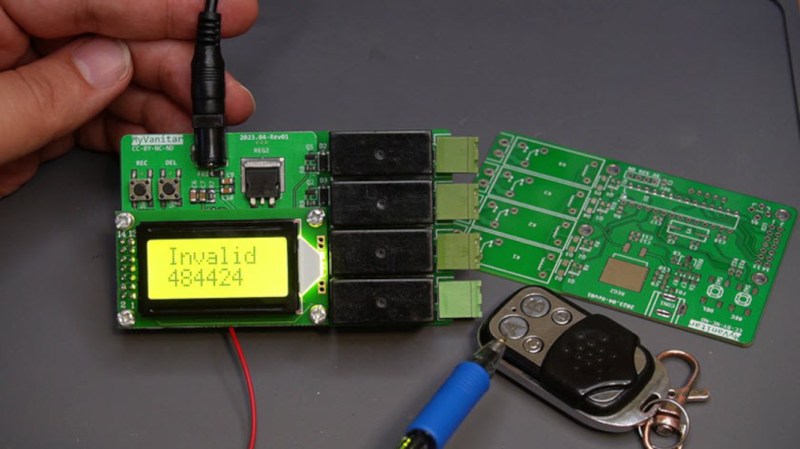
RF Remote Made Easy

The 433 MHz spectrum is a little bit of an oddball. It’s one of the few areas of the radio spectrum which is nearly universally unlicensed, meaning as long as devices using it adhere to the power restrictions and other guidelines about best practices, it’s essentially an open playground. IoT devices operate here, as well as security systems and, of course, remote controls. And, using a few off-the-shelf parts [hesam.moshiri] shows us how to take advantage of this piece of spectrum by designing and building a programmable and versatile 4-channel 433 MHz remote control.

Built around an ATmega8 microcontroller, making it easy to work with Arduino sketches, and with a 2×8 character LCD for ease-of-use when not connected to a computer, the wireless switching device can store up to 80 remote control codes in its EEPROM memory. This was one of the harder parts for [hesam] to sort out, but using structures to store the data for the codes eventually solved the problems. A simple GUI makes using it with whatever remote happens to be on hand fairly straightforward, including the ability to record codes from existing remotes on the fly and also to associate those codes with specific actions.

Schematics and a bill of materials are available on the project’s page, making this fairly accessible to those looking to add some wireless connectivity to a project, home automation system, or IoT device. It’s mainly set up as a switching device, but with some modifications could be put to work doing more complex tasks. The 433 MHz spectrum is an exciting place to be, too, and things like setting up entire security systems using it are not too far removed from a switching device like this.

Uber safety driver involved in fatal self-driving car crash pleads guilty

The Uber safety driver at the wheel during the first known fatal self-driving car crash involving a pedestrian has pleaded guilty to and been sentenced for an endangerment charge. Rafaela Vasquez will serve three years of probation for her role in the 2018 Tempe, Arizona collision that killed Elaine Herzberg while she was jaywalking at night. The sentence honors the prosecutors' demands and is stiffer than the six months the defense team requested.

The prosecution maintained that Vasquez was ultimately responsible. While an autonomous car was involved, Vasquez was supposed to concentrate on the road and take over if necessary. The modified Volvo XC90 in the crash was operating at Level 3 autonomy and could be hands-free in limited conditions, but required the driver to take over at a moment's notice. It noticed Herzberg but didn't respond to her presence.

The defense case hinged on partly blaming Uber. Executives at the company thought it was just a matter of time before a crash occurred, according to supposedly leaked conversations. The National Transportation Safety Board's (NTSB) collision findings also noted that Uber had disabled the emergency braking system on the XC90, so the vehicle couldn't come to an abrupt stop.

Tempe police maintained that Vasquez had been watching a show on Hulu and wasn't paying attention during the crash. Defense attorneys have insisted that Vasquez was paying attention and had only been momentarily distracted.

The plea and sentencing could influence how other courts handle similar cases. There's long been a question of liability surrounding mostly driverless cars — is the human responsible for a crash, or is the manufacturer at fault? This suggests humans will still face penalties if they can take control, even if the punishment isn't as stiff for conventional situations.

Fatal crashes with autonomy involved aren't new. Tesla has been at least partly blamed for collisions while Full Self Driving was active. The pedestrian case is unique, though, and looms in the background of more recent Level 4 (fully driverless in limited situations) offerings and tests from Waymo and GM's Cruise.While the technology has evolved since 2018, there are still calls to freeze robotaxi rollouts over fears the machines could pose safety risks.

This article originally appeared on Engadget at https://www.engadget.com/uber-safety-driver-involved-in-fatal-self-driving-car-crash-pleads-guilty-212616187.html?src=rss