Spotify's royalty model will get a massive revamp next year to give "working artists" a bigger cut, according to Music Business Worldwide. Starting in the first quarter of 2024, Spotify will reportedly implement three changes meant to "combat three drains on the royalty pool." The first one is establishing a minimum number of annual streams a track must reach before it starts generating royalties, which is supposed to demonetize tracks that earn less than 5 cents a month.
Apparently, while these tracks make up a tiny percentage of music on the platform — 99.5 percent of all monetized content will still be earning money after this change — their royalties still cost Spotify tens of millions of dollars a year. Based on Music Business Worldwide's computations, a track has to generate 200 plays a year to be able to earn 5 cents. As The Verge notes, the company is already getting flak for this particular change, because there are a lot of indie tracks that don't reach that threshold. Smaller artists might see their already meager earnings dwindle so that popular artists could get paid more.
Meanwhile, the second change coming to the platform will leverage its anti-fraud detection technology. If it detects illegal activity, such as the use of AI tools to repeatedly stream tracks and artificially boost their play count, the company will slap their distributors with financial penalties. Spotify is hoping that by enforcing a per-track penalty, it could deter people from committing streaming fraud in the long run. How effective this move is, of course, depends on the accuracy of the company's fraud detection technology.
The third and the last change in the service's royalty model will affect creators of "non-music noise content," such as white noise and binaural beats. At the moment, there are a lot of noise tracks on Spotify that are only 31 seconds long, uploaded that way because the platform pays for every play that's longer than half a minute. With the change that's supposedly coming, though, Spotify will require these noise tracks to meet a minimum length of time before they can generate royalties.
While this move can potentially cut noise creators' earnings significantly, Spotify originally wanted to take even more drastic measures. According to a previous Bloomberg report, the company considered removing white noise content from its platform altogether and prohibiting future uploads in the category, because doing so would raise its annual gross profit by as much as $38 million. Spotify neither confirmed nor denied these changes — "We do not have any news to share at this time," a spokesperson told Music Business Worldwide —so we'll have to wait for its official announcement to know if they're real and when they will be implemented if that's the case.
This article originally appeared on Engadget at https://www.engadget.com/spotify-looks-set-to-overhaul-its-royalty-model-next-year-081722667.html?src=rss
Ford has called its 20,000 employees back to work now that it has reached a tentative agreement with the United Auto Workers (UAW). The two parties have agreed on a new four-year labor contract that include a 25 percent pay increase for employees over that period, according to Reuters and The New York Times. With the cost-of-living wage adjustments the union has also successfully negotiated, the total pay hikes would amount to 33 percent, the UAW said. In addition to a wage hike, the contract also has stipulations for higher pensions and the right to strike over company plans to close factories.
Based on those rates, the highest-paid employees at Ford will ultimately be earning more than $40 an hour, up from $32, and have a base pay of $83,000 for a 40-hour-a-week workload. Meanwhile, recent hires will see their pay double over the next four years. As The Times notes, Ford initially offered to pay its workers 23 percent more, telling the union that it's what the company could afford without making big changes to its business. However, the UAW pushed for a bigger percentage and managed to reach this agreement with Ford by having thousands of its workers walk out over the past few weeks.
Approximately 8,700 personnel at the company's largest truck plant in Kentucky had stopped working, along with another 10,000 in Illinois and Michigan. Around two weeks after the strikes began, Ford suspended the construction of a Michigan battery factory for electric vehicles "until [it's] confident about [its] ability to competitively operate the plant."
Ford, like other automakers, are taking steps to electrify its fleet in hopes of having an all electric vehicle lineup over the next 10 years or so. The automakers affected by the strike, which also include GM and Stellantis, previously said that their electrification efforts currently costing them billions of dollars would be affected by the union's demands. "Toyota, Honda, Tesla and the others are loving the strike, because they know the longer it goes on, the better it is for them," Ford executive chairman William C. Ford Jr. said. Tesla and the Japanese automakers aren't unionized, but the UAW argued that its success with the current strikes could give it the momentum it needs to expand and organize at other companies.
This article originally appeared on Engadget at https://www.engadget.com/ford-reaches-a-tentative-agreement-with-striking-auto-workers-052421002.html?src=rss
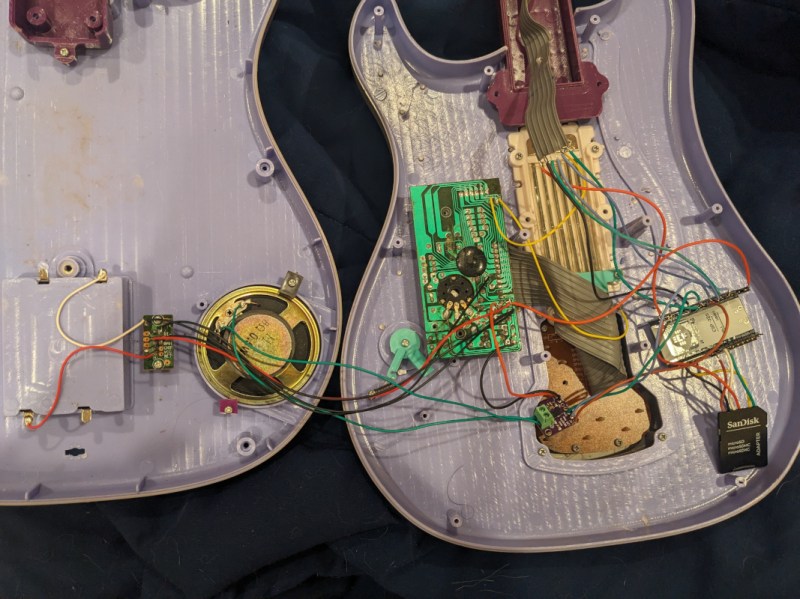
Getting the finishing details on a Halloween costume completed is the key to impressing friends and strangers alike on the trick-or-treat rounds. Especially when it comes to things like props, these details can push a good Halloween costume to great with the right touches. [Jonathan]’s friend’s daughter will be well ahead of the game thanks to these additions to a toy guitar which is part of her costume this year.
The toy guitar as it was when it arrived had the capability to play a few lackluster sound effects. The goal here was to get it to play a much more impressive set of songs instead, and to make a couple upgrades along the way as well. To that end, [Jonathan] started by dismantling the toy and investigating the PCBs for potential reuse. He decided to keep the buttons in the neck of the guitar despite their non-standard wiring configuration, but toss out the main board in favor of an ESP32. The ESP32 is tasked with reading the buttons, playing a corresponding song loaded on an SD card, and handling the digital to analog conversion when sending it out to be played on the speaker.
The project doesn’t stop there, though. [Jonathan] also did some custom mixing for the songs to account for the lack of stereo sound and a working volume knob, plus he used the ESP32’s wireless capabilities to set the guitar up as a local file server so that songs can be sent to and from the device without any wires. He also released the source code on the project’s GitHub page for anyone looking to use any parts of this project. Don’t forget there’s a Halloween contest going on right now, so be sure to submit the final version of projects like these there!
Meta’s increasingly aggressive push to promote Threads seems to be paying off. Mark Zuckerberg said the app currently has “just under” 100 million monthly active users, and that he thinks there’s a “good chance” the app could reach 1 billion users in the next couple of years.
“I thought for a long time, there should be a billion-person public conversations app that is a bit more positive and I think that if we keep at this for a few more years, then I think we have a good chance of achieving our vision there,” Zuckerberg said during the company’s third-quarter earnings call.
Threads’ growth has been closely watched since its July launch. The app saw 100 million sign-ups in its first week, but quickly saw engagement drop off amid complaints about limited functionality and feeds flooded with posts from brands. But Meta has steadily added new features, and engagement seems to have rebounded in recent weeks as Elon Musk makes unpopular changes to X, like stripping headlines from links. The Wall Street Journalreported this week that Threads has recently succeeded in attracting former “power users” from X.
Threads’ growth wasn’t the only bright spot for Meta, which reported just over $34 billion in revenue for the quarter, a 23 percent increase from last year. There are no 3.9 billion people who use one of the company’s each month, a new high for the social media company. During a call with analysts, Zuckerberg said that Meta’s recent focus on “efficiency,” which resulted in the company shedding more than 20,000 jobs over the last year, has been an effective strategy that will continue as the company faces “a very volatile world.”
Zuckerberg also shared that Meta would be increasingly focused on generative AI going forward. “We're going to continue deprioritizing a number of non-AI projects across the company to shift people towards working on AI instead,” Zuckerberg said.
Those AI investments, however, won’t come at the expense of new spending on the metaverse. Reality Labs, Meta’s division overseeing its AR and VR spending, continued its multibillion-dollar losing streak. Revenue from Reality Labs sank to just $210 million, with losses climbing to $3.7 billion for the quarter and more than $11 billion since the start of 2023. Meta CFO Susan Li said the losses were expected to accelerate further in the coming year due to “ongoing product development efforts in augmented reality/virtual reality and our investments to further scale our ecosystem.”
Zuckerberg, who has recently attempted to highlight AI advancements within AR and VR, said that the technology has the potential to reshape all of the company’s services. “Generative AI is going to transform meaningfully how people use each of the different apps that we build,” he said.
This article originally appeared on Engadget at https://www.engadget.com/mark-zuckerberg-threads-has-just-under-100-million-monthly-active-users-222548501.html?src=rss
Data from a meteorite impact on Mars that was recorded by NASA’s InSight lander in 2021 is now helping to clear up some confusion about the red planet’s interior makeup. A pair of studies published today in the journal Nature separately determined that Mars’ iron-rich core is smaller and denser than previous measurements suggested, and it’s surrounded by molten rock.
The now defunct InSight lander, which arrived on Mars in November 2018, spent four years recording seismic waves produced by marsquakes so scientists could get a better understanding of what’s going on beneath the planet’s surface. But, estimates of the Martian core based on InSight’s initial readings from nearby quakes didn’t quite add up. At the time, scientists found the core’s radius to be somewhere between 1118 and 1149 miles — much larger than expected — and contained a perplexingly high composition of lighter elements complementing its heavy liquid iron.
The numbers for those light elements were “bordering on the impossible,” said Dongyang Huang of ETH Zurich, a co-author of one of the studies. “We have been wondering about this result ever since.” Then, a breakthrough came when a meteorite struck Mars in September 2021 all the way across the planet from where InSight is positioned, generating seismic waves that ETH Zurich doctoral student Cecilia Duran said “allowed us to illuminate the core.”
IPGP/ CNES/ N. Starter
Based on those measurements, the two teams have found that Mars’ core more likely has a radius of about 1013-1060 miles. This, the ETH Zurich team notes, is about half the radius of Mars itself. A smaller core would also be more dense, meaning the previously inexplicable abundance of light elements may actually exist in smaller, more reasonable amounts. This is all surrounded by a layer of molten silicates about 90 miles thick, the teams found, which skewed the initial estimates. And, it’s unlike anything found in Earth’s interior.
According to Vedran Lekic from University of Maryland, a co-author of the second paper, the layer serves as somewhat of a “heating blanket” for the core that “concentrates radioactive elements.” Studying it could help scientists uncover answers about Mars’ formation and its lack of an active magnetic field.
This article originally appeared on Engadget at https://www.engadget.com/mars-core-looks-bigger-than-it-is-because-its-wrapped-in-radioactive-magma-211359695.html?src=rss
It's finally happening: X (formerly known as Twitter) has begun rolling out yet another feature nobody asked for. Now, users will have the option to call each other via audio and video calls on the platform. This doesn't come as a total surprise, as CEO Linda Yaccarino previously confirmed that video chat would be coming to the social media site back in August. It's just the latest step in X's evolution to becoming the "everything" app overlord owner Elon Musk wants it to be.
After opening X, some users are greeted with a prompt announcing "Audio and Video calls are here!" The prompt also included instructions on how to review who can call or make other changes to how the feature works. These options can be found in the settings section of your Direct Messages. If you have no interest in allowing people on X to call you, you can go to your DMs and look for the Settings menu, which looks like a tiny gear. From there, you can disable the calling option. However, if you do want to keep it on, you can choose to allow calls from verified users, people in your address book or just people you follow.
X
X doesn't have the best track record of creating a safe space, especially for minority communities, so it's not hard to see why many people would prefer to opt out of using this feature. Additionally, not everyone will receive the prompt about the new calling feature, which is enabled by default. It’s probably smart to see if it's already available on your account then you decide whether you'd like to keep it on.
Perhaps the folks at X will rethink this one, and maybe we can trade this feature to save Circles. But if this is a feature that must exist, it would have been a better move to allow users to turn it on themselves, instead of having it on automatically. Some users may not find out about the feature until a random troll decides to call and antagonize them.
This article originally appeared on Engadget at https://www.engadget.com/x-is-rolling-out-audio-and-video-calling-feature-nobody-asked-for-205836943.html?src=rss
The Biden Administration is reportedly set to unveil a broad executive order on artificial intelligence next week. According toThe Washington Post, the White House’s “sweeping order” would use the federal government’s purchasing power to enforce requirements on AI models before government agencies can use them. The order is reportedly scheduled for Monday, October 30, two days before an international AI Safety Summit in the UK.
The order will allegedly require advanced AI models to undergo a series of assessments before federal agencies can adopt them. In addition, it would ease immigration for highly skilled workers, which was heavily restricted during the Trump administration. Federal agencies, including the Defense Department, Energy Department and intelligence branches, would also have to assess how they might incorporate AI into their work. The report notes that the analyses would emphasize strengthening the nation’s cyber defenses.
On Tuesday evening, the White House reportedly sent invitations for a “Safe, Secure, and Trustworthy Artificial Intelligence” event for Monday, October 30, hosted by President Biden. The Washington Post indicates that the executive order isn’t finalized, and details could still change.
OpenAI CEO Sam Altman
PHILIP FONG via Getty Images
Meanwhile, European officials are working on AI regulations across the Atlantic, aiming for a finalized package by the end of the year. The US Congress is also in the earlier stages of drafting AI regulations. Senator Charles Schumer (D-NY) hosted AI leaders on Tuesday at the second AI Insights Forum.
AI regulation is currently one of the most buzzed-about topics in the tech world. Generative AI has rapidly advanced in the last two years as image generators like Midjourney and DALL-E 3 emerged, producing convincing photos that could be disseminated for disinformation and propaganda (as some political campaigns have already done). Meanwhile, OpenAI’s ChatGPT, Anthropic’s Claude, Google’s Bard and other advanced large language model (LLM) chatbots have arguably sparked even more concern, allowing anyone to compose fairly convincing text passages while answering questions that may or may not be truthful. There are even AI models for cloning celebrities’ voices.
In addition to misinformation and its potential impact on elections, generative AI also sparks worries about the job market, especially for artists, graphic designers, developers and writers. Several high-profile media outlets, most infamously CNET, have been caught using AI to compose entire error-ridden articles with only the thinnest of disclosures.
This article originally appeared on Engadget at https://www.engadget.com/the-white-house-will-reportedly-reveal-a-sweeping-ai-executive-order-on-october-30-200558649.html?src=rss
The Bigscreen Beyond is miraculous. I expected the first hardware from Bigscreen, a company known mainly for its VR movie-watching app, to be merely a noble effort. You know, a brave attempt by a newcomer to make a splash in the niche world of VR – something that deserves golf claps and little more. They say hardware is hard for a reason; how can a small software company take on titans like Valve and Meta?
Despite everything stacked against it (and it's not without some freshman stumbles), the Bigscreen Beyond stands out. It's less a headset like the original Oculus Rift, and more akin to an oversized pair of glasses that can still immerse you. Consequently, it's the most comfortable VR solution I've ever tested. It also has some of the sharpest displays I've ever seen, thanks to cutting-edge Micro-OLED panels (Meta, meanwhile, has fallen back on cheaper LCD displays for the Quest 3).
Somehow, a small VR app company built a truly compelling upgrade from the Valve Index, which is still one of the best VR headsets around. That deserves more than just golf claps.
With all that being said, the Bigscreen Beyond also isn't something I can recommend to most people. The average gamer doesn't need a Ferrari, after all. While Meta is aiming for the masses with the $299 Quest 2 and $499 Quest 3, the $999 Bigscreen Beyond is squarely targeted at Valve Index owners and VR enthusiasts who demand more comfort and better screens. It's meant for a niche of the niche. The Beyond is even harder to justify if you're stepping into high-end VR for the first time, since it requires two SteamVR base stations ($300 for a pair) and Valve Index controllers ($279). A $1,578 setup isn't exactly the best introduction to VR.
Nothing about the Beyond is easy. That makes it best suited for people who are already used to the inconveniences and indignities of PC VR. Upon ordering it, you'll need to create a 3D scan of your face via a mobile website. That process took around five minutes for me, but it requires an iPhone – Android users will need to borrow one or sneakily scan their faces at an Apple Store.
Photo by Devindra Hardawar/Engadget
Once your face is scanned, Bigscreen 3D prints an eyepiece cushion that's built specifically for you. That process also determines the interpupillary distance, or IPD for the headset's lenses. Instead of being adjustable like some competitors, Bigscreen has 18 (!) different models of the Beyond to fit IPDs between 55 millimeters and 72mm. The company says being so rigid about IPD sizes allows it to reduce weight – I can only imagine the logistical nightmare that creates. (That extreme customization also means it’ll be tough to share the Beyond with others.)
I'll admit, I was shocked how well it fit the first time I tried the Beyond. It barely felt like I was wearing anything at all, since the weight was evenly distributed across my face. There was no pressure around my eyes, or on the bridge of my nose, issues I've come to expect from heavy VR headsets. There was also no light leakage either, something that can easily kill immersion, and the cushions easily clamp onto the headset using magnets.
Photo by Devindra Hardawar/Engadget
According to Bigscreen founder and CEO Darshan Shankar, the company developed a unique skin-safe foam material for the face cushion. It can be washed with soap and water, making it potentially more sanitary than the sweat-absorbing pads on other headsets. Shankar says he's been using one foam pad for several years, and, surprisingly enough, he doesn't try to protect it while traveling. If you do need a replacement, though, you can order one from Bigscreen for $49.
Given how small it is, the Beyond also doesn't have room to fit glasses like the Quest 3. Instead, prescription glasses wearers will have to order custom lenses from the company. I can't speak about that ordering process much — Bigscreen just shipped me prescription lenses alongside my review unit — but it’ll involve plugging in your prescription alongside your order. (Snagging lenses for the Quest 3 from Zenni Optical is no different than ordering a normal pair of glasses.) The Beyond's lenses magnetically snap onto its displays without any effort, and they're also easy to remove for cleaning.
You can tell that the Bigscreen Beyond isn't like any other VR headset on the market with one glance. Imagine chopping off the top and bottom of the Valve Index, leaving only the displays behind. It looks suitably futuristic, with transparent plastic alongside the front and a few LEDs to let you know when it's powered up. It also weighs just 127 grams (0.28 pounds), slightly more than a deck of playing cards. In comparison, the Valve Index comes in at 1.8 pounds, while the Quest 3 weighs 1.1 pounds. The Beyond ships with a rear head strap, which was tight enough to stay secured on my head, but there's also a top strap in the box for those who need it.
Photo by Devindra Hardawar/Engadget
If you look closely at Bigscreen's promotional photos for the Beyond, you may notice something that's missing: Headphones. It doesn't include any built-in speakers of its own, so you'll have to come up with your own solution. I was able to fit Arctis's Nova Pro headphones on top of the Beyond, but that defeats the purpose of having such a light headset. I eventually paired my AirPod Pros to my Windows PC — something I never do otherwise — and that worked just fine. Bigscreen plans to release a $129 audio strap later this year but, for now, Beyond buyers should plan to have wireless earbuds handy.
So clearly Bigscreen managed to create a unique headset, but how well does it handle VR? Simply put, it's far better than I expected from the company's first stab at hardware. Its Micro-OLED displays are bright and feature far more contrast than the Quest 3's LCD panels. They’re also noticeably sharper than the Index's. The Beyond offers 2,560 by 2,560 pixels per eye, while the Valve headset delivers 1,440 by 1,600 pixels per eye.
That difference was particularly stark while replaying Half-LIfe: Alyx, a game I've already spent dozens of hours immersed in while testing the Index years ago. On the Bigscreen Beyond, it felt more like I was stepping into Alyx's dystopian world. I could barely feel the headset on my face, and everything just looked more realistic. I had a far easier time reading small text on newspapers strewn about the game—something that took a lot of squinting on the Index.
True to Bigscreen's original mission, the Beyond is also a fantastic headset for watching Netflix, YouTube or a handful of 3D films. It's not quite as relaxing as my home theater, since I'm stuck in an office chair tied to my computer, but it's certainly the best PC VR headset I've encountered for watching media. It's tough for me to choose between the Beyond and the Quest 3, though. Bigscreen's headset has far better optics, but I can't lay on the couch or in bed while wearing it. Meta probably wins when it comes to sheer convenience.
As great as the Beyond's screens are, they still occasionally display reflections and artifacts like every other VR headset. Shankar says that's a symptom of the Beyond's pancake lenses — the Quest 3 and Quest Pro also have similar reflections. Older headsets like the Index often exhibited "god rays" in bright scenes, which typically showed up as extra glare. I can live with visual imperfections during genuine VR experiences, but they're distracting while watching movies, which look far more pristine on a big screen TV and home theater projector.
Photo by Devindra Hardawar/Engadget
Ironically enough, Bigscreen managed to create a VR headset that's better at gaming than it is for watching media. But if you're stuck in an apartment without room for a large TV, or you want to recreate the experience of sitting front row in a theater using the Bigscreen app, the Beyond still delivers a decent sense of immersion. It's sort of like going to a theater with a projector on the fritz — you learn to live with it just to see something on an enormous screen.
I'll reiterate: Most people should not buy the Bigscreen Beyond. The Meta Quest 3 is right there! (And the Quest 2 is even cheaper!) But if you're a VR fanatic for something lighter, brighter and sharper than the Valve Index, it's a genuinely compelling upgrade… As long as you don't mind shelling out another $999.
This article originally appeared on Engadget at https://www.engadget.com/bigscreen-beyond-review-gunning-for-vr-throne-valve-index-190004793.html?src=rss
Intel may have downplayed a killer feature for its new 14th-gen processors, which can reach 6GHz. The company hasn’t marketed the chips’ new Intel Application Optimization (APO), but an enterprising Reddit user (viaTom’s Hardware) reports that it offers attention-grabbing performance boosts for supported games. Why the lack of advertising for such a potent feature? One guess is that APO seemingly only supports two older titles at launch: Rainbow Six Siege (2015) and Metro Exodus (2019).
One of the more dramatic examples of APO upgrading performance was detailed in the Intel subreddit by u/LightMoisture. With their setup using the Intel i9-14900K, the feature boosted Metro Exodus’ frame rate from 273 FPS to 339 FPS, a 24 percent increase. Rainbow Six Siege had even more eye-opening gains, going from 659 FPS to 867 FPS, a nearly 32 percent enhancement.
The Redditor notes that they ran the games in 1080p resolution on low settings with a high-end memory setup to test what APO can do in ideal conditions. It won’t likely reproduce those numbers on higher settings, and we don’t know how it would handle newer and more graphically demanding games.
The Verge’s Tom Warren tested the feature on “very high” presets at 1080p resolution. APO boosted Rainbow Six Siege (with a Core i9-14900K system and an RTX 4090 GPU) from 615 FPS to 688 FPS, nearly a 12 percent increase. Meanwhile, Metro Exodus Enhanced on the same rig rose from 177 FPS to 207 FPS, almost a 17 percent rise. Those numbers aligned closely with Intel’s guidance, which estimated a 13 percent increase in Rainbow Six Siege and a 16 percent increase in Metro Exodus.
Intel
Unfortunately, in addition to APO’s slight problem of supporting just two games at launch, the feature also has a clunky setup. You’ll need to track down motherboard drivers (always a fun task) that support Intel’s Dynamic Tuning. (To make matters worse, not all vendors have posted them online.) Once you find and install the right ones, navigate to your PC’s BIOS settings to enable the feature.
After that, you’ll want to install the APO app from the Microsoft Store, which lets you manage settings and toggle it quickly. Adding even more joy to the task, several Redditors reported that following external links to the Microsoft Store won’t work and that you’ll need to open the storefront and search for Intel APO manually. In addition, if you haven’t installed all of the necessary drivers, the app installation will reportedly fail. However, once set up, the feature should automatically detect compatible games (hopefully more than two before long) once you launch them. If future setups are easier and Intel adds new game support regularly, it could wind up outshining 6GHz as the new chips’ marquee attraction.
This article originally appeared on Engadget at https://www.engadget.com/an-overlooked-feature-for-intels-14th-gen-chips-boosts-gaming-performance-with-one-click-183335312.html?src=rss
Apple has released iOS 17.1. The iPhone update, which is available now for all users, brings improvements to AirDrop, more control options for StandBy, new Apple Music features and further customization for Photo Shuffle on the Lock Screen. It also brings a slew of bug fixes.
The iOS 17.1 update is available now for all recent iPhones (2018 and later), and can be downloaded by going to Settings > General > About > Software Update. The most notable addition with iOS 17.1 is an improvement to AirDrop that will allow content to continue transferring over the internet even if you leave AirDrop range, which should help to cut down on the headache of failed transfers.
It also brings some new features for Apple Music, now giving users the option to add songs, albums, and playlists to their Favorites, and have these show in their library. Apple Music is also getting new color-changing cover art collections, and song suggestions at the bottom of playlists. These features are also coming to Apple Music on Mac with the macOS Sonoma 14.1 update, which was released today as well.
With iOS 17.1, Apple has also added Home key support for Matter locks, fixed a pairing issue with the Apple Watch that caused users’ Significant Location privacy setting to reset and resolved issues with keyboard responsiveness, among other things. Apple released iOS 17.1 today alongside watchOS 10.1, which brings the Double Tap gesture to the latest Apple Watch lineup, and macOS Sonoma 14.1.
This article originally appeared on Engadget at https://www.engadget.com/ios-171-is-here-with-improvements-to-airdrop-and-new-flair-for-apple-music-180740395.html?src=rss