Meta's VR headsets will continue using Qualcomm chips for the foreseeable future

Meta will continue to use Qualcomm's chips in its Quest line of virtual reality headsets and the two companies are teaming up to build "customized" chipsets, Qualcomm announced at IFA 2022. "We’re working with Qualcomm Technologies on customized virtual reality chipsets — powered by Snapdragon XR platforms and technology — for our future roadmap of Quest products," said Meta CEO Mark Zuckerberg in the press release.

Meta's Quest 2 is powered by Qualcomm's Snapdragon XR2, so it's essentially continuing with the status quo. However, it looks like the two companies will be working closely on developing the next generation of chipsets, with Qualcomm saying that "both companies' engineering and product teams will deepen technical collaboration to deliver next-generation platforms and core technologies." 

Early this year, Qualcomm announced that it was teaming up with Microsoft as well on custom chips for AR glasses, with Microsoft promising "lightweight" and energy-efficient wearables. Qualcomm said that it was "working with Microsoft... [to develop] custom AR chips," so it appears to be working with both rivals on roughly the same thing. 

Meta is more invested in the metaverse, however, essentially staking its fate on the idea of meeting others in VR for business, socializing, gaming and more. By having a say in the design, it could effectively make its ideas easier to implement. "Unlike mobile phones, building virtual reality brings novel, multi-dimensional challenges in spatial computing, cost, and form factor," Zuckerberg said. "These chipsets will help us keep pushing virtual reality to its limits and deliver awesome experiences."

Meta recently jacked up the price of the Quest 2 headset from $300 to $400, even though it's now nearly two years old. That's no doubt due in part to the scarcity and higher prices of chips and components. It may be hoping to bring those down for the next generation, otherwise very few users will be able to access those, um, glorious virtual playgrounds.
US police agencies have been using a low-cost surveillance tool to track people’s phones

Police and law enforcement agencies, even in small areas with fewer than 100,000 residents, have been using a low-cost phone tracking tool called Fog Reveal, according to AP and the EFF. AP has published a report detailing authorities' use of the tool since at least 2018 for various investigations, including to track murder suspects and potential participants in the January 6th Capitol riot. The tool, sold by Virginia company Fog Data Science LLC, doesn't need a warrant and can be accessed instantly. To get geofence data, authorities usually have to issue a warrant to companies like Google and Apple, and it could take weeks for them to get the information they need. 

Fog Reveal, AP explains, uses advertising identification numbers, which are unique IDs assigned to each mobile device, to track people. It gets its information from aggregators that collect data from apps that serve targeted ads based on a user's location and interest, such as as Waze and Starbucks. Both the coffeehouse chain and the Google subsidiary denied explicitly giving their partners permission to share data with Fog Reveal. 

The Electronic Frontier Foundation obtained access to documents about Fog through Freedom of Information Act requests, which it then shared with AP. EFF special adviser, Bennett Cyphers, describes the tool as "sort of a mass surveillance program on a budget." Its prices reportedly start at only $7,500 a year, and some agencies even share access with other nearby departments to bring costs down further. Looking at data from GovSpend, which monitors government spending, AP found that Fog managed to sell around 40 contracts to nearly two dozen agencies. Authorities have already used it to search hundreds of records from 250 million devices. 

While Fog Reveal only tracks people using their advertising IDs that aren't connected with their names, authorities are able to use its data to establish "patterns-of-life" analyses. They can, for instance, establish that a specific ad ID belongs to a person who typically passes by a Starbucks from home on the way to work. Further, Fog gives authorities access to the movements of an ad ID going back to at least 180 days. Fog managing partner Matthew Broderick even recently admitted that the tool "has a three year reach back."

Authorities used the tool to varying degrees of success over the past years. Washington County prosecutor Kevin Metcalf said he has previously used Fog without a warrant for circumstances that required immediate action, such as to find missing children and to solve homicide cases. He said about privacy concerns surrounding Fog's use: "I think people are going to have to make a decision on whether we want all this free technology, we want all this free stuff, we want all the selfies. But we can't have that and at the same time say, 'I'm a private person, so you can't look at any of that."

The EFF, of course, doesn't share his sentiment. It called Fog "a powerfully invasive tool" and is encouraging people to disable ad ID tracking on their phones. 

The Morning After: Twitter’s edit button is real

Twitter has rather tentatively announced it’ll bring an edit button to users, but not for a while. First, it’s being tested by the platform’s employees, then it will slowly roll out to paying customers who subscribe to Twitter Blue. After the better part of two decades, the addition of such a basic feature will likely baffle non-tweeters the world over. But Twitter’s regard has always been disproportionate to its reach, mostly because of the number of journalists who use (or used) it. That said, it doesn’t feel like the addition of an edit button will help supercharge signups on a platform that seems to have reached its natural ceiling a long time ago.

– Daniel Cooper

The biggest stories you might have missed

Lenovo ThinkPad X1 Fold hands-on: Big upgrades, inside and out

It’s bigger, faster and more practical, but still expensive.

Sam Rutherford / Engadget

Lenovo’s ThinkPad X1 Fold broke new ground as the first laptop with a flexible OLED display, but that was the only really great thing about it. Thankfully, Lenovo is quick to learn from its mistakes, and the second-generation Fold is bigger, better and much more user friendly. Our Sam Rutherford got to spend some time with a pre-production version of the new device – and likes it a lot. He said the bigger display, better keyboard and beefier insides all add up to a machine that, while still eye-wateringly expensive, might actually justify some of that cost.

Continue Reading.

The best educational toys for kids

Keep those young brains working hard.

Will Lipman Photography for Engadget

There’s no better way to give your kid the tools to succeed in our modern world than by teaching them the fundamentals of science, technology, engineering and math. (Well, there is, but you can’t order a billion-dollar trust fund and a luxury education for $9.99 on Amazon.) For our back-to-school guide, we collected a bunch of cool toys that will help your kids learn the basics of coding, design, engineering, electronics and everything in between. Plus, they’re just as fun for adults as kids.

Continue Reading.

The next USB standard will double existing speeds even with an older cable

USB 4 (Version 2.0) will reach speeds of up to 80 Gbps.

The bunch of swell folks behind USB are gearing up to start talking about the updated version of its USB 4.0 standard. And the big news is that speeds are jumping from 40 Gbps all the way up to 80 Gbps over a USB-C type connector. Faster speeds are great and all, but what’s really exciting is that the new plans will also double performance on existing 40 Gbps USB-C passive cables, where compatible.

Continue Reading.

EU proposes new rules to make phones and tablets last longer

It wants to reduce e-waste by making sure we can repair our phones.

VladTeodor via Getty Images

The European Union is on a mission to crack down on e-waste and has already mandated a common charger to reduce the current mess of cables and plugs. Now, the bloc is looking at rules to enforce minimum standards for phone and tablet repairability. One of the key proposals is to ensure users can replace the display, battery, SIM tray and back cover for at least five years after purchase. It won’t turn into anything real just yet, but it does show the bloc’s commitment to driving better environmental practices in the tech industry.

Continue Reading.

SpaceX secures five more NASA astronaut missions as part of a $1.4 billion contract

Musk’s company can take advantage of Boeing’s stumbles.

NASA has awarded a further five astronaut missions to SpaceX as it secures launch capacity to keep the ISS crewed until 2030. That’s good for Elon Musk and his associates, and a further blow to Boeing, which is struggling to get its own crew capsule ready to fly. The deal takes the amount of cash NASA has handed to SpaceX up to nearly $5 billion, all the while Boeing scrambles to get its first crewed test flight of Starliner ready for 2023.

Continue Reading.

Leica shows off its first 4K ultra-short-throw projector

Leica has just unveiled its first ultra-short-throw (UST) projector called the Cine 1 that can beam an 80- or 100-inch image while parked as little as six inches from a wall. While it might seem a bit strange for a camera company to build a projector, UST models require precise optics to create a square image while beaming straight up — and that's right up Leica's alley. 

The company said it's using its Summicron lens tech with aspherical elements "manufactured in accordance with Leica standards. It also uses a triple-RGB laser with a 25,000 hour service life (built in collaboration with HiSense, according to The Verge) and a Texas Instruments DLP chip. 

Leica has two versions of the Cine 1 designed for 80-inch and 100-inch screens, with the former positioned about six inches from the wall and the latter about 12 inches. Leica recommends setting them at exactly those positions and using the suggested screen sizes, as the optics were designed for that. To that end, it's also selling 80- and 100-inch ambient light-rejecting (ALR) screens. They output 2,100 and 2,500 lumens for the 80- and 100-inch models, respectively.

On the audio side, it offers built-in Dolby Atmos-powered speakers for surround sound. It comes with a TV tuner for for linear TV and HiSense's VIDAA OS as a smart TV platform. You can also install external storage, Blu-ray players or consoles via the HDMI and USB inputs. 

Other key specs are still missing, like color space coverage and HDR support. However, they're reportedly priced at $6,900 for the 80-inch and $7,900 for the 100-inch model, so you'd expect all the bells and whistles possible. Currently, the most advanced UST projectors out there are Samsung's LSP7T 4K with HDR10+ starting at $3,500, the $3,000 Formovie Theater with Dolby Vision and HiSense's L9G 3,000-lumen Laser TV projectors with Dolby Vision priced at $5,000 with a 100-inch ALR screen. 

Microsoft’s Game Pass Friend & Family tier goes live in two countries

Following a leak last week, Microsoft has unveiled the Game Pass Friends & Family in Ireland, offering the same benefits of Game Pass Ultimate for you and four others at €22 ($22) per month. That's less than double the Game Pass Ultimate price for one person (€13), and works out to just €4.40 ($4.40) a month each. Better still, it's not limited to family and the only restriction is that all four members have to be in the same country. 

So far, it's come to just two countries, but that might change soon. "Currently we are piloting this plan in Colombia and the Republic of Ireland. Future countries / regions might be added in the next months," Microsoft wrote in a FAQ.

Users in those countries with an existing Game Pass Ultimate plan will see their remaining days pro-rated, basically according to the price difference. That means for 30 days of Game Pass Ultimate you'll get 18 days of Game Pass Friends & family, while 30 days of Xbox Game Pass or Live Gold gets you 12 days. 30 days of EA Play nets 6 days of Game Pass Friends & Family.

In the US, Xbox Game Pass or PC Game Pass costs $10 per month, while Game Pass Ultimate is $15 with multiplayer capabilities. The Game Pass Friends & Family is likely to cost around $25 stateside, according to The Verge, or $5 per month per person. On top of multiplayer, Ultimate users can also access Xbox Cloud Gaming, Xbox Live and more. 

The Ease of Wireless Charging, Without the Wait

Historically, there have been a few cases of useful wireless power transmission over great distances, like a team at MIT that was able to light up a 60 W bulb at several meters, and of course Nikola Tesla had grand dreams of drawing energy from the atmosphere. But for most of us wireless power is limited to small, short-range devices like cellphone chargers. While it’s not a lot of work to plug in a phone when it needs a charge, even this small task can be automated.

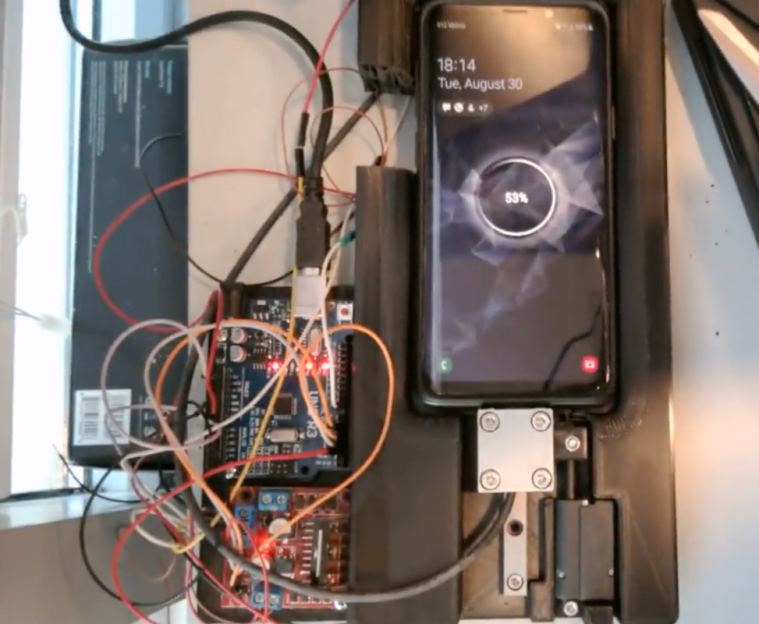
This build begins with a 3D printed cradle for the smartphone to sit in. When the device detects that the phone has been placed in the cradle, it uses a linear actuator to drive a custom-built charging cable into the phone’s USB port. Similarly, when the phone is lifted from the cradle the cable is automatically removed. It appears that there is some play in the phone’s position that lets the charger be plugged in smoothly, and the project’s creator [Larpushka] points out that the linear actuator is not particularly strong so we don’t imagine the risk of damage is very high.

While wireless charging still may have the edge when it comes to keeping debris out of the port, we still really enjoy a project like this that seems to be done for its own sake. There are some improvements that [Larpushka] plans to make, but for now we’re delighted by this build. For anyone looking to add true wireless charging to any phone that doesn’t have it, though, it’s not too difficult to accomplish either.

Highly Reliable Digital Temperature Sensor Series Designed for Automotive Applications

Highly Reliable Digital Temperature Sensor Series Designed for Automotive Applications

Sensirion has announced a new highly reliable digital temperature sensor series STS4xA that currently consists of two versions: STS41A-AD1B and STS41A-AW1B, with the latter offering optional wettable flank packaging to support automated optical inspection (AOI).

Lakshita Khanna Fri, 09/02/2022 - 12:47
Circuit Digest 02 Sep 08:17

Stellar P6 Automotive MCU with Superior Integration Capabilities for EV Platform System Integration

Stellar P6 Automotive MCU with Superior Integration Capabilities for EV Platform System Integration

STMicroelectronics has unveiled new microcontrollers designed for the coming electrified drivetrains and domain-oriented, over-the-airupdateable systems that are the foundation of the next generation of EVs. ST’s new Stellar P automotive MCUs are the industry’s first qualifiable devices for model year 2024 vehicles to integrate the new CAN-XL in-car communication standard.

Lakshita Khanna Fri, 09/02/2022 - 12:10
Circuit Digest 02 Sep 07:40

Meta is shutting down Facebook 'Neighborhoods' for local communities

Meta is axing Facebook's Nextdoor-like product called Neighborhoods before it even becomes available to most users. The social network started offering it to select users in Canada back in 2020, touting it as a dedicated space where people can interact with their local communities. It expanded its tests last year and rolled out access to various communities across Canada and the US. Based on the screenshot of a post written by a Meta product manager and obtained by social media consultant Matt Navarra, the company is ending its test of Neighborhoods on October 1st. It will no longer be available after that date.

Groups revolving around local communities aren't new or rare on the website, but Neighborhoods spaces come with special features. They allow users to create separate profiles where they can limit their public information if they don't want people nearby to know too much about them. Users can also find groups for specific activities that are populated with locals through the Neighborhoods tab. 

The product manager didn't mention why Meta is shutting down Neighborhoods in their announcement. According to TechCrunch, though, the company said it originally invested in the project when it saw how popular Nextdoor was. However, it reportedly decided that the best thing to do for this particular area is to let people form their own local communities using the website's existing Groups feature.

Facebook is shutting down its Nextdoor-clone Neighborhoods on Oct 1st

h/t @grigg_digitalpic.twitter.com/Zob6ny5gf5

— Matt Navarra (@MattNavarra) September 1, 2022

Another possible explanation is that Meta is shutting down the project as part of its cost-cutting efforts. It also recently announced that it's closing the standalone Facebook Gaming app in what could be a move to help the company survive what Mark Zuckerberg calls "one of the worst downturns [it has seen] in recent history."

iPhone 14 Pro's two hole-punch cutouts may look like a single 'wide pill'

Apple's big annual iPhone event is only a few days away and we'll soon find out exactly what the company has up its sleeve. In the meantime, the rumor mill is still churning away. The latest word on the street concerns the dual hole-punch cutouts that the iPhone 14 Pro is expected to have.

According to 9to5Mac and MacRumors (with corroboration from Bloomberg's Mark Gurman), Apple will fill the gap between the cutouts with a blacked-out area of the screen, making it appear to be a single "wide pill-shaped cutout." Also interesting is what Apple seemingly plans to do with that section of the display.

The reports suggest iPhone 14 Pro will move the privacy indicators for the camera and microphone to that gap. Instead of showing a small orange dot in the top-right corner when the microphone is in use and a green dot when the camera is active, these indicators will apparently have more prominence between the cutouts.

Per 9to5Mac, Apple's thinking is to make the indicators look more like they do on MacBook, which shows a green indicator whenever an app is using the camera. On top of that, the iPhone 14 Pro would be able to show privacy indicators for the camera and microphone simultaneously — on current models, if both are in use, only a green dot is displayed. Additionally, it seems you'll be able to tap on the privacy indicators to see which apps are using the mic and camera.

Meanwhile, Apple may be redesigning the Camera app to position more controls at the top of the screen — namely the flash and Live Photo buttons. More photo and video settings might appear below the hole-punch cutouts. These changes aren't set in stone, according to 9to5Mac, which may be a good thing, as folks may not want to cover most of the display with their hand while they adjust photo and video settings.