Apple's latest Watch Series 8 just came out last month, but you can already grab a deal on it. The 41mm model is selling at Amazon in Midnight or Red for $349, for a savings of $50 (13 percent), and the 44mm model is on sale at $379, or $50 off the regular price. That'll get you all of Apple's latest Watch features, including a skin temperature sensor, low power mode and more. Be aware, though, that stock appears to be limited so you may have to move quickly.
The Series 8 is more of an incremental update over the Series 7, but it does have some useful new features. The first is a new temperature sensor that Apple has tied to women's health, giving female users an estimate on when they may be ovulating. It's meant to be used overnight, sampling your wrist temperature every five seconds so you can see shifts from your baseline temperature.
The other key feature is Crash Detection. Much as current watches can detect a fall, the Series 8 can detect car crashes via a pair of new accelerometers. It works in concert with the other sensors already included in the Apple Watch to detect four different types of crashes, including rollovers, front impact, back impact and side impact.
While battery life is the same as before at 18 hours, there's a new power mode that keeps it going for up to 36 hours on a full charge. It also uses a newer S8 system-in-package processor, that should allow for improved performance. With those updates, we found the Series 8 to be the "new best smartwatch," letting Apple keep its, er, crown in that department. As mentioned, if you're looking to get one, act quickly.
After announcing it at I/O 2019, teasing it in 2020 and finally launching it officially last year, Google is shutting down the Assistant Driving Mode dashboard, 9to5Google reported. The feature gives users an Android Auto-lite experience on their smartphone while driving, and was effectively a replacement for the Android Auto smartphone app, which itself was killed last year.
Assistant Driving Mode shows a home screen-style page with Google Assistant up top, a music player and volume controls below that, and buttons to make a call or send a message. It can be accessed from the Assistant by saying "Hey Google, launch Driving Mode," or pinned to your home screen.
Steve Dent/Engadget
If you're confusing the Assistant Driving Mode with the Google Maps feature also called Driving Mode (above), that's understandable. Rather than launching from Assistant or the home screen, though, the Google Maps version launches from a four-dot menu at bottom right when you start navigation. Once open, it shows a row of large icons for calls, messages, and media apps that are easy to see and access while driving. Weirdly, when you first launch that mode within Maps, it offers to pin the other Driving Mode to your home screen.
Google is shutting down Assistant Driving Mode because it noticed that most people were just using the Maps version, it told 9to5Google. However, folks may not have even known the Assistant version existed because of the naming confusion and similarity between the apps. Google should maybe clarify the situation around navigation and entertainment for folks who don't have Android Auto built into their vehicles, because it's pretty darn confusing.
Epic Games and Match Group are attempting to expand their lawsuits against Google to include additional allegations against the search giant. In a motion filed on Friday with the District Court of California, the two companies accused Google of paying off developers that had the means and ability to create competing Android app stores.
Specifically, Epic and Match point to agreements like Project Hug. The initiative, later called the “Apps and Games Velocity Program,” saw Google spend millions of dollars to keep some of Android’s most popular developers on the Play Store, according to a complaint filed by Epic last year.
“Some of these agreements were intended to, and did, stop developers from launching competing app stores,” the motion states, adding Google committed a “per se” violation of the Sherman Act, the primary US antitrust law. Under the Sherman Act, per se violations don’t require a plaintiff to show how a certain behavior negatively affected the market since it’s generally accepted such actions reduce competition (price fixing, for instance, falls under that category).
Google told Engadget it would oppose the motion. “Epic and Match are adding more inaccurate claims to their failing lawsuits and we’re looking forward to setting the record straight in court,” a company spokesperson said.
“The program on which Epic and Match base their claims simply provides incentives for developers to give benefits and early access to Google Play users when they release new or updated content; it does not prevent developers from creating competing app stores, as they allege,” they added. “In fact, the program is proof that Google Play competes fairly with numerous rivals for developers, who have a number of choices for operating systems and app stores.”
The motion comes after both Epic and Match reached temporary agreements with Google earlier this year to ensure their apps remain on the Play Store while they resolve their litigation. In a countersuit Google filed in June, the company accused Match of attempting to pay “nothing at all” for access to the Play Store. Google’s store fees have also drawn scrutiny from the Department of Justice and a group of more than three dozen states.
Kanye West’s return to Twitter has been short-lived. Less than a day after Elon Musk welcomed him back to the platform, the rapper saw his account suspended for posting an antisemitic message. On late Saturday night, West, who goes by Ye now, said he would go “death con 3 On JEWISH PEOPLE.” In the same message, West defended himself, suggesting he wasn’t antisemitic because “black people are actually Jew.”
According to BuzzFeed News, it took some time before Twitter removed the hateful tweet. However, as of Sunday, it’s no longer possible to see the message on West’s timeline. “The account in question has been locked due to a violation of Twitter’s policies,” a company spokesperson told Engadget.
The suspension comes after West’s Instagram account was similarly restricted by Meta. In a post that has since been deleted, West shared a screenshot of a message he sent to Sean “Diddy” Combs where he implied the rapper was being controlled by a group of powerful Jewish people, reports NBC News.
The American Jewish Committee condemned the post and comments West made during an interview with Fox News host Tucker Carlson earlier in the week. "The behavior exhibited this week by Kanye West is deeply troubling, dangerous, and antisemitic, period,” the organization said on Twitter. “There is no excuse for his propagating of white supremacist slogans and classic antisemitism about Jewish power, especially with the platform he has.”
After his Instagram suspension, West took to Twitter to lash out at Meta CEO Mark Zuckerberg. That post is still on the platform.
Apple will more widely adopt USB-C across its product portfolio over the next few years, according to Bloomberg’s Mark Gurman. Writing in his latest Power On newsletter, Gurman says he expects the company to transition all of its wireless earbuds, including the recently refreshed AirPods Pro, to the charging standard by 2024. Additionally, Apple could refresh accessories like the Magic Mouse with USB-C – and a more intuitive design, one would hope – as early as next year.
The reported shift would put most of Apple’s products in compliance with the European Union’s upcoming USB-C mandate. Earlier this week, the European Parliament voted to make the port the common charging standard across the bloc. Once enacted, the legislation will make it so that any new phones, tablets and headphones released in the EU will need to feature USB-C for charging by the end of 2024. The mandate will extend to laptops in the spring of 2026.
In May, Gurman reported that Apple had begun testing USB-C iPhones ahead of the EU adopting the proposed legislation. At the time, he warned that if the company were to proceed with the change, “it wouldn’t occur until 2023 at the earliest.” He now says the iPhone 15 line “is essentially a lock” to receive USB-C next fall.
However, Apple’s switch to USB-C may be short-lived. Gurman expects the company to transition the iPhone and iPad “entirely” to inductive charging “at some point in the next few years.” He notes the company may see the technology as a way to get around the EU’s legislation since it doesn’t cover wireless charging.
Of course, if you’ve been following the Apple rumor mill for long enough, you’ll know that a portless iPhone is something the company has reportedly been thinking about ever since it removed the headphone jack from the iPhone 7 in 2016. Since then, however, Qi charging has created a few problems for Apple – including, most notably, the high-profile cancelation of AirPower in 2019.
The fates of Apple and Taiwanese semiconductor manufacturer TSCM have grown inextricably intertwined since the advent of the iPhone. As each subsequent generation of iPhone hurtled past the technological capabilities of its predecessor, the processors that powered them grew increasingly complex and specialized — to the point that, today, TSCM has become the only chip fab on the planet with the requisite tools and know-how to actually build them. In his new book, Chip War: The Fight for the World's Most Critical Technology, economic historian Chris Miller examines the rise of processor production as an economically crucial commodity, the national security implications those global supply chains might pose to America.
The greatest beneficiary of the rise of foundries like TSMC was a company that most people don’t even realize designs chips: Apple. The company Steve Jobs built has always specialized in hardware, however, so it’s no surprise that Apple’s desire to perfect its devices includes controlling the silicon inside. Since his earliest days at Apple, Steve Jobs had thought deeply about the relationship between software and hardware. In 1980, when his hair nearly reached his shoulders and his mustache covered his upper lip, Jobs gave a lecture that asked, “What is software?”
“The only thing I can think of,” he answered, “is software is something that is changing too rapidly, or you don’t exactly know what you want yet, or you didn’t have time to get it into hardware.”
Jobs didn’t have time to get all his ideas into the hardware of the first-generation iPhone, which used Apple’s own iOS operating system but outsourced design and production of its chips to Samsung. The revolutionary new phone had many other chips, too: an Intel memory chip, an audio processor designed by Wolfson, a modem to connect with the cell network produced by Germany’s Infineon, a Bluetooth chip designed by CSR, and a signal amplifier from Skyworks, among others. All were designed by other companies.
As Jobs introduced new versions of the iPhone, he began etching his vision for the smartphone into Apple’s own silicon chips. A year after launching the iPhone, Apple bought a small Silicon Valley chip design firm called PA Semi that had expertise in energy-efficient processing. Soon Apple began hiring some of the industry’s best chip designers. Two years later, the company announced it had designed its own application processor, the A4, which it used in the new iPad and the iPhone 4. Designing chips as complex as the processors that run smartphones is expensive, which is why most low- and midrange smartphone companies buy off-the-shelf chips from companies like Qualcomm. However, Apple has invested heavily in R&D and chip design facilities in Bavaria and Israel as well as Silicon Valley, where engineers design its newest chips. Now Apple not only designs the main processors for most of its devices but also ancillary chips that run accessories like AirPods. This investment in specialized silicon explains why Apple’s products work so smoothly. Within four years of the iPhone’s launch, Apple was making over 60 percent of all the world’s profits from smartphone sales, crushing rivals like Nokia and BlackBerry and leaving East Asian smartphone makers to compete in the low-margin market for cheap phones.
Like Qualcomm and the other chip firms that powered the mobile revolution, even though Apple designs ever more silicon, it doesn’t build any of these chips. Apple is well known for outsourcing assembly of its phones, tablets, and other devices to several hundred thousand assembly line workers in China, who are responsible for screwing and gluing tiny pieces together. China’s ecosystem of assembly facilities is the world’s best place to build electronic devices. Taiwanese companies, like Foxconn and Wistron, that run these facilities for Apple in China are uniquely capable of churning out phones, PCs, and other electronic. Though the electronics assembly facilities in Chinese cities like Dongguan and Zhengzhou are the world’s most efficient, however, they aren’t irreplaceable. The world still has several hundred million subsistence farmers who’d happily fasten components into an iPhone for a dollar an hour. Foxconn assembles most of its Apple products in China, but it builds some in Vietnam and India, too.
Unlike assembly line workers, the chips inside smartphones are very difficult to replace. As transistors have shrunk, they’ve become ever harder to fabricate. The number of semiconductor companies that can build leading-edge chips has dwindled. By 2010, at the time Apple launched its first chip, there were just a handful of cutting-edge foundries: Taiwan’s TSMC, South Korea’s Samsung, and — perhaps — GlobalFoundries, depending on whether it could succeed in winning market share. Intel, still the world’s leader at shrinking transistors, remained focused on building its own chips for PCs and servers rather than processors for other companies’ phones. Chinese foundries like SMIC were trying to catch up but remained years behind.
Because of this, the smartphone supply chain looks very different from the one associated with PCs. Smartphones and PCs are both assembled largely in China with high-value components mostly designed in the U.S., Europe, Japan, or Korea. For PCs, most processors come from Intel and are produced at one of the company’s fabs in the U.S., Ireland, or Israel. Smartphones are different. They’re stuffed full of chips, not only the main processor (which Apple designs itself), but modem and radio-frequency chips for connecting with cellular networks, chips for WiFi and Bluetooth connections, an image sensor for the camera, at least two memory chips, chips that sense motion (so your phone knows when you turn it horizontal), as well as semiconductors that manage the battery, the audio, and wireless charging. These chips make up most of the bill of materials needed to build a smartphone.
As semiconductor fabrication capacity migrated to Taiwan and South Korea, so too did the ability to produce many of these chips. Application processors, the electronic brain inside each smartphone, are mostly produced in Taiwan and South Korea before being sent to China for final assembly inside a phone’s plastic case and glass screen. Apple’s iPhone processors are fabricated exclusively in Taiwan. Today, no company besides TSMC has the skill or the production capacity to build the chips Apple needs. So the text etched onto the back of each iPhone — “Designed by Apple in California. Assembled in China”—is highly misleading. The iPhone’s most irreplaceable components are indeed designed in California and assembled in China. But they can only be made in Taiwan.
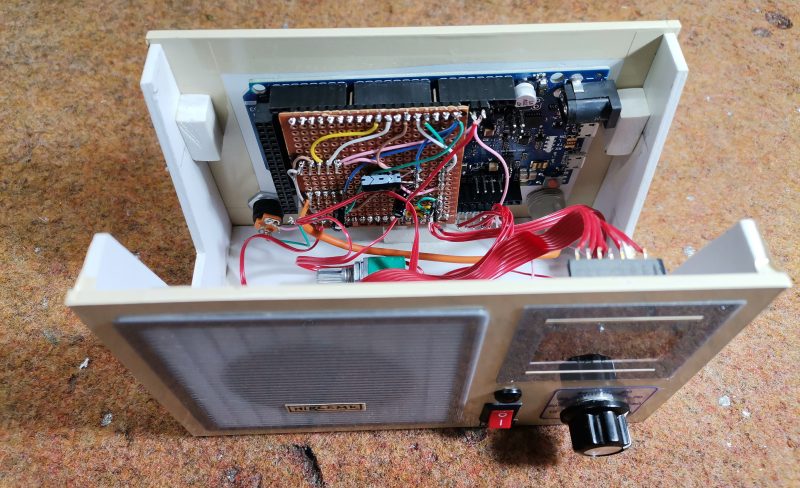
Older hackers will remember that a crystal set radio receiver was often one of the first projects attempted. Times have changed, but there’s still something magical about gathering invisible signals from the air and listening to the radio on a homemade receiver. [mircemk] has brought the idea right up to date by building an FM radio with an OLED display, controlled with a rotary encoder.
The design is fairly straightforward, based as it is on another project that [mircemk] found on a Chinese site, but the build looks very slick and would take pride of place on any hacker’s workbench. An Arduino Due forms the heart of the project, controlling a TEA5767 module, an SH1106 128×64 pixel OLED display and a rotary encoder. The sound signal is passed through an LM4811 headphone amplifier for private listening, and a PAM8403 Class D audio amplifier for the built-in loudspeaker. The enclosure is made from PVC panels, and accented with colored adhesive tape for style.
It’s easier than ever before to quickly put together projects like this by connecting pre-built modules and downloading code from the Internet, but that doesn’t mean it’s not a worthwhile way to improve your skills and make some useful devices like this one. There are so many resources available to us these days and standing on the shoulders of giants has always been a great way to see farther.
With New York Comic Con underway this weekend, Paramount shared a new trailer for the final season of Star Trek: Picard. After the previous teasers mostly played up the nostalgia of the principal cast of The Next Generation returning to the franchise, the new trailer finally offers a look at season three’s story. And judging from the clip, Picard will end with a bang.
The trailer opens with Starfleet facing an entirely new threat in the form of an alien vessel called the Shrike. What follows is a fun series of scenes that sees Admiral Jean-Luc Picard recruit his old friends, some of them a little less than willing, to face a villain played by Pulp Fiction’s Amanda Plummer. There’s something satisfying about seeing how characters like Worf have changed in unexpected ways in their later years. Even more unexpected are the two cameos at the end of the trailer. Daniel Davis is back as holographic Professor Moriarty, while Brent Spiner will play Data’s evil Android twin, Lore.
Alongside a new trailer for Star Trek: Picard, Paramount also shared fresh teasers for season five of Discovery and the midseason return of Prodigy. The latter will debut on October 27th, while the former is expected to arrive sometime next year. The final season of Picard will begin streaming on February 16th, 2023.
I guess while I was doing a memory upgrade I some how managed to bump the component off. and now doesn't power up.
It just clicks, Atom resistor fix done some years ago.
I would like to replace it but have no idea what part it is.
DS1815+ U37 ( I guess it's a power mosfet or voltage regulator?? But I have no idea the value etc etc)
HELP HELP HELP!!!
Any help Greatly appreciated
Thanks Warren.
When the next Call of Duty arrives on October 28th, fans will need to connect a phone number to their Battle.net account to play the game. “Call of Duty: Modern Warfare II, newly created Overwatch 2 accounts, and newly created Call of Duty: Modern Warfare accounts require a phone number,” says a recently updated support page spotted by PC Gamer.
News of the requirement comes following a week of controversy around SMS Protect, the phone-linking system in use by Overwatch 2 and soon Modern Warfare II. After a bumpy launch that saw a DDoS attack prevent many from playing Overwatch 2 on its release day, Blizzard announced it would scale back the requirement. Where the studio previously said all players would need to link a phone number to their Battle.net account, now that requisite only falls on new Overwatch players. In part, the system has been controversial because “certain pre-paid” numbers could not be used in conjunction with SMS Protect. Before Friday, players with service from mobile providers like Cricket Wireless found they could not play the game.
At the moment, it’s unclear if all Warzone 2.0 players will need a mobile phone number to playthat game once it arrives on November 16th. Since 2020, Infinity Ward has required all free-to-play Warzone users on PC to go through a two-factor authentication process. Activision Blizzard did not immediately respond to Engadget’s request for clarification and comment.