New Explorer Kits for Product Designers Needing Centimeter-Level Positioning Accuracy
u-blox has announced new explorer kits to make it quicker and easier for engineers to design and evaluate products requiring centimeter-level positioning capabilities. Set to launch in early 2023, the ready-to-use XPLR-HPG-1 and XPLR-HPG-2 solutions will combine u-blox’s unique offering across the key technologies required to achieve highly precise positioning. Both these kits
The cafeteria workers at Waymo's offices are forming a union, according to NBC News. As the news organization notes, that makes them the latest group of people to organize at one of Silicon Valley's most prominent companies. Waymo's food service personnel are also following in the footsteps of the 4,000 Google cafeteria workers who quietly unionized during the COVID-19 pandemic. The autonomous driving tech company used to be an experimental unit under Google before it became an Alphabet subsidiary.
Like Google's other food service workers, Waymo's are employed by contracting firm Sodexo. Workers cited the high cost of living in the Bay Area where Alphabet's offices are located as the reason why they want to unionize. They said their $24-per-hour pay isn't enough to live adequately in the city, where rents are astronomical, and that their health plan is prohibitively expensive. The workers are also asking for better treatment and benefits, since they don't enjoy the same perks as full-time Alphabet employees.
Organizers for the unionization efforts at Waymo told NBC News that they've already gathered signatures from majority of the workers. Sodexo said that it "respects the rights of [its] employees to unionize or not to unionize" but didn't say whether it will voluntarily recognize the union. If it does, the workers will have to file for an NLRB election to be able to join the other Alphabet cafeteria workers at Unite Here.
Hackers believed to be based in Russia temporarily forced around 14 public-facing websites for US airports offline on Monday. The LaGuardia, O’Hare and LAX websites were among those targeted, and most are back online. A senior US government official said that air traffic control, internal airport communications and other critical operations were not affected, but travelers looking for security wait times or other information may have been inconvenienced, according to ABC News. An LAX spokesperson affirmed that "no internal airport systems were compromised and there were no operational disruptions."
"On Monday October 10th, 2022 at approx. 0300 hours there was a denial of service incident lasting 15 minutes that resulted in intermittent delays accessing the LaGuardia airport website," a Port Authority spokesperson told ABC News. "The Port Authority's cybersecurity defense system did its job by detecting the incident quickly, addressing the problem in 15 minutes, and enabling us to alert others by notifying federal authorities immediately. There was no operational impact to any Port Authority facilities."
The incident, said to be the result of distributed denial of service (DDoS) attacks, have been pinned on pro-Russia hacker group Killnet. The hackers are not believed to be government actors, however. There's no evidence that the Russian government was involved in this incident, a cybersecurity analyst said.
Both the Cybersecurity and Infrastructure Security Agency and Transportation Security Administration are monitoring the situation, CNN reports. CISA noted it didn't have any worries about airport operational disruptions.
The Lemondrop and Fireball Nanobox grooveboxes pack a lot of punch for their size, and 1010music is expanding the lineup with the Razzmatazz drum machine. The pocket-sized device packs in a 64-step sequencer and eight drum voices. Each of the voices has two FM oscillators and a WAV sample layer, which should enable you to blend organic, acoustic and digital elements to create unique drum sounds.
Filters, resonators, bit-crushers, delay, reverb and four types of distortion can help you produce distinct sounds too. But if you'd rather not go through all that trouble, you can opt to use the Razzmatazz's 120 preset kits and sequences instead.
You'll be able to put together tracks with the help of eight drum and percussion pads, which you can control via the two-inch touchscreen or a MIDI device. Using the Super Stepper visual sequencer, 1010music says beatmakers can tap or swipe to create rhythms and simultaneously see all eight pads across 16 steps. You'll be able to create lengthy drum sequences of up to 64 steps, each of which can last as long as eight bars. Along with the touchscreen, the groovebox has two knobs and four buttons.
The Razzmatazz is a proper sampler, since there's a line-in jack through which you can record audio. Alternatively, you can load WAV files onto the device using a microSD card. There's also a mode that enables you to play back loops or sample slices. However, there's unfortunately no option to slice up samples on the device, which is powered through a USB-C connector.
Best of all, the Razzmatazz fits in with the candy-colored Nanobox aesthetic. It comes in an eye-catching hot pink. You can pick up the groovebox from the 1010music website and other retailers for $399.
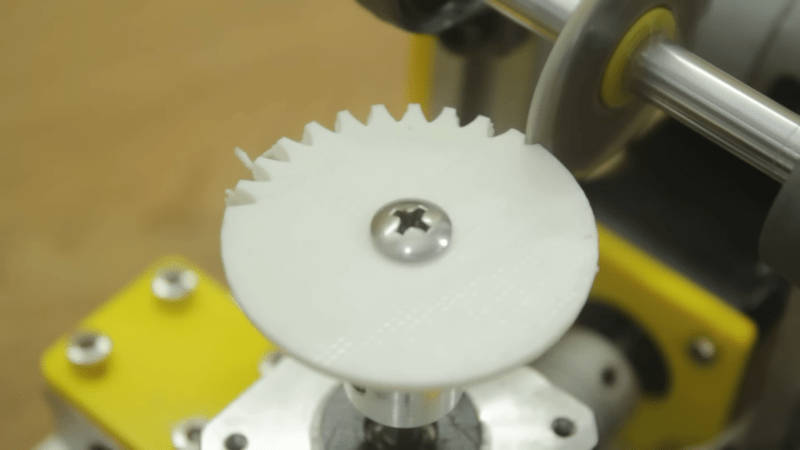
We’ve seen plenty of people 3D printing custom gears over the years, but [Mr Innovative] decided against an additive process for his bespoke component. He ended up using a simple CNC machine that makes use of several components that were either salvaged from a 3D printer or produced on one. Using a small saw blade, the machine cuts gear teeth into some plastic material and — presumably — could cut gears into anything the saw blade was able to slice into, especially if you added a little lubrication, cooling, and dust removal.
If you’ve built a 3D printer, you’ll see a lot of familiar parts. Stepper motors, aluminum extrusion, straight rods, bearing blocks, and rod holders are all used in the build. There’s also a lead screw and the associated components you usually see in a printer’s Z-axis. Naturally, an Arduino drives the whole affair.
The saw blade was custom-made from a washer, grinding an edge and using a 3D printed template to cut teeth in it. We might have been more inclined to use a cut-off wheel from a rotary tool, but this certainly did the trick. An LCD accepts the gear diameter and number of teeth. The stepper rotates the correct number of degrees and another stepper lowers the cutting head which is spinning with a common DC motor.
As impressive as this machine is, the fact remains that a 3D printer can produce more complex designs. For example, a herringbone pattern can help with alignment issues. It has been done many times. You can even use a resin printer, although you might prefer to stick with FDM.
This might be your best chance to save money on a 2021 iPad Pro. Ahead of its Prime Early Access Sale, Amazon has discounted the 256GB 12.9-inch model by 25 percent to $899. The more affordable 11-inch iPad Pro is also on sale. However, it appears Amazon only has stock of the 512GB variant. After a 23 percent discount, the 11-inch model is $849, down from $1,099. The promotion applies to both Silver and Space Gray colorways across both 11-inch and 12.9-inch models.
The iPad Pro is one of the most powerful tablets you can buy at the moment. Engadget awarded the 2021 model a score of 87, praising the device for its speedy M1 processor and mini-LED screen that makes watching HDR content an absolute joy. At the time, it felt like iPadOS wasn’t a perfect match for the iPad Pro's powerful hardware, but with iPadOS 16 on the way and new multitasking features like Stage Manager part of the release, the tablet is about to become more capable.
One thing to keep in mind is that Apple may refresh the iPad Pro later this month. Persistent rumors suggest the company plans to introduce a model that features an M2 processor, MagSafe charging and a handful of other upgrades. For that reason, you may want to wait if you want to buy the most powerful iPad possible. However, if you’re mainly interested in getting the most value for your money, then it’s hard to go wrong with the current M1 model.
Just under a year ago, Mark Zuckerberg announced that the company he founded as a Harvard undergrad would change its name to Meta. "From now on, we're going to be metaverse-first, not Facebook-first," he said during a virtual keynote at the company’s Connect event.
Zuckerberg has spent the year since hyping all things metaverse. He’s shown off dystopian VR offices, looked at pictures of space in VR with Neil deGrasse Tyson and persuaded morethan one professional athlete to play VR games with him. He went on Joe Rogan’s podcast to extol the virtues of mixed martial arts and virtual reality. Rogan even got an early demo of Meta’s new high-end VR headset, which is expected to launch during Connect.
But the metaverse has also proved to be a massive money pit. In the last year alone, the company has lost billions of dollars on its metaverse ambitions, and the trend is unlikely to reverse any time soon. The company, which last year announced plans to hire 10,000 workers in Europe solely to build its metaverse, is now cutting staff and reorganizing teams.
So at this year’s Connect, which kicks off at 10 AM PT tomorrow with a keynote from Zuckerberg, the stakes feel even higher. And we still have a lot of questions about what it really means to be a “metaverse company.”
Can Zuckerberg explain what the metaverse even is (again)?
It’s perhaps the most obvious issue, but in the nearly a year since Zuckerberg first attempted to articulate what a metaverse is, it’s still not very clear. Last year, Zuckerberg described it as “an embodied internet where you’re in the experience, not just looking at it.” The company’s website currently says the metaverse is “the next evolution in social connection and the successor to the mobile internet.”
But what those words mean to most people is fuzzy at best. “Outside of early adopters and tech-savvy people, there's still confusion as to what is the metaverse and what we're going to be doing with it,” says Carolina Milanesi, a consumer analyst with Creative Strategies.
That means Zuckerberg will not only need to offer an understandable definition, but an idea of what it will mean for the billions of people already on his platform. Which brings us to…
Can it ever look cool?
Meta
This may not seem like the most important problem facing Zuckerberg’s vision for a mobile internet-replacing metaverse, but it’s one that could go a long way toward building the hype he so desperately craves. Because, right now, Meta’s metaverse looks… kind of crappy.
This was never more apparent than when Zuckerberg very earnestly shared a capture from Horizon Worlds of his avatar in front of a VR Eiffel Tower and Sagrada Familia that could generously be described as flat and amateurish. He quickly followed up with a new avatar, and promised better graphics for Horizon Worlds would be coming at Connect.
But Meta will need to show more than just graphics that look like they were created this millennium. Ideally, it would show a metaverse experience that actually looks cool. Or at least one that could appeal to people already spending time in Roblox or Fortnite or other metaverse-adjacent spaces.
Milanesi adds that it would help to show off metaverse experiences that go beyond just having meetings or hanging out with strangers in VR. “I think there are other use cases either on the education side or on the entertainment side, that might be a bit more interesting,” she says.
However, early signs suggest we shouldn’t expect drastic improvements to Horizon Worlds. According to a recent report from The Verge, the app is so buggy that the company is struggling to get its own employees to use it consistently.
How will it get creators and third-parties on board?
But that brings up another issue: for all of Zuckerberg’s talk about interoperability and making the metaverse an open ecosystem, Meta has so far shown little progress when it comes to bringing outside developers or other companies into its vision in a meaningful way.
They’ve also already alienated many creators and would-be early adopters with a 48-percent commission on sales of virtual items in Horizon Worlds. For a company that has made Apple’s “App Store Tax” a central talking point, and has made investing in creators one of its top priorities, it’s no surprise that a high take feels like a slap in the face to creators.
Meta
How will it handle harassment, misinformation and other harms?
Considering Meta’s track record on unintended harms, the company has said surprisingly little about how it plans to address these issues in the metaverse. The company has given cursory nods to trust and safety in the Metaverse — Meta policy chief Nick Clegg has talked about defining standards for the metaverse — but so far the company seems to be borrowing from the same playbook it’s always used.
Already, this is more than a theoretical problem. Meta added a “Personal Boundary” feature in February, billing it as a way for people to protect their personal space while in VR. But that update only came after reports of groping in the metaverse had already gone viral. While that update may address one form of harassment, others have noted it could also encourage other disturbing behaviors, like encircling users in an effort to virtually “gang up” on them.
It also shows that Meta is still largely reactive when it comes to safety issues: spinning up new features and quick fixes in response to a bad news cycle rather than launching with them already in place.
What about AR and non-headset enabled experiences?
We’re expecting Zuckerberg to talk a lot about virtual reality — the company is launching its newest headseat at Connect — but it’s a lot less clear how augmented reality fits into the company’s current plans. Meta has teased AR glasses, but those are likely at least two years away.
And without glasses, much of Meta’s work on AR is limited to in-app effects for Instagram and Facebook, which are popular but definitely not part of any kind of metaverse. And it’s still not at all clear that Meta has a plan for integrating its existing social platforms into the metaverse. In a recent interview with Protocol, Zuckerberg suggested the company was thinking about it, but stopped short of giving any kind of idea as to how this may work.
“For Horizon, making it so that you can create a world and share it on Facebook or Instagram, and people can just jump into it from there — that's going to be pretty valuable,” he said. But, he added, “we need to be careful about not making it primarily a mobile experience.” The reason, he said, is because he wants the metaverse to be about new platforms and technologies, not simply an extension of the mobile products that already exist. But the fact is the market for VR headsets is still tiny compared with the number of people who use Facebook and Instagram.
And if he wants more of them onboard, they should be able to experience the metaverse in some form with the devices they already own.
Last week LG announced that it would allow third-party TV manufacturers to use its webOS platform and now its main rival is following suit. Samsung has revealed that it will license its Tizen OS TV platform for use in non-Samsung TV models for the first time, partnering with Akai, RCA and a bunch of other brands (Bauhn, Linsar, Sunny, Vispera) sold in Europe, Australia and New Zealand.
The partnership gives those manufacturers access to Tizen OS features like Samsung TV Plus (a free streaming TV and video platform), Universal Guide for discovery and personalized recommendations, and Samsung's Bixby and other voice assistants.
As we noted when LG first announced it would license webOS to other TV makers, these deals give buyers another option on lower-priced smart TVs that might otherwise run Android TV, Roku or Amazon's Fire TV. While you've probably never heard of many of the brands mentioned, the fact that Samsung is opening its Tizen platform means it could come to TVs sold in the US at some point.
Samsung's Smart TV and LG's webOS are good options instead of Android TV, as both offer good search and personalization capabilities, a choice of multiple voice assistants (their own plus Alexa and Google) and support for Apple Airplay (though not Chromecast). Google TV is a big update from Android TV, but the majority of TVs and streaming boxes like NVIDIA's Shield TV still use the latter — though Google's plan is to eventually have all third-party devices running Google TV.
Did you think the big tech events were over for the year? This week, it’s Microsoft’s turn, and we’re expecting lots of Surface news. That might include a long-overdue Surface Studio refresh and even a mini desktop. First up is the Surface Pro 9. It’ll reportedly use 12th-generation Core i5 and i7 U-series processors (considerably faster than the Pro 8’s 11th-gen parts). Don’t expect much to change on the outside, though. It’s likely the Surface Pro 9 will largely resemble its predecessor, with a 13-inch 120Hz display and two Thunderbolt 4 ports.
Some wild cards exist, like the previously teased Project Volterra, a compact desktop for developers building ARM-native Windows apps with AI features. It might look like a Mac mini, but it seems to be pitched at developers. We’ve outlined everything else we’re expecting to see right here. The event kicks off on Wednesday October 12th at 10 AM ET.
According to Bloomberg’s Mark Gurman, Apple should transition all of its wireless earbuds to the USB-C charging standard by 2024. The company may even refresh accessories like the Magic Mouse with USB-C as early as next year. The reported shift would put most of Apple’s products in compliance with the European Union’s upcoming USB-C mandate. The European Parliament recently voted to make the port the common charging standard across the EU. Once enacted, any new phones, tablets and headphones released in the bloc will need USB-C charging by the end of 2024. This will extend to laptops in 2026.
For the Chromecast with Google TV (HD), it's clear Google didn't try to do too much. As Engadget’s Sam Rutherford put it, that's totally OK, because the original blueprint works fine. It’s just tailored for 1080p screens this time. You get the same great UI, a nifty compact remote for all the basics and more than good enough performance — for just $30. So if you've got an aging set or secondary display that could benefit from a modern streaming TV OS, this is probably the solution.
Paramount has shared a new trailer for the final season of Star Trek: Picard at New York Comic Con. After the previous teasers mostly played up the nostalgia of the principal cast of The Next Generation returning to the franchise, the new trailer finally offers a glimpse at season three’s story. New threats, getting the old band back together and some surprise additions.
This week, we dived into everything we learned at Google’s Pixel 7 event. Sure, it’s nice to have new phones, but it’s even nicer to see Google developing a cohesive design for all of its new devices. The Pixel Watch actually looks cool! And while we were ready to knock the (way too late) Pixel Tablet, its speaker base seems genuinely useful.
They claim the company paid developers to prevent Play Store competition.
Epic Games and Match Group are attempting to expand their lawsuits against Google. In a motion filed last Friday with a federal court in the Northern District of California, the two companies accused Google of paying off developers who had the means and ability to create competing Android app stores.
That’s almost all the vehicles Rivian has ever delivered.
Rivian is recalling 13,000 EVs – almost all its delivered electric trucks and SUVs – due to an issue that could render drivers unable to steer and control their vehicles. The company issued the recall after seven reports that a fastener connecting the steering knuckle to the vehicle's upper control arm "may not have been sufficiently torqued."The automaker is hoping it can check all affected vehicles within 30 days. Rivian told customers they can bring their vehicles to service centers to have the fasteners tightened in minutes.
A court in the Netherlands has ruled that a US company violated a Dutch worker's human rights by forcing him to keep his webcam on during work hours, TechCrunch has reported. Hired by Florida telemarketing firm Chetu, the employee was terminated for refusing to be monitored "for nine hours per day" by a program that streamed his webcam and shared his screens.
The company said it fired the worker for "refusal to work" and "insubordination." However, the employee stated that he "didn't feel comfortable" being monitored all day. "This is an invasion of my privacy and makes me feel really uncomfortable. That is the reason why my camera is not on," he's quoted as saying in the court documents. (Chetu failed to show up for the court hearing.)
"Tracking via camera for eight hours per day is disproportionate and not permitted in the Netherlands," the verdict states, adding that it also violated Article 8 of the European Convention on Human Rights. The court found that Chetu dismissed the employee unfairly and must pay a $50,000 fine, along with the worker's back wages, court costs, and unused vacation days. It was also required to remove a non-compete clause.
As Florida is an at-will state, employees can be fired for any reason as long as it's not illegal. In the Netherlands and other EU countries, however, you must have a valid motive for firing someone (refusal to perform work, culpable conduct, etc.) — otherwise, the employee has grounds to dispute it.