This browser extension tells you who paid for Twitter verification

Twitter verification is now just a $8 away away, but that doesn't mean the social network has democratized its long-standing status symbol entirely. The Twitter verification badge is now split between two different groups: accounts that were officially verified for being "notable in government, news, entertainment, or another designated category," and accounts that paid for the checkmark by being subscribed to Twitter Blue. But it can be difficult to tell the difference between the two types of verified accounts without clicking into their individual profiles, which is why one Twitter user created a tool to make it a lot easier.

Introducing Eight Dollars, a simple browser extension that swaps out Twitter's standard verification badge for two different labels that spell out if an account is "actually verified" or if it "paid for verification." Without the extension, you'd need to click on a user's profile, and then tap on the verification checkmark to determine if the user's check was approved by Twitter staff or purchased through Twitter Blue, but Eight Dollars makes that information available directly in your timeline.

If you're confused by the new Twitter Verification feature, I've been working with some friends on a Chrome Extension that helps you tell the differencehttps://t.co/zXkwzhXIc1pic.twitter.com/pHTBswBnnE

— Walter Lim (@iWaltzAround) November 10, 2022

The extension was originally only available for Chrome, but New Zealand designer Walter Lim says it should work with Microsoft Edge as well as Firefox, and he's also added Safari to his to-do list. Installing any of them will take a little extra work: the add-on is currently only available on GitHub, and needs to be installed manually using the browser's developer mode. Even so, it could be worth the effort — unless you like being fooled by hackneyed scam accounts and impersonators.

Chris Rock's upcoming comedy special will be Netflix's first-ever livestream

Netflix is finally ready to dip into livestreaming months after word emerged of its plans. The service has confirmed that Chris Rock will debut a comedy special live on the service sometime in early 2023. He's the "first artist" to receive the distinction, the company says, and the stream will be available worldwide.

The firm revealed its live show strategy following a Deadlinescoop this May. At the time, Netflix said it would focus on unscripted material like stand-up specials, competition shows and an upcoming Netflix is a Joke festival. In theory, you could vote on a reality TV series or watch a raw comedy gig with mistakes intact.

Chris Rock is about to make history as the first artist to perform live on Netflix!

The legendary comedian, writer, director, and actor’s newest comedy special will premiere live — globally — in early 2023 on Netflix! pic.twitter.com/707y0Afa08

— Strong Black Lead (@strongblacklead) November 10, 2022

The expansion isn't a shock when some of Netflix's main rivals have at least some form of livestreaming in place. Disney+ livestreamed Oscar nominations in February, and will air live episodes of Dancing With the Stars this fall. Others focus heavily on sports. Amazon Prime Video broadcasts weekly NFL matches, for example, while Apple TV+ has Friday Night Baseball. These offerings give you a reason to either join a service or stay subscribed when you've exhausted the usual on-demand fare.

Netflix also hasn't been shy about experimenting with different formats beyond its linear movies and TV shows. It has offered trivia shows and other interactive programming, and is diving further into mobile games. Livestreams could help Netflix further diversify its content and help it avoid a repeat of this year's subscriber losses.

Elon Musk tells Twitter employees ‘bankruptcy is not out of the question’

Two weeks after taking over Twitter, Elon Musk has finally addressed the company’s remaining staff and the message was bleak. Speaking at an all-hands meeting, Musk said that Twitter is losing so much money that “bankruptcy is not out of the question,” The Information and Platformer reported.

Twitter hasn’t turned a profit since 2019, and ad revenue has declined significantly since Musk’s takeover as advertisers pull back from the platform. At the all-hands, Musk suggested that Twitter’s future depends upon the success of the revamped Twitter Blue subscription service.

“The reason we’re going hardcore on subscribers is to keep Twitter alive,” he said, according to The Information.

Musk also told employees, again, that they are expected to work from Twitter’s office, a reversal of the company’s previous “work from anywhere” policy. “If you can physically make it to an office and you don’t show up, resignation accepted," he said, Platformer’s Zoe Schiffer, reported.

Twitter is also rapidly losing the top executives that survived Musk’s layoffs. The company’s chief information security officer, chief privacy officer and chief compliance officer all recently resigned, exposing the company to potential new FTC fines. And two other high-profile executives, head of trust and Safety Yoel Roth and head of ad sales Robin Wheeler, also resigned on Thursday, Bloombergreported. The two had joined Musk in a town hall aimed at reassuring Twitter’s advertisers just one day before.

Developing…

Netflix's 'The Witcher: Blood Origin' teaser depicts a fantastical, bloody world

Netflix's The Witcher franchise is going through some major changes, with Henry Cavill, the star of the main show, set to depart. Before Cavill's swansong in season three, though, a miniseries set in the same universe will hit the streaming service, and Netflix has offered another look at it.

The latest teaser for The Witcher: Blood Origin opens with sword-elf Scian (Michelle Yeoh) carrying out a ritual before showing violence, devastation and magic in otherworldly, high-fantasy settings. The four-episode miniseries is set 1,200 years before the events of The Witcher. Scian and her cohorts will bring about the very first witcher — a monster hunter with magic powers.

The Witcher: Blood Origin will arrive on Netflix on December 25th. It could help you bide time until the arrival of season three of The Witcher, which is slated to premiere next summer.

Google expands its test of Play Store billing alternatives to the US

Google's pilot for Play Store billing alternatives is finally coming Stateside. The company is expanding its "user choice billing" test to the US, Brazil and South Africa. As before, you'll be asked to choose either Google's in-app purchasing system or something else (such as the developer's) when you buy in-app content.

There are more apps involved in the test, too. On top of Spotify, which started rolling out an early implementation of billing choices this week, Bumble is now set to participate. The dating app will offer your pick of payment systems in some countries in the "coming months."

The official terms of Google's Play Store billing choice system cut Google's fees by four percent. It's still making a significant 26 percent from each transaction. In a response to TechCrunch, however, Spotify said its deal with Google met its expectations for fairness. It's not known if Spotify received any special conditions.

The test was originally announced in March. In September, Google said the pilot would initially serve Play Store shoppers in Australia, the European Economic Area, India, Indonesia and Japan. Google says "positive" early feedback from developers and users prompted the expansion.

This experiment isn't altruistic. Along with Apple, Google faces pressure from regulators and politicians that believe mobile OS creators are abusing their dominance to rob users of options for in-app payments. It's also no secret that large developers and media outlets, including Spotify, Epic Games and The New York Times, are banding together to demand the freedom to use alternative billing. Bumble's main rival, Match Group, is even taking action against Google over alleged antitrust violations. In theory, the test helps Google avoid (or at least mitigate) fines and regulatory crackdowns it would otherwise face.

NASA confirms underwater debris is from the 1986 Challenger explosion

A documentary crew searching for World War II-era aircraft wreckage recently discovered historical artifacts of a more modern variety. After reviewing the footage, NASA has confirmed that underwater wreckage filmed off the Florida coast is from the disastrous final flight of the space shuttle Challenger, in which seven people were killed.

Divers working on the documentary noticed “a large human-made object covered partially by sand on the seafloor.” It had a modern construction, including eight-inch square tiles, commonly used in shuttles’ thermal protection systems. That tipped off the crew members that the wreckage may be NASA-related, and they contacted the space agency, which looked over the footage and confirmed its origin. NASA says it is considering what additional actions to take regarding the debris.

The tragic Challenger flight took off on January 28th, 1986, breaking apart only 73 seconds into its journey. All six crew members and school teacher Christa McAuliffe were killed in the explosion or resulting impact. McAuliffe was selected from over 11,000 applicants for the position of NASA's Teacher in Space. The launch was broadcast live on national television, and it stands as a tragedy so infamous that many people remember exactly where they were when it happened.

In addition to McAuliffe, the mission took the lives of commander Francis R. “Dick” Scobee; pilot Michael J. Smith; specialists Ronald E. McNair, Ellison S. Onizuka, and Judith A. Resnik; and payload specialist Gregory B. Jarvis. In 2018, ISS astronauts completed the science lessons McAuliffe had planned for the trip.

An investigation into the explosion revealed that O-ring seals in the solid rocket booster segment joints had stiffened from unexpectedly cold temperatures the night before. Despite concerns from O-ring manufacturer Morton Thiokol’s engineers, the company’s management submitted a recommendation to launch. The tragedy ultimately grounded the space shuttle program for 32 months and led to the creation of the agency’s Office of Safety, Reliability and Quality Assurance.

In Search of The Bermuda Triangle, the documentary revealing the wreckage, is set to air on Tuesday, November 22nd, on The History Channel.

NASA administrator Bill Nelson said in a statement on Thursday: “While it has been nearly 37 years since seven daring and brave explorers lost their lives aboard Challenger, this tragedy will forever be seared in the collective memory of our country. For millions around the globe, myself included, January 28th, 1986, still feels like yesterday. This discovery gives us an opportunity to pause once again, to uplift the legacies of the seven pioneers we lost, and to reflect on how this tragedy changed us. At NASA, the core value of safety is — and must forever remain — our top priority, especially as our missions explore more of the cosmos than ever before.”

Trigger Your Home Automation Routines With Home Buttons

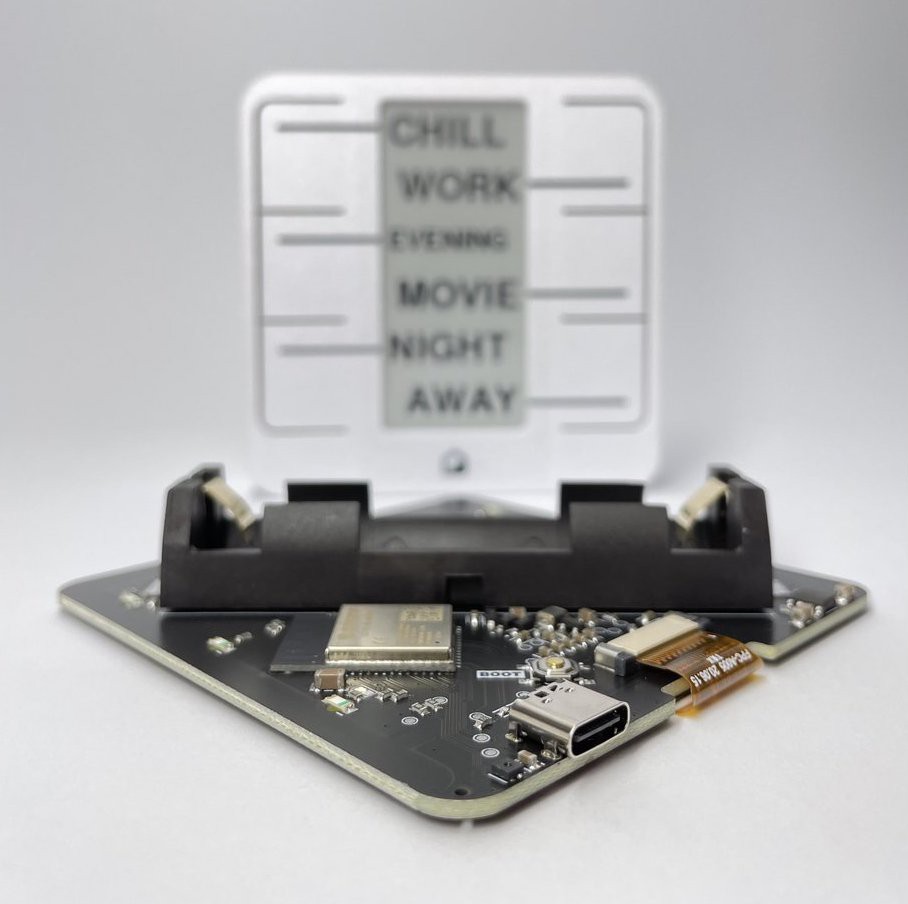
Home automation systems are all well and good, so long as the person who built it all is around to drive it. Let’s face it, they’re quite often a complex web of interconnected systems, all tied to the specifics of one’s home — and someone less familiar with it all could get a little irritated if, on a chilly day, the interface to the boiler is via a Python script, and something won’t work. Just saying. Home Buttons by [Matej Planinšek] over on Hackaday.IO is a nicely polished project, which aims to take some of the hackiness out of such automation by providing a sleek front end to those automation routines, enabling anyone to rock on over and set one in action without hassle.

The PCB is based around the ESP32-S2-mini which deals with WiFi connectivity and integration with Home Assistant using the usual MQTT protocol. We expect integration with other flavors of home automation would not be difficult to achieve. The center of the unit holds a simple E-Ink display, for that low-standby power. Specifically, the unit chosen is a Good Display GDEY029T94 2.9″ which this scribe can confirm is easy to interface and pretty cheap to purchase from the usual Chinese online vendors. This was matched up with six clicky Alps SKRB-series low-profile tact switches, which sit on either side of the display, and corresponds to a flexure-type affair on the 3D printed front casing. Neat and simple.

The PCB design was provided in Altium format, which you can find on the project GitHub page. This shows a straightforward design, with a few nice little details here and there. The internally mounted 186550 cell is reportedly good for at least a year of operation, but when time, it can be charged via USB. A Xysemi XB8608AF (PDF) protection chip provides appropriate limiting for the 186550 cell, shielding it from the perils of overcharging, discharging, and whatnot. Not that that is likely in this current setup. A Sensiron SHTC3 humidity and temperature sensor is also in there, hanging off the I2C bus, which makes sense for this application.

Home Automation hacks are plenty on these pages, like this scroll-wheel interface, for instance. If all this stuff is looking quite overbearingly complicated to get into, how about starting with a Pico W?

GM reveals the first vehicles that will access its expanded hands-free driving network

GM has announced the first few vehicles that will gain access to Super Cruise's expanded road network. The company announced in August it would double the size of the hands-free advanced driver assistance system's (ADAS) network to over 400,000 miles (644,000 kilometres) of roads in the US and Canada. What a surprise: the first vehicles to gain access to this broader Super Cruise network are the newest, high-end SUVs.

GM says it will start delivering vehicles with expanded Super Cruise access in mid-November. The following SUVs will be able to use the larger hands-free driving network, as long as they were built on October 3rd or later:

  • 2023 Chevrolet Tahoe – High Country and Premier trims

  • 2023 Chevrolet Suburban – High Country and Premier trims

  • 2023 Cadillac Escalade, Escalade ESV and Escalade-V

  • 2023 GMC Yukon Denali Ultimate

In the coming months, existing Super Cruise vehicles that are built on GM's Vehicle Intelligence Platform will gain access to the expanded network following over-the-air updates. GM says that by the end of next year, Super Cruise will be available around the globe on 22 models.

As for Ultra Cruise, GM's next-gen ADAS that's currently in pre-production, that will be available on select premium models. GM anticipates that Ultra Cruise will work on 2 million miles of North American roads at the outset.

More Twitter privacy and security executives abandon ship

It's a day ending in the letter "y" which inevitably means there's more drama at Twitter. Chief information security officer Lea Kissner, chief privacy officer Damien Kieran and chief compliance officer Marianne Fogarty have all quit, according to The Verge. The report suggests that the company's engineers will now be responsible for ensuring compliance with regulations. Twitter is currently subject to a Federal Trade Commission consent order, which includes certain privacy and security requirements.

"I've made the hard decision to leave Twitter," Kissner wrote in a tweet. "I've had the opportunity to work with amazing people and I'm so proud of the privacy, security and IT teams and the work we've done."

I've made the hard decision to leave Twitter. I've had the opportunity to work with amazing people and I'm so proud of the privacy, security, and IT teams and the work we've done.

I'm looking forward to figuring out what's next, starting with my reviews for @USENIXSecurity 😁

— Lea Kissner (@LeaKissner) November 10, 2022

The departures will surely have a significant impact on Twitter's security and privacy teams. To that end, The Verge obtained a Slack message purportedly shared by a Twitter lawyer, which notes that engineers have been asked to "self-certify" that they're complying with FTC requirements and other laws. "This will put huge amount of personal, professional and legal risk onto engineers," the message reads. "I anticipate that all of you will [be] pressured by management into pushing out changes that will likely lead to major incidents." The lawyer, who urged workers to seek whistleblower protection if they felt the need to, warned that such changes are "extremely dangerous for our users." 

The FTC consent order is part of a settlement Twitter reached with the agency in May. One of the conditions requires the company to employ a "comprehensive privacy and information security program" to examine new products for privacy and security risks. The lawyer noted that if Twitter violates the consent order, it could be on the hook for "billions of dollars" in fines, which would be "extremely detrimental to Twitter’s longevity as a platform."

This week, the company revamped the Twitter Blue service and started allowing users to obtain a checkmark (previously used to denote that an account was verified) for $8 per month. That's already created a minefield of impersonation, spoof accounts and scams.

A Twitter employee suggested to The Verge that the rushed rollout of the paid checkmark scheme, as mandated by new owner Elon Musk, bypassed the typical privacy review process. “The people normally tasked with this stuff were given little notice, little time, and [it's] unreasonable to think [the privacy review] was comprehensive,” said the employee, who noted that none of the team's recommendations were put into effect before the new Twitter Blue went live. That team was only able to review possible risks the night before Twitter rolled out the retooled service.

“No CEO or company is above the law, and companies must follow our consent decrees,” Douglas Farrar, the FTC’s director of public affairs, told The Washington Post. “Our revised consent order gives us new tools to ensure compliance, and we are prepared to use them.”

Engadget has contacted Twitter for comment.

Tiny robotic fingers let humans interact with insects

Human fingers are clearly too big to safely play with bugs, but technology might offer a far gentler option. Scientists at Ritsumeikan University have developed soft robotic "microfingers" that let people interact with insects. The tiny digits (just 0.47in long and 0.12in wide) combine flexible liquid metal strain sensors with pneumatic balloon "muscles" to offer just enough force for touching a bug without hurting it. The human operator controls the miniscule hand with a robotic glove.

To test the technology, researchers used the microfingers to measure the reaction force from a pill bug's legs and torso. The creature's 10 millinewtons of pushback from the legs lined up with previous estimates — a figure that science couldn't directly verify until now.

The technology could be helpful for studying insect forces like walking or flying (and yes, the temptation to tickle a bug is there). However, the team also sees the invention as potentially useful for other micro-scale interactions, particularly with the help of augmented reality glasses that could provide a clearer view. Future versions could one day help doctors directly interact with bacteria and viruses.

The challenge, as with many scientific inventions, is translating the discovery to a practical product. The Ritsumeikan team warned that this is a proof of concept and a "representative study." It could be a while before the technology is thoroughly tested, let alone ready for mass production. All the same, this hints at a future where humans can grab and poke the smallest objects in a very natural way.