Posts with «mega» label

Building a sweet plastic MIDI controller

With parts from a bathroom organizer and arcade buttons, Alex “GlacialGeyser” made his own MIDI machine.

MIDI controllers can be great instruments to supplement your musical skills. As seen in the video below, Alex’s project is no exception, and he’s able to produce some really beautiful music using it and a keyboard. Physically, he created this out of plastic parts from a bathroom organizer and a cutting board that he cut using mostly handheld power tools. An Arduino Mega serves as the brains of the operation along with two 75mm 10k faders, two 10k knobs, pitch bend and modulation wheels, and a couple of LEDs.

The build is finished off with a splattered paint effect and nearly a whole can of clear coat. Programming the device was a challenge, but it seems Alex gained some useful knowledge for next time!

You can find more about GlacialGeyser’s MIDI controller on his Imgur writeup.
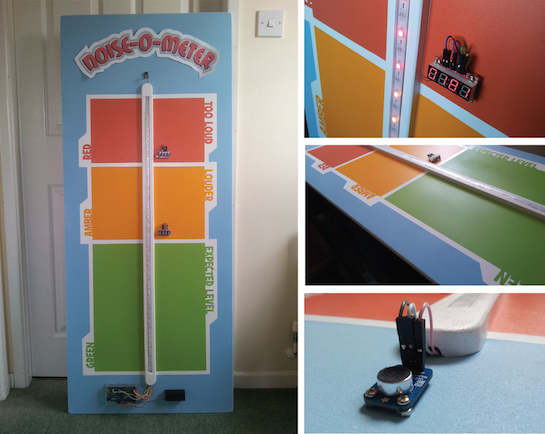
An Arduino VU meter for classrooms

With his beautifully-colored classroom “noise-o-meter,” Mr. Jones knows when things are getting out of hand.

When you were in school (or if you are in school) the teacher likely told the class to be quiet, perhaps repeating him or herself over an over during the day. The teacher, however, likely never really defined what is good and bad. Mr. Jones has finally solved this issue by creating a classroom “noise-o-meter” using an Arduino, an electret microphone, and a programmable LED strip. In order (apparently) too keep the class in line, noise is simply marked as green for “expected,” amber for “louder,” and “red” for too loud which corresponds nicely with more “traditional” VU meters.

I built this a short while ago as an idea to use in a primary classroom setting. Poster displays are often used by primary teachers wanting to control the noise levels in their classrooms but I wanted to add technology to make it dynamic and responsive. The motivation for this came after seeing the Adafruit Digital NeoPixel LED Strip online and realizing its potential as part of a VU meter.

Are you a teacher and want to build one for yourself? You can check out Mr. Jones’ Instructables page or his own website in a different format.

An animatronic talking takeout container

An Arduino plus fake food and audio capabilities equals something truly unique!

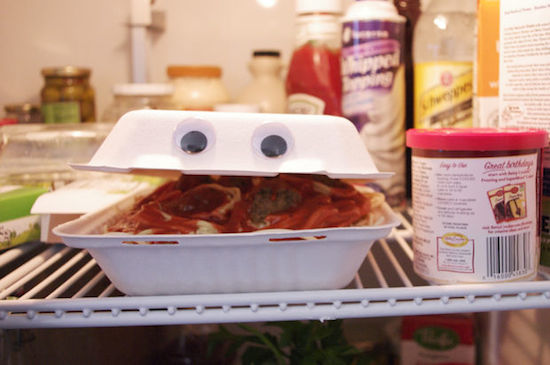
Randy “randofo” Sarafan had an idea when he was in college: a takeout container that talked. To the world’s great benefit, now that he knows about electronics, he finally made this dream a reality. Using an Arduino Mega with a Seed Studio Music Shield, he was able to coordinate the movements of a servo and thus the lid of a box with the audio coming out of a speaker. After attaching googly, or “googily” eyes, and modifying a fake serving of spaghetti, he had something that should be quite entertaining!

This idea came about after having taken a special effects film class when I was in college. While in the class, I made a short film of myself talking to a takout container with a face drawn on it. However, not having the know-how to do anything with electronics, the initial version was being controlled by a friend pulling upon and releasing a thin fishing line. While I do not doubt that my friend was skilled at controlling the lid in this manner, I couldn’t help but thinking that it would be great if I could automate the whole thing — at the very least — less embarrasing.

You can find more info on how to build this “foodie” contraption on the project’s Instructables page!

The MR-808 is a robotic drum “synthesizer”

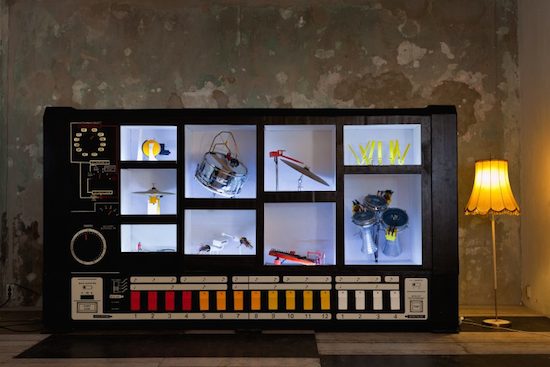
The MR-808 robotic drum machine looks like a gigantic Roland synthesizer, but plays with real instruments!

The Roland TR-808 was released in 1981 and was meant to replace a human drummer for practice purposes, but was instead used to produce music itself, helping to birth the electronic, techno, and hip hop genres. Moritz Simon Geist and the Sonic Robots collective, however, decided to turn this on its head, with a machine made to look like a gigantic ‘808, but containing real instruments.

With a variety of hardware, including an Arduino Uno and Mega, an audience can program the MR-808 using a tablet and get down to the grooves they create themselves!

In 2013 I [Geist] found Sonic Robots a loose group of friends, hackers, technicians and artists and we had the idea of reversing the concept of the ‘808 and putting the physical aspect back into this gorgeous drum machine. For the Installation MR-808 we began to replaced eleven sound with mechanical actuators like motors and solenoids, so that reals drums (snare, BD ..) could be played live.

You can read all about the device on the Sonic Robots page, as well as find more information on how it works here.

Connected question mark hopes to spark 1 million conversations

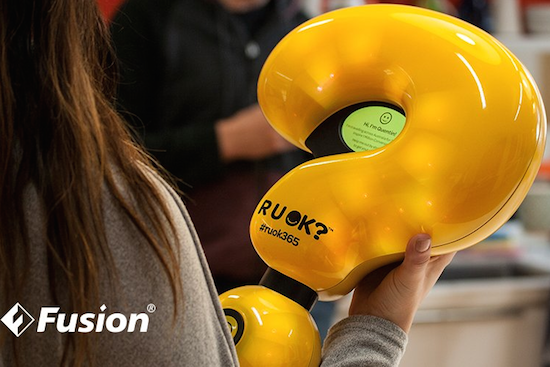
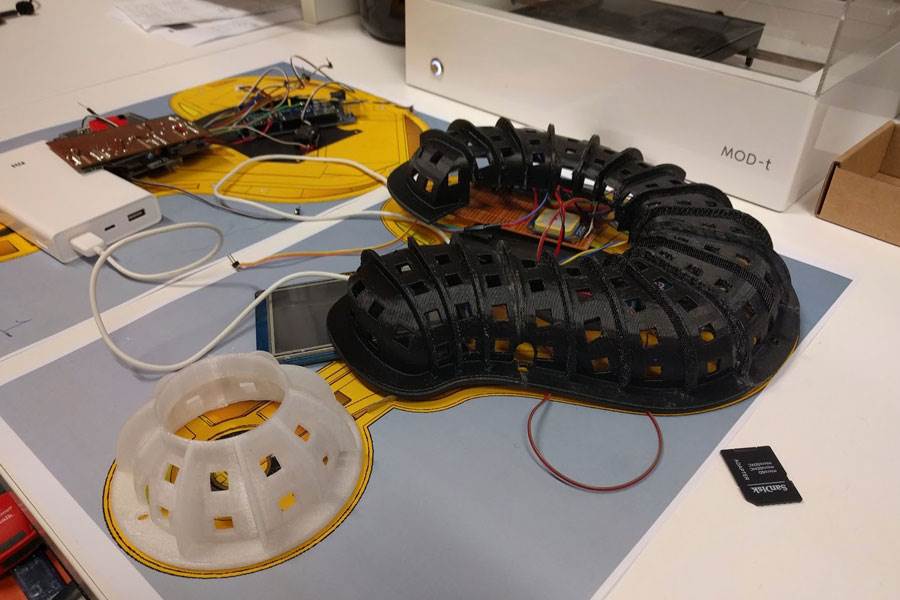
Suicide prevention charity R U OK? has partnered with digital innovation agency Fusion to create a fully-connected device in the form of a question mark with hopes of sparking a million conversations throughout Australia. Similar to the Olympic Torch, Quentin will be passed from person to person as it makes its way from town to town starting on Thursday, September 8th.

But unlike the Olympic Torch, the route is not planned. Instead, the journey is determined by the challenge it issues to each new keeper motivating them to reconnect face-to-face with people in their lives.

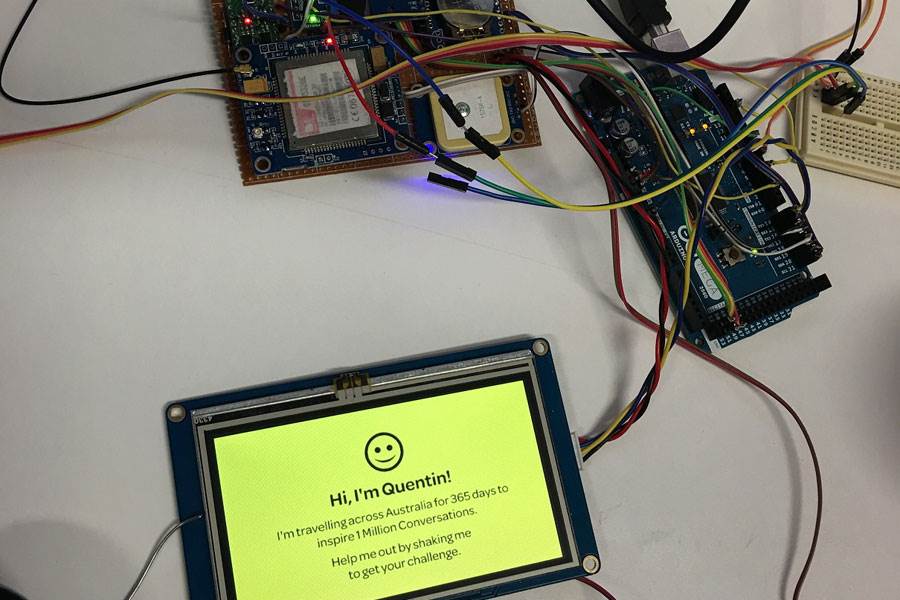
Quentin consists of a translucent 3D-printed shell, and is equipped with an Arduino/Genuino, some sensors, GPS, a display, and an array of LEDs that illuminate, animate and communicate. Users can interact with the device either by SMS or shaking it to receive their R U OK? challenge. Quentin also publishes its activity to the charity’s website, including distance travelled, challenges issued, and the number of keepers.

(Photos: Fusion / Campaign Asia)

Your Arduino can tell you which countries you AREN’T in

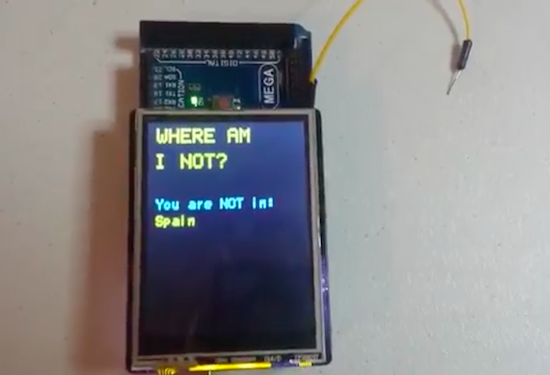
A few months ago, Connor Nishijima demonstrated a neat project highlighting the Arduino Uno’s “built-in motion sensor.” Now, he’s using the Arduino Mega’s “built-in anti-GPS” to guess which countries you’re NOT in.  How, you ask? By reading the frequency of the alternating current (AC) cycles in his house using an open analog pin.

You’ll need an Arduino Mega to fit the array of Strings below, Uno doesn’t cut it even with use of PROGMEM. The Sketch is also written to use the Seeed Studio TFT Shield, but if you remove all “TFT” lines from the sketch you can just see the output in the Serial Monitor. An antenna (just a breadboard jumper) on A7 might be necessary.

Since various locations have varying power systems, Nishijima was able to program the board with a list of all those that cycle the AC at 60Hz and 50Hz AC. By knowing which one you have, the Arduino can then reckon which countries you’re not in and display its findings on the TFT shield.

Perhaps the best part of Nishijima’s hilarious video, though, is what happens when you don’t have enough AC in your home. When this occurs, you’ll receive the following error message: “NO ******* CLUE WHERE YOU ARE. SORRY NOT SORRY PAY YOUR ELECTRIC BILL.”

Admittedly, he notes that this trick is “pretty useless, but fun, nonetheless.” You can find more about the anti-GPS project on GitHub.

Talk to the (animatronic) hand!

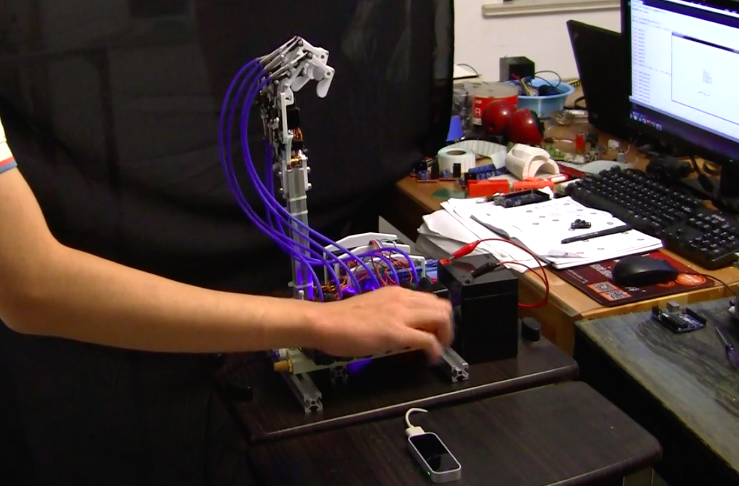
Maker Shuang Peng has created a 13 DOF animatronic hand using an Arduino Mega, seven servo motors, and six air cylinders, along with a Leap Motion sensor for control.

As briefly described on his Instructables page:

There are various ways to control the hand. I’ve tried the Leap Motion sensor and the data glove, which catches my motion via Processing. Then the Processing communicate with the Mega via serial. Now, I’m trying to use EMOTIV Insight EEG sensor to control it.

HardWino is an open-source, Arduino-based cocktail maker

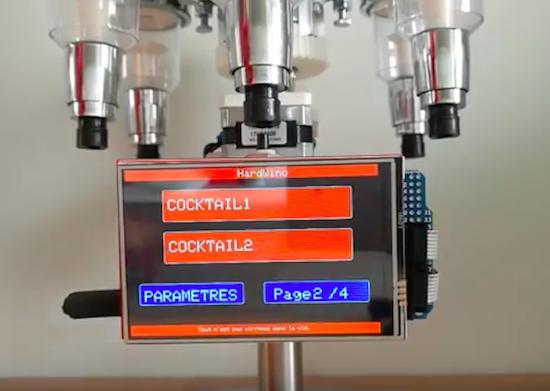
While it may not be the first (nor will it be the last) robotic bartender we’ve seen, Pierre Charlier has come up with a clever and affordable way to mix the perfect drink at home. Say hello to HardWino.

The automatic cocktail maker consists of a six-slot, rotating beverage holder that is controlled by an Arduino Mega and uses a TFT screen to accept orders. The project also includes stepper motors and L298 driver boards, which are supported by 3D-printed parts. Power is supplied through a 12V DC jack.

Charlier provides a step-by-step breakdown of the build in the video below. Keep in mind, however, that this is merely a prototype. We can’t wait to see the final result!

Build an electric go-kart on a budget with Arduino

Growing up, there was nothing cooler than hopping in a go-kart for a quick spin around the neighborhood. But you know what would make it even cooler? If you built your own electric set of wheels. That’s exactly what two engineering students, Adrian Georgescu and Masoud Johnson, have done using commonly available components along with a secondhand frame they picked up for $125 and a few Arduino.

Although they initially targeted a motor power output of 3kW, they were unable to find any that fit their budget. So as any true Makers would do, the duo settled on creating one out of an old Subaru alternator instead. Price tag? $30.

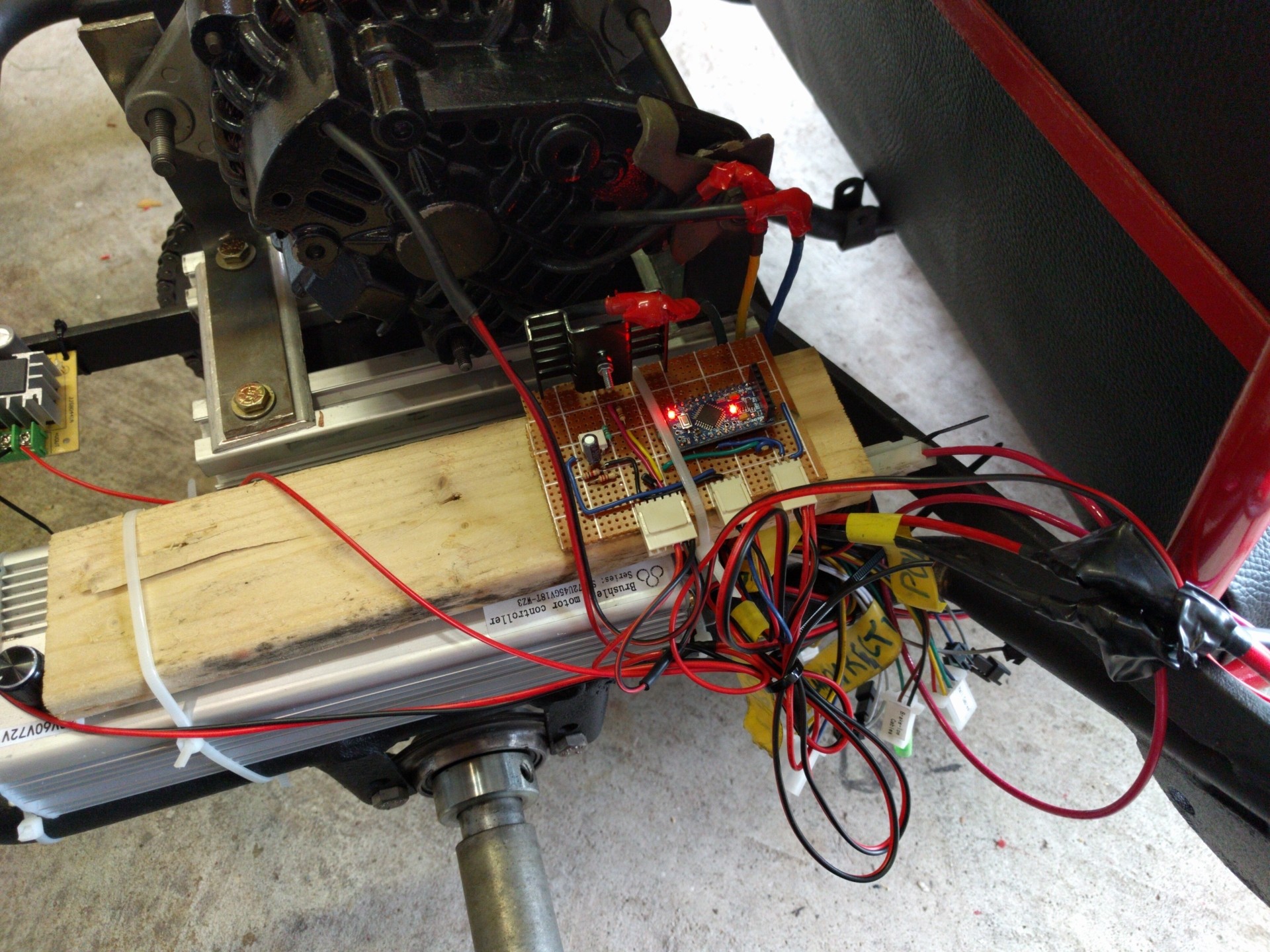
For the rest of their project, Georgescu and Johnson used an electric scooter’s three-phase motor controller, three LiPo battery packs, a trio of Arduino Pro Minis, and an Arduino Mega. The Arduinos are tasked with throttle control, speed sensing, RPM measurement, and transmitting the data over to a virtual dashboard on an Android app.

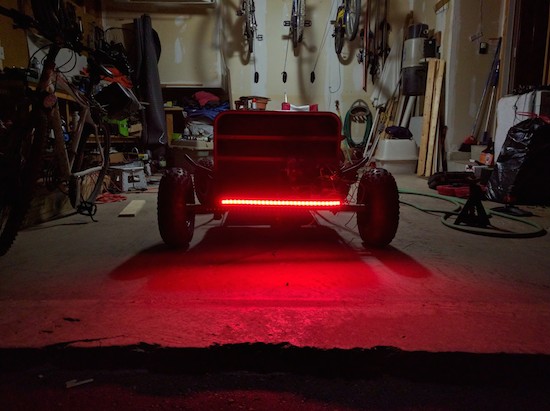
To finish off the build, the students reupholstered the seat, painted the chassis red and black, and threw on 60 LEDs. You can see the end result in action below, as the e-kart reaches a top speed of roughly 33mph (53km/h).

An Arduino-based cartridge reader for Nintendo systems

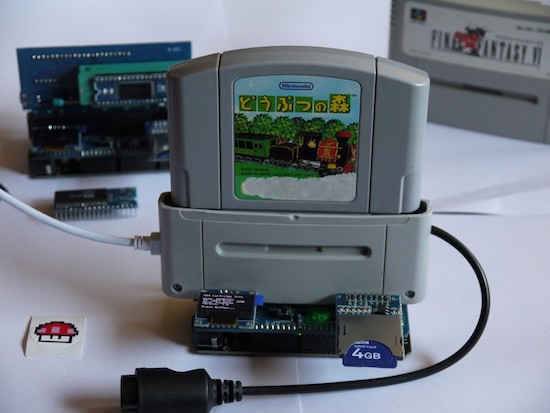
GitHub user Sanni has created a Nintendo cartridge and save game reader shield for the Arduino Mega.

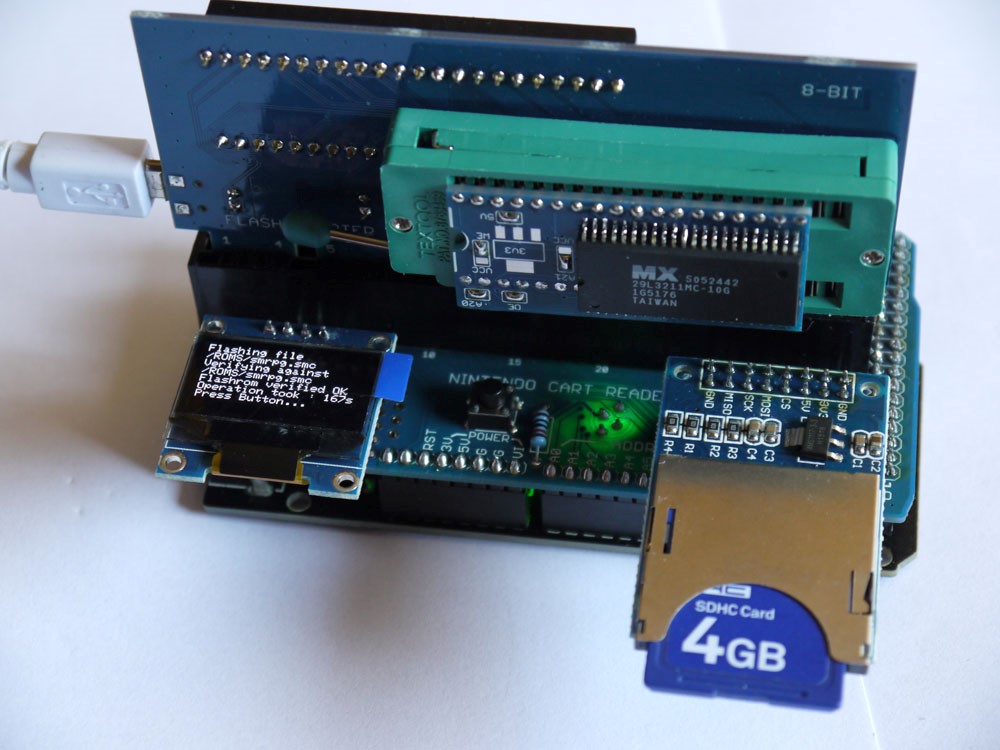
The ROM gets saved to an SD card. You can also read/write save files to the SRAM, display information about the cartridge on a 0.96″ 128X64 OLED LCD, and calculate the checksum of your ROM dump. You control it using the push button–one click moves the selection down, a double-click moves it up, and a long press executes the current menu option.

As the Maker explains, this shield:

  • Reads SNES ROMs and reads/writes save games from and to the SNES cartridge–supported types include: LoRom, HiRom, ExHiRom, SuperFX, SuperFX2, SA1 (can’t write save back to SA1)
  • Read/writes SFC Nintendo Power cartridges
  • Reads N64 ROMs and reads/writes save games (4K/16K EEPROM + SRAM + Flash RAM)
  • Reads/writes N64 Controller Paks and also can test a N64 controller
  • Programs Flash ROMs like 29F016, 29F032, 29F033, 29F1610 and 29L3211 (needs 3.3V)