Posts with «featured» label

Experiencing the solar flux with an interactive installation

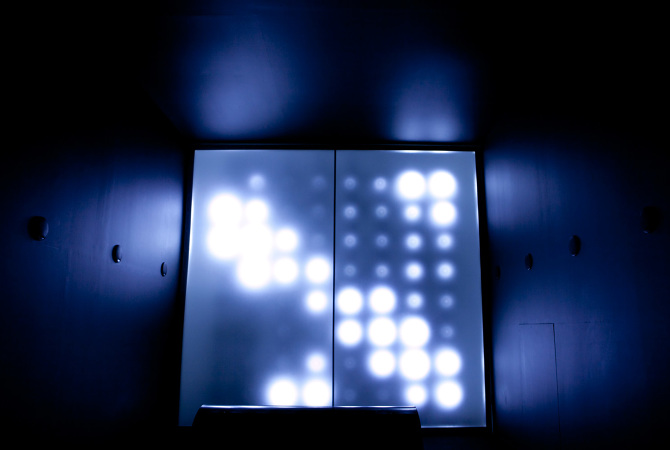
Dmitry Morozov shared with us a new interactive installation called  Solarman at the Polytech Museum in Moscow. 2014 and It’s a work he created with Julia Borovaya and Edward Rakhmanov using 64 ultra bright LEDs, 12-channel sound system and 8 electrical nerve stimulation electrodes controlled by Arduino Mega :

Data on power of X-radiation flux from the Sun is received in real time from the satellite GOES15 which is tracking solar activity. It is being converted into streams of sound, light and electric discharges, thus allowing a spectator to experience in more intensive and evident way the influence of the main luminary of the solar system.

The data, which is measured in watts per square meter, come with a frequency of once per minute. A special computer algorithm transforms it in sound waves, distributed by 12 channels in the space. The radiation power directly controls the height of tones and spectral changes in the sound. The speed of sound displacement in the space is also dependent on these parameters. Light is generated by algorithmic transformation of X-ray emission into physical modeling of light particles, which also affect the muscle stimulators in the chair to produce weak electric discharges.

Check the video below to see the power of the sun:

Arduino Blog 09 Dec 19:57

Casa Jasmina: a New Domestic Italian Landscape (NEW WEBSITE!)


Last October at Maker Faire Rome, Massimo Banzi, Bruce Sterling and Lorenzo Romagnoli announced a new exciting project.
The project, called Casa Jasmina, is a real Apartment in Turin, hosted by Toolbox Coworking in a old industrial building already shared by Officine Arduino (the Italian Arduino headquarter), and Fablab Torino.

The apartment will serve as test bed for the latest development from the open source community. We will explore the boundaries in the field of open source connected home showcasing the best of open source furnitures, connected objects, and white goods hacks.

Shortly anyone will have the opportunity to experience living in a open source connected home, Casa Jasmina will be available for rent on Airbnb.

Do you want to collaborate with us or propose your ideas? Please check the partnership opportunities and get in touch! hashtag #CasaJasmina

Today we are launching the official online presence of the project and to celebrate the kickoff of Casa Jasmina website, we are happy to share Bruce Sterling thoughts on the project.

———————————–

A New Domestic Italian Landscape

A lot has already been said about the Internet of Things, so the time has come to attempt to live the dream.

As a science fiction writer and design critic, I’m all for speculation. However, the IoT is no longer a theory. It features genuine industrial consortia, proliferating standards, and exciting new capacities in sensors, data, and analytics. The Internet of Things is coming into the home, and that most definitely includes the Italian home.

So, how will that happen? It seems there are five basic approaches.

  1. THING CENTERED. In this model, every object has its own Internet connectivity and they all talk to each other independently. It’s like the old-school Internet, but with things instead of websites.
  2. GATEWAY CENTERED. There’s a home control box or a router which serves as a boss for all the anarchic things, enforces a standard on them, and protects them from security attacks.
  3. MOBILE CENTERED. The real action inside in the operating system of a powerful personal smartphone, which acts as the handheld remote-control for everything.
  4. CLOUD CENTERED. The household Internet of Things is run by offshored professionals who have advanced data analytics and can manage all domestic objects and services for a fee.
  5. INDUSTRIAL FOG. Everything is run locally, but with an urban, automated factory-style model that includes building management software and Smart City services.

What’s missing in these five models of the IoT? A user-centered model, a citizen-centered model, an open-source collaborative model. That’s the prospect that interests us at “Casa Jasmina,” the Torino Fab Lab / Toolbox Co-Working domestic lab in Torino, Italy.

This design approach is what we can contribute, from Torino, to this epic world struggle — and it is epic, and it is a world struggle of great consequence to us and everyone else.

The older, customer model, where twentieth-century consumers bought their dumb appliances from simple boxes and plugged them in, is becoming extinct. A new domestic landscape is becoming visible. We want to bring that to life with the values of “Make In Italy” — rapid invention, plenty of mistakes, and results that combine innovation with elegance.

My role in Casa Jasmina is that of curator. In the blizzard of new things that constitutes the Internet of Things, I have to figure out what belongs on the premises. Casa Jasmina an actual, functional apartment directly above the lasers, routers and 3DPrinters of the famous Torino Fab Lab. It will have guests in it; people will sit in the chairs, sleep in the beds. I will personally test every last “thing” that goes in there.

Our first piece of household furniture is already chosen: it’s “Pietro Micca,” our pet Roomba robotic vacuum cleaner. I chose this vacuum cleaner as our mascot, not because it’s “high tech,” but because the Roomba line is ten years old, well-established, a living reality of domestic home automation. “Pietro Micca” will be martyred, because we are going to hack him relentlessly, but he represents “normal life.” That’s what we want to see and display in Casa Jasmina — the “normal life” of about ten years from now.

 Soon, as Casa Jasmina’s curator, I will be “accessing” many other objects and services. We are looking for sponsors, advisors, experimenters, and developers. Let me be quite specific. These are among the things we need.

  • A terrace garden. This is an Italian home and we want living things to grow, flower, and thrive there.
  • A study area including a bookshelf, effective task lighting, and cultural materials reflecting our Make in Italy values.
  • Artworks including electronic art displays.
  • A guide to Torino for our many foreign friends. How does an Internet-of-Things home properly display the city that surrounds it?
  • A functional kitchen. Being Turinese, we naturally favor Slow Food that is good, clean and fair.
  • Children’s toys and furniture. How does an Internet-of-Things home respond to small, innocent people who are not its power-users and don’t interact with its controls? Children are participants in home life and any proper home design takes their needs into account.
  • Temperature control, water control, electricity monitors, building-management services.
  • Household appliances.
  • Party supplies. A congenial home of the future must stand ready to entertain!

Bruce Sterling

Build a 3d-printed remote control box with the help of Materia 101

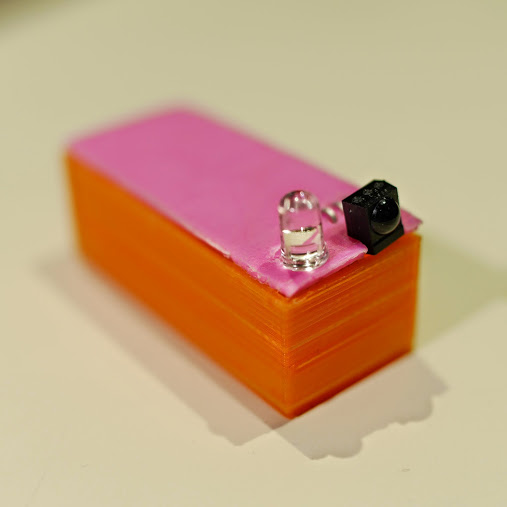
One of the pleasures of watching TV depends on the use of a remote control that allows you to change channels from where you are. In the tutorial of this week, Kristoffer made an add-on to a previous lesson teaching us how to control a computer with a remote control like the one of your TV using Arduino Micro, IR-sensor. The add-on is a custom and colourful 3d-printed case created with Freecad and Materia 101.

Follow the 12 steps of the lesson on Scuola >>

Check the previous tutorials on 3d printing with Material 101.

Interested in getting in touch and showing your experiments? Join Kristoffer on the Arduino forum dedicated to Materia 101 and give us your feedback.

Hashtag: #Materia101

Making it a special XMas on the Arduino Store with Gift Guides

Regardless of your budget, time and flair, there’s a perfect pick to put under your friends’ and relatives’ tree this year. We created a series of Gift Guides to help you be more relaxed and efficient in finding the best solution for all. You can check below and find out also some good news regarding free shipping (check at the end of the blogpost!)

Kids

Winter holidays and Christmas is the time most of the people focus on kids and family in the most broader sense. And never like today we have the chance to make a present and open up new worlds to the little ones.

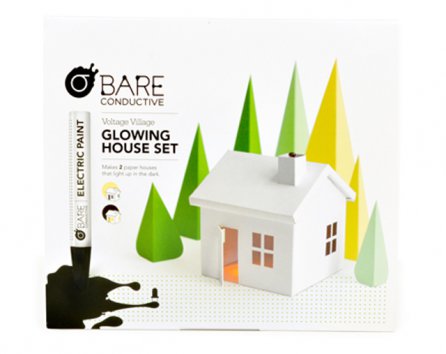
Yes. I’m talking about the experience you have playing with littleBits Base Kit for the first time. It’s an excitement for electronics you can share with kids and teenagers also happening when playing with Bare Conductive Pen, Voltage Village  Glowing House or the TV-B-Gone Kit designed to shut off any TV. They are like an entire universe hiding into a game box!

Explore the gift guide dedicated to kids


IoT & Connectivity

IoT and connected devices  has absolutely exploded in the past year, so if you’ve got coders and startuppers on your gift list, these ideas could save your time. In this gift guide you’ll find a selected list for different tastes and for sure there’s something for everyone.

From the well known Arduino Yún to the Annikken Andee for Android  smartphones designed to make mobile integration simple, you can learn how to build Wireless Sensor Networks and test the power of Bluetooth 4.0 Low Energy with Blend Micro.

Explore the gift guide dedicated to IoT


Home Lab

Some people say that in the future our homes will be fully automated, with refrigerators ordering your milk when it’s over, and other gizmos enabling the materialisation of a truly smart home. Is this what we want? Probably we’re not sure yet but there are a few tools  that you can buy for your house that will get you and your friends to feel like what it means to have a home lab.

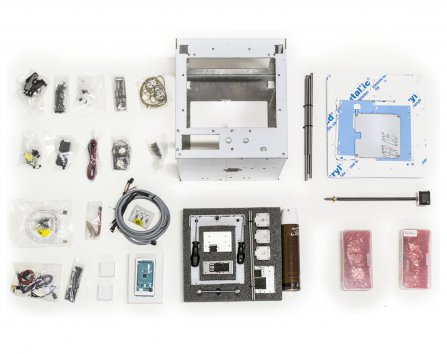
Starting from a Materia 101 kit to 3d print cool decorations for Christmas and you can take your holiday time to build it with the help of some friends. Or use some quite days to dive in the world of electronics exploring Make Electronics book by Charles Platt or tinkering with some components you’ve never had time to explore like the Arduino Wireless SD Proto Shield or the Tinkerkit DMX Receiver .

Explore the gift guide dedicated to Home Lab


Fashion Tech

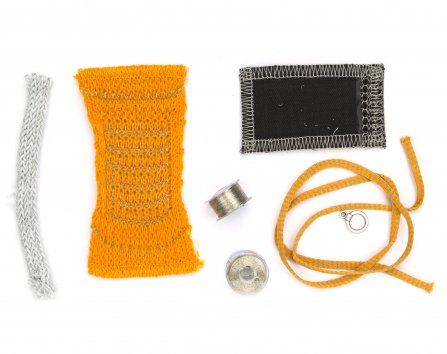
Fashion and tech are closer than ever these days. Textile sensors make every interactive project comfortable to wear and easy to prototype. Soft potentiometers, Textile push buttons, Stretch sensors connected to an Arduino Lilypad are the best components to explore this promising field. You can begin with the Open Softwear book 2nd edition plus the Easy Wearable Kit and then move forward with  yellow EL-Wires to brighten your winter. If you want to explore new approaches not related with electronics, then try  the DIY alternative to print fabrics using light with Lumi KIT Red or Blu.

Explore the gift guide dedicated to Fashion


Arduino Store is now offering FREE SHIPPING to Europe via GLS for all orders over €100, below 3 Kg overall weight. GLS delivery will take 4-5 working days to reach you. In December, this may take longer due to end-of-the-year seasonality. Should you need delivery by Dec. 24th, we strongly advice you to place the order before Dec. 15th. Learn more about shipping

Arduino Blog 03 Dec 13:10
arduino store  fashion  featured  gift  guide  iot  kids  

Control your Christmas lights with sms and Arduino Yún

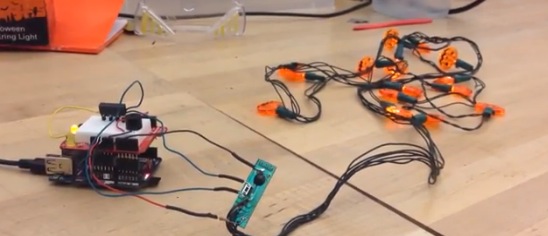
December is finally here and we can start thinking about indoor or outdoor decorations for the holiday. Christmas lights are an excellent way to light up any event and a user on instructables wanted to be able to control the lights remotely with text messages.

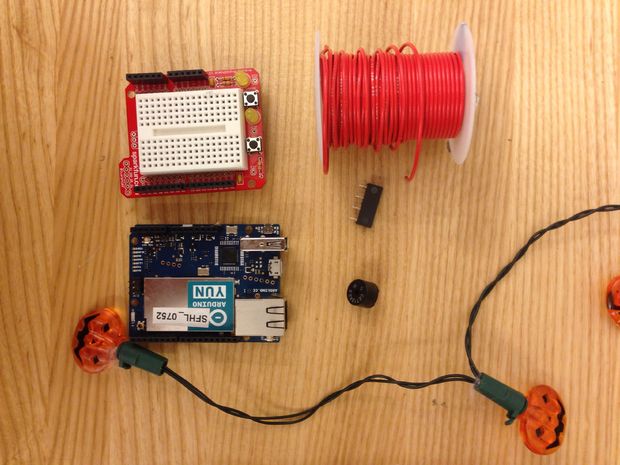
Check his 12-step tutorial  and take a look at the bill of materials:

  • An Arduino Yún – You could use another Arduino with a Wifi Shield though.
  • A Protoshield with (or without) a tiny breadboard
  • A regular breadboard will work as well, but will be less compact.
    If you want to solder more, you can just use a small circuit board instead.
  • A 5V relay
  • A piezo buzzer
  • Wires
  • A battery operated Christmas decoration (It’s not even Thanksgiving, so I’m using a Halloween decoration)
  • A Temboo account
  • A Twilio account


Arduino Blog 01 Dec 21:43

Earthquakes reinterpreted by the human body become art

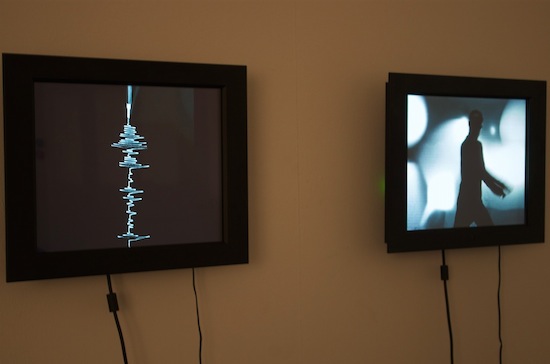
“Earth Partitions” installation by artist Melik Ohanian was exhibited at the Centre d’Art Contemporain à Sète in France and it’s composed by two synchronized videos with a dancer and a seismogram, the second being “written” by the first.

The dancer with two controllers in the hands was asked to “translate” into corporal expression and movements what he saw in a seismogram of an earthquake . His movements were consequently “translated back” to a seismogram using a device. Both the mime and the seismograph were filmed at the same time and both were then broadcasted simultaneously on two different screens during the exhibition.

The project was made thanks to the work of Out of Pluto, a multidisciplinary startup working on the research and development of new technologies to materialize various projects and ideas and decided to share with us some more info about this installation.

Arthur and Mathias, founders of the startup, submitted the project to this blog describing me how they used two Arduino boards:

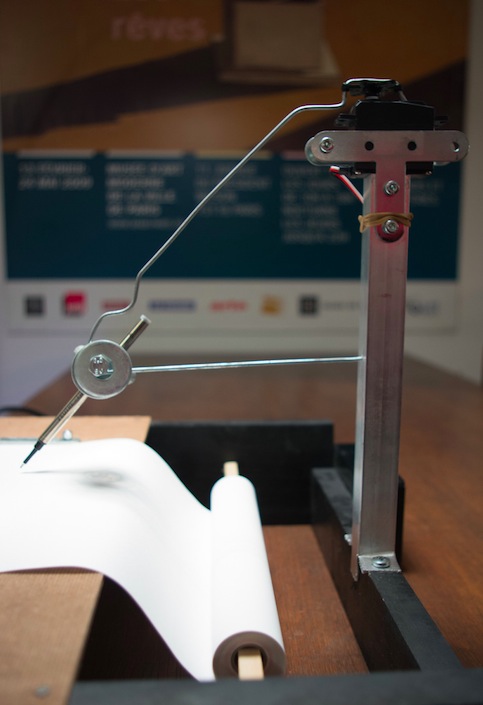
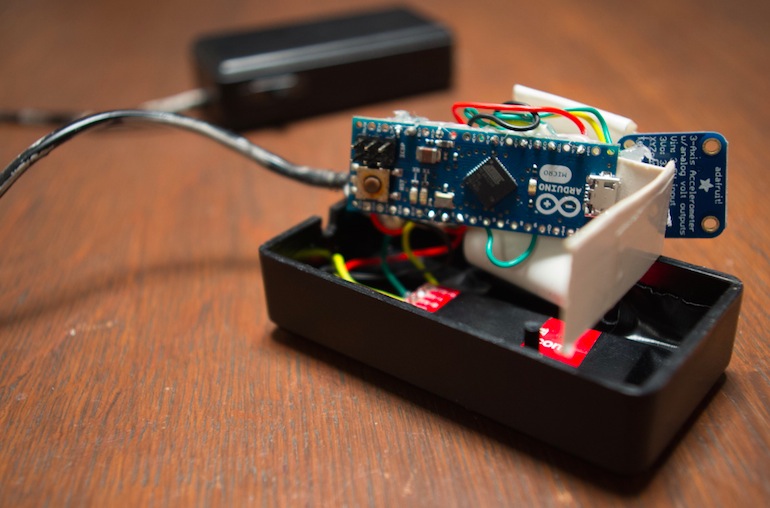
The Arduino Micro reads the accelerometer values, computes a global value and sends it via bluetooth to the computer. The computer reads this value, computes an angle according to a configurable ratio (sensitivity) and sends a new value to the Arduino Uno. The Arduino Uno sends the angle to the servo motor that rotates to this angle and then come back to 0 (if no other value is sent). Coming back to 0 simulates the end of the “earthquake”. The mechanical part of the arm is flexible so there is some inertia involved, creating the typical outline of seismograms. There is a simple motor to pull the paper at a constant speed.

Take a look at the video:

Pimp your ikea lamp into a customized death star

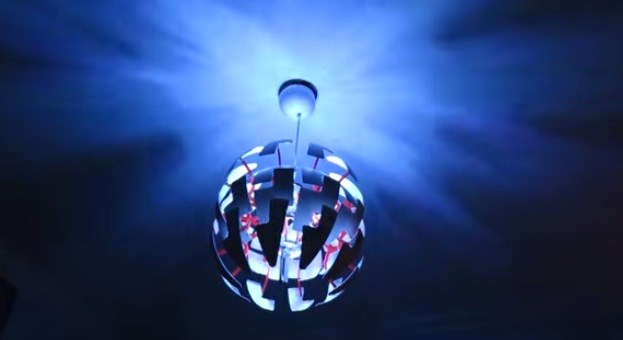
Ikea hacks are well widespread in the maker movement and David Bliss, founder at Nurun, did a great job transforming the Death Star inspired PS 2014 Pendant Lamp into something more dynamic.

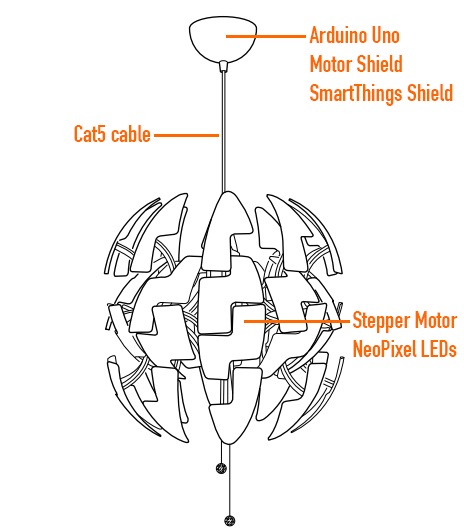
The lamp was pimped up with an Arduino Uno and Arduino Motor Shield, NeoPixel LEDs and other components you can see in the illustration.

The detailed description of the project is on his blog , the code on github and the final result in the following video:

Arduino Blog 26 Nov 22:41
arduino  featured  ikea  led  motor  shield  

Making something useful for your home with Materia 101

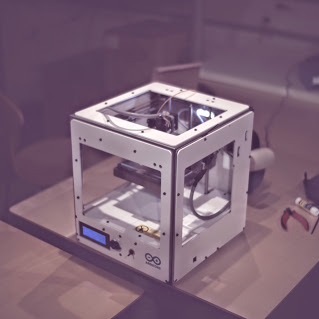
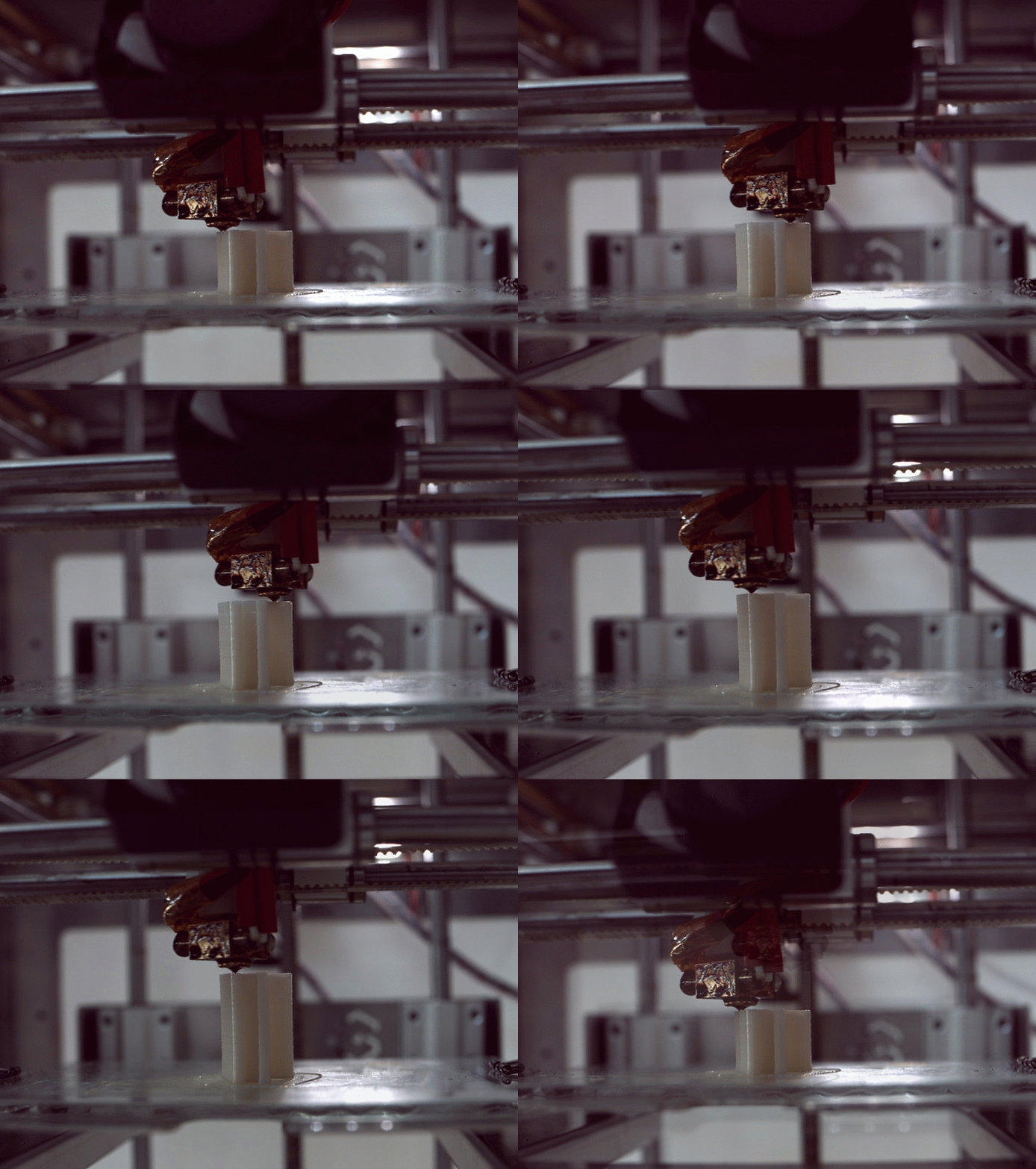
When you become a happy owner of a Materia 101 3d printer, the first days are really important to start experimenting with the right attitude. Understanding quickly how to get what you want from it means becoming aware of the potential applications of the 3d printing technology in your environment.

Last week we published  the tutorial  on  “Getting started with Materia 101″ created by Kristoffer  and kicking off a series of step-by-step guides to explore different topics, softwares and settings for your 3d printer.

Take a look at the second tutorial focused on  fixing things at home: “Making something useful” tutorial shows you how to start from a need, to design and print a solution. It feels great to be able to fix what’s broken!

Interested in getting in touch and showing your experiments? Join Kristoffer on the Arduino forum and give us your feedback.

Next week we are going to post a tutorial on how to create 3d-printed cases for Arduino boards. Stay tuned.

Hashtag: #Materia101

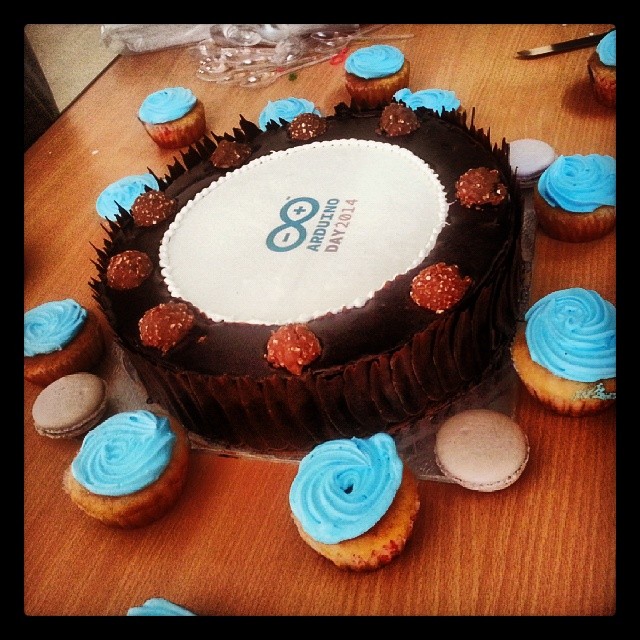
Save the date for Arduino Day 2015: Saturday 28th of March

Last year, during the first celebration of Arduino Day more than 240 user groups, makerspaces, hackerspaces, fablabs, schools, studios and educators throughout Europe, North and South America, Asia, Africa and Australia planned activities, workshops, events for a wide range of audiences and skillsets. They celebrated together the open source community gathered around Arduino globally.

We are now organizing the second edition of this worldwide anniversary celebrating Arduino community and the makers’ movement. Everyone can participate in the role of organizer or as a participant.
Stay tuned because at the beginning of February we’ll be launching the open call for entries. In the meanwhile check the countdown here http://arduinoday.tv – Hashtag: #ArduinoD15


Global emotional light with Arduino

Based on open source technology and programming, LUZ is a lighting project that product designer Marina Mellado designed and targeted to those people who are physically and psychologically affected by the lack of sun or daylight.

Luz is a one meter diameter ring of light. It connects two LED stripes RGB SMD5050 to an Adafruit TCS34725 sensor ( which I use to get the temperature of colour (K) and the light intensity (Lux) Values ) and an Arduino Uno.

The electronic system is programmed to modify gradually the light-color sensibility of the lamp depending on the weather conditions when the sensor is positioned by the window.

Check the video below to see the lamp in action:

Arduino Blog 21 Nov 15:44