Posts with «art» label

Go Behind the Scenes of Installing an Interactive LED Art Exhibit

Nick Squires details his time spent using his maker skills to produce an interactive art installation and performance.

Read more on MAKE

The post Go Behind the Scenes of Installing an Interactive LED Art Exhibit appeared first on Make: DIY Projects and Ideas for Makers.

Macchina poetica converts sounds into onomatopoeic words


Macchina Poetica is a digital prototype converting sounds into onomatopoeic words and images and it’s inspired by the art of the Futurism movement.

Futurism is a modernist, avant-garde artistic movement originated in Italy in the early 20th century. Thanks to sound representation, Futurism artists aimed to emphasize speed, technology, youth and violence, all concepts arising from industrial innovations and war.

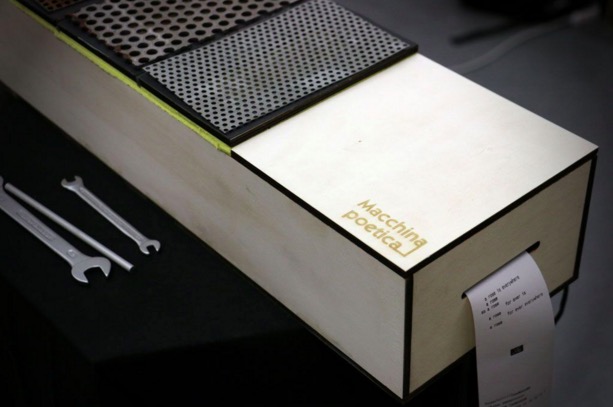
In order to keep continuity with this particular artistic movement, the authors, Alessandra Angelucci, Aris Dotti, Rebecca Guzzo, students at Master of Advanced Studies in Interaction Design SUPSI, decided to design an object that looks like the musical instrument of Futurism movement (precisely a Celesta). The object plays a metallic sounds and the user is facilitated in understanding how to use the object due to a instrument-like interface.

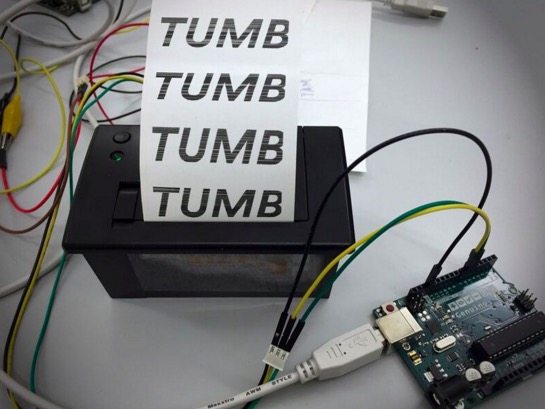
The machine is built using 4 piezo sensors, a thermal printer, a board, electrical cables, 4 resistors (1K), a 6 volt power supply and a Genuino Uno board.

The instrument’s interface is designed with plywood, metal plates and sponge that serves as a shock absorber. Between the metal plates and the sponge there are the piezo sensors along with resistors communicating with the Genuino Uno board every time the user interacts with the metallic plates. Once the Genuino receives the signal, it sends a command to the thermal printer that will print a word or a Futurism poem.

The interaction takes place when the user with the help of a metal tool (for example a screwdriver or a wrench) strikes the metal plates with different pressures. At the end of the performance the user and the viewers can have a clear overview of the produced sounds reviewing the printed paper outputs.
The prototype is the result of two weeks physical computing class Creating Tangible Interfaces held by Ubi De Feo at Maind program SUPSI  in Lugano, the goal of the course is how to make tangible interfaces via learning fundamentals of electronics prototyping and interaction design.  (Applications are open for the next edition 2016/2017 starting in September 2016)

Create Big Music Mashups on This Enormous MIDI Sequencer Board

A picture might be worth a thousand words, but for an interactive sound work called GRIDI a picture is worth infinite midi loops!

Read more on MAKE

The post Create Big Music Mashups on This Enormous MIDI Sequencer Board appeared first on Make: DIY Projects, How-Tos, Electronics, Crafts and Ideas for Makers.

Try Not to Have a Heart Attack While Watching This Egg/Pendulum Dance

It's just an egg, placed in a vulnerable position. "I thought it would be fun to pit a large metal machine against a small fragile object," says Mendoza.

Read more on MAKE

The post Try Not to Have a Heart Attack While Watching This Egg/Pendulum Dance appeared first on Make: DIY Projects, How-Tos, Electronics, Crafts and Ideas for Makers.

Slap Yourself Awake with This Ridiculous “Wake-Up Machine” Alarm Clock

Swedish tech artist and comedienne Simone Giertz tries her hand at creating the most annoying alarm clock possible

Read more on MAKE

The post Slap Yourself Awake with This Ridiculous “Wake-Up Machine” Alarm Clock appeared first on Make: DIY Projects, How-Tos, Electronics, Crafts and Ideas for Makers.

“Arduino Borealis” Combines LEDs and Paint

[Stef Cohen] decided to combine three different artistic mediums for her latest project. Those are painting, electronics, and software. The end goal was to recreate the aurora borealis, also known as the northern lights, in a painting.

The first step was to make the painting. [Stef] began with a shadow box. A shadow box is sort of like a picture frame that is extra deep. A snowy scene was painted directly onto the front side of the glass plate of the shadow box using acrylic paint. [Stef] painted the white, snowy ground along with some pine trees. The sky was left unpainted, in order to allow light to shine through from inside of the shadow box. A sheet of vellum paper was fixed to the inside of the glass pane. This serves to diffuse the light from the LEDs that would eventually be placed inside the box.

Next it was time to install the electronics. [Stef] used an off-the-shelf RGB LED matrix from Adafruit. The matrix is configured with 16 rows of 32 LEDs each. This was controlled with an Arduino Uno. The LED matrix was mounted inside the shadow box, behind the vellum paper. The Arduino code was easily written using Adafruit’s RGB Matrix Panel library.

To get the aurora effect just right, [Stef] used a clever trick. She took real world photographs of the aurora and pixelated them using Photoshop. She could then sample the color of each pixel to ensure that each LED was the appropriate color. Various functions from the Adafruit library were used to digitally paint the aurora into the LED matrix. Some subtle animations were also included to give it an extra kick.


Filed under: Arduino Hacks, led hacks

Giant Fog-Breathing Robotic Crow Shoots Lasers

Artist David Cranmer's "Stakcgrox" is a 3.5 meter tall robotic crow with a rotating head and glowing eyes that shoot lasers.

Read more on MAKE

The post Giant Fog-Breathing Robotic Crow Shoots Lasers appeared first on Make: DIY Projects, How-Tos, Electronics, Crafts and Ideas for Makers.

Floating Fantasy

The Amazing Air-Filled Under-Sea Adventure used more than 40,000 balloons to fill the building’s five-story atrium

Read more on MAKE

The post Floating Fantasy appeared first on Make: DIY Projects, How-Tos, Electronics, Crafts and Ideas for Makers.

MAKE » Arduino 29 Jun 19:00
airigami  arduino  art  art & design  balloons  make46  mf  ocean  sea  

Selfie typewriter hammers out ASCII portraits

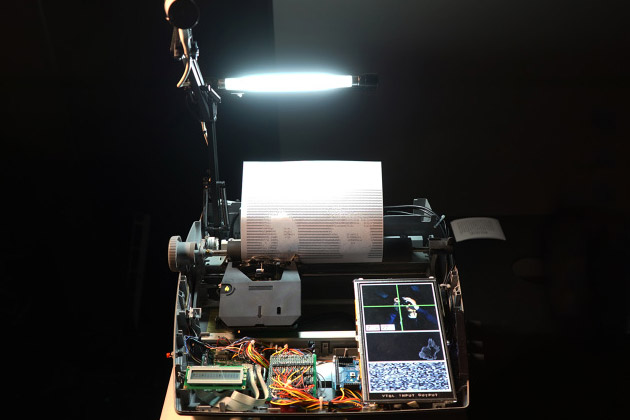
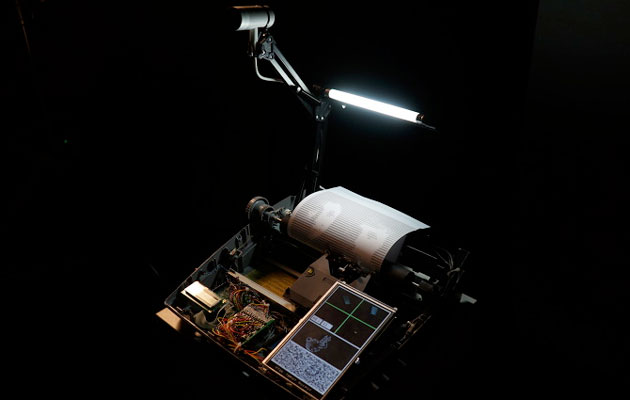
Dimitry Morozov, better known as vtol, is a Russian musician, engineer and artist who decided that selfies were far too modern for his liking. Instead, he wanted people to wait for their gratification, and so hooked up an iSight camera to an Arduino-controlled Brother sx-4000 typewriter. Once a person sticks their face in front of the machine, named i/o, the typewriter painstakingly hammers out a portrait in ASCII art. The hardware was shown off at the 101 festival in Smolny, St. Petersburg in Russia, which ended earlier this month - but you can still see the device in action if you watch the video.

Via: Kotaku

Source: vtol

Engadget 24 Apr 18:38
arduino  art  design  dimitrymorozov  io  misc  typewriter  video  vtol  

In Russia, you have to type out your selfies

Dimitry Morozov, better known as vtol, is a Russian musician, engineer and artist who decided that selfies were far too modern for his liking. Instead, he wanted people to wait for their gratification, and so hooked up an iSight camera to an Arduino-controlled Brother sx-4000 typewriter. Once a person sticks their face in front of the machine, named i/o, the typewriter painstakingly hammers out a portrait in ASCII art. The hardware was shown off at the 101 festival in Smolny, St. Petersburg in Russia, which ended earlier this month - but you can still see the device in action if you watch the video.

Filed under: Misc

Comments

Via: Kotaku

Source: vtol

Engadget 24 Apr 18:38
arduino  art  design  dimitrymorozov  io  misc  typewriter  video  vtol