Posts with «arduino» label

Be the Firebender You Want to See in the World

Always wanted to be a citizen of Fire Nation? Here’s one way to ace the citizenship exam: punch-activated flaming kung fu gauntlets of doom.

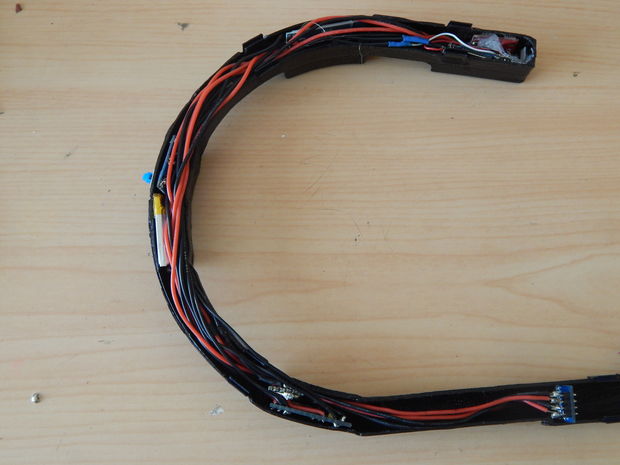
As with all the many, many, many flamethrower projects we’ve featured before, we’ve got to say this is just as bad an idea as they are and that you should not build any of them. That said, [Sufficiently Advanced]’s wrist-mounted, dual-wielding flamethrowers are pretty cool. Fueled by butane and containing enough of the right parts for even a minimally talented prosecutor to make federal bomb-making charges stick, the gauntlets each have an Arduino and accelerometer to analyze your punches. Wimpy punch, no flame — only awesome kung fu moves are rewarded with a puff of butane ignited by an arc lighter. The video below shows a few close calls that should scare off the hairy-knuckled among us; adding a simple metal heat shield might help mitigate potential singeing.

Firebending gloves not enough to satisfy your inner pyromaniac? We understand completely.

Thanks to [Nils Hitze] for the hot tip. Yep.


Filed under: misc hacks, wearable hacks

False Claims On Kickstarter: What’s New?

Kickstarter and its ilk seem like the Wild West when it comes to claims of being “The world’s most (Insert feature here) device!” It does add something special when you can truly say you have the world record for a device though, and [MellBell Electronics] are currently running a Kickstarter claiming the worlds smallest Arduino compatible board called Pico.

We don’t want to knock them too much, they seem like a legit Kickstarter campaign who have at time of writing doubled their goal, but after watching their promo video, checking out their Kickstarter, and around a couple of minutes research, their claim of being the world’s smallest Arduino-compatible board seems to have been debunked. The Pico measures in at an impressive 0.6 in. x 0.6 in. with a total area of 0.36 sq.in. which is nothing to be sniffed at, but the Nanite 85 which we wrote up back in 2014 measures up at around 0.4 in. x  0.7in. with a total area of around 0.28 sq.in.. In this post-fact, fake news world we live in, does it really matter? Are we splitting hairs? Or are the Pico team a little fast and loose with facts and the truth?

There may be smaller Arduino compatible boards out there, and this is just a case study between these two. We think when it comes to making bold claims like “worlds smallest” or something similar perhaps performing a simple Google search just to be sure may be an idea.


Filed under: Arduino Hacks, Crowd Funding

Spice Up Your Bench With 3D Printed Dancing Springs

Not all projects are made equal. Some are designed to solve a problem while others are just for fun. Entering the ranks of the most useless machines is a project by [Vladimir Mariano] who created the 3D Printed Dancing Springs. It is a step up from 3D printing a custom slinky and will make a fine edition to any maker bench.

The project uses 3D printed coils made of transparent material that is mounted atop geared platforms and attached to a fixed frame. The gears are driven by a servo motor. The motor rotates the gears and the result is a distortion in the spring. This distortion is what the dancing is all about. To add to the effect, [Vladimir Mariano] uses RGB LEDs controlled by an ATmega32u4.

You can’t dance without music. So [Vladimir] added a MEMs microphone to pick up noise levels which are used to control the servo and lights. The code, STL files and build instructions are available on the website for you to follow along. If lights and sound are your things, you must check out the LED Illuminated Isomorphic Keyboard from the past.


Filed under: musical hacks
Hack a Day 30 Jul 06:00
arduino  diy  led  musical hacks  neopixel  slinky  sound  toy  

Acquisition Ushers in New Era for Arduino; Banzi Named Chairman

Arduino announced an acquisition today that will merge Arduino.cc and Arduino.org.

Read more on MAKE

The post Acquisition Ushers in New Era for Arduino; Banzi Named Chairman appeared first on Make: DIY Projects and Ideas for Makers.

Acquisition Ushers in New Era for Arduino; Banzi Named Chairman

Arduino announced an acquisition today that will merge Arduino.cc and Arduino.org.

Read more on MAKE

The post Acquisition Ushers in New Era for Arduino; Banzi Named Chairman appeared first on Make: DIY Projects and Ideas for Makers.

A new era for Arduino begins today

BCMI, the company founded by Massimo Banzi, David Cuartielles, David Mellis and Tom Igoe, co-founders of Arduino, announces that today it has acquired 100% ownership of Arduino AG, the corporation which owns all of the Arduino trademarks.

Following the acquisition, Mr. Massimo Banzi becomes the new Chairman and CTO of Arduino. Dr. Fabio Violante will be appointed as the new CEO, replacing Mr. Federico Musto who will pursue other opportunities outside Arduino AG.

“This is the beginning of a new era for Arduino in which we will strengthen and renew our commitment to open source hardware and software, while in parallel setting the company on a sound financial course of sustainable growth. Our vision remains to continue to enable anybody to innovate with electronics for a long time to come,” said Mr Banzi.

“I’m really excited and honoured to join Massimo, the co-founders and the amazing Arduino team as CEO. In the past two years we have worked very hard to get to this point. We envision a future in which Arduino will apply its winning recipe to democratize the Internet of Things for individuals, educators, professionals and businesses,” said Dr. Violante.

Arduino Blog 28 Jul 18:01

NOMNOM is an audiovisual DJ machine

Perhaps you enjoy various flavors of electronic music, and would love to try making your own. Although this seems like a fun idea, after considering the amount of equipment and knowledge that you need to get started, many people simply move on to something else. On the other hand, the NOMNOM machine, seen here, allows you to create tunes visually using YouTube clips as samples.

The device has 16 buttons which can start and stop up to 16 clips displayed via a JavaScript web application. An Arduino Uno takes input from these buttons as well as four potentiometers to modify the clip sounds, and sends the appropriate signals to the computer running the app. There are also four knobs that control the repetition rate, volume, speed and playable length of each selected video. This enables you to make really interesting music without the normally steep learning curve.

For more details, you can check out the project log on Hackaday.io or on GitHub. NOMNOM will also be making an appearance at the World Maker Faire in New York City this fall, so be sure to see it in person if you’re there!

Arduino Blog 28 Jul 17:35

Search for coins and jewelry with this DIY metal detector

While using a metal detector to find valuable jewelry, and less valuable aluminum cans, can be interesting, the more accurately you can pinpoint the “treasure,” the easier it is. For excellent accuracy while maintaining a wide sensing field, Maker “TechKiwiGadgets” built a detector with not one, but four sets of sensing coils, all controlled using an Arduino Mega.

The device generates and senses a magnetic pulse from each set of coils, which is modified if there is a metallic object present. In search mode, the four signals are combined into a single display, and once an object is located, the four sensors can be shown in a split-screen. You can then dig where, and only where, it’s needed, minimizing work and your environmental impact!

Want to create your own? Check out TechKiwiGadgets’ Instructables page for more details and see a demo of it below!

Hackaday Prize Entry: The Arduino Powered LED Persistence Of Vision Rechargeable 3D Printed Fidget Spinner

It had to come to this. For his entry into this year’s Hackaday Prize, [Sean Hodgins] created a persistence of vision fidget spinner. This isn’t just any PoV fidget spinner — this is the ultimate in fidget spinner technology. It’s rechargeable, and there’s an Arduino inside. The enclosure is 3D printed. It improves morale. It is everything you ever wanted in a fidget spinner, and it’s the last fidget spinner project [Sean] will ever make.

We’ve seen electronic fidget spinners before, but never to this degree of polish. The fidget spinner that teaches coding is fantastic, but it’s not quite as refined as connoisseurs of fine fidgets would like. The Internet of Fidget Spinners is likewise a worthy effort and even includes RGB LEDs and WiFi, but [Sean]’s POV fidget spinner is on another plane of reality. This spinner uses batteries that can be recharged, and there’s even a 3D printed (sintered, even!) enclosure that fits everything into a small, compact package. It is, by far, the most elegant fidget spinner we’ve ever seen, and it measures its own rotation speed. It just doesn’t get any better than that.

You can grab all the sources for this amazing fidget spinner on [Sean]’s GitHub, or check out the under-monetized demo video he made below.


Filed under: The Hackaday Prize

Get into shape as you game with Cykill

If you’re having trouble finding time to work out because you’d rather play video games, then this is the solution you’ve been waiting for. The Cykill device modifies a normal exercise bike into a device that won’t let you power on your Xbox unless you’re pedaling sufficiently fast enough.

Making this even more motivating, is that if you stop pedaling fast enough, it immediately cuts power, ruining any in-progress game, and potentially even damaging your hard drive!

To implement this hack, Instructables user “Fuzzy-Wobble” used an Arduino Uno to intercept the bike’s normal control signals. From this data, as well as settings on a custom control panel, it decides whether or not to activate switchable plug that provides power to the Xbox.

If you’d like to build your own forced-fitness setup, be sure to check out the project’s write-up here. Gaming not your thing? Perhaps it’s Netflix binge-watching getting in the way of your healthy lifestyle instead…