The Echo Show 8 is one of Engadget’s favorite smart displays, and it’s on sale right now. At $75 after a $55 discount, the smart display is only $5 more than it was during Black Friday last year. Amazon has also discounted the Echo Show 15 by $55. You can get the company’s largest smart display for just under $225 at the moment. Separately, Amazon is offering up to 35 percent off on Echo speakers. One of the highlights here is the chance to pick up a 5th-generation Echo Dot for just $35.
Engadget Senior Editor Nicole Lee awarded the Echo Show 8 a score of 87 in 2021. Despite being a few years old now, the Echo Show 8 is the best smart display for most people. Its 8-inch, 1,280 x 800 resolution display is large enough to make viewing photos and participating in video calls comfortable. At the same, the Echo Show 8’s display isn’t so large it will look out of place in a kitchen or bedroom. Moreover, the Show 8's built-in speakers are also powerful enough to fill a small room, and the device features enough processing power not to feel sluggish. If you’re concerned about your privacy, the Show 8 comes with a physical camera shutter and a mic mute button.
Like all of Amazon’s Echo devices, the Show 8 works best if you already own other Alexa-compatible devices. If you’re not in the Amazon ecosystem, the 2nd-gen Google Nest Hub could be a better purchase, particularly if you depend on services like Gmail and GCal. The Nest Hub also doesn’t come with a camera for video calls, which might not be a downside if you value your privacy.
"Birds fly South for the winter and North for the summer," has historically proven to be only slightly less reliable a maxim than the sun always rising in the East and setting in the West. Humanity has been fascinated by the comings and goings of our avian neighbors for millennia, but the why's and how's of their transitory travel habits have remained largely a mystery until recent years. In Flight Paths, science author Rebecca Heisman details the fascinating history of modern bird migration research and the pioneering ornithologists that helped the field take off. In the excerpt below, Heisman recalls the efforts of Dr. Bill Cochran, a trailblazer in radio-tagging techniques, to track his airborne, and actively-transmitting, quarry across the Canadian border.
Swainson’s thrush looks a bit like a small brown version of its familiar cousin the American robin. Its gray-brown back contrasts with a pale, spotted chest and pale “spectacle” markings around its eyes. These thrushes are shy birds that forage for insects in the leaf litter on the forest floor, where they blend in with the dappled light and deep shadows. Birders know them by their fluting, upward-spiraling song, which fills the woods of Canada and the northern United States with ethereal music in summer. But they don’t live there year-round; they spend the winters in Mexico and northern South America, then return north to breed.
On the morning of May 13, 1973, a Swainson’s thrush pausing on its journey from its winter home to its summer home blundered into a mist net in east-central Illinois. The researchers who gently pulled it from the net went through all the usual rituals—weighing and measuring it, clasping a numbered metal band around its leg—but they added one unusual element: a tiny radio transmitter weighing just five- thousandths of an ounce. They carefully trimmed the feathers from a small patch on the bird’s back, then used eyelash glue to cement the transmitter, mounted on a bit of cloth, in place against the bird’s skin (Generations of ornithologists have learned exactly where to find the eyelash glue at their local cosmetics store. Designed to not irritate the delicate skin of the eyelids when attaching false eyelashes, it doesn’t irritate birds’ skin, either, and wears off after weeks or months.)
When the thrush was released, it probably shuffled its feathers a few times as it got used to its new accessory, then returned to resting and foraging in preparation for continuing its trek. At only around 3 percent of the bird’s total body weight, the transmitter wouldn’t have impeded the bird noticeably as it went about its daily routine. Then, around 8:40 that evening, after the sun had dipped far enough below the horizon that the evening light was beginning to dim, the thrush launched itself into the air, heading northwest.
It would have had no way of knowing that it was being followed. Bill Cochran — the same engineer who, a decade and a half earlier, had rigged up a tape recorder with a bicycle axle and six thousand feet of tape so that Richard Graber could record a full night of nocturnal flight calls — had been waiting nearby in a converted Chevy station wagon with a large antenna poking out of a hole in the roof. When the thrush set out into the evening sky, Cochran and a student named Charles Welling were following on the roads below.
All they could see in the deepening night was the patch of highway illuminated by their headlights, but the sound of the wavering “beep . . . beep . . . beep” of the transmitter joined them to the thrush overhead as if by an invisible thread. They would keep at it for seven madcap nights, following the thrush for more than 930 miles before losing the signal for good in rural southern Manitoba on the morning of May 20.
Along the way, they would collect data on its altitude (which varied from 210 to 6,500 feet), air and ground speed (eighteen to twenty-seven and nine to fifty-two miles per hour, respectively, with the ground speed depending on the presence of headwinds or tailwinds), distance covered each night (65 to 233 miles), and, crucially, its heading. Because they were able to stick with the bird over such a long distance, Cochran and Welling were able to track how the precise direction the bird set out in each night changed as its position changed relative to magnetic north. The gradual changes they saw in its heading were consistent with the direction of magnetic north, providing some of the first real-world evidence that migrating songbirds use some sort of internal magnetic compass as one of their tools for navigation. Today Bill Cochran is a legend among ornithologists for his pioneering work tracking radio-tagged birds on their migratory odysseys. But it wasn’t birds that first drew him into the field of radio telemetry; it was the space race.
From Sputnik to Ducks
In October 1957, the Soviet Union launched the world’s first artificial satellite into orbit. Essentially just a metal sphere that beeped, Sputnik 1 transmitted a radio signal for three weeks before its battery died. (It burned up in the atmosphere in January 1958.) That signal could be picked up by anyone with a good radio receiver and antenna, and scientists and amateur radio enthusiasts alike tracked its progress around and around Earth.
It caused a sensation around the world — including in Illinois, where the University of Illinois radio astronomer George Swenson started following the signals of Sputnik 1 and its successors to learn more about the properties of Earth’s atmosphere. Around 1960, Swenson got permission to design a radio beacon of his own to be incorporated into a Discoverer satellite, the U.S. answer to the Sputnik program. In need of locals with experience in electrical engineering to work on the project, he recruited Bill Cochran (who still had not officially finished his engineering degree — he wouldn’t complete the last class until 1964) to assist.
Cochran, as you may recall, had spent the late 1950s working at a television station in Illinois while studying engineering on the side and spending his nights helping Richard Graber perfect his system for recording nocturnal flight calls. By 1960, no longer satisfied with flight calls alone as a means of learning about migration, Graber had procured a small radar unit and gotten Cochran a part-time job with the Illinois Natural History Survey helping operate it. But along the way, Cochran had apparently demonstrated “exceptional facility with transistor circuits,” which is what got him the job with Swenson. It was the transistor, invented in 1947, that ultimately made both the space race and wildlife telemetry possible.
The beating heart of a radio transmitter is the oscillator, usually a tiny quartz crystal. When voltage is applied to a crystal, it changes shape ever so slightly at the molecular level and then snaps back, over and over again. This produces a tiny electric signal at a specific frequency, but it needs to be amplified before being sent out into the world. Sort of like how a lever lets you turn a small motion into a bigger one, an amplifier in an electrical circuit turns a weak signal into a stronger one.
Before and during World War II, amplifying a signal required controlling the flow of electrons through a circuit using a series of vacuum-containing glass tubes. Vacuum tubes got the job done, but they were fragile, bulky, required a lot of power, and tended to blow out regularly; owners of early television sets had to be adept at replacing vacuum tubes to keep them working. In a transistor, the old-fashioned vacuum tube is replaced by a “semiconductor” material (originally germanium, and later silicon), allowing the flow of electrons to be adjusted up or down by tweaking the material’s conductivity. Lightweight, efficient, and durable, transistors quickly made vacuum tubes obsolete. Today they’re used in almost every kind of electric circuit. Several billion of them are transisting away inside the laptop I’m using to write this.
As transistors caught on in the 1950s, the U.S. Navy began to take a special interest in radio telemetry, experimenting with systems to collect and transmit real-time data on a jet pilot’s vital signs and to study the effectiveness of cold-water suits for sailors. These efforts directly inspired some of the first uses of telemetry for wildlife research. In 1957, scientists in Antarctica used the system from the cold-water suit tests to monitor the temperature of a penguin egg during incubation, while a group of researchers in Maryland borrowed some ideas from the jet pilot project and surgically implanted transmitters in woodchucks. [ed: Although harnesses, collars, and the like are also commonly used for tracking wildlife today, surgically implanting transmitters has its advantages, such as eliminating the chance that an external transmitter will impede an animal’s movements.] Their device had a range of only about twenty-five yards, but it was the first attempt to use radio telemetry to track animals’ movements. The Office of Naval Research even directly funded some of the first wildlife telemetry experiments; navy officials hoped that radio tracking “may help discover the bird’s secret of migration, which disclosure might, in turn, lead to new concepts for the development of advanced miniaturized navigation and detection systems.”
Cochran didn’t know any of this at the time. Nor did he know that the Discoverer satellites he and Swenson were building radio beacons for were, in fact, the very first U.S. spy satellites; he and Swenson knew only that the satellites’ main purpose was classified. Working with a minimal budget, a ten-pound weight limit, and almost no information about the rocket that would carry their creation, they built a device they dubbed Nora-Alice (a reference to a popular comic strip of the time) that launched in 1961. Cochran was continuing his side job with the Illinois Natural History Survey all the while, and eventually someone there suggested trying to use a radio transmitter to track a duck in flight.
“A mallard duck was sent over from the research station on the Illinois River,” Swenson later wrote in a coda to his reminiscences about the satellite project. “At our Urbana satellite-monitoring station, a tiny transistor oscillator was strapped around the bird’s breast by a metal band. The duck was disoriented from a week’s captivity, and sat calmly on the workbench while its signal was tuned in on the receiver. As it breathed quietly, the metal band periodically distorted and pulled the frequency, causing a varying beat note from the receiver.”
Swenson and Cochran recorded those distortions and variations on a chart, and when the bird was released, they found they could track its respiration and wing beats by the changes in the signal; when the bird breathed faster or beat its wings more frequently, the distortions sped up. Without even meaning to, they’d gathered some of the very first data on the physiology of birds in flight.
An Achievement of Another Kind
Bill Cochran enjoys messing with telemarketers. So, when he received a call from a phone number he didn’t recognize, he answered with a particularly facetious greeting.
“Animal shelter! We’re closed!”
“Uh . . . this is Rebecca Heisman, calling for Bill Cochran?”
“Who?”
“Is this Bill Cochran?”
“Yes, who are you?”
Once we established that he was in fact the radio telemetry legend Bill Cochran, not the animal shelter janitor he was pretending to be, and I was the writer whom he’d invited via email to give him a call, not a telemarketer, he told me he was busy but that I could call him back at the same time the next day.
Cochran was nearly ninety when we first spoke in the spring of 2021. Almost five decades had passed since his 1973 thrush-chasing odyssey, but story after story from the trek came back to him as we talked. He and Welling slept in the truck during the day when the thrush landed to rest and refuel, unwilling to risk a motel in case the bird took off again unexpectedly. While Welling drove, Cochran controlled the antenna. The base of the column that supported it extended down into the backseat of their vehicle, and he could adjust the antenna by raising, lowering, and rotating it, resembling a submarine crewman operating a periscope.
At one point, Cochran recalled, he and Welling got sick with “some kind of flu” while in Minnesota and, unable to find a doctor willing to see two eccentric out-of-towners on zero notice, just “sweated it out” and continued on. At another point during their passage through Minnesota, Welling spent a night in jail. They were pulled over by a small-town cop (Cochran described it as a speed trap but was adamant that they weren’t speeding, claiming the cop was just suspicious of the weird appearance of their tracking vehicle) but couldn’t stop for long or they would lose the bird. Welling stayed with the cop to sort things out while Cochran went on, and after the bird set down for the day, Cochran doubled back to pick him up.
“The bird got a big tailwind when it left Minnesota,” Cochran said. “We could barely keep up, we were driving over the speed limit on those empty roads — there aren’t many people in North Dakota — but we got farther and farther behind it, and finally by the time we caught up with it, it had already flown into Canada.”
Far from an official crossing point where they could legally enter Manitoba, they were forced to listen at the border as the signal faded into the distance. The next day they found a border crossing (heaven knows what the border agents made of the giant antenna on top of the truck) and miraculously picked up the signal again, only to have their vehicle start to break down. “It overheated and it wouldn’t run, so the next thing you know Charles is out there on the hood of the truck, pouring gasoline into the carburetor to keep it running,” Cochran recalled. “And every time we could find any place where there was a ditch with rainwater, we improvised something to carry water out of the ditch and pour it into the radiator. We finally managed to limp into a town to get repairs made.”
Cochran recruited a local pilot to take him up in a plane in one last attempt to relocate the radio-tagged bird and keep going, but to no avail. The chase was over. The data they had collected would be immortalized in a terse three-page scientific paper that doesn’t hint at all the adventures behind the numbers.
That 1973 journey wasn’t the first time Cochran and his colleagues had followed a radio-tagged bird cross-country, nor was it the last. After his first foray into wildlife telemetry at George Swenson’s lab, Cochran quickly became sought after by wildlife biologists throughout the region. He first worked with the Illinois Natural History Survey biologist Rexford Lord, who was looking for a more accurate way to survey the local cottontail rabbit population. Although big engineering firms such as Honeywell had already tried to build radio tracking systems that could be used with wildlife, Cochran succeeded where others had failed by literally thinking outside the box: instead of putting the transmitter components into a metal box that had to be awkwardly strapped to an animal’s back, he favored designs that were as small, simple, and compact as possible, dipping the assembly of components in plastic resin to seal them together and waterproof them. Today, as in Cochran’s time, designing a radio transmitter to be worn by an animal requires making trade-offs among a long list of factors: a longer antenna will give you a stronger signal, and a bigger battery will give you a longer-lasting tag, but both add weight. Cochran was arguably the first engineer to master this balancing act.
The transmitters Cochran created for Lord cost eight dollars to build, weighed a third of an ounce, and had a range of up to two miles. Attaching them to animals via collars or harnesses, Cochran and Lord used them to track the movements of skunks and raccoons as well as rabbits. Cochran didn’t initially realize the significance of what he’d achieved, but when Lord gave a presentation about their project at a 1961 mammalogy conference, he suddenly found himself inundated with job offers from biologists. Sharing his designs with anyone who asked instead of patenting them, he even let biologists stay in his spare room when they visited to learn telemetry techniques from him. When I asked him why he decided to go into a career in wildlife telemetry rather than sticking with satellites, he told me he was simply more interested in birds than in a job “with some engineering company making a big salary and designing weapons that’ll kill people.”
This article originally appeared on Engadget at https://www.engadget.com/hitting-the-books-flight-paths-rebecca-heisman-harper-publishing-143053788.html?src=rss
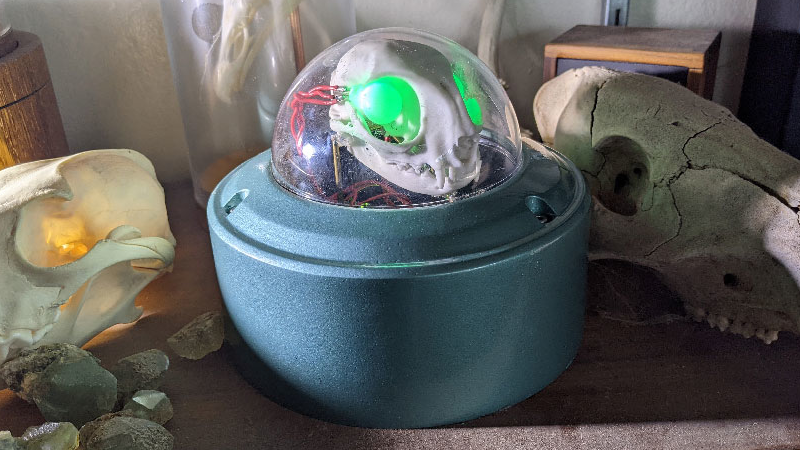
[Emily Velasco] has an internet provider that provides sub-par connectivity. Instead of repeatedly refreshing a browser tab to test if the network is up, [Emily] decided to create an internet status monitor by embedding indicator lights in a cat skull…for some reason.
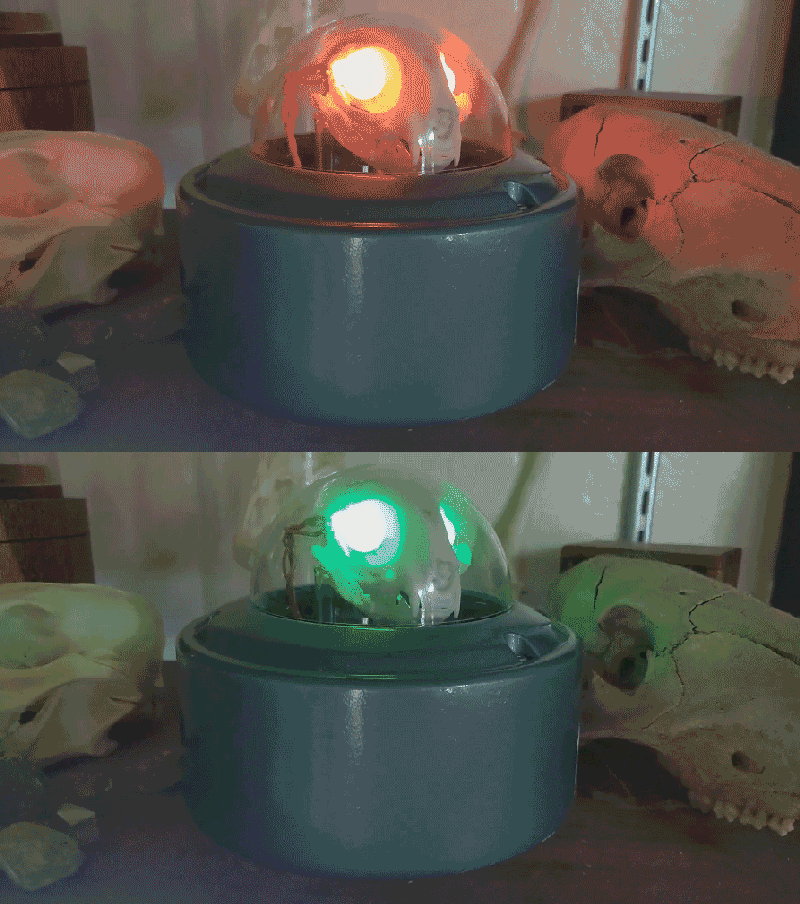
The electronics are straightforward, with the complete parts list consisting of an Arduino Nano 33 IoT device connected to a pair of RGB LEDs and 50 Ohm resistors. The Nano attempts to connect to a known site (in this case, the Google landing page) every two seconds and sets the LEDs to green if it succeeds or red if it fails.
The cat skull is thankfully a replica, 3D printed by one of [Emily]’s Twitter acquaintances, and the whole project was housed in a domed security camera enclosure. [Emily] mounts the LEDs into the skull to create a “brain in a jar” effect.
Japan is officially moving forward with restrictions aimed at limiting China’s access to advanced chipmaking machinery. As CNN reports, the country announced Friday it would tighten export controls on 23 types of semiconductor manufacturing equipment. Once the new rules take effect in July, companies like Nikon and Tokyo Electron will need to obtain approval from Japan’s trade ministry if they want to sell their tools in some 160 territories across the world. A Japanese government spokesperson told CNN the restrictions aren’t designed to target a specific nation. However, Japan’s east asian rival is among the nations on the restricted list.
“We will fulfill our responsibilities in the international community as a technology-owning country and contribute to maintaining international peace and security,” Yasutoshi Nishimura, Japan’s minister of economy, trade and industry, told reporters.
The restrictions follow the US and Netherlands enacting similar export controls. At the start of the year, the three countries reportedly reached an agreement to limit China’s access to western-made lithography machines. In March, the Netherlands made good on the deal, announcing it would restrict overseas sales of semiconductor technology in the interest of its national security. Those restrictions will affect ASML. As of last year, the Dutch firm was the only company in the world producing the extreme ultraviolet lithography (EUV) machines chipmakers need to make the 5nm and 3nm semiconductors that power the latest phones and computers.
China has homegrown firms capable of making up some of the shortfall the country’s tech industry will experience from the lack of access to western-made lithography equipment. However, it may take some time before those companies match the capacity of their American, Japanese and European rivals. According to research from Reuters, Shanghai Micro Electronics Equipment (SMEE), China’s only producer of lithography equipment, makes machines capable of printing 90nm node semiconductors. More promising is the work of SMIC, the country’s leading semiconductor manufacturer. Last summer, it began volume production of 14nm chips and began making 7nm chips without access to foreign-made equipment.
This article originally appeared on Engadget at https://www.engadget.com/japan-joins-us-led-effort-to-restrict-chinas-access-to-chipmaking-equipment-214602553.html?src=rss
Elon Musk broke US labor law in 2018 when he tweeted Tesla factory workers would forgo stock options if they chose to unionize, according to a federal appeals court. On Friday, the Fifth Circuit Court of Appeals, in a decision spotted by Business Insider, upheld a National Labor Relations Board (NLRB) ruling that found Musk made unlawful threats around employee compensation.
In May 2018, a Twitter user asked Musk about his stance on unions. “Nothing stopping Tesla team at our car plant from voting union. Could do so tmrw if they wanted,” he tweeted in response. “But why pay union dues & give up stock options for nothing? Our safety record is 2X better than when plant was UAW & everybody already gets healthcare.”
Tesla factory literally has miles of painted yellow lines & tape. Report about forklifts not beeping is also bs. These are both demonstrably false, but were reported as “facts” by Reveal.
The tweet immediately drew the attention of labor activists, and in 2021, the NLRB, responding to a complaint from the United Auto Workers union, found Musk had threatened employees. Tesla has argued the tweet was Musk’s way of pointing out that workers at other automakers don’t receive stock options. NLRB chair Wilma Liebman saw it differently. "The employee is going to hear it as, 'If I vote to unionize, stock options will no longer be an option,'" she told Bloomberg in 2018.
After reviewing the decision, the Fifth Circuit Court sided with the NLRB. "Because stock options are part of Tesla's employees' compensation, and nothing in the tweet suggested that Tesla would be forced to end stock options or that the UAW would be the cause of giving up stock options, substantial evidence supports the NLRB's conclusion that the tweet is as an implied threat to end stock options as retaliation for unionization," the panel wrote.
The court ordered Musk to delete the tweet. As of the writing of this article, the message is still live. The Fifth Circuit Court also upheld an order from the NLRB that Tesla reinstates Richard Ortiz, a worker the automaker fired for organizing employees at its Fremont factory in California.
This article originally appeared on Engadget at https://www.engadget.com/court-rules-elon-musk-broke-federal-labor-law-with-2018-tweet-195420903.html?src=rss
If you’re in the market for a new ultraportable laptop, one of the best you can buy is on sale right now. While supplies last, you can get the base model M2 MacBook Air – in either Silver or Space Grey – for $1,000. That’s $200 off the MacBook Air’s current $1,200 starting price. It’s also an all-time low for the 2022 model. If interested in the new MacBook Air, we recommend acting fast on this deal.
Engadget Senior Editor Devindra Hardawar awarded the M2 MacBook Air a score of 96 last year. Since then, the ultraportable has sat atop our best laptops list, and for good reason. The M2 Air offers a compelling mix of performance, portability and ease of use. It also has a lovely 13.6-inch display and a powerful set of four speakers. What’s more, it’s possible to regularly get more than 16 hours of battery life out of the Air. Many will also appreciate that it only weighs 2.7 pounds and is less than 12 millimeters thick. Outside of a web camera that could be better and a modest 256GB of storage on the base model, there’s very little about the M2 Air that’s not compelling.
Apple has handed the UK’s Competition and Markets Authority a major setback in its effort to regulate the tech giant. On Friday, the company won an appeal against an investigation the antitrust watchdog launched last fall. As a refresher, the CMA opened a full market probe into Apple and Google in November. At the time, the regulator said that many UK businesses felt restricted by the “stranglehold” the two tech giants had on mobile browsing. The probe also sought to determine if Apple was restricting the cloud gaming market through its App Store rules.
Per Reuters, Apple successfully argued the regulator had “no power” to investigate its position in the mobile browser market. The company said the CMA should have opened the probe at the same time it first published its report on mobile ecosystems last June. The Competition Appeal Tribunal (CAT), the court that oversees CMA cases, agreed with Apple, saying the regulator gave notice of its investigation too late.
Apple said it was “pleased” with the CAT’s decision, adding it would “continue working to deliver support for developers and a safe and secure experience for users.” Naturally, the CMA was less thrilled with the case’s outcome.
“We are disappointed with today’s judgment. We made this market investigation reference to make sure that UK consumers get a better choice of mobile internet services and that UK developers can invest in innovative new apps. Our concerns, and the reasons why we launched our market investigation, were not challenged by Apple,” the regulator said in a statement. "Given the importance of today's judgment, we will be considering our options including seeking permission to appeal."
This article originally appeared on Engadget at https://www.engadget.com/apple-wins-appeal-against-uk-antitrust-probe-into-mobile-browser-dominance-163706177.html?src=rss
If you’re tight on counter space, multi-purpose kitchen gadgets can come in handy by giving you one device that can do many things. The Instant Pot is a great example of this, as are Breville’s Smart Ovens that combine things like a toaster, broiler, air fryer and others into one machine. As with most Breville gear, the ovens are on the expensive side — but now you can get up to 36 percent off a bunch of Smart Oven models.
The one we like the most is the Smart Oven Air Fryer Pro, which is down to $320 — that's the lowest we’ve seen and a return to its Black Friday price. The tabletop oven has 13 cooking modes, including dedicated air fryer and dehydrate settings. It’s not particularly compact with its one-cubic-foot interior, but that allows it to handle a whole turkey, an entire Dutch oven and most 9x13 sheets on which you could roast vegetables, air fry potatoes and more. If you can do without the proof, cookies and dehydrate settings, though, you could get away with the standard Smart Oven, which is on sale for an all-time low of $280.
Although those have “smart” in the name, they aren’t in the way you might be thinking. Breville’s true “smart” oven is the Joule Oven Air Fryer Pro, which is on sale for $430. It takes the standard Pro model and adds WiFi and app connectivity to it in some pretty useful ways. You can set cooking timers in the app and it’ll alert you when your food needs attention, and you can even set the machine to certain cooking modes using Alexa or Google Assistant voice controls. The app also has “autopilot” recipes, which are guided recipes you can follow while the oven handles some of the process by changing modes and temperatures automatically.
The Joule is best for those who love to spend time in the kitchen and love experimenting with new tech, while the standard Smart Ovens are better for most people. If you have a tight budget, the cheapest option in this sale is Breville’s Mini Smart Toaster Oven, which comes in at $128. It does a lot more than toast bread with its additional bagel, bake, pizza, reheat, roast and cookie settings, and it comes in a more compact design. You’ll be able to fit four slices of bread it in, a six-cup muffin tin or an 11-inch pizza - smaller than either of the full-sized Smart Ovens, but still big enough to make it a versatile machine.
This article originally appeared on Engadget at https://www.engadget.com/breville-smart-ovens-are-down-to-record-low-prices-right-now-130045017.html?src=rss
Back at CES 2022, Google talked about how it‘s improving Android’s integration with the Windows ecosystem in several ways. Nearby Share was one of the features it promised for Microsoft’s desktop OS. Now, the tech giant has rolled out a beta Nearby Share app for Windows, making it much, much easier to transfer files between mobile and PC. You can download it right now from the Android website, as long as your computer is running the 64-bit version of Windows 10 and up and isn’t powered by ARM processors.
You’ll have to switch on your PC’s WiFi and Bluetooth for the feature to work, but you can choose who can see your device and send you files to fend off any potential spam messages. Under the drop-down menu for the device visibility setting, you can choose to make your PC visible to everyone, to your contacts, to your own devices only, or to nobody at the moment. Unless you choose the last option, an Android device will be able to share files with your computer whether the app is open or only running in the background.
To send files from your PC to an Android phone, simply drag or drop them into the Nearby Share app or right-click on them and choose the Nearby Share option. If you own both devices and they’re logged into a common Google account, transfers are automatically accepted even if the recipient’s screen is off. Just take note that both devices have to be within 16 feet of each other.
Google has released Nearby Share for the US and most countries worldwide, with some exceptions. It also said that while the beta app only works with Android phones and tablets right now, it will expand its compatibility across the company’s ecosystem.
This article originally appeared on Engadget at https://www.engadget.com/google-launches-a-beta-nearby-share-app-for-windows-pcs-120201590.html?src=rss
Activision Blizzard is facing yet another complaint by the National Labor Relations Board (NLRB). The labor agency has “found merit with several elements of the unfair labor practice charges filed by the Communications Workers of America (CWA)” on behalf of the company’s workers, the union has told Engadget. This particular case pertains to the CWA’s accusations that the game developer illegally surveilled workers when they walked out in July last year to protest the lack of gender equality in the company, the overturning of Roe v. Wade, as well as Activision Blizzard’s alleged union-busting practices.
The NLRB found after an investigation that the company broke labor laws by using managers and security staff to monitor workers during the walkout. In addition, the labor board found merit in the CWA’s accusation that the developer threatened to cut off workers’ access to an internal chatroom where they discussed their pay, hours and overall working conditions. According to IGN, though, NLRB has dismissed one charge regarding the company cutting off people’s chat access to an all-hands meeting. The publication says Activision Blizzard‘s chief administrative officer Brian Bulatao has informed workers that chat was shut down for future all-hands because that particular meeting turned toxic. Attendees used it as a chance to “disparage the work of the Diablo Immoral team and others,” he explained.
An NLRB spokesperson told Reuters that it will move forward and prosecute Blizzard if the company doesn’t settle.
The company’s labor practices were thrust into the spotlight after California filed a lawsuit against it in 2021 for fostering a “frat boy” workplace. After a two-year investigation, the state’s Department of Fair Employment and Housing had determined that the developer discriminated against female employees. It’s one labor issue after another for Activision Blizzard after that, mostly related to workers’ organizing efforts. To note, the company is also facing another NLRB complaint, accusing it of violating labor laws by implementing an overbroad social media policy that prevented workers from talking about their working conditions and threatening employees who were exercising their right to join a union. Activision Blizzard told Engadget that those allegations were “false.”
This article originally appeared on Engadget at https://www.engadget.com/nlrb-says-activision-blizzard-illegally-surveilled-employees-during-a-walkout-094211193.html?src=rss