On Thursday, Twitter CEO Elon Musk said he'd appointed someone to take over from him as CEO, and it didn't take long for that person's identity to be confirmed. Less than a day later, Musk confirmed NBCUniversal's head of ad sales, Linda Yaccarino, is taking on the job. Yaccarino is expected to start her new role in around six weeks and "will focus primarily on business operations, while I focus on product design and new technology," Musk wrote.
Yaccarino is known for being an "industry advocate for finding better ways to measure the effectiveness of advertising," according to The Wall Street Journal. Yaccarino’s efforts at NBCU have included a close partnership with Twitter. This recently expanded for the 2024 Olympic Games, which will see Twitter host video from the event. Yaccarino tweeted at Musk around the time news emerged of the companies' renewed partnership. “Hey, @elonmusk, here’s an idea for our new partnership: Periscope for Paris 2024. Let’s just go hi-res first," Yaccarino wrote.
Is that what we can expect from the new boss? Periscope, resurrected?
The Morning After isn’t just a newsletter – it’s also a daily podcast. Get our daily audio briefings, Monday through Friday, by subscribing right here.
Google definitely doesn't want to be left behind with AI.
Engadget
It was a huge week for tech news: Google I/O happened, and we finally got a close look at the Pixel Fold and the company’s latest AI plans. Engadget Deputy Editor Nathan Ingraham also joins the podcast to discuss his review of The Legend of Zelda: Tears of the Kingdom, the follow-up to one of the greatest games ever made.
It had been exclusive to Sony’s retail site since launch.
PlayStation VR2 is now widely available after a two-month stint of exclusivity at Sony’s Direct consumer storefront. The company revealed this would be happening last month but did not set an official date and didn’t say which retailers would offer the headset. Well, now we know. You can pick up the PSVR2 at Amazon, GameStop, Best Buy and other smaller retailers.
The first M3 chips will reportedly arrive later this year.
According to Bloomberg’s Mark Gurman, Apple is testing an M3 chipset with a 12-core processor and 18-core GPU. He speculates the M3 variant Apple is testing is the base-level M3 Pro the company plans to release sometime next year. Notably, the M3 line is expected to take advantage of TSMC’s forthcoming 3nm node process. The move from 5nm to 3nm would appear to account for the increase in core density. Before we see the pro chip, however, we’d first expect Apple to reveal the standard M3 chip.
The Apple Watch Ultra is is one of the best wearables for sports and outdoors enthusiasts thanks to the durable design and high-end features, but that $799 price tag can be hard to digest. If you've been waiting for a deal, now's the time to buy as it's on sale at Amazon for just $702 ($97 or 12 percent of) — the lowest price we've seen to date.
The Apple Watch Ultra is truly built for outdoor activity. It offers refined navigation and compass-based features, like the ability to set waypoints and ability to retrace your steps if you get lost. For scuba enthusiasts and others, there's a depth gauge and dive computer too. As such, it's the ideal wearable for hikers and divers.
Other features are geared toward endurance athletes, like the accurate route tracking and pace calculations that make use of a dual-frequency GPS. And Apple still includes the health features found in other Watch models too, like sleep tracking, temperature sensing and electrocardiogram readings, along with messaging, audio playback and Apple Pay. It offers a stellar 36 hours of battery life as well and up to 60 hours in low-power mode.
On the downside, the Apple Watch Ultra has a chunky (though rugged) case that you may not find comfortable to wear to bed. Moreover, the positioning of the action button is a little awkward, because it's right where many people will go to steady the Apple Watch Ultra with one finger while they press the digital crown or side button. Still, it garnered an excellent score of 85 in our review. That $702 price is a killer deal, but keep in mind that it's only offered on the model with the Ocean Yellow band.
NASA has pulled the plug on its Lunar Flashlight project, which was designed to look for sources of ice on our nearest neighbor. The agency spent the last few months trying, and failing, to get the craft to generate the necessary amount of thrust to get the small satellite to its intended destination. Officials say that the issue was likely caused by debris buildup in the fuel lines, which prevented the CubeSat from working to its full potential.
The “briefcase sized” Lunar Flashlight first launched in December, and was developed by students at Georgia Tech. Once deployed, it was expected to start a four-month journey to the moon, after which point it would look for surface water ice at the moon’s perpetually-dark south pole. Unfortunately, despite a months-long effort to remedy the issue, the craft will proceed past Earth and then fly into the orbit, but hopefully not too close to, the sun.
NASA is choosing to take a glass half-full approach to the failure, pointing to the success of many of the project’s components. Barbara Cohen, principal investigator at the Goddard Space Flight Center, said that while it’s disappointing, the mission proved the efficacy of several tools first used on the satellite. And that researchers "collected a lot of in-flight performance data on the instrument that will be incredibly valuable to future iterations."
This article originally appeared on Engadget at https://www.engadget.com/nasa-ends-its-lunar-flashlight-mission-101557786.html?src=rss
Apple's iPhone 14 Emergency SOS satellite feature launched last year in the US and Canada, then came to France, Germany, Ireland and the UK shortly afterwards. Now, it's finally launching elsewhere on the planet, coming to New Zealand and Australia — two countries with large wilderness areas lacking any cellular service. As before, it's available to all iPhone 14 users ( iPhone 14, iPhone 14 Plus, iPhone 14 Pro, and iPhone 14 Pro Max) on iOS 16.4 or greater and is free for two years following activation.
"Australians know full well the importance of remaining connected in regional, rural, and remote areas, particularly when they need emergency services," said Australia’s minister of communications, Michelle Rowland, in a statement. "The ability to contact Triple Zero with Emergency SOS via satellite when there is no mobile coverage is a strong backup to keep Australians connected in an emergency."
Emergency SOS via Satellite is activated by a long press on the power and volume buttons, or rapidly pressing the power button five times. The interface guides you on the best direction to point your iPhone for the best signal. Once connected, you can open a message interface with emergency service providers, and the phone will also communicate your location. If everything goes to plan, you'll receive a message that responders have been notified, and to stay where you are.
You can also share your location with family members in a non-emergency using the Find My app. Users simply open the Me tab, swipe up to see My Location via Satellite, and tap Send My Location. It also works with iPhone and Apple Watch Crash and Fall Detection features. There's even a demo mode that lets you practice using Emergency SOS so you can act quickly if a real emergency arises.
"Since launching last year, Emergency SOS via satellite has already helped save lives in the 12 countries where it has been available," Apple noted. It added that users should be patient if they use the feature, as "it can take a few minutes for even short messages to get through" due to the low bandwidth and rapid speeds of satellites.
This article originally appeared on Engadget at https://www.engadget.com/apples-iphone-14-emergency-sos-feature-arrives-in-new-zealand-and-australia-090241910.html?src=rss
Apple is testing an M3 chipset with a 12-core processor and 18-core GPU, according to Bloomberg’s Mark Gurman. In his latest Power On newsletter, Gurman reports a source sent him App Store developer logs that show the chip running on an unannounced MacBook Pro with macOS 14. He speculates the M3 variant Apple is testing is the base-level M3 Pro the company plans to release sometime next year.
Notably, the M3 line is expected to take advantage of TSMC’s forthcoming 3nm node process. The move from 5nm to 3nm would appear to account for the increase in core density. If you recall, the M1 Pro and M2 Pro feature eight- and 10-core processors, alongside 14 and 16-core GPUs. Put another way, the M3 Pro reportedly features 50 percent more CPU cores than its first-generation predecessor. Per Gurman, Apple has gone with an even split between high-performance and efficiency cores on the new silicon. He says the chip was spotted configured with 36GB of RAM. For context, the M2 Pro starts with 16GB of memory, and you can upgrade it to feature up to 32GB of RAM.
Of course, before Apple announces the M3 Pro, the company first needs to release the standard M3 chip. “My belief is the first Macs with M3 chips will begin arriving toward the end of the year or early next year,” Gurman notes. In the meantime, Apple is expected to announce its newest Mac, the long-rumored 15-inch MacBook Air, at WWDC 2023 next month.
This article originally appeared on Engadget at https://www.engadget.com/apples-m3-pro-chipset-could-feature-12-cpu-cores-205959150.html?src=rss
If a Pixel phone is your daily driver, you may want to keep a charger nearby. An Engadget reader contacted us on Sunday to report that their Pixel 6 Pro has recently been overheating and excessively draining its battery. They suspect the culprit is the Google app and an update that began rolling out on May 12th.
“I haven't touched my phone in the past hour. It's just been on a standard wireless charger,” the reader says of a screenshot (seen below) they sent of their phone’s settings menu, showing the Google app burning through the 6 Pro’s battery in the background. “Still very hot, and if I didn't roll back to a different version, I wouldn't have a net increase on my phone's battery.”
Courtesy of Engadget reader
A visit to Reddit and the Google support forums shows other Pixel users are experiencing the same issue. “It just started yesterday. Massive battery usage from Google app and to a lesser degree Android System Intelligence. I just went through and did a factory reset, reinstalled most things and it's still happening,” one Reddit user wrote. “Beyond the battery not lasting the phone is getting really warm so I know it's harming the battery and potentially the CPU.”
Those who have tried contacting Google report the company’s support staff haven’t been very helpful. Some users say rolling back to an older version of the Google app hasn’t fixed the problem for them. “Actually ended up with an even older version from May 10, still draining the battery,” writes one Redditor. The reader who contacted us suspects the problem may be server-side. “Google app keeps wrecking the battery regardless of version, and I've rolled all the way back to May 1st,” they write. “I don't know how to see if the app is trying to call home or on a loop with something like that, but the symptoms remain the same.”
Google did not immediately respond to Engadget’s comment request. If the Google app is at fault here, it wouldn’t be the first time a software update has caused headaches for Pixel users. Last May, Google had to patch the Pixel 6 and 6 Pro after an earlier update caused the phones to produce much weaker haptic feedback. The year before the company paused the rollout of its December Pixel update after users found it was making their phones drop calls.
This article originally appeared on Engadget at https://www.engadget.com/pixel-users-report-the-google-app-is-making-their-phones-overheat-193325112.html?src=rss
On the eve of potentially one of the most consequential elections in the country’s history, Twitter began blocking posts in Turkey. “In response to legal process and to ensure Twitter remains available to the people of Turkey, we have taken action to restrict access to some content in Turkey today,” the company tweeted on Friday, in English and Turkish. “We have informed the account holders of this action in line with our policy. This content will remain available in the rest of the world.”
In response to legal process and to ensure Twitter remains available to the people of Turkey, we have taken action to restrict access to some content in Turkey today.
— Twitter Global Government Affairs (@GlobalAffairs) May 13, 2023
Twitter didn’t say which tweets it was blocking, and the company no longer operates a communications department Engadget could contact for more information. Predictably, the decision to comply with a censorship request from the Turkish government has put a spotlight on Elon Musk’s free speech beliefs. On Friday, Musk, who named Linda Yaccarino as the next CEO of Twitter that same day, lashed out at Bloomberg columnist Matthew Yglesias when he suggested the decision “should generate some interesting Twitter Files reporting.”
“Did your brain fall out of your head, Yglesias? The choice is have Twitter throttled in its entirety or limit access to some tweets. Which one do you want?” Musk tweeted at Yglesias.
Did your brain fall out of your head, Yglesias? The choice is have Twitter throttled in its entirety or limit access to some tweets. Which one do you want?
As The Washington Post notes, Sunday’s election could have significant ramifications for Turkey. After two decades in power, Recep Tayyip Erdogan faces the most credible threat to his presidency in recent memory. Ahead of Sunday’s contest, most polls showed opposition leader Kemal Kilicdaroglu had a slight lead on his opponent. If elected, Kilicdaroglu has promised to reshape the country’s domestic policy. Erdogan’s defeat could also have a profound impact on Turkey’s relationship with other powers in the region, including Russia and NATO. Per CNN, If one candidate can’t win more than 50 percent of the vote, the country will hold a run-off election on May 28th. As of the writing of this article, Erdogan holds an 11 percentage point lead on Kilicdaroglu, though that could change as more ballots are counted.
This article originally appeared on Engadget at https://www.engadget.com/twitter-limits-access-to-some-tweets-in-turkey-ahead-of-tightly-contested-election-171432725.html?src=rss
Apple’s second-generation Pencil stylus is one of the best accessories you can buy for an iPad Pro or iPad Air, but at $125, it’s not the most affordable purchase. So it’s worth noting when the stylus is on sale like it is right now at Amazon. At the moment, you can get the Apple Pencil for $85, or 34 percent off what it normally costs. The Pencil’s previous low price was $89, so this is a new all-time low for the accessory. The timing is perfect too since the iPad Air is also on sale this weekend.
The Apple Pencil is a must-have if you’re a visual artist, photographer or designer, but it’s also handy if you enjoy jotting down notes or journaling. You can customize the Pencil’s double-tap feature to suit your needs, and, with built-in pressure sensitivity, you can add as much or as little detail to an illustration as you want. Best of all, you charge the second-generation model by attaching it magnetically to your iPad, a big improvement from the goofy design of the previous model.
On that note, just keep in mind the 2022 iPad does not support the second-generation Apple Pencil. For older iPads, Apple has a handy compatibility list if you’re unsure if the second-generation Pencil will work with your tablet.
This article originally appeared on Engadget at https://www.engadget.com/the-second-generation-apple-pencil-drops-to-a-new-low-of-85-153121076.html?src=rss
Seemingly overnight, Sam Bankman-Fried, the founder of FTX, went from cryptocurrency wunderkind to wanted for questioning by the FBI. After years of unfettered success, the walls of SBF's blockchain empire came crumbling down around him as his tricky financial feats failed and his generalized lack of accounting brought increasing scrutiny by regulators. In SBF: How the FTX Bankruptcy Unwound Crypto’s Very Bad Good Guy, veteran crypto reporter Brady Dale provides a scintillating and clarifying narrative of the entire FTX/Alameda Ventures saga. In the excerpt below, we glimpse in at the immediate aftermath of FTX's sudden insolvency.
When I wrote in Chapter 1, “I am drowning in Sam,” I was here, at this point in the story. I was then. I still am, but the tide is going out. I’m not back on land yet, but I know if I rest and I don’t fight it, the land will find me. I don’t need to find the land. Unlike SBF after CoinDesk’s Ian Allison released his post about Alameda’s balance sheet, I can see the shore from where I am.
In late November and early December SBF would not leave the public eye. He was in magazines. He was in the New York Times. He was doing interviews on YouTube. He was on Twitter Spaces.
YouTube gadfly Coffeezilla was chasing him.
NFT influencers were chasing him. TV reporters were chasing him.
A goofy token shill I will not dignify by naming chased him.
Everyone thought if they could just get one more interview from him, it would make sense.
They were all playing into Sam’s hands. Many who felt betrayed believed that his media tour was working to his benefit, that he might actually get away with losing $8 billion (or was it $10 billion?) in customer money. They saw large media companies as complicit in helping to burnish his image.
But then he was arrested, and as I write this, he’s sitting in the sick-bay of an overcrowded prison in the island nation his company had recently made his home.
Looking back on it, there is not a lot of value to say about all these many appearances. We were all just tea bags soaking in the flavors of a collective stew we had boiled up together, a swirling potion of shifting sadness, outrage, intrigue, schadenfreude, and mockery.
SBF appeared in many places, but to my mind, these were the key media appearances:
Axios interview on Nov. 29. A few pieces were published with different parts of the interview. Where he first said he was down to $100,000.
The first recording from Tiffany Fong’s phone call with SBF, released on YouTube Nov. 29.
The New York Times Dealbook Summit, Nov. 30.
Good Morning America, Dec. 1.
New York Magazine interview on its Intelligencer site, Dec. 1.
The Scoop podcast, Dec. 5.
There were others. People really like the grilling scam vigilante Coffeezilla gave him, too. Eventually, though, listening to these things was like watching one of those YouTube videos of skateboarding accidents: it was a lot of the same thing over and over.
He was sorry, there was an accounting artifact, he should have had better risk management, he shouldn’t have given up his company, etc., etc., etc.
Were anyone to go through the above accounts and more from that month in a two-day marathon session like I did, I think they would eventually discern a strategy. What appeared to be a series of open conversations had become, to my ears, talking points.
I wrote the same for Axios at the time, but I don’t actually think the talking points are all that interesting anymore now that he’s been arrested. At the end of December 2022, he would be back in his family home, under house arrest, his passport taken, and wearing an ankle monitor. Once those handcuffs went on, the public relations campaign became irrelevant because it was something designed to prepare himself if his lawyers succeeded in keeping him out of jail.
As I wrote in the beginning, as new facts and circumstances arise, the set of possible explanations and futures shrink. Before the handcuffs, it seemed almost likely he might get away with the company’s failure. Once he went to jail, it’s hard to imagine how we ever even saw that possibility.
Because they failed to keep him out of jail, the talking points matter very little.
Except one point, which I think is worth highlighting.The fact that Alameda was drawing customer funds from FTX to cover losses on investments hasn’t been verified by a court yet, but it has been alleged in multiple accounts by different government organizations who seem to have had a look at the books.
That cash (in cryptocurrency form) had moved from FTX to Alameda to meet margin calls, make loans, make investments, and even to make political donations. This is, in my estimation, considerably more nefarious than the way SBF described the hole’s origins in his media tour.
In all of his appearances, he described Alameda as having an excessive margin position. For example, in New York Mag, he said:
A client on FTX put on a very large margin position. FTX fucked up in allowing that position to be put on and in underestimating, in fact, the size of the position itself.That margin position blew out during the extreme events over the last few weeks. I feel really bad about that. And it was a large fuckup of risk analysis and risk attention and, you know, it was with an account that was given too much trust, and not enough skepticism.
In other words, FTX let Alameda’s bets on FTX get too big.We were to imagine Alameda was, I don’t know, 12X long $500 million on bitcoin and 20X long $200 million in ether or something.
All secured by the ftt token. And ftt went bad, and now they were out a bunch of money.
When FTX first fell apart, I went into Slack and explained my understanding of the whole debacle to one of my coworkers this way:
Step 1.
Launch a trading desk. Make piles.
Step 2.
Decide you want to make more piles, so open an exchange that prints money off retail trades and use that money to lend to trading desk.
Step 3.
Lend retail money to trading desk in hopes of quadrupling all gains.
Step 4.
Trading desk loses borrowed money.
Step 5.
[Surprised face emoji]
But SBF was trying to spin it as if it had all stayed inside the house. It was just big bets, but funds hadn’t left FTX.This is still bad, but more negligent, less outright theft.
Jason Choi had been with Spartan Capital when FTX was raising money, and he’d declined to invest because he didn’t like the Alameda/ FTX relationship. He explained all this on Twitter after the exchange collapsed.We spoke before complaints had been made against SBF, and I asked him whether he thought it mattered if Alameda had an outsized margin position or had taken customer funds out of the exchange.
“I think functionally they are the same,” he said. “It implies that Alameda is able to run things into seriously negative positions.”
In other words, in terms of what people have lost, each outcome arrives at the same place.
But it does matter in terms of how to understand the decisions made. If funds were taken out and handed to Alameda to use elsewhere, people had to green-light those moves, knowing that they were against the terms of service and against the many assurances that the company had made to the public and their users.
It’s not negligent. It’s willful. Legality aside, it just feels different ethically.
However, for what it’s worth, when SBF and I last spoke he stuck by this explanation: the hole in FTX’s balance sheet was from a margin position Alameda took out. It had failed to adequately hedge, and it had gotten much too long on the wrong collateral.
Before he was arrested, that’s how he described the problem. That’s still how he describes it. He agreed, when we spoke, that it would be different if FTX had been sending actual customer assets to Alameda to use in other ways, but he says that wasn’t happening.
The government is claiming that it did happen, and to do so it’s drawing attention to loans made to SBF and other cofounders, loans they used to make venture investments, to buy stock in Robinhood, political donations, and to purchase real estate.
This points to a part of the story that I didn’t really understand until the complaints started coming out.
When it’s said that someone is a “billionaire,” that doesn’t mean that they have billions of dollars in cash. It doesn’t mean, necessarily, that they can even spend that much money.That doesn’t even mean that they can access billions of dollars in cash, or even many millions.
If someone’s billionaire status is tied up in a stake in a private company, it can be very difficult to turn that value into spendable money. If their status is tied up largely in thinly traded, extremely new crypto tokens, it might be even harder.
In the complaints by the SEC and the CFTC and the DoJ, they allege loans from the Samglomerate, using customer funds, to enable investments, property purchases, political donations, and more. All of these things take actual cash. SBF and his cadre had very high net worth, but it hadn’t occurred to me that they wouldn’t really have access to that much cash until those complaints came out.
Of course SBF, Wang, Singh, and others could borrow money somewhere, and maybe more sophisticated readers than me presumed it was borrowed from banks. Or maybe it was borrowed from some of the new crypto lenders (many of which fell into dire straits). But these various agencies allege something else: the funds were borrowed from FTX customers. And the customers didn’t know. Further, they had no upside. Only downside.
And the downside is here now.
“I thought at the time and still do think that, the size of those loans was substantially less than the profit, than like the liquid trading profit that Alameda had made,” he told me in December. In other words, he denies that the loans were made using FTX user funds.
The whole story of what happened is confusing and dripping in finance jargon and involves a level of mathematics few of us have contemplated recently. It may be that SBF’s story here has been a bet that he was smart enough to cast a spell and convince us all that all the mistakes were only made inside the casino.
And if he had done that well enough, the sting of the error might fade, and if he evaded an arrest and conviction, he might be able to rehabilitate himself in the public eye and apply his considerable gifts, once again.
He might still have won, but then he was arrested.
So in that case, these appearances might really have just been about enjoying that last moment in the spotlight. For some, it’s better to be hated than ignored. But it’s also worth noting that he hasn’t given up on this story.
As I wrote in the prologue: he doesn’t believe the evidence of crimes is there. He seems as eager to reopen the books at FTX and Alameda. He wants everyone to get from 20 percent of the story to 80 or 90 percent. And maybe we will. And maybe the fact that he seems to want that as much as anyone will prove to be a sign that he was right.
But trust me, if you haven’t seen the many media appearances of November and December 2022, you don’t need to. This chapter gives more than you need to know about what he had to say before they put him in a Bahamas jail.
Sources Referenced
“Exclusive: Sam Bankman-Fried says he’s down to $100,000,” Shen, Lucinda, Axios, Nov. 29, 2022.
“Sam Bankman-Fried Interviewed Live About the Collapse of FTX,” New York Times Events,YouTube, Nov. 30, 2022.
“FTX founder Sam Bankman-Fried denies ‘improper use’ of customer funds,” Stephanopoulos, George, Good Morning America, Dec. 1, 2022.
“Sam Bankman-Fried’s First Interview After FTX Collapse,” Fong, Tiffany,
YouTube, posted Nov. 29, 2022
“What Does Sam Bankman-Fried Have to Say for Himself? An interview with the disgraced CEO,”Wieczner, Jen, New York Magazine, Dec. 1, 2022.
“2-hour sit-down with Sam Bankman-Fried on the FTX scandal,” Quinton, Davis, and Frank, Chaparro, The Scoop podcast,The Block, Dec. 5, 2022.
Jason Choi, interview, mobile, Dec. 11, 2022.
“The SBF media blitz’s key messages,” Dale, Brady, Axios, Dec. 8, 2022.
Interview, Sam Bankman-Fried, phone call with spokesperson, Dec. 30, 2022.
This article originally appeared on Engadget at https://www.engadget.com/hitting-the-books-sbf-brady-dale-wiley-ftx-143033761.html?src=rss
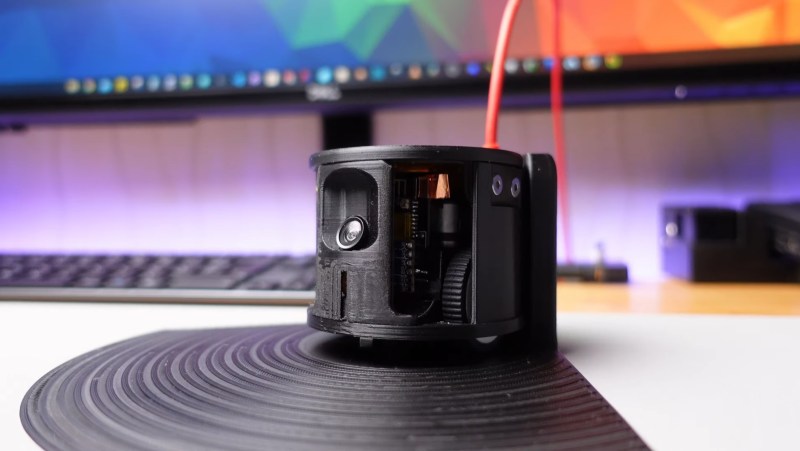
While fixed sensors, relays, and cameras can be helpful in monitoring your home, there are still common scenarios you need to physically go and check something. Unfortunately, this is often the case when you’re away from home. To address this challenge, [PriceLessToolkit] created a guardian bot that can be controlled through Home Assistant.
The robot’s body is made from 3D-printed components designed to house the various modules neatly. The ESP32 camera module provides Wi-Fi and video capabilities, while the Arduino Pro Mini serves as the bot’s controller. Other peripherals include a light and radar sensor, an LED ring for status display, and a speaker for issuing warnings to potential intruders. The motor controllers are salvaged from two 9-gram servos. The onboard LiPo battery can be charged wirelessly with an integrated charging coil and controller by driving the bot onto a 3D-printed dock.
This build is impressive in its design and execution, especially considering how messy it can get when multiple discrete modules are wired together. The rotating castor wheels made from bearings add an elegant touch.
If you’re interested in building your own guard bot, you can find the software, CAD models, and schematics on Github.