Liz Reid, the Head of Google Search, has admitted that the company's search engine has returned some "odd, inaccurate or unhelpful AI Overviews" after they rolled out to everyone in the US. The executive published an explanation for Google's more peculiar AI-generated responses in a blog post, where it also announced that the company has implemented safeguards that will help the new feature return more accurate and less meme-worthy results.
Reid defended Google and pointed out that some of the more egregious AI Overview responses going around, such as claims that it's safe to leave dogs in cars, are fake. The viral screenshot showing the answer to "How many rocks should I eat?" is real, but she said that Google came up with an answer because a website published a satirical content tackling the topic. "Prior to these screenshots going viral, practically no one asked Google that question," she explained, so the company's AI linked to that website.
The Google VP also confirmed that AI Overview told people to use glue to get cheese to stick to pizza based on content taken from a forum. She said forums typically provide "authentic, first-hand information," but they could also lead to "less-than-helpful advice." The executive didn't mention the other viral AI Overview answers going around, but as The Washington Post reports, the technology also told users that Barack Obama was Muslim and that people should drink plenty of urine to help them pass a kidney stone.
Reid said the company tested the feature extensively before launch, but "there’s nothing quite like having millions of people using the feature with many novel searches." Google was apparently able to determine patterns wherein its AI technology didn't get things right by looking at examples of its responses over the past couple of weeks. It has then put protections in place based on its observations, starting by tweaking its AI to be able to better detect humor and satire content. It has also updated its systems to limit the addition of user-generated replies in Overviews, such as social media and forum posts, which could give people misleading or even harmful advice. In addition, it has also "added triggering restrictions for queries where AI Overviews were not proving to be as helpful" and has stopped showing AI-generated replies for certain health topics.
This article originally appeared on Engadget at https://www.engadget.com/google-is-putting-more-restrictions-on-ai-overviews-after-it-told-people-to-put-glue-on-pizza-011316780.html?src=rss
Bloober Team's remake of Silent Hill 2 is due to hit PlayStation 5 and PC on October 8, and it's looking nice and spooky. It's available to pre-order on Steam and via PlayStation.
It's been less than two years since Konami and Bloober Team announced the Silent Hill 2 remake, though news of its existence leaked a few months beforehand, giving fans plenty of time to catastrophize the entire situation. Today we got the first gameplay trailer for the remake, showcasing familiar hallways lined with bloody nurses, low-light environments crawling with bugs, and other nasty surprises that have always been lurking in the sleepy town of Silent Hill. With modern visuals, lighting and sensibilities, it all looks eerily beautiful.
Bloober Team is the studio behind the Layers of Fear franchise, Observer, Blair Witch and The Medium — all perfectly serviceable psychological horror experiences. Still, there's a lot to live up to here: Silent Hill 2 is a beloved, classic horror game. It hit the PlayStation 2 in 2001 and, more than 20 years on, plenty of fans are anxious to see how the remake will hold up.
Bloober Team co-founder Piotr Babieno told Engadget in June 2023 that the studio shifted its entire game-making ethos for the Silent Hill 2 remake. Instead of leading with mood and set dressing, they made mechanics the foundation of the on-screen terror, using player input to generate disquiet. The Layers of Fear collection that came out last summer marked the end of Bloober Team's psychological-horror era.
“This year is like closing the era of making psychological horror games,” Babieno said last June. “Right now we are going into Bloober Team 3.0, making mass-market horror.” He continued, “We decided that our next titles should be much more mass-market oriented. We’d like to talk with more people. We’d like to deliver our ideas, with our DNA, not by environment or storytelling, but by action. So all of our future titles will have a lot of gameplay mechanics. They will be much bigger.”
This article originally appeared on Engadget at https://www.engadget.com/silent-hill-2-remake-hits-ps5-and-pc-on-october-8-230731258.html?src=rss
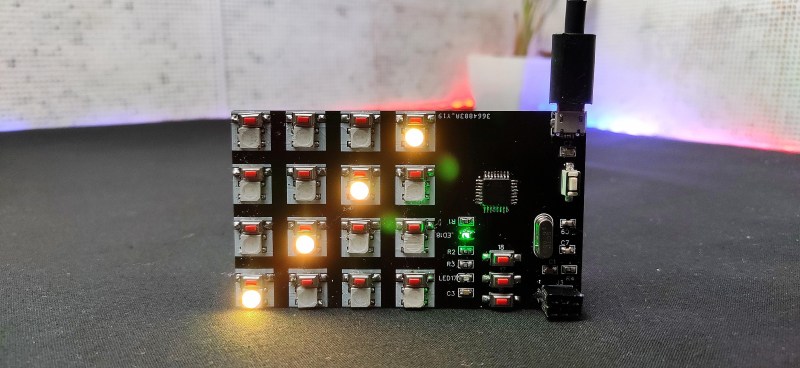
If you want to make a good first impression on someone, it seems like the longer you can keep them talking, the better. After all, if they want to keep talking, that’s a pretty good sign that even if you don’t become business partners, you might end up friends. What better way to make an acquaintance than over a friendly game of tic-tac-toe?
This one will probably take them by surprise, being a 4×4 matrix rather than the usual 3×3, but that just makes it more interesting. The front of the card has all the usual details, and the back is a field of LEDs and micro switches. Instead of using X and O, [Edison Science Corner] is using colors — green for player one, and red for player two. Since playing requires the taking of turns, the microcontroller lights up green and red with alternating single-button presses.
Speaking of, the brains of this operation is an ATMega328P-AU programmed with Arduino. If you’d like to make your own tic-tac-toe business card, the schematic, BOM, and code are all available. Be sure to check out the build and demo video after the break.
Sony’s lovable robo-mascot is getting a new game. During its PlayStation State of Play on Thursday, Sony dropped a trailer for the upcoming PS5 title Astro Bot. The 3D Mario-esque title, a sequel to the beloved pack-in, Astro’s Playroom, arrives on September 6.
The trailer sees our pal Astro wading through puddles full of pink flamingos, grappling across platforms like Bionic Commando and summoning a PS5 console to help fight a giant green alien in a UFO (as one tends to do). In a nod to old-school PlayStation, the trailer even includes a cameo from PaRappa the Rapper.
Sony describes Astro Bot as a “supersized adventure” that spans over six galaxies and 80 levels as you search for your lost crew. You’ll have over 15 new abilities, and, like in its predecessor, it will serve as a showcase for the various sensors and haptics in the DualSense controller.
Astro Bot will be available for pre-order on June 7 ahead of its September 6 release date.
This article originally appeared on Engadget at https://www.engadget.com/sonys-astro-bot-is-getting-the-mario-like-adventure-it-deserves-225716801.html?src=rss
OpenAI said that it stopped five covert influence operations over the last three months that used its AI models for deceptive activities across the internet. These operations, which originated from Russia, China, Iran and Israel, attempted to manipulate public opinion and influence political outcomes without revealing their true identities or intentions, the company said on Thursday. “As of May 2024, these campaigns do not appear to have meaningfully increased their audience engagement or reach as a result of our services,” OpenAI said in a report about the operation, and added that it worked with people across the tech industry, civil society and governments to cut off these bad actors.
OpenAI’s report comes amidst concerns about the impact of generative AI on multiple elections around the world slated for this year including in the US. In its findings, OpenAI revealed how networks of people engaged in influence operations have used generative AI to generate text and images at much higher volumes than before, and fake engagement by using AI to generate fake comments on social media posts.
“Over the last year and a half there have been a lot of questions around what might happen if influence operations use generative AI,” Ben Nimmo, principal investigator on OpenAI’s Intelligence and Investigations team, told members of the media in a press briefing, according to Bloomberg. “With this report, we really want to start filling in some of the blanks.”
OpenAI said that the Russian operation, which it dubbed “Doppelganger”, used the company’s models to generate headlines, convert news articles to Facebook posts, and create comments in multiple languages to undermine support for Ukraine. Another Russian group used used OpenAI's models to debug code for a Telegram bot that posted short political comments in English and Russian, targeting Ukraine, Moldova, the US, and Baltic States. The Chinese network "Spamouflage," known for its influence efforts across Facebook and Instagram, utilized OpenAI's models to research social media activity and generate text-based content in multiple languages across various platforms. The Iranian "International Union of Virtual Media" also used AI to generate content in multiple languages.
OpenAI’s disclosure is similar to the ones that other tech companies make from time to time. On Wednesday, for instance, Meta released its latest report on coordinated inauthentic behavior detailing how an Israeli marketing firm had used fake Facebook accounts to run an influence campaign on its platform that targeted people in the US and Canada.
This article originally appeared on Engadget at https://www.engadget.com/openai-says-it-stopped-multiple-covert-influence-operations-that-abused-its-ai-models-225115466.html?src=rss
Save for Destiny 2, it's been a long time since there's been a first-person shooter from a PlayStation studio. As such, there's been quite a bit of interest in Firewalk Studios' Concord since it was announced a year ago.
We learned more details about the sci-fi game during Sony's State of Play showcase, including a release date and the first look at gameplay. It's coming to PS5 and PC on August 23, and there will be a beta in July. (Heads up: You will need a PlayStation Network account to play on PC.)
Firewalk says it focused on making sure Concord has tight movement, precise gunplay and a range of abilities — just as you might expect from a studio led by former Destiny developers. Given that it's a five vs. five hero shooter, there are plenty of similarities with Overwatch 2 as well (Microsoft now owns that game, for what it's worth).
As you might imagine, there are several roles to choose from, while each of the initial 16 characters, who are dubbed Freegunners, has unique abilities. Firewalk aimed to make Concord approachable for a wide range of players, no matter their preferred play style or skill level. There should be at least one or two Freegunners whose abilities you can get to grips with relatively quickly.
You might throw exploding knives, deploy spores that grant speed boosts, drop a healing pad, cast a wall of fire or block an entire lane with a wall. Some of these abilities will persist on the map between rounds and respawns, and others are designed for more spontaneous use.
There will be six different game modes at launch. Firewalk plans to add more modes, Freegunners, maps and cinematic vignettes as free post-launch updates.
There's a lot of competition in this genre and in the live-service market overall. But Sony already has a hit shooter this year in Helldivers 2. Concord has made a solid impression to date, so it has a fair chance of being successful too.
This article originally appeared on Engadget at https://www.engadget.com/sonys-overwatch-esque-concord-is-coming-to-ps5-and-pc-on-august-23-224046362.html?src=rss
The Until Dawn remaster is heading to PS5 and PC this fall. Sony gave the announcement at its State of Play event after teasing the game earlier this year. The company also dropped a new trailer, and it certainly looks like a spooky delight. In other words, that fall release date is starting to make sense from a themed holiday perspective.
The Until Dawn remake was built in Unreal Engine 5 and boasts several new features that were missing from the original PS4 title. You'll be able to experience the action from a third-person perspective for the first time, which is pretty neat. Developer Ballistic Moon, taking the reins from original dev Supermassive Games, has also said it has expanded the color palette to make it more cinematic and to allow for contextual character movement animations.
We don’t have an exact release date other than fall, but I’ll put money on October. In related news, Sony’s prepping an Until Dawn movie which should release sometime in the nearish future.
This article originally appeared on Engadget at https://www.engadget.com/until-dawn-is-coming-to-ps5-and-pc-this-fall-223945702.html?src=rss
Sony has ported lots of its biggest games to PC recently, and the next one will beGod of War Ragnarok. As part of the State of Play presentation, Sony showed off a trailer for the most recent adventure of Kratos and his son Atreus, and it looks as good as ever. It'll have unlocked frame rates, ultra widescreen monitor support and plenty more visual trickery for PC players, and it'll also include the recently-released Valhalla DLC. It's not a huge surprise, given that the 2018 revival God of War also came to PC a few years ago, but it'll be welcomed by those who want to continue the journey.
As far as visual upgrades go, Sony confirmed in its blog that it'll support NVIDIA RTX DLSS, AMD FidelityFX Super Resolution and Intel XeSS for upscaling the whole thing to whatever screen you're using. And Sony wasn't kidding about the widescreen support — it'll work with 32:9 monitors.
God of War Ragnarok (and its 2018 predecessor) are classic entries in the series, with the engrossing single-player narrative-driven vibe of many of Sony's recent first-party studio games. But the combat is just as good, and Ragnarok adds a lot of new twists to the God of War universe. It's one of my favorite games of the last few years, and it should look positively excellent on high-powered PCs. It'll be available on September 19, and you can pre-order it now.
This article originally appeared on Engadget at https://www.engadget.com/god-of-war-ragnarok-comes-to-pc-on-september-19-222235889.html?src=rss
Microsoft and the Communications Workers of America (CWA) have forged a labor neutrality agreement for all ZeniMax workers. The CWA says the deal is similar to the one from 2022 covering Activision Blizzard’s workforce, which went into effect in April of this year.
“Thousands of our ZeniMax co-workers now have a free and fair path to organize together for better working conditions,” Page Branson, a Senior Quality Assurance (QA) Tester, wrote in a CWA press release.
In 2022, the Xbox maker signed a formal agreement with CWA to respect Activision Blizzard employees’ right to organize. Set to take effect 60 days after Microsoft’s acquisition closed, it didn’t become official until earlier this year. It also extends Microsoft’s early 2023 recognition of ZeniMax QA workers’ right to unionize, and it now includes every eligible employee at ZeniMax.
The CWA says the new agreement means Microsoft will take a neutral approach when employees express interest in joining the union. The workers can communicate with their peers and union reps about membership “in a way that encourages information sharing and avoids business disruptions.”
According to the CWA, workers will have access to a decision-making process that respects their privacy if they wish. In addition, it includes a dispute resolution and arbitration process in the case of any disagreements between the union and Microsoft.
“When we organized our union under a similar legal agreement the process was clear and management did not try to influence anyone’s decision and the company did not try to interfere with the voting process,” Branson wrote. “There is strength in numbers, and as our numbers grow at ZeniMax, at Microsoft, and in the video game industry, we will gain the respect we deserve and raise the standards of working conditions for everyone across the video gaming industry. When we benefit, the consumer and the company will ultimately benefit with us and help keep this industry stable for current and future workers.”
This article originally appeared on Engadget at https://www.engadget.com/microsoft-and-cwa-forge-labor-neutrality-agreement-covering-all-zenimax-workers-212643324.html?src=rss
It'll soon be Apple's turn to talk about its next major operating system updates, giving developers a chance to get their apps ready ahead of a broad rollout this fall. The company's Worldwide Developers Conference is right around the corner. Apple is sure to reveal some of the main features of iOS 18 and iPadOS 18, as well as what's ahead for the likes of watchOS, macOS and visionOS at WWDC 2024.
Given the current tech climate, though, it seems likely that Apple is about to follow its rivals by making a big leap into the realm of generative AI. That could be a major focus of the keynote, since those are the only two letters investors seem to give a hoot about hearing these days.
The Apple rumor mill never stops churning, so we've heard some bits and pieces about what WWDC will perhaps entail. It seems unlikely that we'll get any major hardware announcements at the event, but you never truly know until Tim Cook wraps things up. After all, we did see the Apple Vision Pro make its first appearance at the last WWDC.
In any case, here's what to expect from Apple's WWDC 2024 keynote:
When is WWDC 2024?
WWDC 2024 starts on June 10 and runs through June 14. There will be a variety of events throughout the week, but the bulk of the attention will be on Apple's keynote which is set for 1PM ET on June 10. You'll be able to watch the keynote on apple.com, the Apple Developer app, the Apple TV app and Apple's YouTube channel.
The keynote is where Apple tends to reveal many of the key features for the next major versions of its main operating systems: iOS, iPadOS, macOS, watchOS and most likely visionOS. Apple has also used the WWDC keynote to unveil new hardware over the years, though we expect that to be less of a concern this time around.
ASSOCIATED PRESS
AI
Even though Apple has largely shied away from uttering "AI" too often during its events, there's no getting away from the big tech buzzword of the last two years. Generative AI is quickly seeping into more aspects of our lives and Apple seems primed to grab a piece of that pie.
It's believed that Apple doesn't yet have its own AI chatbot that's ready for primetime. While it continues to beaver away on that, the company has reportedly reached a deal with OpenAI to integrate ChatGPT into iOS 18. According toBloomberg's Mark Gurman, Apple is still interested in reaching an agreement with Google to offer that company's Gemini AI assistant on iPhones too, but that may not happen until further down the line. Siri, meanwhile, is expected to get an upgrade across compatible devices using Apple’s own large language models.
Apple's approach to generative AI in both iOS 18 and macOS 15 is said to be a practical one that's based on helping regular folk in their everyday lives rather than letting them, say, quickly generate long reams of text they can sell as ebooks for a quick buck. Instead, you're more likely to see GAI features like suggested email and message replies, TL;DR text summaries, voice memo transcriptions (finally!) and improved photo touchup tools in core apps.
Apple is expected to handle as much of the AI processing on-device as it can, with the remainder being sent to data centers. That raises questions about how Apple will ensure user privacy, one of the company's core tenets. It will have to spell out how it's keeping user information secure as it moves between the device and a data center.
Photo by Billy Steele/Engadget
iOS 18 / iPadOS 18
As ever, new features are coming to a swathe of iOS and iPadOS apps. Arguably the most notable is the expected introduction of RCS to Messages.
GMSA's RCS, or Rich Communications Service, is a more advanced messaging protocol than the three-decade-old SMS. RCS is more secure than old-school SMS, since it offers end-to-end encryption. It allows for improved media sharing, with high-resolution images, video and audio clips. RCS allows for proper group chats and it supports Wi-Fi messaging too.
And yet for years, Apple refused to bring RCS to its platform — something Google had long been needling it to do — to keep iMessage more of a walled garden. Of course, iMessage itself has many of the same features as RCS. At one point, Apple CEO Tim Cook's response to someone who asked for improved Android texting compatibility so they could share videos with their mother was to "buy your mom an iPhone."
Apple eventually relented on its RCS stance last year, possibly to ensure it complies with strict EU regulations. The company said it would enable RCS support in 2024, so it makes sense that this feature would debut in iOS 18. That means messaging between iOS and Android should be much better in the near future (even if texts from Android devices will still appear as green bubbles on an iPhone). Meanwhile, Google just started allowing Android users to edit RCS messages within a 15-minute window of sending them.
Gurman also noted that Apple is likely to support custom emoji generation based on what you're writing in text messages. It seems that you'll also be able to change the colors of app icons on your home screen and no longer have to keep apps locked to a rigid grid system.
Apple Music may gain an auto-generated playlist feature, following an OpenAI-powered tool that Spotify rolled out in 2023. Custom routes and topographic maps (which debuted on Apple Watch last year) are said to be on the way to Apple Maps. In addition, Apple is rumored to be adding a voice-recording tool to Notes, which would dovetail nicely with the expected transcription function, as well as the option to display mathematical notation.
Other core apps are reportedly in line for some changes, such as generative AI functions in productivity apps like Keynote and Pages. Others like Mail, Fitness and Health are also expected to get new features, but the details haven't been leaked as yet.
Calculator
This long-expected update deserves its own section. That's right, the Calculator app is said to be getting a major overhaul on iPhone and Mac. Snarkiness aside, the revamp actually sounds like it'll be useful, with Notes app integration, improved unit conversions and a sidebar listing recent activity. The app is also said to be coming to iPadOS.
Photo by Devindra Hardawar/Engadget
macOS 15
Let's take a wild guess out of the gate here and declare that Apple will name the next version of macOS after a notable location in California. In all seriousness, that would be the least shocking thing Apple could possibly do on the keynote stage.
Many of the iOS app updates are expected to be replicated in macOS 15, such as the Apple Music, Notes and productivity changes. Rumors suggest that Apple is reorganizing the System Settings app based on importance and priority of the various categories, so the General tab is likely to be bumped up while Sound and Notifications are expected to drop down the list.
Elsewhere, Siri's menu bar icon may get a new look with a flat monochrome design expected to supplant the current colorful version. There may be some welcome accessibility upgrades too, such as a Shortcuts option that allows users to trigger a certain setting or action using a custom spoken phrase.
Photo by Nathan Ingraham / Engadget
Apple hardware
Last year's WWDC was a hardware bonanza, with Apple finally announcing the Vision Pro along with the 15-inch MacBook Air and the M2 Ultra-powered Mac Pro and Mac Studio. We're not expecting much from Apple on the hardware front this time around, though.
The company just updated its iPad lineup and it's likely a little too early for any new laptops given the MacBook Pro and iMac updates in October and MacBook Air refreshes in March. Of course, iPhones will remain under wraps until September, as will the next Apple Watches. However, Apple may take the opportunity to slot its M3 or even M4 chips into its other desktop systems, which remain mired in the M2 generation.
We could see some refreshed peripherals and other devices too. There's always the possibility that Apple will unveil an (official) version of the AirPods Max with a USB-C charging port.
Back in January 2023, Gurman reported that a new Apple TV box would arrive in the first half of 2024. There's still just enough time for that to happen. There's a possibility that Apple may add a camera to the Apple TV as well. In that case, there'd be no need to use an iPhone or iPad for FaceTime chats on the biggest screen in your home.
Photo by Devindra Hardawar/Engadget
Apple Vision Pro
One thing we are expecting on the hardware side is for Apple to reveal where the Vision Pro is going next. Until now, the headset has only been available in the US. That's probably going to change in the coming weeks and months. Multiple reports have suggested that the next phase of the rollout will include Australia, Canada, China, France, Germany, Japan, Singapore, South Korea and the UK. However, there hasn't been much in terms of visionOS 2 leaks so far, so it's unclear what kind of updates the mixed reality operating system will get.
Everything else
The rumor mill has been quiet about watchOS updates too. There will surely be some notable changes to Apple's wearable operating system, but we could be in for a relatively minor iteration of watchOS after last year's massive overhaul.
It's rare that tvOS gets much love during an Apple keynote, but it's bound to get an update that we'll learn about at some point during WWDC. You might have to wait until the Platforms State of the Union event at 4PM ET for the scoop. The same goes for CarPlay and HomePod.
Bear in mind, none of this is certain until the likes of Cook, Craig Federighi et al hit the WWDC keynote stage and start discussing what's next for Apple's products and services. But based on the reporting of several Apple-focused journalists with a strong track record of getting things right, we do expect to hear about many of the above updates and announcements.
This article originally appeared on Engadget at https://www.engadget.com/apple-wwdc-2024-what-to-expect-including-ios-18-ai-and-more-195802569.html?src=rss