The WGA strike ends with protections against AI set in place

The Writers Guild of America (WGA) has voted to officially lift its strike order, over half a year since it stopped work and demanded a better contract with the Alliance of Motion Picture and Television Producers (AMPTP). Writers can officially go back to work after 12:01 AM PT on September 27, even though the organization has yet to hold the final ratification vote. WGA's decision comes shortly after it held a series of negotiation sessions with producers and reached a tentative agreement, with one of the key sticking points being the use of generative AI. 

Now, the WGA has released a summary of the terms of its new contract, and it prominently features protections against the use of generative AI in the writing process. To start with, generative AI can't be used to write or rewrite literary material, and anything it produces cannot be considered source material. Writers can choose to use AI if the company or studio consents to it, but studios can't force writers to use AI software like ChatGPT. If a studio already has materials to hand over to a writer, they have to disclose if those materials include anything generated by AI. Finally, the "exploitation of writers' material to train AI" is prohibited under the new agreement. 

In addition to AI-related protections, writers are also getting higher pay, increased pension and health contributions, as well as higher payment and residuals for streaming projects. Foreign streaming residuals will be based on the number of subscribers for services available globally, while some domestic projects' residuals will be based on hours streamed by subscribers in the US. The new contract will be valid for three years until May 1, 2026. 

While the WGA strike has now ended, SAG-AFTRA's is still ongoing. The group even voted in favor of a strike authorization for performers working in video games recently to give it added leverage in its negotiations with video game producers. 

This article originally appeared on Engadget at https://www.engadget.com/the-wga-strike-ends-with-protections-against-ai-set-in-place-050019363.html?src=rss

X previews its 'shadowban' alerts

X is getting closer to releasing its long-promised alerts that will notify users about whether or not their account has been “shadowbanned.” Andrea Conway, a designer at X, offered a preview of the upcoming feature that Elon Musk first promised last year.

Conway shared two mock-ups: an alert in the notifications tab, as well as an informational page that explains why X may limit the visibility of some accounts. “We have found that your account potentially contains sensitive media — such as graphic, violent, nudity, sexual behavior, hateful symbols, or other sensitive content,” it explains.

“We may cover your posts with a warning so people who don’t want to see sensitive content can avoid it. The reach of your account and its content may also be restricted, such as being excluded from the For You and Following timelines, recommended notifications, trends, and search results.”

starting transparency somewhere pic.twitter.com/QUNKga1t4I

— Andrea Conway (@ehikian) September 26, 2023

Underneath the message is an appeal button, so users can request X revisit its initial decision. Conway also said that users would likely be able to view their account status outside of the app’s notifications tab, but didn’t elaborate on how that might work. She added that the wording and user interface hasn't yet been finalized. 

The company previously introduced a labeling feature for individual tweets that have been “visibility limited” for violating the company’s rules. But the latest update will take that a step further as the restrictions will be visible at the account level, not just for specific tweets.

The feature touches on what has long been a hot-button issue for Twitter, and now X. The company has for years limited the reach of accounts that break its rules. Under Twitter’s previous management, the practice was known as “visibility filtering.” But the company didn’t publicly share details about the practice, or which accounts it limited, which fueled conspiracy theories about “shadowbans.”

The issue came into the spotlight again last year after Musk turned over internal emails and other company records to independent journalists, who published records of Twitter executives discussing visibility filtering. Musk later promised that a future update “will show your true account status, so you know clearly if you’ve been shadowbanned, the reason why and how to appeal.”

Of course visibility filtering and so-called “shadowbanning” were never exactly the same thing. As Recodepointed out last year, Twitter for years said that shadowbanning refers to “deliberately making someone’s content undiscoverable to everyone except the person who posted it, unbeknownst to the original poster.” Whereas visibility filtering — both under Jack Dorsey and now Musk’s leadership — hides tweets from search, recommendations and other surfaces, but doesn’t make them completely invisible.

In any case, the forthcoming update should add some additional transparency — and, potentially, more controversy — to the practice. It’s not clear when the feature will make an official debut, but Conway said the company “should have more to share on this soon.”

This article originally appeared on Engadget at https://www.engadget.com/x-previews-its-shadowban-alerts-003210529.html?src=rss

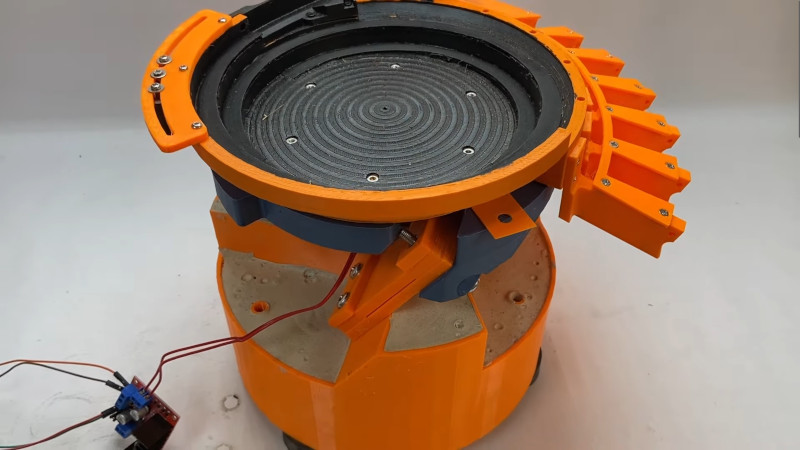
Feed Your Fasteners in Line, With a Bowl Feeder

If you spend much time around industrial processes, you may have seen a vibrating bowl feeder at work. It’s a clever but simple machine that takes an unruly pile of screws or nuts and bolts, and delivers them in a line the correct way up. They do this by shaking the pile of fasteners in a specific way — a spiral motion which encourages them to work to the edge of the pile and align themselves on a spiral track which leads to a dispenser. It’s a machine [Fraens] has made from 3D printed parts, and as he explains in the video below the break, there’s more to this than meets the eye.

The basic form of the machine has a weighted base and an upper bowl on three angled springs. Between the two is an electromagnet, which provides the force for the vibration. The electromagnet needed to be driven with a sine wave which he makes with an Arduino and delivers as PWM via an H-bridge, but the meat of this project comes in balancing the force and frequency with the stiffness of the springs. He shows us the enormous pile of test prints made before the final result was achieved, and it’s a testament to the amount of work put into this project. The final sequence of a variety of objects making the march round the spiral is pure theatre, but we can see his evident satisfaction in a job well done.

Oddly this isn’t the first bowl feeder we’ve seen, though it may be one of the most accomplished. We particularly like this tiny example for SMD parts.

Hack a Day 27 Sep 00:00

The US electrical grid is in desperate need of upgrades, watchdog warns

The US’ outdated electrical grid is not equipped to handle rising demands for renewable energy or the “new normal” threats of extreme weather and cyberattacks. This is according to energy security watchdog, SAFE, whose Grid Security Project found that problems like blackouts and shortages are becoming increasingly common. Without updates to both policy and infrastructure, SAFE warns, these issues are only likely to get worse.

In a new report, SAFE points to events like the deadly 2021 power crisis in Texas, when millions of people were left without electricity during a winter storm, and a 2022 shooting at a North Carolina substation that led to outages for more than 40,000 people. While instances like these may once have been considered rare events, they’re unfortunately becoming par for the course. The report also highlights sophisticated cyberattacks abroad, like the historic hack into Ukraine’s power grid in 2015, as examples of what the US grid could find itself up against.

“Extreme weather events, cyber espionage and domestic terror attacks, combined with increasing demand on aging infrastructure have turned the occasional power failure into alarmingly common events in cities across the United States,” said Thomas Coleman, executive director of SAFE’s Grid Security Project, in a statement published alongside the report.

The rapid transition away from fossil fuels will only add to the strain. Electric vehicles, which draw directly from the grid, have seen exponential adoption in recent years, and the system is still limited in its capacity to deliver energy from renewable sources like wind and solar to populated areas. The current infrastructure won’t be able to reliably keep up with greater energy generation and transmission needs.

According to SAFE, “the progeny of the infrastructure on which our great-grandparents once relied is increasingly inadequate to serve as the foundation of today’s modern economy.” In other words, the grid needs updating, and fast.

This article originally appeared on Engadget at https://www.engadget.com/the-us-electrical-grid-is-in-desperate-need-of-upgrades-watchdog-warns-224554416.html?src=rss

European Union report finds X has a major disinformation problem

X, the company previously known as Twitter, could soon find itself in hot water with European Union officials due to the amount of misinformation on its platform. The platform has an outsize role in the spread of misinformation, according to a new EU report.

The EU shared its findings in its first report on platforms’ handling of mis and disinformation as part of the Digital Services Act. The sweeping law, which recently went into effect, requires major platforms to disclose details about their handling of misinformation. Dozens of companies have additionally agreed to a voluntary “Code of Practice” on disinformation. X announced in May that it was pulling out of the agreement, though the company said it would adhere to the stricter disinformation policies required under the DSA.

The report found that X outstripped many of its larger peers when it comes to the volume of disinformation on its platform, and the engagement such posts attract. “X … is the platform with the largest ratio of mis/disinformation posts,” European Commission Vice President Vera Jourova said in a statement. The report also found that X ranked the highest in discoverability of misinformation and disinformation, followed by Facebook and Instagram.

X didn’t respond to a request for comment. In a series of tweets from its Global Affairs account, the company disputed the “framing” of the data and said it remains “committed to complying with the DSA.”

We disagree with the overall framing of this data and believe that the data does not fit the narrative being covered in the media. This important debate should take into account the full range of actions taken by platforms & recognize the importance of protecting free expression

— Global Government Affairs (@GlobalAffairs) September 26, 2023

In a statement, Jourova said that all of the major platforms need to “to adjust their actions to reflect that there is a war in the information space waged against us.” She said that upcoming elections within the EU “will be an important test for the Code that platforms signatories should not fail.”

She also said that Musk would not be “off the hook” just because Twitter pulled out of the code of practice, according to comments reported by The Guardian. “My message for Twitter/X is you have to comply. We will be watching what you do.”

This article originally appeared on Engadget at https://www.engadget.com/european-union-report-finds-x-has-a-major-disinformation-problem-220859617.html?src=rss

Ford halts construction of Michigan EV battery factory as strikes continue

Ford said on Monday that it was suspending construction of a Michigan battery factory for electric vehicles. The automaker didn’t specify its exact reasons for the shutdown as United Auto Workers (UAW) strikes continue. However, it stated (viaThe New York Times) that it was “pausing work and limiting spending on construction on the Marshall project until we’re confident about our ability to competitively operate the plant.”

The factory was established earlier this year to produce battery tech licensed from China’s Contemporary Amperex Technology Co (CATL). It isn’t yet clear if the suspension is temporary or permanent.

The news came ahead of President Biden’s trip to Michigan on Tuesday to protest alongside picketing workers. Ford didn’t state whether its decision was related to the strikes. The UAW’s walkout against the Big Three automakers expanded to 38 locations in 20 states last week.

The $3.5 billion factory, scheduled to open in 2026, is slated to produce lithium-iron-phosphate batteries for EVs — supplying jobs for at least 2,500 autoworkers and spurring domestic EV battery production. However, the project has been flanked by uncertainty as the Biden Administration weighs regulations that could prevent US companies from working with select Chinese businesses.

UAW PRESIDENT SHAWN FAIN STATEMENT ON FORD’S ANNOUNCEMENT TO PAUSE CONSTRUCTION ON MARSHALL EV BATTERY PLANT:

“This is a shameful, barely-veiled threat by Ford to cut jobs. Closing 65 plants over the last 20 years wasn’t enough for the Big Three, now they want to threaten us…

— UAW (@UAW) September 25, 2023

The UAW has previously given Ford credit for bringing more concessions to the negotiating table during the strike than GM or Stellantis, going as far as sparing Ford from the recent walkout expansions. The union is asking for pay raises, a shorter workweek, protection against inflation and other worker concessions. In an interview this month, Ford CEO Jim Farley claimed meeting the union’s demands “would force Ford to scrap its investments in electric vehicles.”

UAW President Shawn Fain described Ford’s closure as “a shameful, barely-veiled threat by Ford to cut jobs.” He posted on X (formerly Twitter) on Monday, “Closing 65 plants over the last 20 years wasn’t enough for the Big Three, now they want to threaten us with closing plants that aren’t even open yet. We are simply asking for a just transition to electric vehicles and Ford is instead doubling down on their race to the bottom.”

This article originally appeared on Engadget at https://www.engadget.com/ford-halts-construction-of-michigan-ev-battery-factory-as-strikes-continue-210625371.html?src=rss

macOS Sonoma is now available

Apple’s macOS Sonoma update is now available. The Mac’s big 2023 software update adds a new Game Mode for Apple Silicon devices, interactive desktop widgets, videoconferencing improvements and more.

To install macOS Sonoma, you’ll need a somewhat recent computer. It supports MacBook Air, MacBook Pro and Mac mini models from 2018 and newer, iMac and Mac Pro devices from 2019 and later, the Mac Studio from 2022 onward and the 2017 iMac Pro.

Once you’ve determined that your Mac is eligible, you can head to System Settings > General > Software Update to initiate the download and installation.

Devindra Hardawar / Engadget

Many of macOS Sonoma’s top features are under the hood, and it appears to be a largely incremental update. But Apple still added plenty of interesting new features, including high-resolution screensavers of real-world locations, an updated login screen, interactive widgets, various videoconferencing enhancements (including new effects like the balloons pictured above), Safari profiles (for keeping work and personal separate) web apps you can install in the Dock, inline predictive text and more. There’s even a new Game Mode that prioritizes system resources for smoother gaming performance and improves latency for AirPods and wireless controllers.

For more on Sonoma’s features, you can review Engadget’s in-depth preview of the latest version of macOS.

This article originally appeared on Engadget at https://www.engadget.com/macos-sonoma-is-now-available-195607901.html?src=rss

Google Pixel event 2023: What to expect from the new Pixel 8 and Watch 2

On October 4, Google will host an in-person event in New York City where it has promised to introduce the Pixel 8, Pixel 8 Pro and Pixel Watch 2. Thanks to many leaks, including some self-inflicted ones, we have a pretty good idea of what to expect from the company’s latest devices. Here’s everything you need to know about what Google could announce next week.

Pixel 8 and Pixel 8 Pro

As it did last year, Google has already acknowledged the existence of its latest phones ahead of their official launch date. Following months of leaks, on September 7 the company shared a 23-second clip showcasing the Pixel 8 and Pixel 8 Pro from nearly every angle. At the same time, it went live with dedicated landing pages for its new devices on the Google Store. The company claims the Pixel 8 and Pixel 8 Pro feature “the most advanced Pixel cameras yet and Google AI to help you do more, even faster.” The landing page also advertises the Magic Eraser and Live Translate capabilities of the new Pixels, though those are capabilities found on Google’s older devices as well.

According to leaks that have been published so far, many of them sourced by developer and Android Authority contributor Kamila Wojciechowska, the Pixel 8 Pro will feature a flat 6.7-inch OLED screen with 1,344 x 2,992 resolution. For comparison’s sake, the Pixel 7 Pro has a curved 6.71-inch 1,440 x 3,120 display. It’s unclear why Google has seemingly decided to outfit its latest flagship with a smaller screen, but the move to a flat display may have something to do with it. According to Wojciechowska, the 8 Pro’s OLED panel will max out at 1,600 nits of peak brightness when displaying HDR content. It is also apparently capable of more smoothly transitioning between different refresh rates.

As for the Pixel 8, it’s expected to feature a 6.17-inch 1,080 x 2,400 display capable of 1,400 nits of peak brightness. Additionally, the screen will reportedly sport a 120Hz refresh rate, up from 90Hz on the Pixel 7. If that information is accurate, the Pixel 8 will be noticeably smaller than the Pixel 7, which has a 6.31-inch screen. The teaser clip Google shared earlier in the month didn’t show the Pixel 8 Pro’s display, but it did appear to confirm the Pixel 8 will be more compact than last year’s model. As an aside, the Pixel 7a is rumored to be Google’s final a-series phone, which may explain why the company has decided to shrink the Pixel 8.

Internally, both the Pixel 8 and Pixel 8 Pro will reportedly include a new Tensor G3 processor. Most reports suggest Google’s latest in-house chip won’t be a substantial upgrade over the Pixel 7 line’s Tensor G2 SoC, though a faster processor, Wi-Fi 7 connectivity and support for hardware-based ray tracing are among the enhancements fans should expect. As for memory and internal storage, the Pixel 8 will reportedly ship with 8GB of RAM and 128GB of base UFS 3.1 storage, while the Pixel 8 Pro will offer 12GB of RAM and 128GB of space to start. In the US, Google may allow consumers to configure the 8 Pro with as much as 1TB of built-in storage.

More consequentially, the Pixel 8 and Pixel 8 Pro are sure to pack a few photography upgrades. To start, both phones will reportedly feature main cameras with new Samsung ISOCELL GN2 sensors. The 50-megapixel GN2 is the same sensor found on the Galaxy S22 and S23. It’s physically larger than the previous generation GN1 Google has used since the Pixel 6, and capable of capturing 35 percent more light than its predecessor. It also comes with a modern feature set, including the ability to capture 8K video at 30 fps and Staggered HDR photos. The latter is something Google could use to reduce the amount of time it takes to capture HDR images.

since the fun with the Pixel 8 series is basically over anyway...

here are the google store pages of the Pixel 8 and 8 Pro

(P8P 1/2) pic.twitter.com/kcWIGF1iTu

— kamila 🌸 (@Za_Raczke) September 25, 2023

The upgrades won’t stop there for the Pixel 8 Pro. Google’s latest flagship will reportedly feature a new time-of-flight sensor that should improve autofocus performance. More significantly, the Pixel 8 Pro’s ultrawide camera may come with a more modern sensor. According to multiple reports, Google plans to use a new 48-megapixel sensor to replace the Pixel 7 Pro's aging 12MP Sony IMX386. The former is almost twice the size and, as a result, should produce more-detailed images. The Pixel 8 likely won’t receive a new sensor for its ultrawide camera, but Google has reportedly equipped it with a lens with a wider field of view. For selfies, the two phones should offer about the same experience, with both devices rumored to feature a single 10.5MP front-facing camera.

A few early reports suggested the Pixel 8 Pro would include a built-in infrared temperature sensor. It doesn’t appear Google plans to use that component for anything photography-related. Instead, it could allow users to measure the temperature of inanimate objects.

Of course, new hardware is only part of the story with any Pixel release. As in years past, the Pixel 8 and Pixel 8 Pro will likely ship with an assortment of software enhancements, including a redesigned camera app that offers a few new features. However, most exciting of all (if you’re a sustainability nerd like me), is that there are indications Google plans to support the Pixel 8 line with up to seven years of software updates. It’s unclear if the company’s pledge will include seven major Android platform updates. Either way, seven years of monthly security patches would be unprecedented for an Android device, and likely prompt other companies, including Samsung and OnePlus, to extend their software coverage. Even Apple may feel pressured to support its devices for longer. That would be a major win for consumers.

As for pricing, over the weekend Wojciechowska shared an official-looking Google document that suggests the Pixel 8 will start at $699, a $100 increase from the $599 the company charged for the Pixel 7 at release. The same document states the Pixel 8 Pro will start at $899, or the same price as the Pixel 7 Pro. Another leaked document indicates consumers who pre-order the Pixel 8 Pro will get a free Pixel Watch 2 from Google.

Pixel Watch 2

Speaking of the Pixel Watch 2, it looks like the company will improve on a few of its predecessor’s more notable shortcomings. Here again, most of the pre-release information available on Google’s upcoming wearable comes courtesy of Wojciechowska, who cites an internal source within the company for their reporting.

The original Pixel Watch was widely criticized for its subpar battery life. From a hardware perspective, it appears Google decided to tackle that problem from two different angles. Firstly, the Pixel Watch 2 is rumored to feature a Qualcomm Snapdragon W5 Gen 1 processor. A Snapdragon chip would be a huge upgrade from the Pixel Watch’s aging Exynos 9100 SoC. The new processor would not only offer significantly faster performance but much improved power efficiency too, thanks to a 4nm fabrication process. In addition to being less of a battery hog, the W5 includes support for low-power states that would further boost the Pixel Watch 2’s battery life.

At the same time, Google has reportedly outfitted the wearable with a battery that is about four percent larger than the one found on the current Pixel Watch. That would be a modest upgrade, but since we’re talking about a smartwatch, any increase in battery capacity is meaningful.

Separately, the Pixel Watch 2 may include a dedicated ultra-wideband (UWB) chip, something not found on its predecessor. Details on what kind of software features the component would support are slim, but in combination with reports that Google has been working on a lost item tracker codenamed Grogu (yes, that Grogu), it’s not too hard to guess what the company could have in mind. At the very least, the Pixel Watch 2 could offer precision object tracking.

Another nifty feature a UWB chip could enable is seamless media transfers between the Pixel Watch 2 and Pixel Tablet, as well as future Nest smart speakers. That’s something Apple offers with the HomePod mini and UWB-compatible iPhones, so it’s not hard to imagine Google implementing something similar for the sake of feature parity.

Everything else

After a jam-packed I/O last spring that saw Google introduce the Pixel Fold, it’s unlikely the company has any secret hardware that it’s waiting to announce next week. Still, Google probably has a few surprises planned. If Microsoft’s recent Surface keynote is any indication, expect Google to spend at least part of October 4 talking up its latest AI breakthroughs. Whatever the company has in store, make sure to visit Engadget that day. In addition to hands-on coverage after the event, there will be a liveblog hosted by Engadget Deputy Editor Cherlynn Low and Senior Editor Sam Rutherford.

This article originally appeared on Engadget at https://www.engadget.com/google-pixel-event-2023-what-to-expect-from-the-new-pixel-8-and-watch-2-194531738.html?src=rss

Even the CIA is developing an AI chatbot

The CIA and other US intelligence agencies will soon have an AI chatbot similar to ChatGPT. The program, revealed on Tuesday by Bloomberg, will train on publicly available data and provide sources alongside its answers so agents can confirm their validity. The aim is for US spies to more easily sift through ever-growing troves of information, although the exact nature of what constitutes “public data” could spark some thorny privacy issues.

“We’ve gone from newspapers and radio, to newspapers and television, to newspapers and cable television, to basic internet, to big data, and it just keeps going,” Randy Nixon, the CIA’s director of Open Source Enterprise, said in an interview with Bloomberg. “We have to find the needles in the needle field.” Nixon’s division plans to distribute the AI tool to US intelligence agencies “soon.”

Nixon says the tool will allow agents to look up information, ask follow-up questions and summarize daunting masses of data. “Then you can take it to the next level and start chatting and asking questions of the machines to give you answers, also sourced,” he said. “Our collection can just continue to grow and grow with no limitations other than how much things cost.”

The CIA hasn’t specified which AI tool (if any) it’s using as the foundation for its chatbot. Once the tool is available, the entire 18-agency US intelligence community will have access to it. However, lawmakers and the public won’t be able to use it.

Nixon said the tool would follow US privacy laws. However, he didn’t state how the government would safeguard it from leaking onto the internet or using information that’s sketchily acquired but technically “public.” Federal agencies (including the Secret Service) and police forces have been caught bypassing warrants and using commercial marketplaces to buy troves of data. These have included phones’ locations, which the government can technically describe as open-source.

“The scale of how much we collect and what we collect on has grown astronomically over the last 80-plus years, so much so that this could be daunting and at times unusable for our consumers,” Nixon said. He envisions the tool allowing a scenario “where the machines are pushing you the right information, one where the machine can auto-summarize, group things together.”

The US government’s decision to move forward with the tool could be influenced by China, which has stated that it wants to surpass its rivals and become the world’s de facto AI leader by 2030.

The US has taken steps to counter China’s influence while examining AI’s domestic and economic risks. Last year, the Biden administration launched a Blueprint for an AI Bill of Rights, defining the White House’s generative AI values. It has also pushed for an AI risk management framework and invested $140 million in creating new AI and machine learning research institutes. In July, President Biden met with leaders from AI companies, who agreed to (non-binding) statements that they would develop their products ethically.

This article originally appeared on Engadget at https://www.engadget.com/even-the-cia-is-developing-an-ai-chatbot-192358767.html?src=rss

The FCC plans to restore Obama-era net neutrality rules

The Federal Communications Commission plans to reinstate net neutrality protections that were nixed in 2018 during the Trump administration. Restoring those Obama-era rules has been on President Joe Biden's agenda for years, but a deadlocked FCC has prevented that from happening during his time in the White House so far. Now, one day after Anna Gomez was sworn in as the third Democratic member on the FCC's five-person panel, the agency is pushing forward with an attempt to bring back net neutrality regulations.

When net neutrality rules are enforced, internet service providers are not allowed to block or give preference to any content. They can't throttle access to specific websites or charge the likes of streaming services for faster service. They must provide users with access to every site, content and app at the same speeds and conditions. Advocates tout net neutrality protections as the foundation of an open and equitable internet.

FCC chair Jessica Rosenworcel, a long-term supporter of net neutrality rules, announced a plan to restore those protections on Tuesday. "This afternoon, I'm sharing with my colleagues a rulemaking that proposes to reinstate net neutrality," Rosenworcel said at an event at the National Press Club. "We will need to develop an updated record to identify the best way to restore these policies and have a uniform national open internet standard."

The aim is to "largely return to the successful rules" that the FCC adopted in 2015 when President Barack Obama was in office. The proposal aims to reclassify both fixed and mobile broadband as an essential service alongside water, power and phone services under Title II of the Communications Act.

Rosenworcel noted that this is a first step in the process of restoring net neutrality. It will likely take quite some time until net neutrality regulations are restored, as Bloomberg notes. The FCC commissioners will likely start with a vote on the issue ahead of a lengthy period of notice, during which time the agency will accept public comments. The commissioners would then take another vote on the rules. While the push to restore net neutrality rules may prove successful, the implementation could be delayed by legal challenges.

"For everyone, everywhere, to enjoy the full benefits of the internet age, internet access should be more than just accessible and affordable," Rosenworcel said. "The internet needs to be open." She added that repealing net neutrality protections "put the FCC on the wrong side of history, the wrong side of the law and the wrong side of the American public."

This is a developing story. Please check back for updates.

This article originally appeared on Engadget at https://www.engadget.com/the-fcc-plans-to-restore-obama-era-net-neutrality-rules-184624637.html?src=rss