Tinder has rolled out a new feature dubbed “Tinder Matchmaker” that will allow users’ family and friends to access the dating app and make recommendations for potential matches. The matchmakers do not need to have a Tinder profile to view or suggest possible pairings. Hypothetically, that means anyone from your grandmother to your ex-boyfriend could help you select a new profile to match with.
A Tinder user will need to launch a “Tinder Matchmaker session” either directly from a profile card or within the app’s settings. If you see a potential match, you can share a unique link with up to 15 individuals in a 24-hour period. Once a matchmaker gets a link, they can log into Tinder or continue as a guest.
A matchmaker will gain access to profiles they can “like” and if they do, it will appear as a recommendation for the original Tinder user to see. The matchmaker’s abilities are limited though. They can't send messages or actually swipe right on the profiles in question – ultimately, the Tinder user will decide whether or not to match with another.
“For years, singles have asked their friends to help find their next match on Tinder, and now we're making that so easy with Tinder Matchmaker," Melissa Hobley, Tinder's Chief Marketing Officer says on the new feature.
Bumble has a similar offering, where a user can recommend a profile to a friend through a private link that only they can open within the dating app. However, it’s more geared for one-on-one sharing compared to Tinder Matchmaker. Hinge, another key competitor, tried launching a separate Hinge Matchmaker app in 2017. Matchmakers on the Hinge spinoff were supposed to suggest potential pairings based on who the individuals knew personally from Facebook. That secondary app didn't last for Hinge – the app is no longer available.
Tinder’s matchmaker feature is just the latest offering from the company designed to entice more users to engage with the app in new ways. Verification on Tinder got a boost with video selfies, incognito mode finally was introduced earlier this year and the company just started letting Tinder users specify gender pronouns and non-monogamous relationship types.
This article originally appeared on Engadget at https://www.engadget.com/tinder-will-let-your-family-nag-you-and-play-virtual-matchmaker-100011319.html?src=rss
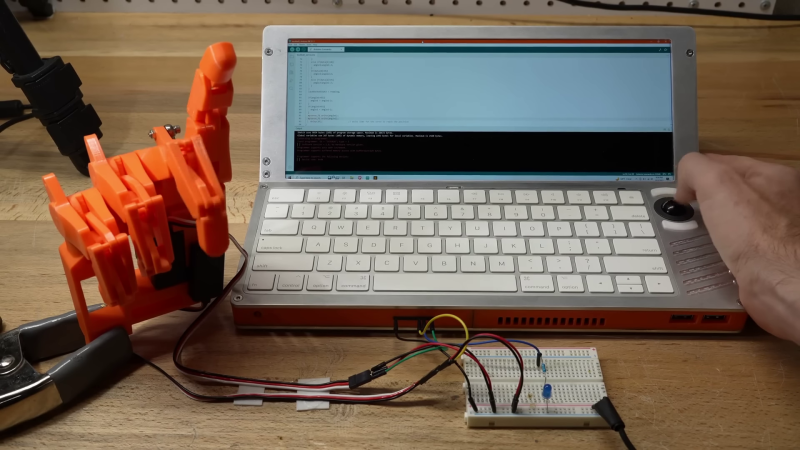
The beauty of a modular ecosystem lies in how it allows individuals to repurpose components in unconventional ways. This is precisely what [Ben Makes Everything] has achieved by using a Framework laptop’s motherboard and battery to create a slab-style cyberdeck. (Video, embedded below.)
The Framework motherboard presents an excellent choice for custom portable computer projects due to its relatively compact size and built-in modular I/O port options, all based on USB-C. Framework even released additional documentation to support this use-case. It’s significantly more powerful than the standard Raspberry PI, which is typically employed in similar projects. Ben chose a 2400 x 900 IPS display that can draw power and video through a single USB-C cable. For user input, he opted for an Apple keyboard and an optical trackball with a PS2 interface. He utilized a Arduino Pro Micro as a PS2-to-USB adaptor, using the remaining pins on the Arduino as a versatile interface for electronic projects.
The enclosure is crafted from machined aluminum plates with 3D printed spacers to secure all components. The screen can be tilted up to 45 degrees for more ergonomic desktop use. The Framework motherboard is equipped with four USB-C ports for peripheral devices; [Ben] allocated one for the display and another for a USB hub which connects the keyboard, Arduino, and external USB and HDMI connectors. The remaining USB-C ports are still available for original Framework expansion cards.
The completed project not only looks fantastic but may also be highly functional. It would have been a great entry in our recent Cyberdeck Challenge.
Waste management has become a pressing global issue as urbanization continues to grow. One innovative solution that addresses this challenge is a "Smart Dustbin". In this project, I will show you how to make a Smart Dustbin using Arduino, where the lid of the dustbin will automatically open when you approach with trash.
DIY Self-Driving Car on a Budget: An Unconventional Experiment
In a unique and budget-friendly project, a determined YouTuber “Computerphile” set out to explore the feasibility of creating a self-driving car using minimal resources. With a clear disclaimer that this experiment is far from trustworthy for real-world applications, the project aimed to investigate the potential of machine learning to enable a vehicle to navigate autonomously. The journey took place from Suffolk to Essex, and the goal was to collect crucial data during the drive that would allow the car to make its way back.
Instagram is testing a sticker creation feature that will let users make custom stickers from their own photos — and other users’, in some cases — and pop them into Reels or Stories. While Meta has been going all in on prompt-based, AI-generated stickers lately, this tool is something much simpler. It’ll just select the subject of a photo and remove the background, creating a free-floating sticker that can be placed over other content.
Adam Mosseri/ Instagram
Adam Mosseri gave a brief demonstration of how it’ll work in a video shared to his broadcast channel. He also said that, in addition to creating stickers from photos saved on your phone, users will be able to make them from “eligible images you see on Instagram.” Mosseri didn’t share any further details on that, but it suggests users will be able to opt in to making their pictures stickerable.
It’s still just a test and hasn’t rolled out to all users, so we’ll see what that actually looks like in time. The platform last week started testing a new polling feature, too, which will show up in the comments section under feed posts.
This article originally appeared on Engadget at https://www.engadget.com/instagrams-latest-test-feature-turns-users-photos-into-stickers-for-reels-and-stories-211046111.html?src=rss
This month has been filled with conflicting rumors of an Apple product launch that either will or won’t happen, but Bloomberg’s Mark Gurman now says the October event is on, and it could bring a long overdue iMac upgrade. In the Power On newsletter, Gurman reports that sources close to Apple said a Mac launch is in the works for this month. Based on current retail supplies and shipping dates for certain models, Gurman suggests we could see a new iMac and possibly some new MacBook Pros.
“Apple retail stores are in short supply of the iMac, as well as the 13-inch MacBook Pro and high-end MacBook Pro — two other models that may be due for a refresh,” Gurman wrote, noting that current shipping estimates for these models show delays until November. That, plus the timing of the company’s earnings call — in November this year, instead of October — suggests Apple has something planned. Gurman speculates the launch event may take place on October 30 or 31.
The 24-inch M1 iMac came out in April 2021 and hasn’t been updated since, making it a good candidate for a refresh. The 13-inch M2 MacBook Pro, which was released in June 2022, is also due for an upgrade.
This article originally appeared on Engadget at https://www.engadget.com/apples-rumored-october-mac-launch-may-happen-after-all-153051265.html?src=rss
This month has been filled with conflicting rumors of an Apple product launch that either will or won’t happen, but Bloomberg’s Mark Gurman now says the October event is on, and it could bring a long overdue iMac upgrade. In the Power On newsletter, Gurman reports that sources close to Apple said a Mac launch is in the works for this month. Based on current retail supplies and shipping dates for certain models, Gurman suggests we could see a new iMac and possibly some new MacBook Pros.
“Apple retail stores are in short supply of the iMac, as well as the 13-inch MacBook Pro and high-end MacBook Pro — two other models that may be due for a refresh,” Gurman wrote, noting that current shipping estimates for these models show delays until November. That, plus the timing of the company’s earnings call — in November this year, instead of October — suggests Apple has something planned. Gurman speculates the launch event may take place on October 30 or 31.
The 24-inch M1 iMac came out in April 2021 and hasn’t been updated since, making it a good candidate for a refresh. The 13-inch M2 MacBook Pro, which was released in June 2022, is also due for an upgrade.
This article originally appeared on Engadget at https://www.engadget.com/apple-may-be-planning-an-october-mac-launch-after-all-153051423.html?src=rss
Space isn't hard only on account of the rocket science. The task of taking a NASA mission from development and funding through construction and launch — all before we even use the thing for science — can span decades. Entire careers have been spent putting a single satellite into space. Nobel-winning NASA physicist John Mather, mind you, has already helped send up two.
In their new book, Inside the Star Factory: The Creation of the James Webb Space Telescope, NASA's Largest and Most Powerful Space Observatory, author Christopher Wanjek and photographer Chris Gunn take readers on a behind the scenes tour of the James Webb Space Telescope's own journey from inception to orbit. Weaving examinations of the radical imaging technology that enables us to peer deeper into the early universe than ever before with profiles of the researchers, advisors, managers, engineers and technicians that made it possible through three decades of effort. In this week's Hitting the Books excerpt, a look at JWST project scientist John Mather and his own improbable journey from rural New Jersey to NASA.
John Mather is a patient man. His 2006 Nobel Prize in Physics was thirty years in the making. That award, for unswerving evidence of the Big Bang, was based on a bus-sized machine called COBE — yet another NASA mission that almost didn’t happen. Design drama? Been there. Navigate unforeseen delays? Done that. For NASA to choose Mather as JWST Project Scientist was pure prescience.
Like Webb, COBE — the Cosmic Background Explorer — was to be a time machine to reveal a snapshot of the early universe. The target era was just 370,000 years after the Big Bang, when the universe was still a fog of elementary particles with no discernable structure. This is called the epoch of recombination, when the hot universe cooled to a point to allow protons to bind with electrons to form the very first atoms, mostly hydrogen with a sprinkling of helium and lithium. As the atoms formed, the fog lifted, and the universe became clear. Light broke through. That ancient light, from the Big Bang itself, is with us today as remnant microwave radiation called the cosmic microwave background.
Tall but never imposing, demanding but never mean, Mather is a study in contrasts. His childhood was spent just a mile from the Appalachian Trail in rural Sussex County, New Jersey, where his friends were consumed by earthly matters such as farm chores. Yet Mather, whose father was a specialist in animal husbandry and statistics, was more intrigued by science and math. At age six he grasped the concept of infinity when he filled up a page in his notebook with a very large number and realized he could go on forever. He loaded himself up with books from a mobile library that visited the farms every couple of weeks. His dad worked for Rutgers University Agriculture Experiment Station and had a laboratory on the farm with radioisotope equipment for studying metabolism and liquid nitrogen tanks with frozen bull semen. His dad also was one of the earliest users of computers in the area, circa 1960, maintaining milk production records of 10,000 cows on punched IBM cards. His mother, an elementary school teacher, was quite learned, as well, and fostered young John’s interest in science.
A chance for some warm, year-round weather ultimately brought Mather in 1968 to University of California, Berkeley, for graduate studies in physics. He would fall in with a crowd intrigued by the newly detected cosmic microwave background, discovered by accident in 1965 by radio astronomers Arno Penzias and Robert Wilson. His thesis advisor devised a balloon experiment to measure the spectrum, or color, of this radiation to see if it really came from the Big Bang. (It does.) The next obvious thing was to make a map of this light to see, as theory suggested, whether the temperature varied ever so slightly across the sky. And years later, that’s just what he and his COBE team found: anisotropy, an unequal distribution of energy. These micro-degree temperature fluctuations imply matter density fluctuations, sufficient to stop the expansion, at least locally. Through the influence of gravity, matter would pool into cosmic lakes to form stars and galaxies hundreds of millions of years later. In essence, Mather and his team captured a sonogram of the infant universe.
Yet the COBE mission, like Webb, was plagued with setbacks. Mather and the team proposed the mission concept (for a second time) in 1976. NASA accepted the proposal but, that year, declared that this satellite and most others from then on would be delivered to orbit by the Space Shuttle, which itself was still in development. History would reveal the foolishness of such a plan. Mather understood immediately. This wedded the design of COBE to the cargo bay of the unbuilt Shuttle. Engineers would need to meet precise mass and volume requirements of a vessel not yet flown. More troublesome, COBE required a polar orbit, difficult for the Space Shuttle to deliver. The COBE team was next saddled with budget cuts and compromises in COBE’s design as a result of cost overruns of another pioneering space science mission, the Infrared Astronomical Satellite, or IRAS. Still, the tedious work continued of designing instruments sensitive enough to detect variations of temperatures just a few degrees above absolute zero, about −270°C. From 1980 onward, Mather was consumed by the creation of COBE all day every day. The team needed to cut corners and make risky decisions to stay within budget. News came that COBE was to be launched on the Space Shuttle mission STS-82-B in 1988 from Vandenberg Air Force Base. All systems go.
Then the Space Shuttle Challenger exploded in 1986, killing all seven of its crew. NASA grounded Shuttle flights indefinitely. COBE, now locked to Shuttle specifications, couldn’t launch on just any other rocket system. COBE was too large for a Delta rocket at this point; ironically, Mather had the Delta in mind in his first sketch in 1974. The team looked to Europe for a launch vehicle, but this was hardly an option for NASA. Instead, the project managers led a redesign to shave off hundreds of pounds, to slim down to a 5,000-pound launch mass, with fuel, which would just make it within the limits of a Delta by a few pounds. Oh, and McDonnell Douglas had to build a Delta rocket from spare parts, having been forced to discontinue the series in favor of the Space Shuttle.
The team worked around the clock over the next two years. The final design challenge was ... wait for it ... a sunshield that now needed to be folded into the rocket and spring-released once in orbit, a novel approach. COBE got the greenlight to launch from Vandenberg Air Force Base in California, the originally desired site because it would provide easier access to a polar orbit compared to launching a Shuttle from Florida. Launch was set for November 1989. COBE was delivered several months before.
Then, on October 17, the California ground shook hard. A 6.9-magnitude earthquake struck Santa Cruz County, causing widespread damage to structures. Vandenberg, some 200 miles south, felt the jolt. As pure luck would have it, COBE was securely fastened only because two of the engineers minding it secured it that day before going off to get married. The instrument suffered no damage and launched successfully on November 18. More drama came with the high winds on launch day. Myriad worries followed in the first weeks of operation: the cryostat cooled too quickly; sunlight reflecting off of Antarctic ice played havoc with the power system; trapped electrons and protons in the Van Allen belts disrupted the functioning of the electronics; and so on.
All the delays, all the drama, faded into a distant memory for Mather as the results of the COBE experiment came in. Data would take four years to compile. But the results were mind-blowing. The first result came weeks after launch, when Mather showed the spectrum to the American Astronomical Society and received a standing ovation. The Big Bang was safe as a theory. Two years later, at an April 1992 meeting of the American Physical Society, the team showed their first map. Data matched theory perfectly. This was the afterglow of the Big Bang revealing the seeds that would grow into stars and galaxies. Physicist Stephen Hawking called it “the most important discovery of the century, if not of all time.”
Mather spoke humbly of the discovery at his Nobel acceptance speech in 2006, fully crediting his remarkable team and his colleague George Smoot, who shared the prize with him that year. But he didn’t downplay the achievement. He noted that he was thrilled with the now broader “recognition that our work was as important as people in the professional astronomy world have known for so long.”
Mather maintains that realism today. While concerned about delays, threats of cancellation, cost overruns, and not-too-subtle animosity in the broader science community over the “telescope that ate astronomy,” he didn’t let this consume him or his team. “There’s no point in trying to manage other people’s feelings,” he said. “Quite a lot of the community opinion is, ‘well, if it were my nickel, I’d spend it differently.’ But it isn’t their nickel; and the reason why we have the nickel in the first place is because NASA takes on incredibly great challenges. Congress approved of us taking on great challenges. And great challenges aren’t free. My feeling is that the only reason why we have an astronomy program at NASA for anyone to enjoy — or complain about — is that we do astonishingly difficult projects. We are pushing to the edge of what is possible.”
Webb isn’t just a little better than the Hubble Space Telescope, Mather added; it’s a hundred times more powerful. Yet his biggest worry through mission design was not the advanced astronomy instruments but rather the massive sunshield, which needed to unfold. All instruments and all the deployment mechanisms had redundancy engineered into them; there are two or more ways to make them work if the primary method fails. But that’s not the only issue with a sunshield. It would either work or not work.
Now Mather can focus completely on the science to be had. He expects surprises; he’d be surprised if there were no surprises. “Just about everything in astronomy comes as a surprise,” he said. “When you have new equipment, you will get a surprise.” His hunch is that Webb might reveal something weird about the early universe, perhaps an abundance of short-lived objects never before seen that say something about dark energy, the mysterious force that seems to be accelerating the expansion of the universe, or the equally mysterious dark matter. He also can’t wait until Webb turns its cameras to Alpha Centauri, the closest star system to Earth. What if there’s a planet there suitable for life? Webb should have the sensitivity to detect molecules in its atmosphere, if present.
“That would be cool,” Mather said. Hints of life from the closest star system? Yes, cool, indeed.
This article originally appeared on Engadget at https://www.engadget.com/inside-the-star-factory-chris-gunn-christopher-wanjek-mit-press-143046496.html?src=rss
Google will have to pay over $1 million to an executive who alleged the company discriminated against her based on her gender and later retaliated when she spoke up about it. Ulku Rowe, a Google Cloud engineering director, accused the company of hiring her at a lower level, lower paid position than men with less experience who were hired for similar roles at the same time, according to Bloomberg Law. She also claimed she was passed over for a promotion in favor of a less qualified male colleague.
A New York jury on Friday decided that Google did commit gender-based discrimination, and now owes Rowe a combined $1.15 million for punitive damages and the pain and suffering it caused. Rowe had 23 years of experience when she started at Google in 2017, and the lawsuit claims she was lowballed at hiring to place her at a level that paid significantly less than what men were being offered.
It comes nearly five years after some 20,000 Google employees organized a walkout to demand changes around the company’s handling of sexual misconduct and discrimination. While the company pledged to do better on sexual harassment, its response still left a lot to be desired on the topics of bias. According to Bloomberg Law, the Rowe lawsuit is the first such case Google has faced since the protests.
This article originally appeared on Engadget at https://www.engadget.com/google-ordered-to-pay-1-million-to-female-exec-who-sued-over-pay-discrimination-214702002.html?src=rss
Blizzard hasn’t exactly been subtle in marketing Diablo IV, but its latest PR stunt is especially on the nose. To celebrate the release of the game’s new season, Season of Blood, and the high-payoff Blood Harvest events it introduced, Blizzard has launched a month-long blood drive in the US that’ll unlock in-game rewards as more people participate. Once donations reach 666 quarts altogether, players will be able to enter a sweepstakes for “a custom liquid-cooled PC infused with real human blood.”
The first tier of rewards, a batch of five weapons cosmetics, will unlock once donations hit 33 percent of the goal. At the 66 percent mark, players will also be granted access to the Loch Raeth Maor Barbarian armor cosmetic. When donations reach 100 percent of the goal — a total of 666 quarts of blood — the Vermilion Eye Piebald Mount will become available, and the sweepstakes for the custom PC will open.
Aside from the whole “human blood in the coolant” gimmick, the Seasons of Blood custom PC features NVIDIA’s GeForce RTX 4090, an Intel Core i9 CPU, 64GB of DDR5 RAM, 3 TB SSD Storage, and the Quantum Vector GPU Waterblock for cooling. And, the sweepstakes won’t just be reserved for those who donated. Once the goal is met, any player in the US over 18 can enter. The blood drive is open from now through November 20, and you don’t need to go anywhere special to get in on it. Players 18+ can donate at their local blood centers, then submit proof on the Diablo Blood Harvest website.
A typical blood donation is 1 pint, so it’ll take a little over 1,300 donations to hit the final goal. Players can keep track of the blood drive’s progress by visiting the above website and its motivational fountain of gushing blood. At the time of writing, it’s already at 15 percent — or almost halfway to the first goal.
Considering the Red Cross recently announced we’re in the middle of a blood shortage, it’s maybe not the worst idea. All of the rewards will be doled out a few days after the blood drive closes, on November 22. Happy harvest!
This article originally appeared on Engadget at https://www.engadget.com/blizzard-will-raffle-off-a-human-blood-infused-pc-if-diablo-iv-players-donate-666-quarts-192828807.html?src=rss