FuboTV accuses Disney, Fox and Warner Bros. of antitrust practices over joint streaming service

FuboTV, a streaming platform dedicated to live sports, has filed an antitrust lawsuit against Disney, Fox and Warner Bros. Discovery, accusing the companies of staging "a years-long campaign" to hamper its business. The company's lawsuit comes shortly Disney-owned ESPN, Fox and Warner Bros. Discovery announced that they're launching a sports streaming service in the fall of 2024, which will give subscribers access to sporting events from the networks they own. FuboTV's complaint argued that the companies are stealing its playbook and that the launch of their joint venture will destroy competition and lead to price inflation for consumers. 

Further, FuboTV alleged that the launch of the defendants' streaming service is but "the latest coordinated step" in their "campaign to eliminate competition in the sports-first streaming market" and in their effort to block its business. The streaming service said the defendants charge it content licensing rates that are 30 to 50 percent higher than the rates they charge other distributors. They also allegedly force FuboTV to bundle "dozens of expensive non-sports channels" that "customers do not want" with their sports offerings as a condition of licensing their content. All these increase the costs FuboTV must pass onto its customers, the company explained. 

FuboTV also claimed that the companies in question have prevented it from being able to offer streaming products subscribers would like, including content available on Hulu. Plus, the defendants allegedly impose a limitation on how many subscribers can buy their content package, ensuring that FuboTV can't make a dent in the market. 

"Each of these companies has consistently engaged in anticompetitive practices that aim to monopolize the market, stifle any form of competition, create higher pricing for subscribers and cheat consumers from deserved choice," FuboTV CEO David Gandler said in a statement. "By joining together to exclusively reserve the rights to distribute a specialized live sports package, we believe these corporations are erecting insurmountable barriers that will effectively block any new competitors from entering the market. This strategy ensures that consumers desiring a dedicated sports channel lineup are left with no alternative but to subscribe to the Defendants' joint venture."

Engadget has reached out to all three defendants: ESPN has declined to comment, while Fox and Warner Bros. Discovery have yet to get back to us. FuboTV is asking the court to prohibit the joint venture's launch or to impose restrictions, such as economic parity of licensing terms, on the defendants.

This article originally appeared on Engadget at https://www.engadget.com/fubotv-accuses-disney-fox-and-warner-bros-of-antitrust-practices-over-joint-streaming-service-064140676.html?src=rss
Signal usernames will keep your phone number private

Instant messaging app Signal is best known for its privacy-related settings, though with phone numbers being the heart of the platform since its inception, there was no way to fully hide your own number until now. Earlier today, Signal announced that you'll soon be able to create a unique username (not to be mistaken with your profile name), which you can share with others via a link or QR code — as opposed to sharing your number. You'll be able to change your unique username as often as you want, but it needs to contain two or more numbers at the end, as part of Signal's anti-spoofing efforts. You can even delete your username entirely, as it is an optional feature.

Naturally, you'll still need a phone number to sign up for Signal, but note that with the new default, your number will no longer be visible to everyone (you can change this setting manually, if needed). There will also be a new option which prevents people from finding you by your number; they will need to have your exact unique username to do so. In other words, people who already have your number won't necessarily know that you are also on Signal, which is a good thing if you prefer to stay anonymous in this platform's public groups.

As is the case with any new feature, the likes of spammers and scammers will eventually find a way to abuse usernames, as you won't be able to verify their numbers instantly. Pro tip: when you see new contacts that appear to be your acquaintances, always double check with them through other means — preferably in person, or at least via a phone call. You may look out for these new Signal features in a few weeks' time, or you can get an early taste in the beta release.

This article originally appeared on Engadget at https://www.engadget.com/signal-usernames-will-keep-your-phone-number-private-050008243.html?src=rss

Apple says the iPhone 15’s battery has double the promised lifespan

Apple has updated the iPhone 15’s battery lifespan. The company said on Tuesday its latest iPhones can retain 80 percent of their original charging capacity after 1,000 cycles — double the company’s previous estimate — without any new hardware or software updates. Not so coincidentally, the change will arrive in time for upcoming EU regulations that will assign an energy grade for phones’ battery longevity.

Before today, Apple’s online support documents quoted iPhone batteries as maintaining 80 percent of their original full charge after 500 cycles. But after the company retested long-term battery health in its 2023 smartphones — iPhone 15, iPhone 15 Plus, iPhone 15 Pro and iPhone 15 Pro Max — it found they can retain 80 percent capacity after at least 1,000 cycles. The company said its support documents will be updated on Tuesday to reflect the new estimate.

Apple says its testing involved charging and draining the batteries 1,000 times under specific conditions and a suite of tests reflecting common uses. As for how the estimate doubled without any physical or software changes, the company attributes the upgrade to continual improvements to its battery components and iOS power management.

For older (pre-2023) iPhones, the original estimate of retaining 80 percent capacity after 500 charge cycles still stands — at least for now. Apple said it’s looking into whether older models’ estimates need to be updated.

Apple

Starting in June 2025, smartphone and tablet manufacturers doing business in the EU will be assigned a grade (A to G) indicating their energy efficiency, battery longevity, protection from dust and water and resistance to accidental drops. The battery longevity portion of the grade requires at least 800 charging cycles while retaining at least 80 percent of their original capacity, helping explain why Apple began retesting its devices’ long-term health.

For ideal battery longevity, Apple recommends keeping your phone in temperatures between 62 and 72 degrees Fahrenheit when possible. You’ll also want to avoid charging or leaving your handset in hot environments (95 degrees or warmer) while trying to avoid much direct sun exposure. In addition, if you’re storing an old iPhone long-term, it’s best to leave it half-charged.

In addition, Apple will soon move one of your phone’s most essential battery metrics to a different part of iOS settings. Beginning in iOS 17.4, currently in beta, the battery cycle count will move from Settings > General > About to a more logical home under Battery Health (under Settings > Battery). Apple introduced the battery cycle count to its mobile software in iOS 17, which was launched last fall.

This article originally appeared on Engadget at https://www.engadget.com/apple-says-the-iphone-15s-battery-has-double-the-promised-lifespan-213736866.html?src=rss

Acer’s latest Swift laptops have AMD 8040 chips with Ryzen AI support

Acer unveiled a pair of AMD Ryzen 8040 series laptops on Tuesday. Unsurprisingly, given their chips’ dedicated neural processing units (NPU), the company is marketing the 2024 Acer Swift Edge 16 and Swift Go 14 as AI workhorses. The Windows 11 machines support OLED displays, Radeon 780M graphics and 32GB of RAM.

The Ryzen 8040 chip series, revealed in December, has a dedicated AI Engine that AMD claims makes it up to 1.4 times faster than its predecessors in Llama 2 and AI vision model performance. Acer says the Swift Edge 16 and Swift Go 14 will deploy the NPU for AI-related tasks like PurifiedVoice (remove background noise in calls and recordings) and PurifiedView (blurring backgrounds in images and correcting your eyes’ positioning on video calls).

Acer

Like most new Windows machines (including Acer’s models launched at CES 2024), the laptops have a dedicated Microsoft Copilot button on their keyboards for quick ChatGPT-like AI queries. (Copilot taps into Microsoft and OpenAI’s servers through the cloud rather than using the machines’ on-device NPU.)

Both machines’ AMD chips include Microsoft’s Pluton security co-processor. Introduced in 2020 through a partnership with AMD and Intel, it bakes security directly into the processor, helping protect your credentials, encryption keys and personal data from hackers.

Acer Swift Edge 16

Acer

Acer markets the Acer Swift Edge 16 as optimizing performance without sacrificing portability. All device variants have a 16-inch OLED panel with WQXGA (3200 x 2000) resolution and a 120Hz frame rate with less than a 0.2ms response time. It supports 100 percent of the DCI-P3 color gamut and VESA DisplayHDR True Black 500 certification for (what should be) accurate and nuanced visuals.

The laptop’s Ryzen 7 8840U processor is joined by AMD Radeon 780M integrated graphics. The notebook has up to 32GB of LPDDR5 RAM and 2TB PCIe 4.0 SSD storage. Depending on your configuration, it supports Wi-Fi 7 or Wi-Fi 6E.

The Swift Edge 16 weighs 2.71 lbs and is 12.95mm tall. It’s encased in a magnesium-aluminum alloy chassis and has a 54 Wh battery. It includes two USB-C ports (with USB4 speeds of up to 40Gbps), two USB-A, one HDMI 2.1 and a microSD slot.

Acer Swift Go 14

Acer

The smaller of the pair, the Acer Swift Go 14, has up to an AMD Ryzen 9 8945HS octa-core processor with AMD Radeon 780M graphics. (Cheaper configurations will trade that for a Ryzen 7 8845HS or Ryzen 5 8645HS.) The machine maxes out at 32GB LPDDR5X RAM and up to 2TB PCIe Gen 4 SSD.

The top-shelf 14-inch variant will have a WQXGA (2880x1800) OLED display with a 90Hz refresh rate. Another version will swap that for a 1920 x 1200 IPS panel with touchscreen capabilities. The device’s hinge can extend to 180 degrees, and its glass trackpad is 44 percent larger than the previous model’s. It supports Wi-Fi 6E.

Thanks to its smaller footprint, Acer markets the Swift Go 14 as the more portable version. However, it’s about seven percent heavier than its 16-inch counterpart — at 2.91 lbs. It ships in configurations with either a 65 or 50 Wh battery.

Both models have 1440p QHD webcams, although only the Swift Go 14 is listed as having a privacy shutter. The smaller model is lighter on ports than the 16-inch model, forgoing the pair of USB-A connections in the larger one. The Swift Go 14 has two USB-C ports (both supporting USB4 speeds), an HDMI 2.1 connector and a microSD slot.

Pricing and availability

The Swift Edge 16 launches in March in North America, starting at $1,300. Meanwhile, the Swift Go 14 follows in April, starting at $700. Apart from their entry-level models, Acer hasn’t yet detailed how pricing will break down across various configurations.

This article originally appeared on Engadget at https://www.engadget.com/acers-latest-swift-laptops-have-amd-8040-chips-with-ryzen-ai-support-182942352.html?src=rss

Twitch is increasing channel subscription prices for the first time

Amazon has been looking to bolster Twitch's bottom line for a while. After laying off around 500 workers and reducing how much streamers make from Prime subscriptions, the streaming service is increasing the price of its subscriptions for the first time.

Twitch says it's "updating prices in several countries to help streamer revenue keep pace with rising costs and reflect local currency fluctuations." The first markets to feel the impact of those changes are the UK, Canada, Australia and Turkey.

As of March 28, Tier 1 subscriptions and gift subs will be more expensive in the UK, Canada and Australia. A base/gift sub is going up from £5 to £6 in the UK, $7 CAD to $8 in Canada and $8 AUD to $9 in Australia. Tier 2 and 3 prices will remain the same in those countries.

In Turkey, Twitch is significantly increasing the price of all three tiers. For instance, a Tier 1 sub will soon cost 43.90 lira ($1.42) instead of 9.90 (32 cents) — the value of the Turkish lira has plummeted over the last 15 years.

These price changes only apply to subscriptions bought on the web. Twitch says it will update prices on its mobile apps in the coming months. It's currently more expensive to buy a sub on the Twitch iOS app. The service also expects to update pricing in other countries later this year.

On the plus side, streamers will have the same revenue share, so they'll earn more from subscriptions in the UK, Canada, Australia and Turkey. Twitch recently announced changes to streamer payouts from Prime subscriptions. They'll soon earn a (generally lower) fixed amount for each Prime sub, dispensing on the subscriber's location. Meanwhile, it'll soon be easier for smaller streamers to qualify for the Partner Plus program and benefit from a better subscription revenue split.

This article originally appeared on Engadget at https://www.engadget.com/twitch-is-increasing-channel-subscription-prices-for-the-first-time-181202078.html?src=rss

There’s a Pokémon Presents livestream scheduled for February 27

The Pokémon Company is hosting a morning livestream on February 27 at 9AM ET to share “exciting Pokémon news” on its official YouTube channel. The yearly stream, appropriately named Pokémon Presents, will provide a bunch of info about what’s coming down the pike throughout 2024.

The company does this stream every year, but this one could be special. After all, it happens to fall exactly on the totally not made-up holiday Pokémon Day, which celebrates the original Japanese release of Pokémon Red and Pokémon Green back in 1996.

We don’t know exactly what will be shown, but we have some informed guesses. Given previous Pokémon Presents streams, we’ll likely get updates on live-service hits like Pokémon Go, the MOBA Pokémon Unite and the recently-released tracking app Pokémon Sleep.

Dollars to doughnuts, we’ll also get something more substantial to chew on. Most of these streams feature the announcement of an actual Pokémon RPG. Chronologically speaking, it’s too soon to expect a reveal for the true next-gen Pokémon game, as Scarlet and Violet just launched in 2022. The mainline entries typically follow a three-year release cycle.

That leaves remakes and spinoffs. Pokémon Brilliant Diamond and Shining Pearl released in 2021 so it’s high-time for remakes of the beloved Pokémon Black and White fifth-gen titles. This is just a guess, but it’s not like the Pokémon Company is gonna skip a generation in its remake-a-palooza. It’s Black and White’s turn to shine.

There’s also a chance we’ll get a new Let’s Go title set in another region of the Poké-verse. We could even get a new action RPG like Pokémon Legends: Arceus. There’s always going to be some oddball announcements, like a new Pokémon Mystery Dungeon or even a new Pokémon Art Academy that integrates the Switch’s touchscreen.

Exciting news, Trainers!

New episodes of Pokémon Concierge are in production! Stay tuned for updates! 🏖 pic.twitter.com/NE3ZwwmCXz

— Pokémon (@Pokemon) February 19, 2024

You should expect some announcements regarding content set in the Pokémon cinematic universe. The delightfully quirky stop-motion show Pokémon Concierge was just renewed for a second season, so we could see a teaser. There could also be a trailer for a new season of Pokémon Horizons: The Series.

Also, to throw a bit of cold water on expectations, this is a stream conducted by The Pokémon Company, and not Nintendo. You won’t catch a whiff of software planned for the Switch 2, or whatever the new console ends up being called. Rumors swirl that the release of that console has been delayed until 2025. Nintendo’s holding its own Direct livestream tomorrow, but it’ll focus on third-party titles and will likely not include any news on the forthcoming console.

This article originally appeared on Engadget at https://www.engadget.com/theres-a-pokemon-presents-livestream-scheduled-for-february-27-173512254.html?src=rss

OnePlus rejoins the smartwatch scene with the promise of a 100-hour battery life

After months of rumors, OnePlus has announced its second smartwatch. It will formally debut the OnePlus Watch 2 at Mobile World Congress in Barcelona later this month. The company is notorious for drip feeding details about its products and while it has yet to reveal some key information about the wearable, OnePlus has offered up a few juicy morsels.

For one thing, the company has made the lofty claim that the OnePlus Watch 2 will run for up to 100 hours on a single charge. That’s with “full Smart Mode” enabled rather than a battery saver mode, according to OnePlus. 

Obviously, we’ll need to see how well the OnePlus Watch 2 actually fares in the wild, but that purported battery life far exceeds that of most mainstream smartwatches, such as the Apple Watch Series 9 (18 hours) and Pixel Watch 2 (24 hours with always-on display enabled). OnePlus president Kinder Liu says the company's goal for the device is to "win the title of the Best Flagship Smartwatch of the year with its market-beating battery life."

🩶 Radiant Steel
🖤 Black Steel
Introducing our flagship #OnePlusWatch2, built with stainless steel and sapphire crystal for rugged elegance

— OnePlus (@oneplus) February 20, 2024

The wearable apes the design language of the OnePlus 12 series, according to the company. It has a stainless steel chassis and a sapphire crystal watch face. The OnePlus Watch 2 will be available in two colorways, Black Steel and Radiant Steel.

OnePlus promises "unparalleled reliability for everyday use and meticulous health monitoring" too, but it's keeping other key details under wraps for now, including pricing and the release date. One other factor the company hasn't confirmed is what operating system the OnePlus Watch 2 will use. Reports have suggested that it will run on Wear OS, which will hopefully help the smartwatch fare much better than its poorly received predecessor. Liu indicated the company was aware of the tepid response to the OnePlus Watch, noting that it took a "three-year hiatus and a reflective pause" between wearables.

This article originally appeared on Engadget at https://www.engadget.com/oneplus-rejoins-the-smartwatch-scene-with-the-promise-of-a-100-hour-battery-life-165620187.html?src=rss

Tinder is bringing its advanced ID verification system to the US and UK

Tinder has announced it’s bringing an advanced ID verification system to the US, UK, Brazil and Mexico. This is part of an ongoing effort to reduce the number of catfish swimming around the old dating pool. The new system requires that users take a video selfie and upload a valid driver’s license or passport.

Tinder has long required users to take photos or video selfies as part of its verification process, which would provide a blue checkmark to illustrate authenticity. So the passport and driver’s license stuff is new. Once you upload the ID, Tinder will check to see if it lines up with your video selfie and the photos on your profile. It’ll also look at the date of birth on the license or passport to confirm your age.

If the idea of uploading your ID to a dating app gives you an icky feeling, you can still get verified with just a video selfie. However, your profile will get a blue camera icon badge, and not a blue checkmark.

Tinder started testing this system last year in New Zealand and Australia, and it must have worked out just fine, given the broader roll-out. The updated verification tool is coming to the UK and Brazil by spring and the US and Mexico by summer. In other words, catfish only have a few more months left to do their thing. That includes you, AI catfish.

This shouldn’t be confused with Tinder’s recently-abandoned background check feature, which was powered by the non-profit Garbo. Tinder and Garbo paired up to provide a robust background check tool on the app in 2019, to check users for histories of violence.

Garbo ended up breaking it off with Tinder’s parent company, Match Group, after disagreements over payments and how to best use the tool. Garbo’s CEO said she’d rather leave the partnership instead of allowing "the vision of Garbo to be compromised and relegated to a piece of big corporations’ marketing goals.”

This article originally appeared on Engadget at https://www.engadget.com/tinder-is-bringing-its-advanced-id-verification-system-to-the-us-and-uk-164353306.html?src=rss

The best vlogging cameras for 2024

If you’re a content creator or YouTuber, camera companies increasingly want your business. Last year was no exception, with several new vlogging-specific models released by Canon, Sony, DJI and others. That means there are now over a dozen on sale, alongside regular mirrorless cameras that also do the job well.

Models specifically designed for vlogging include Sony’s new ZV-E1 full-frame mirrorless that launched last year, DJI’s Osmo Pocket 3 or Canon’s compact PowerShot V10. Others, like the new Panasonic G9 II and last year’s Canon EOS R6 II are hybrid mirrorless cameras that offer vlogging as part of a larger toolset.

All of them have certain things in common, like flip-around screens, face- and/or eye-detect autofocus and stabilization. Prices, features and quality can vary widely, though. To that end, we’ve updated our guide with all the latest vlogging cameras designed for novice to professional creators, in all price ranges. Engadget has tested all of these to give you the best possible recommendations.

Factors to consider before buying a vlogging camera

Vlogging cameras are designed for filmmakers who often work alone and either use a tripod, gimbal, vehicle mount or just their hands to hold a camera. It must be good for filming yourself as well as other “B-roll” footage that helps tell your story. The biggest requirement is a flip-around screen so you can see yourself while filming. Those can rotate up, down or to the side, but flipping out to the side is preferable so a tripod or microphone won’t block it.

Continuous autofocus (AF) for video with face and eye detection is also a must. It becomes your camera “assistant,” keeping things in focus while you concentrate on your content. Most cameras can do that nowadays, but some (notably Canon and Sony) do it better than others.

If you move around or walk a lot, you should look for a camera with built-in optical stabilization. Electronic stabilization is another option as long as you’re aware of its limitations. You’ll also need a camera with a fast sensor that limits rolling shutter, which can create a distracting jello “wobble” with quick camera movements.

Steve Dent/Engadget

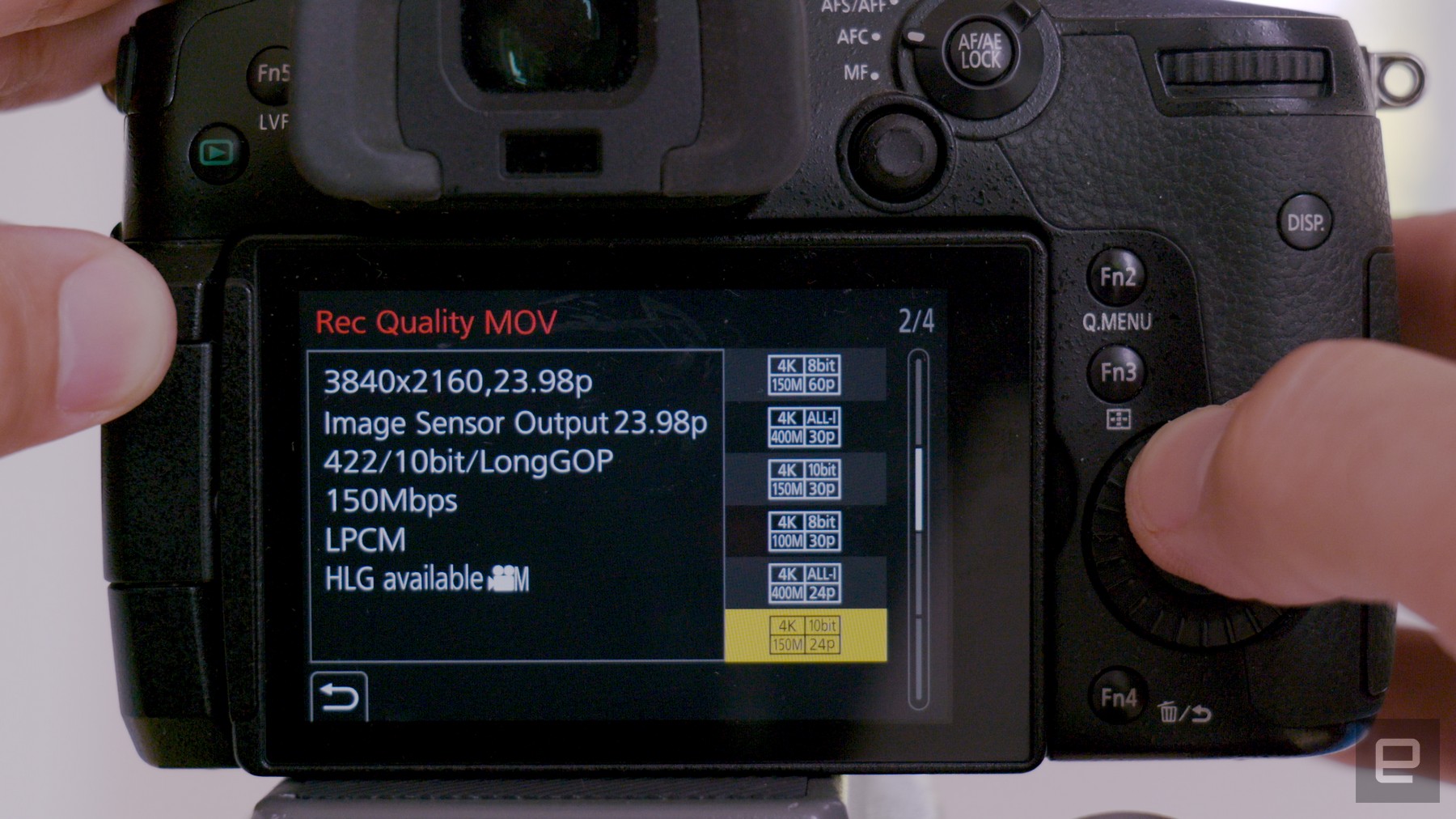
4K recording is another key feature. All cameras nowadays can shoot 4K up to at least 24 fps, but if possible, it’s better to have 4K at 60 or even 120 fps. If you shoot sports or other things involving fast movement, look for a model with at least 1080p at 120 fps for slow-motion recording.

Video quality is another important consideration, especially for skin tones. Good light sensitivity helps for night shooting, concerts and so on, and a log profile helps improve dynamic range in very bright or dark shooting conditions. If you want the best possible image quality and can afford it, get a camera that can record 4K with 10-bits (billions) of colors. That will give you more options when it’s time to edit the footage.

Don’t neglect audio either — if the quality is bad, your audience will disengage. Look for a camera with a microphone port so you can plug in a shotgun or lapel mic for interviews, or at least one with a good-quality built-in microphone. It’s also nice to have a headphone port to monitor sound so you can avoid nasty surprises after you’ve finished shooting.

You’ll also want good battery life and, if possible, dual memory card slots for a backup. Finally, don’t forget about your camera’s size and weight. If you’re constantly carrying one while shooting, especially at the end of a gimbal or gorillapod, it might actually be the most important factor. That’s why tiny GoPro cameras are so popular for sports, despite offering lower image quality and fewer pro features.

The best action and portable cameras

If you’re just starting out in vlogging or need a small, rugged camera, an action cam might be your best bet. In general, they’re easy to use as you don’t have to worry about things like exposure or focus. Recent models also offer good electronic stabilization and sharp, colorful video at up to 4K and 60 fps. The downsides are a lack of control; image quality that’s not on par with larger cameras; and no zooming or option to change lenses.

The best compact vlogging cameras

Compact cameras are a step up from smartphones or action cameras, with larger sensors and much better image quality. At the same time, they’re not quite as versatile as mirrorless or DSLR cameras (and not necessarily cheaper) and they lack advanced options like 10-bit video. For folks who want the best possible quality without needing to think too much about their camera, however, they’re the best option.

The best mirrorless/DSLR vlogging cameras

This is the class that has changed the most over the past couple of years, particularly in the more affordable price categories. Interchangeable lens cameras give you the most options for vlogging, offering larger sensors than compact cameras with better low-light sensitivity and shallower depth of field to isolate you or your subject. They also offer better control of your image with manual controls, log recording, 10-bit video and more. The drawbacks are extra weight compared to action or compact cameras, more complexity and higher prices.

This article originally appeared on Engadget at https://www.engadget.com/best-vlogging-camera-151603452.html?src=rss

Dr. Garmin will see you now

There’s a reason smartwatches haven’t replaced clinically-validated gear when you visit the hospital — accuracy and reliability are paramount when the data informs medical procedures. Even so, researchers are looking for ways in which these devices can be meaningfully used in a clinical setting. One project in the UK has explored if a Garmin Venu 2 and dedicated companion app could be used to free up doctors and nurses, six minutes at a time.

The Six Minute Walk Test (6MWT) is used to diagnose and monitor a number of cardiovascular maladies. This includes conditions like Pulmonary Hypertension that, if left untreated, are eventually fatal. “[The test has been] a cornerstone of hospital practice and clinical trials for decades all around the world as [...] a marker of how well the heart and lungs are working,” explained project leader Dr. Joseph Newman. While a change in a blood test marker might be clinically relevant, Newman said “it’s probably more important to someone that they can walk to the shop and back.” The test requires a patient walk on a flat, hard surface for six minutes straight, which stresses the heart enough to measure its capacity. A professional tests the patient’s heart rate and blood oxygen levels at the start and end, and while it’s simple and reliable, "it’s not perfect,” according to Newman. “This is why we’ve looked to change it in two important ways," he said, "can we make it shorter [...] and digitize it for remote use?"

After all, six minutes is a lifetime in a clinical setting, and patients dislike having to schlep all the way to their hospital just to walk up and down a corridor. It’s why Newman and Lucy Robertson — both researchers at the Royal Papworth Hospital in Cambridge — began looking for ways to revolutionize the test. They wanted to see if the test could be shortened to a single minute, and also if it could be carried out by a patient at home using a Venu 2. The watch was connected to a secure and dedicated clinical trial platform built by Aparito – a Wrexham-based developer – for testing. This was then sent out to patients who were instructed to wear the watch and walk outdoors to complete their own tests. “They’re asked to walk on flat, even, dry, relatively straight roads rather than in laps or circuits,” said Dr. Newman, with patients walking at their own natural pace.

“We carried out a product appraisal early on in the research process and were open-minded as to the brand or model,” said Newman. “Garmin came out on top for a few reasons; we can access raw data as well as Garmin’s algorithmically-derived variables,” he said. Because the research was being funded by a charity, the British Heart Foundation, the watch had to offer good value for money. It helped that Garmin, because of its existing health research division, gave the team “confidence in the accuracy of the sensors,” not to mention the fact that Aparito feels that “the Garmin SDK is relatively easy to work with,” he said. But while Garmin is in use right now, there’s no reason this setup couldn’t eventually work with a number of other brands. “As long as the technology works, it’s accurate, reliable and patients accept it, then we’re not tied to any brand.”

There are several benefits in giving patients the ability to run the tests at home: it’s more representative of the demands of their actual life, and patients can retake the test at regular intervals, making it easier to track that person’s health over time. “We can see real value in providing patients with pulmonary hypertension with an app and smartwatch to monitor their progress,”said Dr. Newman. “It’s unlikely to ever fully replace the need for in-person hospital reviews, but it will likely reduce their frequency.”

The results of the study right now suggest cutting the test to one minute has no detrimental effect on its outcome or accuracy,and that patients are far more likely to run the test regularly if they’re able to do so at home. “It’s likely that the upfront costs of wearables [to a hospital] may be offset by the longer term reduction in hospital visits,” said Newman. If that turns out to be right, then it means clinicians can better focus their time and efforts where their expertise is more valuable.

This article originally appeared on Engadget at https://www.engadget.com/dr-garmin-will-see-you-now-160013340.html?src=rss