Mark Zuckerberg may still be explaining exactly what the metaverse is, but the Meta CEO just showed off another technology he says will be crucial to the company’s vision of creating immersive environments. Meta's AI researchers are working on a voice-powered bot that allows users to change their virtual surroundings with voice commands.
Zuckerberg demoed an early version of the concept, called Builder Bot, at a virtual event detailing the company’s latest AI research.
“It enables you to describe a world and then it will generate aspects of that world for you,” Zuckerberg said. In his demo, he and another Meta employee used voice commands to create a very basic beach scene with a picnic table, clouds, and, yes, Zuckerberg’s signature hydrofoil. They also added some sound effects of seagulls and ocean waves.
Facebook
For now though, the technology seems to be in a relatively early stage. The environment Zuckerberg generated looked much flatter and lower-res than past metaverse demos, though his legless avatar was present much like other recent demos. “As we advance this technology further, you're going to be able to create nuanced worlds to explore and share experiences with others with just your voice,” he said.
The builder bot is part of a larger AI project called Project CAIRaoke that aims to create the kind of conversational AI necessary to create these virtual worlds. Facebook isn’t the first to experiment with this type of research. OpenAI showed off a neural network capable of generating images from text last year. But Zuckerberg said that project CAIRaoke would be central for the Meta’s future.
“In the metaverse, we're going to need AI that is built around helping people navigate virtual worlds as well as our physical world with augmented reality,” Zuckerberg said. “When we have glasses on our faces, that will be the first time that an AI system will be able to really see the world from our perspective: See what we see, hear what we hear and more.”
Zuckerberg’s comments come as he is trying to pivot the company from social networking to metaverse technology, a move that has so far proved to be incredibly expensive. But as the core Facebook service starts to lose users for the first time ever, Zuckerberg has said “metaverse” experiences like the company’s VR Horizon Worlds will drive future growth.
Those who were able to lock in an early shipment date for the Steam Deck are perhaps just a few days away from getting their hands on the system. To give a clearer idea of which Steam games will run on the handheld PC, Valve has set up a page where you can check whether titles in your library are compatible.
After you log in with your Steam account, the tool will organize your library into a few sections. If a game is marked as Verified, it should run on Steam Deck with few, if any, hiccups. Unsurprisingly, Valve games such as Half-Life 2 and Portal 2 are deemed Verified, as are third-party games such as God of War, Death Stranding, Tetris Effect and Sekiro: Shadows Die Twice.
Those labeled Playable will run on the system but "might require extra effort to interact with or configure," according to Valve. Valheim, The Witcher 3, Inscryption and The Elder Scrolls V: Skyrim are among those.
There might be some games in your library that don’t currently work on the device at all. One of those, sadly, is Fall Guys. Virtual reality games like Half-Life: Alyx and the VR version of Hellblade: Senua's Sacrifice won't run on it either. The tool will also say how many games in your library haven’t yet been tested on Steam Deck.
Valve has tested a little more than 400 games on Steam Deck so far, according to SteamDB. As of Wednesday, there were 64,679 games listed on Steam, so the company has only checked a fraction of them on its new hardware. Valve is continuing to test games though, so more will be Verified in the coming months.
The tool builds on a set of labels Valve has been adding to Steam games over the last few months. Although there are many more untested games than ones Valve has actually checked, this could still be a handy way to see whether buying a Steam Deck might be worthwhile.
It took nearly three years, but Apex Legends Mobile is almost here — for some people, at least. Respawn has announced a "limited regional launch" next week for 10 countries that include Australia, New Zealand, Argentina, Colombia, Indonesia, Malaysia, Mexico, Peru, the Philippines and Singapore. You're likely out of luck if you're reading this, then, but these early adopters will get to play on both Android and iOS.
The small-scale release will last through the spring and help the team refine gameplay and features before a wider launch, Respawn said. The initial mobile character roster mostly sticks to those available when Apex Legends launched in 2019, although the fast-moving Octane will also be an option.
Respawn stressed that you won't see cross-play with non-mobile platforms. You'll need at least an iPhone 6s to play on iOS, while Android users will need 3GB of RAM and OpenGL 3.0 or higher graphics support. The developers have focused their Android optimizations on popular brands like Samsung, Oppo and Xiaomi.
The limited debut might be frustrating if you're eager to play a Fortnite or PUBG alternative. It's easy to understand the cautious approach, however. Apex Legends is one of the few battle royale games to enjoy lasting success, and the mobile debut represents a major opportunity to expand the title's reach. A careful premiere could be key to competing with other heavyweights and keeping Apex in the spotlight for years to come.
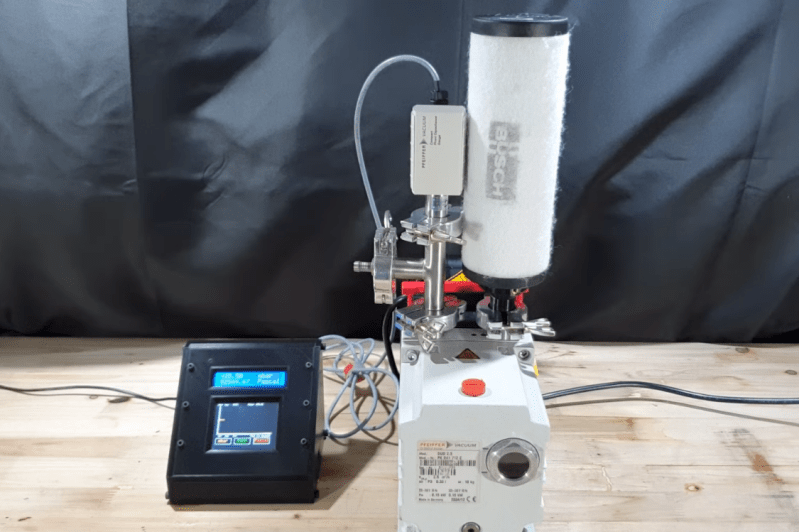
Necessity might be the mother of all invention, but we often find that inventions around here are just as often driven by expensive off-the-shelf parts and a lack of willingness to spend top dollar for them. More often than not, we find people building their own tools or parts as if these high prices are a challenge instead of simply shrugging and ordering them from a supplier. The latest in those accepting the challenge of building their own parts is [Advanced Tinkering] who needed a specialty pressure gauge for a vacuum chamber.
In this specific case, the sensor itself is not too highly priced but the controller for it was the deal-breaker, so with a trusty Arduino in hand a custom gauge was fashioned once the sensor was acquired. This one uses an external analog-to-digital converter to interface with the sensor with 16-bit resolution, along with some circuitry to bring the ~8 V output of the sensor down to the 5 V required by the microcontroller. [Advanced Tinkering] wanted a custom live readout as well, so a 3D printed enclosure was built that includes both an LCD readout of the pressure and a screen with a graph of the pressure over time.
Spotify has released the first episodes of a new audio format it's calling the "bookcast" with help from Dolly Parton and James Patterson. The pair co-wrote a novel titled Run, Rose, Run, which has been blended with an original soundtrack written, recorded and produced by Parton.
The bookcast format brings together audio storytelling with sound elements and original music. Spotify says it delivers "an immersive listening experience."
Run, Rose, Run tells the story of a musician who moves to Nashville to chase her dream of making it in the music industry. Her songs are inspired by a "brutal secret" that threatens to thwart her plans.
You'll be able to listen to the bookcast on Spotify for free. The first two episodes are out now, featuring excerpts from the book set to Parton's music. More episodes will arrive over the next couple of weeks, with the last six landing on March 7th, the same day the novel is released. Parton will release the soundtrack on March 4th, and the firsttwo songs are available now.
The bookcast, which comes from a pair of hugely popular creatives, emerges in the wake of some notable artists pulling their music from Spotify. Neil Young and Joni Mitchell both removed their work from the platform after the former accused the company of allowing Joe Rogan to spread harmful misinformation on his podcast. Brené Brown paused new episodes of her Spotify-exclusive podcasts, while film director Ava DuVernay this month ended her podcast deal with the company before producing any shows for Spotify.
It's possible the bookcast was in the works long before the Rogan controversy blew up, so it doesn't entirely seem to be a case of damage control. However, if Spotify's looking to build up some goodwill, it could go far worse than recruiting Parton and Patterson.
It took NASA and its partners nearly four dozen trips between 1998 and 2010 to haul the roughly 900,000 pounds worth of various modules into orbit that make up the $100 billion International Space Station. But come the end of this decade, more than 30 years after the first ISS component broke atmosphere, the ISS will reach the end of its venerable service life and be decommissioned in favor of a new, privately-operated cadre of orbital research stations.
NASA
The problem NASA faces is what to do with the ISS once it’s been officially shuttered, because it’s not like we can just leave it where it is. Without regular shipments of propellant reactant to keep the station on course, the ISS’ orbit would eventually degrade to the point where it’s forward momentum would be insufficient to overcome the effects of atmospheric drag, subsequently plummeting back to Earth. So, rather than wait for the ISS to de-orbit on its own, or leave it in place for the Russians to use as target practice, NASA will instead cast down the station from upon high like Vader did Palpatine.
NASA is no stranger to getting rid of refuse via atmospheric incineration. The space agency has long relied on it in order to dispose of trash, expended launch vehicles, and derelict satellites. Both America’s Skylab and Russia’s Mir space stations were decommissioned in this manner.
Skylab was America’s first space station, for the whole 24 weeks it was in use. When the final 3-astronaut crew departed in early 1974, the station was boosted one last time to 6.8 miles further out in a 289-mile graveyard orbit. It was expected to remain there until the 1980s when increased solar activity from the waxing 11-year solar cycle would eventually drag it down into a fiery reentry. However, astronomers miscalculated the relative strength of that solar event, which pushed up Skylab’s demise to 1979.
In 1978, NASA toyed with the idea of using its soon-to-be-completed Space Shuttle to help boost Skylab into a higher orbit but abandoned the plan when it became clear that the Shuttle wouldn’t be finished in time, given the accelerated reentry timetable. The agency also rejected a proposal to blow the station up with missiles while still in orbit. The station eventually came down on July 11th, 1979, though it didn’t burn up in the atmosphere as quickly as NASA had predicted. This caused some rather large pieces of debris to overshoot the intended Indian Ocean target South-Southeast of South Africa and instead land in Perth, Australia. Despite NASA’s calculations of a 1 in 152 chance that a piece of the lab could hit someone during its de-orbit, no injuries were reported.
Mir's deorbit went much more smoothly. After 15 years of service it was brought down on March 23rd, 2001, in three stages. First, its orbit was allowed to degrade to an altitude of 140 miles. Then, the Progress M1-5 spacecraft — basically an attachable rocket designed specifically to help deorbit the station — docked with the Mir. It subsequently lit its engine for a little over 22 minutes to precisely put the Mir down over a distant expanse of the Pacific Ocean, east of Fiji.
As for the ISS’ oncoming demise, NASA has a plan — or at least a pretty good idea — for what’s going to happen. "We've done a lot of studies," Kirk Shireman, deputy manager of NASA's space station program, told Space.com in 2011. "We have found an orbit and a change in velocity that we believe is achievable, and it creates a debris footprint that’s all in water in an unpopulated area."
According to NASA standards — specifically NASA-STD-8719.14A, Process for Limiting Orbital Debris — the risk of human casualty on the ground is limited to less than 1 in 10,000 (< 0.0001). However, a 1998 study conducted by the ISS Mission Integration Office discovered that an uncontrolled reentry would carry an unacceptable casualty probability of between .024 to .077 (2 in 100 to 8 in 100). A number of controllable decommissioning alternatives have been discussed over the decades, including boosting the ISS farther into orbit in the event of an unexpected evacuation of the station’s crew.
"We've been working on plans and update the plans periodically," Shireman continued. "We don’t want to ever be in a position where we couldn’t safely deorbit the station. It's been a part of the program from the very beginning."
Beginning about a year before the planned decommissioning date, NASA will allow the ISS to begin degrading from its normal 240-mile high orbit and send up an uncrewed space vehicle (USV) to dock with the station and help propel it back Earthward. The ultimate crew from the ISS will evacuate just before the station hits an altitude of 115 miles, at which point the attached USV will fire its rockets in a series of deorbital burns to set the station into a capture trajectory over the Pacific Ocean.
NASA has not yet settled on which USV will be employed. A 2019 plan approved by NASA’s safety council, ASAP, relied on Roscosmos to outfit and send up another Progress spacecraft to do what it did for the Mir. However, that vehicle might not actually be available when the ISS is set to come down because Russia’s commitment to the ISS program terminates in 2024. In April of last year, Russian state media began making noise that the country would abandon the station entirely by 2025, potentially stripping parts from this station to reuse in its upcoming national station and leaving the ISS without a reliable way to break orbit. The ESA’s Automated Transfer Vehicle or NASA's Orion Multi-Purpose Crew Vehicle, though still in development, are both potential alternatives to the Progress.
“NASA is continuing to work with its international partners to ensure a safe deorbit plan of the station and is considering a number of options," spokeswoman Leah Cheshier told UPI via email in 2021, declining to elaborate on what those options might entail but adding that any deorbiting mission would be "shared by the ISS partnership and is negotiation-sensitive at this time."
The ISS is now entering its third and most productive decade of utilization, including research advancement, commercial value, and global partnership. The first decade of ISS was dedicated to assembly, and the second was devoted to research and technology development and learning how to conduct these activities most effectively in space. The third decade is one in which NASA aims to verify exploration and human research technologies to support deep space exploration, continue to return medical and environmental benefits to humanity, continue to demonstrate U.S. leadership in LEO through international partnerships, and lay the groundwork for a commercial future in LEO.
More than half of the experiments performed aboard the ISS nowadays are for non-NASA users, according to the report — including nearly two dozen commercial facilities — “hundreds of experiments from other government agencies, academia, and commercial users to return benefits to people and industry on the ground.” This influx of orbital commercial activity is expected — and being actively encouraged — to further increase over the next few years until humanity can collectively realize Jeff Bezos’ dream of building a low Earth orbit mixed-use business park.
After unveiling its beefy H-series 12th-gen laptop chips during CES, Intel is finally ready to shed more light on its new U and P-series CPUs for ultraportables. And, much like AMD's upcoming Ryzen 6000 chips, it looks like Intel is aiming to deliver a huge performance boost, while consuming less power than last year's hardware.
The big takeaway? It's going to be an interesting year for ultraportable PCs, which could offer enough power to play a few games and give Apple's custom processors some serious competition.
With the Core i7-1280P, Intel's fastest 28-watt P-series CPU, the company claims you'll see up to 70 percent faster multithreaded performance than last year's i7-1195G7. Notably, Intel says it also offers better multithreaded performance than the Core i9-11980HK, one of its fastest processors from 2021, while consuming around half as much power. And of course, that also means it beats out the Ryzen 7 5800U from last year (Intel didn't have access to AMD's new processors for benchmarking, naturally).
Like the rest of its 12th-gen lineup, Intel's U and P-series chips are a new hybrid design that combines Performance cores (P-cores) and Efficient cores (E-cores) on a single die. The i7-1280P is a 14-core chip (6 P-cores along with 8 E-cores) that maxes out at 4.8GHz on its P-cores. Its 28-watt base power consumption puts it in thin and light territory, but it can scale up to 64-watts to reach Max Turbo speeds. (That's for when you're plugged in and not worrying about energy consumption as much.)
Intel's 12th-gen U-series processors, which are targeted at the slimmest ultraportables, are spearheaded by the Core i7-1265U. That's a 10-core chip (2P and 8E) that also maxes out at 4.8GHz. Its 15-watt base power consumption is on par with previous U-series chips, but it can go up to 55-watts to reach its Max Turbo speed.
While Intel's hybrid design is clearly a leap forward for the P-series CPUs — the i7-1280P is around 20 percent faster than last year's chips in the Crossmark benchmark — we're still waiting to see how the U-series chips will compare. It's surprising that Intel still isn't saying much about U-series performance, but we'd wager there would be a significant speed bump from the architecture changes alone.
The 12th-gen laptop CPUs will also feature Intel's Xe graphics, though it doesn't seem like much has changed since last year. The P and U-series chips will still offer up to 96EUs (execution units). According to Intel's benchmarks, the i7-1280P hits 82fps in Grand Theft Auto V and 53fps in Chorus while playing with medium graphics settings in 1080p. With high quality settings, it sees up to 115fps in League of Legends and 81 fps in Rocket League—but that's not a huge surprise for less demanding titles.
While we're still waiting to get our hands on new systems with Intel and AMD's latest ultraportable hardware, the landscape feels far more exciting than last year, when Intel's 11th-gen CPUs were a pretty ho-hum upgrade. Perhaps 2022 will finally be the year ultraportables can finally solve most of our gaming needs.
Microsoft is following up on a promise to improve Twitch livestreaming on Xbox consoles. As of today, Xbox Series X/S and Xbox One owners can stream on Twitch directly from the system Guide. Once you've linked your Twitch account, you just have to choose a "go live now" option to start broadcasting. You also have access to some streamer-friendly options, including the bitrate, resolution, title and separate audio levels for your game and microphone.
The integration is smart enough to automatically pause your feed and change show titles if you switch games, and you can decide whether or not you want viewers to hear your party chat. Your Xbox friends can also choose to receive alerts when you go live on Twitch.
This kind of tie-in wasn't surprising. Microsoft shut down Mixer nearly two years ago, leaving Xbox users without a truly integrated livestreaming option. The Twitch app filled that gap, but required significantly more steps to go live. This makes it more viable to stream on an Xbox, and might help Microsoft compete against Sony's relatively strong Twitch support on the PS4 and PS5.
LinkedIn is delving deeper into the podcast world. It's debuting a podcast network that features in-house shows from the LinkedIn News team as well as programs from industry figures.
The shows, unsurprisingly, are geared toward a professional audience. They focus on areas including understanding tech, managing mental health and explaining the hiring process. Reid Hoffman, the co-founder and executive chairman of LinkedIn, will co-host a podcast about personal entrepreneurship called The Start-Up of You that will premiere this spring.
The company says the LinkedIn Podcast Network is a pilot and builds on the success of Hello Monday, a podcast produced by LinkedIn News in which host Jessi Hempel delves into the evolving nature of work. The shows are ad-supported and the initial sponsor is Verizon, Engadget's former parent company.
The podcast network ties into LinkedIn's other products — such as newsletters, live events, videos and posts — with the idea that hosts and audiences will be able to keep conversations going outside of the shows. Listeners will be able to check out the podcasts on LinkedIn directly if they follow the hosts and subscribe to their newsletters. The shows will also be available on Apple Podcasts, Spotify and other podcast platforms.
You might be waiting a while for the next big Call of Duty game after this year. Bloomberg sources claim Activision is delaying the 2023 Call of Duty release after Vanguard "failed to meet" sales targets. Executives reportedly fear they're releasing games in the franchise too quickly, and that Black Ops Cold War may have eaten some demand for the newer title. The free-to-play Warzone might also have affected sales of the paid releases.
Activision is said to be working on projects that would cover the absence, including a new free-to-play online game as well as a slew of extra content for the flagship Call of Duty game arriving in late 2022. Treyarch is believed to be working on the delayed game and would help with the free-to-play offering. The delay isn't connected to Microsoft's purchase of Activision, according to the tipsters. That deal isn't expected to close until 2023.
The publisher didn't confirm or deny the delay in a statement to Bloomberg. Instead, the spokesman promised an "exciting slate" of paid and free Call of Duty "experiences" for 2022, 2023 and the years ahead. Activision would share more when the "time is right," according to the representative. The company had already revealed that this year's release is an Infinity Ward-developed sequel to the 2019 Modern Warfare reboot.
The rumored delay comes as Ubisoft is said to be converting an Assassin's Creed Valhalla expansion into DLC as it looks to fill a void between Valhalla itself and the online-oriented Infinity. While the circumstances behind the shifting schedules are different, there's a common element: both major publishers are struggling to maintain the annual release schedules for their signature franchises. There's no guarantee the companies will slow their releases from this day forward, but they might not be quite as predictable as in years past.