YouTube is making it easier to find the best moments in a video. The service is updating its desktop and mobile video players with a previously experimental graph that shows the most popular (that is, replayed) segments. You might not have to use guesswork or chapter markers to jump past the fluff and get to the content you're really there to watch.
The company has also teased plans to test an "easier" method of seeking the exact point in a video that you want to play. Rather than simply displaying a thumbnail for a given point, the player will show a visual timeline (below) that can indicate a scene change. The test will come "soon" to Premium subscribers through YouTube's "new" section.
Google
The additions join an existing wave of improvements, including an enhanced full-screen mode, auto-generated chapters and single-video looping. These latest upgrades are more targeted, however— YouTube is clearly aware that you might not want to sit through a whole video just to find the snippet you're really looking for.
Meta’s accounting of the most popular content on Facebook continues to be a confusing mess to untangle. The company released the latest version of its “widely viewed content report,” which details some of the most-viewed Facebook posts in the United States.
And, once again, the latest report raises questions about the company’s ability to limit the spread of what Meta euphemistically refers to as “lower-quality posts.” Between January and March of this year, six of the top 20 most popular links on Facebook were from a spammy website that has since been banned by the company for inauthentic behavior.
“In this report, there were pieces of content that have since been removed from Facebook for violating our policies of Inauthentic Behavior,” the company wrote in a blog post. “The removed links were all from the same domain, and links to that domain are no longer allowed on Facebook.”
The links all came from a Vietnam-based “news” site called Naye News. Unfortunately, Facebook didn’t share details about the actual URLs that went viral and were later removed, so there’s not much we can glean about the actual content. What we do know is that Naye News, which as Bloomberg reporter Davey Alba points out has never before appeared in a widely viewed content report, was able to reach a vast number of Facebook users before the company banned it. Links to Naye News appeared six times on the list of the top 20 URLs, including the two top spots. Together, these links got more than 112 million views, according to the report.
This website wasn’t the only source of questionable content that made it into the top most-viewed list. The fourth-most popular link on the list was a YouTube clip from a town hall meeting with Wisconsin Senator Ron Johnson, featuring a nurse making provablytly false claims about COVID-19 treatments.
During a call with reporters, head of Facebook Integrity Anna Stepanov, said that links to the YouTube video were demoted in News Feed after it was debunked by fact checkers. The company also added warning labels to discourage it from being reshared. “Without these features, this link would likely have received even more reach,” Stepanov said.
But even with those measures, the link was still viewed more than 22.1 million times on Facebook. That’s more than the number of views on the original YouTube video, which currently has about 6.5 million views.
Meanwhile, another URL on the report, which got 12.3 million views, is a link to a website called “heaveemotions.com,” that now redirects to a website that appears to be meant to trick visitors into installing malware. On Facebook though, the link originally rendered a preview with meme-style text that reads: “They told me the virus is everywhere. I told them so is God. Can I get an Amen? I Bet you won’t repost.”
Screenshot/ Facebook
It’s not the first time overtly spammy content has appeared in one of these reports. In the last version of this report, the top Facebook Page was one later removed by the company for breaking its rules. Reporter Ryan Broderick later identified the page’s origins as a Sri Lankan content farm.
The reports, which Meta began releasing in part to rebut data suggesting far-right personalities consistently dominate the platform, are one of the only windows the company offers into what’s popular on Facebook. That’s been a key question for researchers trying to study the platform and how information, and misinformation, spreads across it. But researchers have also raised questions about how Meta was compiling these reports, which in the past have surfaced bizarre results.
Notably, Meta now says it’s changing the way it evaluates what content is the most “widely viewed” on its platform. Previous reports identifying the top links on Facebook were based on any public post that contained a URL, even if the was just appended to the body of a text post. This meant that popular Pages could effectively spam their followers with random links — like to a website representing former Green Bay Packers football players — embedded in a text or photo post.
Researchers had widely criticized this approach as a widely distributed text post with a link at the end is a lot different than a link post in which the linked content is fully rendered as a preview. Now, Meta is reversing course. “Moving forward, links will need to render a preview in order to be counted as a view, as that more accurately represents what people are seeing.”
Even so, these reports are still only a limited look at what’s most popular on Facebook. The company says the list of the top 20 most-viewed links — the list that included Naye News and COVID-19 misinformation — “collectively accounted for 0.03% of all Feed content views in the US during Q1 2022.” But as always with Facebook, its sheer size means that even a fraction of a percent can equate to millions of views. At the very least, these reports show that it’s still relatively easy to game Facebook’s algorithms and spread “low quality” content.
If we're honest, we're kind of obsessed with food here at Engadget. Senior news editor Billy Steele is a backyard pitmaster and has the finsta to prove it. Editor-in-chief Dana Wollman treats her NYT Cooking recipe box the way gamers treat their backlog. Commerce writer Nicole Lee has channeled her passions into Instant Pot, sous vide and rice cooker experimentations. And my transition into an Italian grandmother is nearly complete with my preference for laboriously homemade pasta sauce over the stuff in store-bought jars. We turn to foodie YouTube and TikTok late at night; we trade recipes in Slack; and we often use this stellar Guy Fieri emoji when things are, as the kids say, chef's kiss.
We live for food when we're not living for tech, so many of us jumped at the opportunity to cook for work. Enter Cooking Week, our first kitchen-focused series, where we explore the intersection of cooking and tech, while also testing out some of the most popular — and wackiest — kitchen gadgets available right now. We dove into the worlds of grills, immersion blenders and, yes, air fryers, and tried out some high-tech appliances that were intimidating at first, but that we eventually mastered.
Long-time Engadget readers will know that we've written about kitchen gadgets before. We've been able to squeeze in mentions of electric kettles and pizza ovens over the years, but we see Cooking Week as our first official love letter to food on Engadget. We hope that you enjoy reading these stories as much as we enjoyed writing them (or, even better, as much as we enjoyed eating the spoils of our testing).
Check out all of the Cooking Week stories right here.
Which of these has greenlit a documentary about HQ Trivia?
Netflix
CNN
Quibi
If you read the headline and correctly chose CNN, congratulations! You've won some internet points, I guess.
An untitled documentary about the trivia app that everyone seemed to be playing a few years ago is scheduled for a 2023 release. It's based on a podcast by The Ringer called Boom/Bust: The Rise and Fall of HQ Trivia. As Deadlinereports, CNN has lined up a director, Salima Koroma (Dreamland: The Burning of Black Wall Street).
HQ Trivia, which was built by the creators of Vine, debuted in August 2017 and it initially ran two live trivia games per day. The concept was pretty simple. Answer several questions correctly in a row and you'd split the prize pot. Along with the chance to win cash through a mobile app, charismatic main host Scott Rogowsky helped turn HQ Trivia into a phenomenon. At one point, more than 2.3 million people were playing the game simultaneously.
HQ Trivia is still around, though it now runs just one game per week. The latest edition had a commendable 21,000 players. However, at $1,500, the prize was a far cry from the $300,000 the app offered at one point when Dwayne "The Rock" Johnson was a guest host.
It also emerged during Warner Bros. Discovery's upfront presentation that Eva Longoria: Searching for Mexico is moving to CNN. The docuseries was initially a CNN+ exclusive, but the high-profile streaming service was killed less than a month after its debut.
The Biden administration may be struggling in its efforts to fight security-related misinformation. The Washington Postsources claim the Department of Homeland Security has "paused" a Disinformation Governance Board just three weeks after its April 27th announcement. Officials reportedly decided to shut down the board May 16th, but that decision appears to be on hold after a last-minute effort to retain board leader Nina Jankowicz. She resigned from the board and the DHS today (May 18th).
While the leakers didn't directly explain why the Disinformation Governance Board was frozen, they claim the White House neither had clear messaging nor a defense against misinformation and threats levelled against Jankowicz. The board was meant to examine approaches for fighting viral lies and had no power over content, but far-right influencers and outlets misrepresented it as a censorship tool and villainized Jankowicz. The campaigns led to harassment and threats against the board leader — in other words, the board was the victim of the very sort of attack it was supposed to prevent.
We've asked the DHS for comment. In a statement to the Post, the department said the board's role had been "grossly mischaracterized" and that Jankowicz had been targeted by "unjustified and vile personal attacks and threats." Previously, Homeland Security Secretary Alejandro Mayorkas and White House press secretary Jen Psaki have respectively tried to clarify the board's objectives and debunk falsehoods with little effect.
There is a chance the board could survive depending on a Homeland Security Advisory Council review. If the reports are true, though, the US government may have to rethink its anti-disinformation efforts if they're going to survive both criticism and internal scrutiny.
TikTok is rolling out a feature that will make it easier for users to give appropriate credit to a creator who inspired one of their videos. A new button that's rolling out over the next few weeks will allow you to tag, mention and credit a video in the description.
Users have long been able to tag each other, but this is a bigger push to encourage them to give proper credit to the original work. When you riff on someone else's dance move, joke, meme or audio, adding attribution for their TikTok will be more straightforward.
After you create or edit a TikTok, you'll see a new "video" icon on the posting page. Tap that, and you'll be able to choose a video that you've favorited, liked or posted, or that shares the same sound as your TikTok. Once you pick a video that inspired you, TikTok will add it as a mention in the caption. The app will explain the crediting feature after you tap the video icon for the first time. Users will also be notified when one of their videos is tagged in this way.
TikTok
"Today, we're introducing new tools to better enable creator credit and equitable attribution for our creator community and content originators," Kudzi Chikumbu, TikTok's creator community director, wrote in a blog post. "These features are an important step in our ongoing commitment to investing in resources and product experiences that support a culture of credit, which is central to ensuring TikTok remains a home for creative expression."
Attribution (or lack thereof) is a thorny issue on TikTok and other platforms. Last June, many Black creators on TikTok went on strike. They stopped sharing dance challenges and instead called out the lack of credit they were receiving in an attempt to gain more recognition.
Rick Lewis, for instance, appeared in one TikTok as though they were about to share a dance they created for a Megan Thee Stallion song, before flipping the bird at the camera and switching to a caption that read "Sike. This app would be nothing without Black people." Their TikTok, inevitably, was co-opted by another creator, who racked up nearly a million views (twice as many as Lewis' original) with their spin on it.
The move follows the rollout of the YouTube Shorts remix feature, which automatically includes attribution for the original video's creator. TikTok's approach, however, will require users to manually add credit for the original work.
Meanwhile, Chikumbu says TikTok is working to lift up the creators of trends through initiatives like its Originators series. The Creator Portal also stresses the importance of including proper attribution for trend originators, including tips on how to find them.
It hasn't been a great spring for Sony in terms of new product leaks. The company's new flagship headphones, the WH-1000XM5, broke cover early, as did its latest earbuds. Today, the company officially announced the LinkBuds S: a set of $200 true wireless earbuds with active noise cancellation (ANC) and a host of handy features. Sony says they're designed for a "never off wearing experience," with transparency mode allowing you to tune into your surroundings as needed.
Joining the open wear LinkBuds that debuted earlier this year, the LinkBuds S have a more "traditional" closed design. The shape is similar to Sony's other recent earbuds, the flagship WF-1000XM4 and the $100 WF-C500. The LinkBuds S are much smaller though, making them more comfortable to wear for longer periods of time, which also serves Sony's mission of all-day use. In fact, the company claims the LinkBuds S are "the world's smallest and lightest, noise-canceling, hi-res" true wireless earbuds. And the IPX4 rating means they can withstand workouts too.
Inside, 5mm drivers deliver "powerful bass and stunningly clear vocals," according to Sony. The company's Integrated Processor V1, which is also on the WH-1000XM5 headphones, works to maintain sound quality, minimize distortion and bolster noise cancellation. The LinkBuds S also support high-resolution listening via Sony's LDAC codec and DSEE Extreme upscaling. The latter technology recovers finer details that are typically lost to compression of digital audio content. A low-latency mode is on the way for gaming and Sony is working with Niantic to bring spatial audio and head tracking to the AR mobile game Ingress.
Another key difference from the first set of LinkBuds is the addition of ANC. On the LinkBuds S, there's enough noise-blocking ability to reduce background clamor, but Sony is clear the tech isn't as robust as the WF-1000XM4. While this new model doesn't let the outside world in by design, it's equipped with transparency mode to get that job done. What's more, the company's Adaptive Sound Control can be configured to change noise canceling and ambient sound settings based on your activity or location. Plus, Sony's handy Speak-to-Chat feature is available here, which automatically senses your voice, pauses the audio and activates ambient sound mode when you begin to talk.
Sony
The main feature Sony is hyping for the LinkBuds S is called Auto Play. True to the rumors, this tool automatically plays or resumes audio based on your activity when you put the earbuds in or complete a call. If you're on a walk, for example, you can have a specific playlist selected for that behavior. Auto Play is limited right now in two ways. First, it's only available in the Sony Headphones Connect app on Android right now. The company plans to bring it to iOS in early June. Second, it only works with Spotify and soundscape app Endel.
For calls, Sony says its Precise Voice Pickup Technology "optimally controls the microphones on both earbuds." Combined with a mesh cover for the mics, the company explains that you can expect clarity walking down a busy street or on a windy day. These claims vary widely from product to product, so we'll be sure to put this through its paces during our review. Other convenience features include compatibility with voice assistants, a full suite of customizable touch controls and support for both Google Fast Pair and Windows Swift Pair.
In terms of battery life, Sony says you can expect up to six hours of use with active noise cancellation enabled. There's another 14 hours in the charging case too, but the company didn't specify any non-ANC listening times. The case doesn't support wireless charging, but it does offer a quick-charge option. Just five minutes will give you an hour of use.
The LinkBuds S are up for pre-order starting today with general availability starting May 20th. You'll have black and white color options to choose from at most retailers, but Best Buy will carry an exclusive beige (Ecru) version. This $200 model will sit in the middle of Sony's true wireless lineup, with the flagship WF-1000XM4 at the top and the affordable WF-C500 below. The open design LinkBuds also occupy the mid-range for $20 cheaper, and Sony plans to deliver the Auto Play functionality to that model via firmware update.
Sous vide cooking has been the province of professional chefs for decades, and for good reason: A temperature-controlled water bath ensures perfectly cooked food. Instead of worrying about whether a steak is medium rare or whether that chicken breast will be dry, simply dial in the desired temperature, dunk in your vacuum-sealed food ("sous vide" is French for "under vacuum"), wait a while and your food will be done to perfection, with little to no guesswork required.
If you haven’t tried this method yet, it’s not as complicated as you might think. Wand-like immersion circulators have been on the market for several years now, making sous vide cooking affordable and accessible to home chefs. Several Instant Pot models even have a sous vide mode that holds the water at a set temperature, though it’s not quite as accurate as dedicated machines. If you’re curious about giving sous vide a go, we’ll walk you through the process of choosing the right machine for you and share some of the tips and tricks we’ve learned through our own experiments.
How to pick a smart sous vide machine
Almost all of the immersion circulators on the market work the same way, so you really can't go wrong whichever you choose. That said, there are a few criteria to keep in mind when comparison shopping. For one, you'll want it to keep an accurate temperature and to maintain that temperature for an extended period of time, especially for foods that take over a day to cook. (This isn't uncommon, especially for tough cuts of meat.) It's better if it's powerful enough to heat up water quickly, though you could always help it along by using hot tap water to start.
Engadget picks
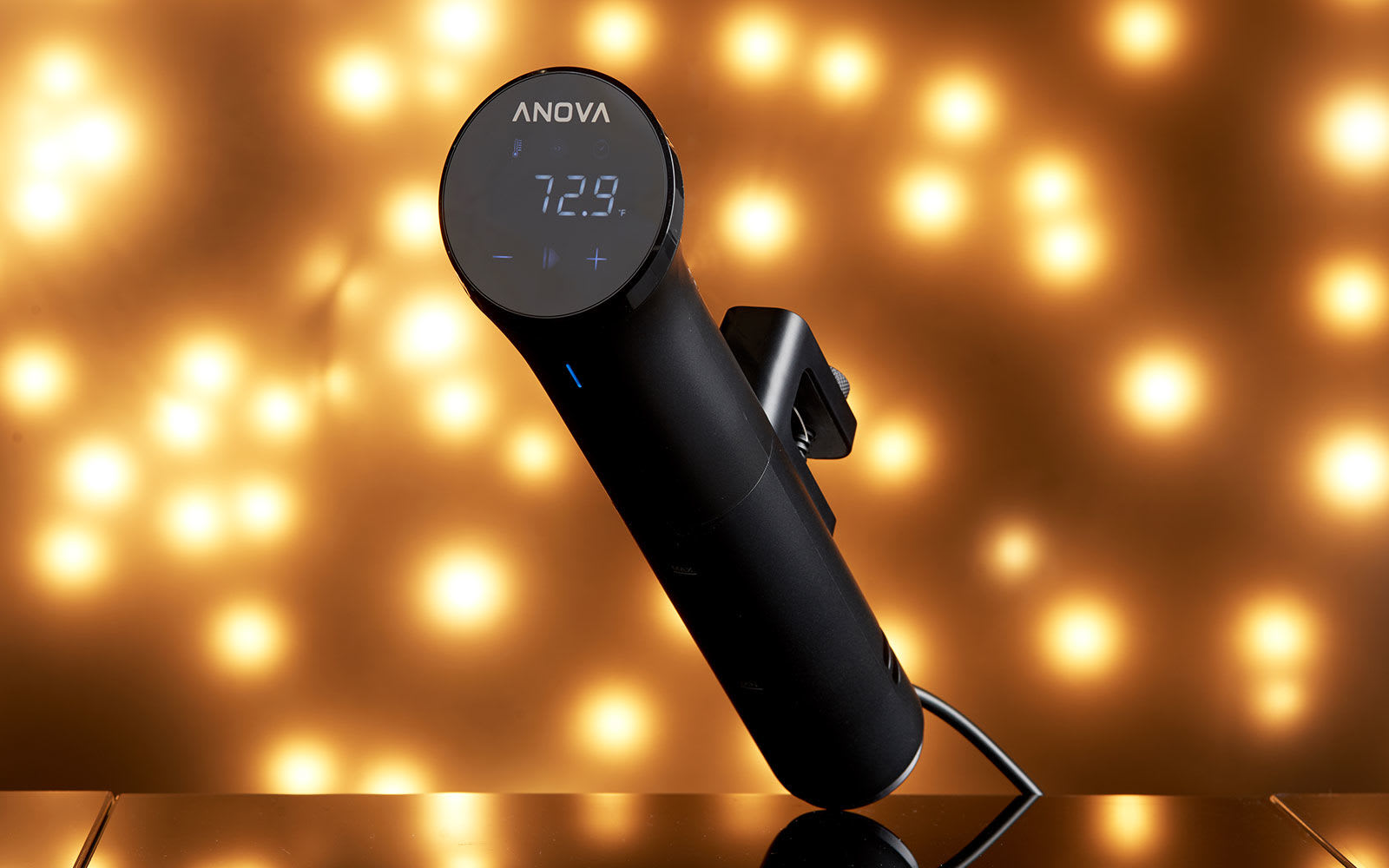
Several Engadget staffers tend to prefer the sous vide devices from Anova, as the company has a strong track record for precision and the interface is intuitive. Anova offers several different models at varying power levels (and price points). The lower-end Nano, for example, won't heat up water as quickly and doesn't have an adjustable clamp, but it's only $129 and will likely suit most home cooks. If you're a little more ambitious or see yourself cooking a lot of things via sous vide , upgrading to the higher-end Precision Cooker or Precision Cooker Pro might make sense.
We’d recommend the Anova Precision Cooker Nano for most people on account of its affordable price, compact size and intuitive controls. The companion app is helpful as well, as it comes with hundreds of recipes that will get you started on your sous vide journey. The Breville Joule is our runner-up because, while it lacks onboard controls, it’s a little more compact than the Anova, while the companion app has a “visual doneness” guide that lets you know what the food should look like when it’s cooked.
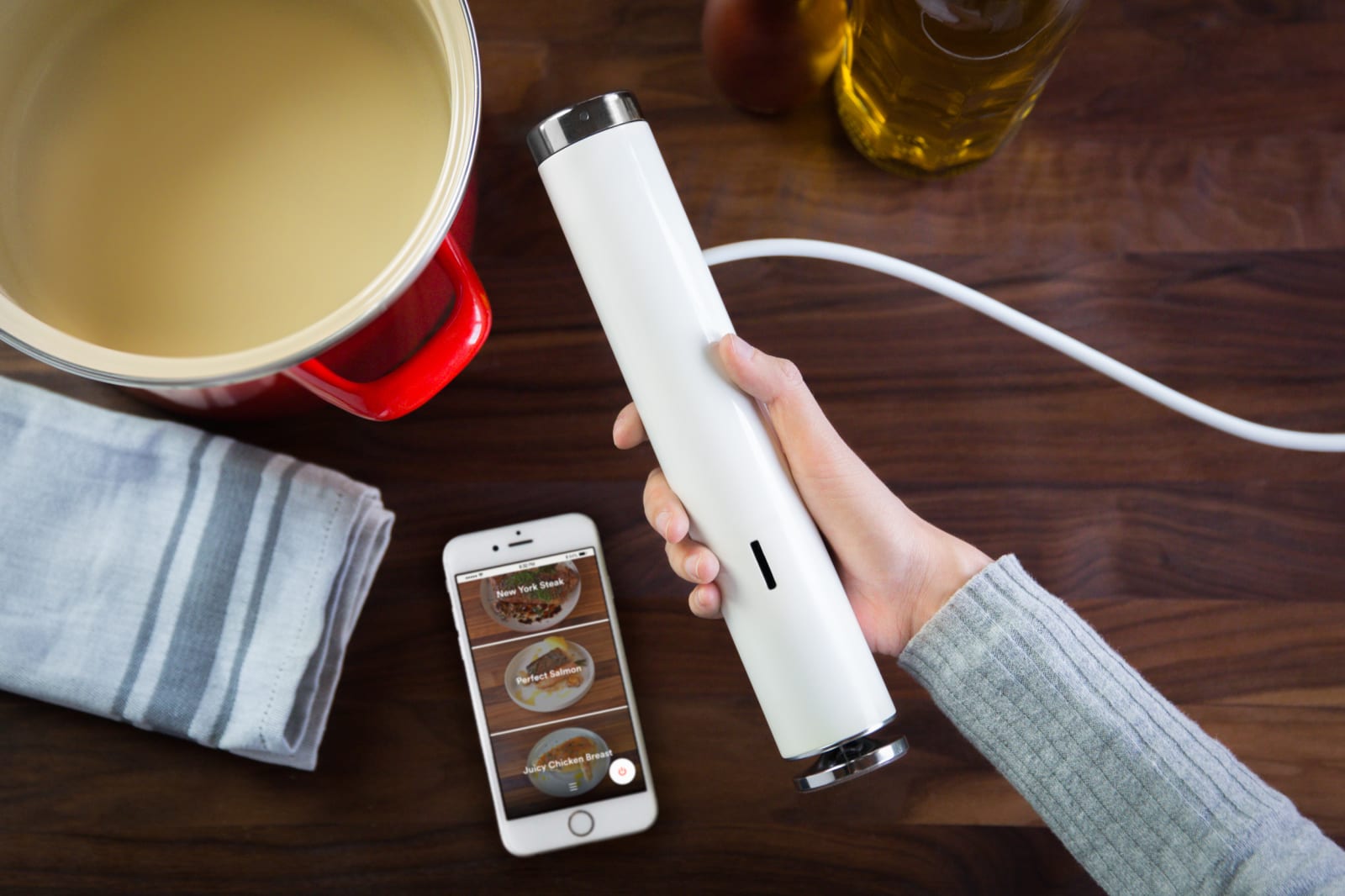
Another popular choice is the Breville Joule (formerly known as the Chefsteps Joule, until Breville acquired the brand), which is a personal favorite of mine due to its small size. It's a little more powerful than the aforementioned Nano and can heat up water a few minutes faster. I also like that it has a magnetic base, making it easier to attach to certain pots. The one downside is that it lacks onboard controls; the only way to use it is via the companion app. I personally don't find this to be a problem, but if you simply need to be able to see the temperature at a glance and dial it up or down with ease, this might not be for you.
It's also worth mentioning the Monoprice Strata, which is the cheapest of the lot at only $70. There's no WiFi or Bluetooth connectivity here, but it gets the job done all the same.
What else to consider
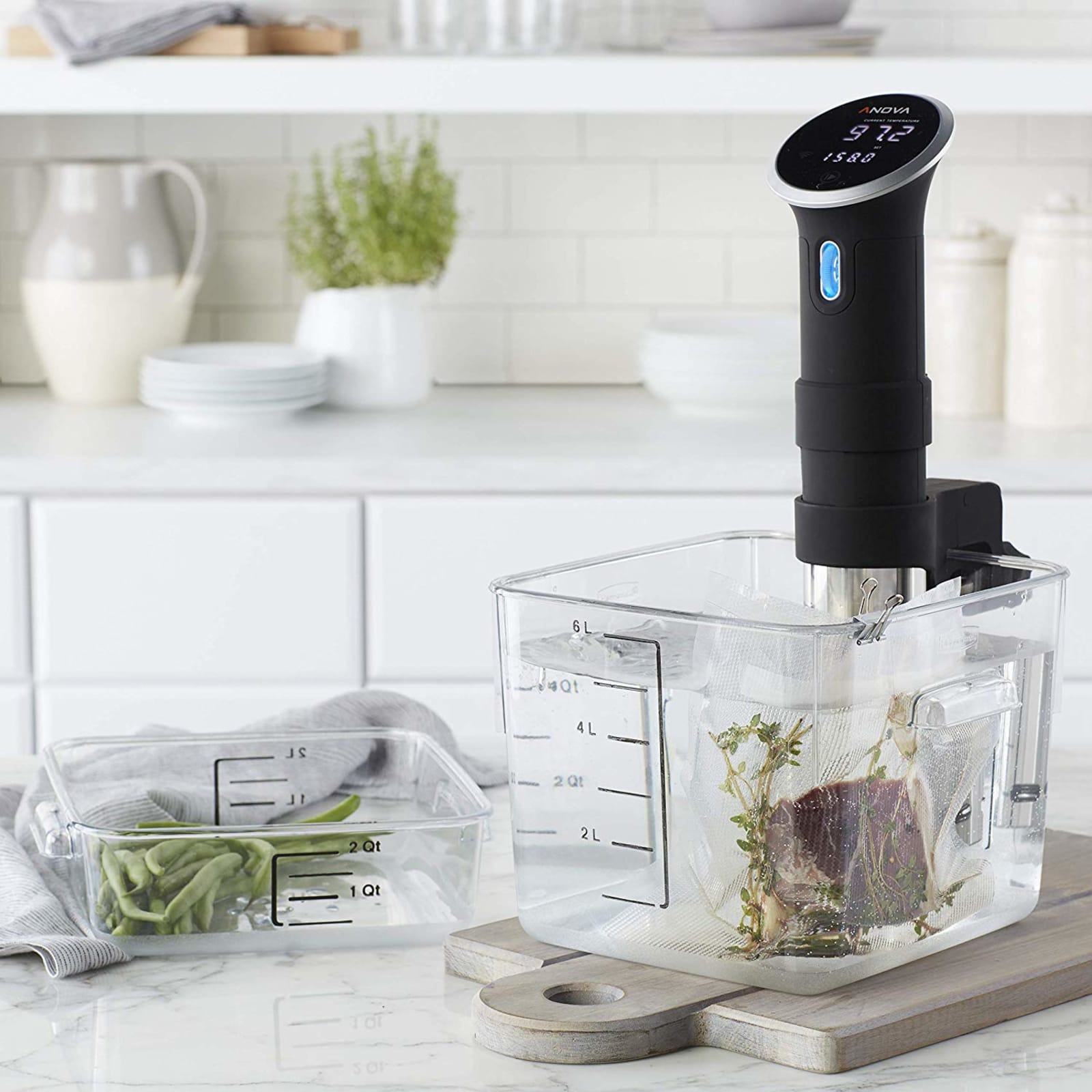
At a minimum, the other items you need to cook sous vide are a large metal pot (big enough to fill with water) and zipper-lock freezer bags to put the food in. Alternatively, you can use reusable silicone bags such as these from Stasher. Rather than using a vacuum sealer to get rid of air, you would use the water displacement method: Immerse the bagged food in the water while partially unsealed, and water pressure will push the air through the opening. Once everything is mostly underwater, you can seal the bag and it'll stay submerged.
If it still floats, you can stick one or two spoons in the bag, and that will hopefully weigh things down. (J. Kenji Lopez-Alt from Serious Eats also suggests using a large binder clip attached to the bottom of the bag along with a heavy spoon.) If you're concerned about water getting in the bag, you can attach the bag tops to the pot with binder clips, thus keeping the bag upright.
If you're really serious about sous vide, you might want to invest in some specialty equipment. Instead of pots, for example, you could opt for large restaurant-grade plastic containers by Cambro or Rubbermaid. Not only is plastic a better insulator than metal, but there's generally more space for more food, which is handy when you're cooking for a crowd.
Whether you use a pot or a plastic container, it's best to cover the vessel with plastic wrap when cooking for long periods, to keep evaporation to a minimum. Some companies, like Chefsteps, offer custom silicone pot lids that are made specially to accommodate their sous vide cookers. Alternatively, Lopez-Alt offers a much cheaper and more ingenious solution: cover your water in ping pong balls. They'll slow down evaporation.
Additionally, while zipper-lock bags work well for most tasks, it's still not a bad idea to get a vacuum sealer along with thicker plastic bags designed specifically for sous vide. For one, this lets you sous vide vegetables or braised meats, which typically require a higher temperature. (Zipper-lock bag seams might fail when it's that hot.) This also lets you freeze a bunch of food, vacuum seal them and sous vide packets straight from the freezer, which is convenient for batch cooking.
You likely already have this at your disposal, but another handy tool is a good skillet to sear your meat. That sous vide device might be able to cook your steak to medium rare, but it won't be able to brown it. A cast iron skillet, on the other hand, will. You could also consider a torch like the Bernzomatic TS8000, and we've seen others use a Searzall — but a cast iron skillet is far more affordable than either option. Of course, if you have a grill, you can use that too.
There are other miscellaneous items that could prove useful. Lopez-Alt likes having a pot lid organizer immersed in the container to help separate several submerged bags. If you want to make custard, yogurt or breakfast cups with your sous vide cooker, you should get yourself some mason jars too.
One more indispensable item worth considering: a trivet to rest your water vessel on so you don't destroy your countertop.
Sous vide recipe resources
Since affordable sous vide cookers have been in the market for a few years now, there’s no shortage of recipes and guidelines online to help you figure out what to do with your newfangled kitchen gadget. The links below are some of our favorites, though bear in mind that a lot of this is based on personal taste. Your mileage may vary.
It only makes sense that the maker of one of the most popular sous vide machines also has a deep library of sous vide recipes. If you're ever at a loss as to what to make via sous vide, simply peek at this website, where you can search for recipes from professionals and amateurs alike.
We've mentioned it several times here already in this guide, but Serious Eats truly is a remarkably useful resource for all things sous vide. Its guide to sous vide steak is a favorite among Engadget staffers, as is its take on slow-cooked sous-vide style eggs, which results in some of the best eggs I've ever had.
Years before making the Joule, Chefsteps made a name for itself as a cooking school with a heavy emphasis on food science, tech and molecular gastronomy. That's probably why the sous vide recipes from Chefsteps are some of the more creative ones we've seen. One recipe, for example, teaches you how to make that perfect chicken breast along with the perfect accompaniment for said chicken breast — perhaps a crunchy apple fennel salad and a buttery carrot puree. Other favorite recipes include wonderfully tender salmon filets, juicy pork chops and Chefsteps' own interpretation of the "sous vide egg bites" you sometimes find in certain Starbucks shops.
This is actually a cookbook from the people behind the Nomiku WiFi sous vide machine (which has since been discontinued), but the recipes in it will work with any sous vide device. Not only does it have beautiful photographs, but it also offers fantastic recipes like jerk chicken wings, duck confit and chocolate pots du creme.
Aside from immersion circulators like the ones mentioned here, you could also opt for multi-purpose appliances that offer sous vide-like functions. Several Instant Pots, for example, offer such a feature. They include the Instant Pot Pro, Duo Plus, Pro Plus, Duo Crisp and Max. Unfortunately, however, they do not circulate the water like the aforementioned immersion circulators, and the temperatures aren’t quite as precise (which is a definite downside if you need something cooked to a specific temperature). But if you don’t really care about that, or you just want to dabble occasionally in sous vide, this might be a viable option.
If you’re dead set on a multi-tasking appliance and you have the money to spend, consider the Anova Precision Oven. Thanks to its use of steam, you can indeed use it to cook foods via sous vide but without the need for plastic bags. It also uses a fan to circulate the moist air around the food and a probe thermometer helps keep foods at a precise temperature. And, of course, the Precision Oven can be used as a regular oven as well, and is great for baking breads and bagels. It is, however, quite expensive at $600 and takes up a lot of counter space.
Images: Will Lipman for Engadget (Anova / holiday light background)
Russia is supposedly using its invasion of Ukraine to try new technology on the battlefield. As Reutersreports, the Russian government says it's using a new wave of laser weapons to counter the Western technology aiding Ukraine's self-defense. Deputy prime minister Yury Borisov claimed Russia was using prototypes for a drone-destroying laser weapon, Zadira, that can burn up drones. One test incinerated a drone 3.1 miles away within five seconds, according to the official.
A more established system, Peresvet, reportedly blinds satellites up to 932 miles above Earth. This was already "widely deployed," Borisov claimed. The deputy leader maintained that new lasers using wide electromagnetic bands could eventually replace traditional weapons.
This isn't the first reported use of cutting-edge tech in the war against Ukraine. CNNnoted that Russia has fired multiple Kinzhal hypersonic missiles at Ukrainian targets. This variant of the Iskander short-range ballistic missile can be launched from a fighter jet (the MiG-31K). Russia has maintained that Kinzhal is virtually impossible to stop due to its very high speed, but US and UK officials have dismissed its effectiveness and argued that it's really just an air-launched variant of a conventional weapon.
As with those hypersonic weapons, it's difficult to know how well the lasers work in practice. Russia has routinely made false claims about its overall capabilities and the war in Ukraine, where it has struggled to gain ground despite a large military. However, these uses may be less about turning the war around and more about symbolism — Russia wants to boast about its technological prowess and discourage further material support for Ukraine.
It was last August that Saints Row developer Volition unveiled its vision for a more grounded reboot of the open-world series. The new title was intended as a swerve away from the series’ trademark preposterousness and juvenalia. Now, with the game set to debut on August 23rd, the team would like to clarify that just because it’s grounded, doesn’t mean it’s not going to be fun. Saints Row hasn’t suddenly become a po-faced exploration of organized crime, and it remains just as cartoonish as you may expect, it’s just a bit more grounded in its cartoonishness.
Last year, Chief Creative Officer Jim Boone and Lead Mission Designer Jeremy Bernstein said that the Saints Row series had burned out its narrative runway. After all, when your character has conquered the Earth, descended into Hell and fought a hair-rock opera duel with the Devil, street-level crime is going to feel like a big comedown. “I’ve been wanting to clarify that!” said Creative Director Brian Traficante, “I believe you can continue that runway [...] but we didn’t want to.”
“In terms of going back to the grounded tone, it took some time,” said Traficante, as the team sought to analyze and define “what is Saints Row?” That series-defining formula seems to focus on meshing fun gameplay, silly jokes, cartoonish violence and a hefty dose of reference gags. “At times, it’s a gag for a gag’s sake, but there’s a consciousness of making sure that it’s exactly what we want to do, and it’s the right time to do it,” he said. There was a focus on ensuring that there’s plenty of light moments to balance out the times in the story when things go dark.
Writer Jennifer Campbell said that the team abides by “the rule of making sure that you’re punching up, not punching down.” Campbell added that “we’re exploring a more diverse group of characters so it gives us a lot more avenues to explore, anyway.” Traficante said that the developers created “internal mechanisms” to help ensure that a broad group of people could weigh in on some of the edgier gags in the game. He added that the team wanted to craft jokes that would enable “everyone [to] be a part of the joke.”
Saints Row’s use of parody reached a fairly extreme level during the fourth game, where it ran a series of relationship-simulation sequences in the vein of Mass Effect. (Except, of course, the camera wasn’t cutting away as quickly when two characters decided to spend some alone time together.) These parodies are “definitely in the recipe,” said Traficante, but that they aren’t “front and center” in the new title, so players will need to hunt out the nods.
Volition
And players will spend a lot of time being encouraged to hunt through the world of Santo Ileso in pursuit of storytelling, gameplay and entertainment. The team has laced the city with randomly spawning discoverables, like a security fan loaded with cash, for you to find as you walk around. Traficante said that it takes testers around a week, playing full time, to work their way through the bulk of the title, which is vast and ever-growing.
As well as the breadth of the city, Volition also wanted to emphasize the depth of features like character customization. Users can expect a level of tweaking that looks to be beyond the level offered in, say, Cyberpunk 2077. You’ll be able to customize your appearance, voice and clothing, as well as the looks of your cars and weapons. And none of these features will be pay-to-use, mercifully, with everything instead unlocking the further into the game you progress.
Interestingly, the new title has a little less narrative freedom than some of its predecessors as a consequence of this richer, deeper world. This, says Jennifer Campbell, is to help imbue the game with a greater sense of purpose and meaning, bolstering the story. “We were really focused on keeping a causal chain, because you’re doing things in response to something,” she said. “You’re shooting at things because you did something earlier in the mission to elicit a response from an enemy faction,” she added, with the aim of putting “reason behind the things that we asked the player to do.” Players will feel that “their actions are affecting the game state.”
Having now seen around 45 minutes of gameplay footage, I can say that the new title focuses on a narrower definition of silly. You can melee an opponent, stick a grenade down their throat and then throw their body over to a group of enemies to blow them up. Or you can ask a friend in co-op play to pick up your car with a helicopter’s trailing electromagnet and drop you off at a mission location. There are piñata guns and footballs that stick to people hurling them up into the air, as well as a new wingsuit mechanic that enables you to bounce off a pedestrian to give yourself more flight time.
Certainly, the arrival of this Saints Row game feels like it’s going to be more of an event than it did previously. The enduring success of GTA Online’s ever-present crime simulation sandbox has sucked so much air out of the genre that having a new alternative should be a big deal: We haven’t had a true “GTA-like” game since 2016’s Watch Dogs 2. The one risk is that Saints Row is looking to perfect a game that users have now moved on from.