It's a good time for a home security update, as a bunch of Nest products are on sale at Amazon and Adorama for the lowest prices we've seen. The easy-to-install Nest Doorbell (Battery) and Nest Cam Outdoor have particularly steep discounts of $50, letting you grab them for just $130 each.
The Nest Doorbell (Battery) is a popular item because it's much easier to install than any wired doorbells. As with the cameras, it will send you alerts when you have a visitor and you can chat with them through your phone and the built-in speaker and microphone. Google's "intelligent alerts" can tell the difference between a visitor, a package being delivered, an animal sighting and more, so you can see if a situation requires your immediate attention. If the regular $180 price has made you pause, it's now on sale for $130, the lowest price we've seen to date.
Both the Nest Cam Indoor and Outdoor record video at 1080p and send alerts to your phone when they detect motion. They also have built-in microphones and speakers so you can hear what's happening and speak to anyone on the other end of the camera. However, the Nest Cam indoor is designed to blend in to your home, with a range of colors, built-in stand, wall mount and hinge. It's currently on sale for $80 or $20 off the regular price.
Meanwhile, you can pick up the Nest Cam Outdoor for just $129, or $51 off the regular $180 price. That model obviously has a weatherproof design so that you can install it outside your home, along with expanded Night Vision to better spot outdoor intruders. It also packs an internal battery that lets you set it up without the need for an AC plug, providing up to seven months of battery life before a recharge depending on usage.
Engadget
To make best use of the cameras and doorbell, you need to be able to see and hear anyone at the other end. A good way to do that is using the Nest Hub devices, which can also control your smart home devices, provide entertainment and more. Luckily, the Nest Hub 2nd Generation is on sale for $60 at Adorama, for a savings of $40. Finally, you can pick up the larger Nest Hub Max with a 10-inch touchscreen and built-In Google Assistant at $179 for a savings of $50, or 22 percent off.
Follow @EngadgetDeals on Twitter for the latest tech deals and buying advice.
IoT and home automation have come a long way since they first gained popularity in 2014, thanks to the debut of a game-changing IC called the ESP8266 by espressif systems. Today we know it as the nodeMCU module and in many of our projects, we have used this IC to build many home automation projects where our focus was on building AC Motor Speed Control or Phase Angle Control systems.
China’s Shenzhou-14 mission has successfully docked with the country's Tiangong space station on Sunday. According to CNN, the three-person crew of the spacecraft arrived at the Tianhe “Harmony of the Heavens” crew module at 5:42PM local time after launching from the Jiuquan Satellite Launch Center in the Gobi Desert earlier in the day. The arrival marks the start of a six-month stay at the station for the mission’s astronauts that will see China attempt to make significant progress toward the completion of Tiangong.
The country hopes to finish building the station by the end of the year. Next month, it will launch the first of two lab modules that will expand Tiangong’s capabilities, with the latter to follow in October. The modules will allow Chinese astronauts to conduct microgravity and life science research. After the country completed its first-ever tandem spacewalk last year, the Shenzhou-14 crew will conduct multiple EVAs to prepare the station for expansion. Among the three astronauts is Liu Yang, the first Chinese woman to make it to space nearly a decade ago during the country’s Shenzhou-9 mission.
Once complete, the entire t-shaped structure will be about a fifth of the size of the International Space Station, with long-term accommodation for three astronauts. According to Reuters, China is exploring the possibility of allowing commercial space flights to visit Tiangong. It has also invited international space agencies to visit the station. The successful launch of Shenzhou-14 caps off a busy week in space travel, with NASA preparing to begin testing its next-generation SLS rocket again and Blue Origin successfully completing its fifth crewed flight on Saturday.
Nearly four years after it first announced the game, Blizzard released Diablo Immortalon Android, iOS and PC earlier this week. And shortly after the game made its way to mobile one day early, players with Samsung phones took to Reddit and other community forums to complain about technical issues. On some devices with the company’s own in-house Exynos chipsets, Diablo Immortal is unplayable, with one of the most prominent issues being textures not loading properly.
“We are exploring the issues people are experiencing with some Samsung Galaxy specific devices that use Exynos chipsets,” a Blizzard spokesperson said in a Reddit comment spotted by SamMobile. “For now, we may disable downloads for this set of devices while we work to address this. Apologies on this and we will be working on getting a fix up and ready as soon as possible.”
Among the list of affected handsets include older devices like the Galaxy S10, Note 10 and A51 5G, but people with models as recent as the Galaxy S22 have also complained of texture issues. If you own a Qualcomm-equipped version of one of those phones, you can download and play the game without issue. You can check what chipset your phone features by navigating to the “About Phone” section of Android’s system settings.
Marvel’s I Am Groot Disney+animated series will arrive on August 10th. Marvel Studios announced the release date on Sunday in a poster the company shared on Twitter. The announcement means Marvel fans will have more than one series to watch this summer, with She-Hulk: Attorney at Lawpremiering a week after I Am Groot.
If it wasn’t clear from the poster, which features Baby Groot resting his cute head on the front of Star-Lord’s iconic Sony TPS-L2 Walkman, the series takes place after 2014’s Guardians of the Galaxy. While Disney has yet to share many details on the series, we do know that Vin Diesel will return to voice Groot in his latest misadventures. With Sunday’s announcement, there’s a good chance we could see Disney share the show’s first trailer soon. Groot will also appear in the upcoming Guardians of the Galaxy Holiday Special, which is due later this year, as well as Guardians of the Galaxy Vol. 3 next year.
Weeks after NASA decided to postpone testing of its next-generation Space Launch System to make repairs to the rocket, it’s ready to try again. Starting at 12:01AM on June 6th, technicians at NASA’s Kennedy Space Center in Florida will begin rolling out the spacecraft from the facility’s Vehicle Assembly Building. It will take approximately eight to 12 hours for NASA to transport Artemis 1 along the four-mile road to Launch Pad 39B, with the agency planning to livestream part of the event on YouTube.
As Space.com notes, the overnight rollout is a concession toward utility. Moving the vehicle at night means NASA can avoid subjecting it to the worst of Flordia’s hot and humid daytime weather. Once Artemis 1 is back at Pad 39B, NASA plans to restart the rocket’s “wet dress rehearsal” on June 19th. The test is designed to replicate the countdown procedure it will undergo when the Artemis 1 mission hopefully gets underway later this year.
Following an initial attempt on April 1st, NASA attempted to complete a modified version of the trial on April 14th, but that was cut short after technicians discovered a hydrogen leak in the SLS mobile launch tower. NASA eventually decided to roll the rocket back to the Vehicle Assembly Building to fix the issues that had come up in its previous test attempts and give a critical gaseous nitrogen supplier time to complete capacity upgrades.
Provided there aren’t further setbacks, the June 19th fueling trial will take about 48 hours to complete. If all goes according to plan, the earliest Artemis 1 could get underway is on July 26th, though it’s among dozens of potential launch dates NASA has plotted out between now and the end of 2022, with more dates available next year.
As expected, Stellantis, the parent company of Dodge and Jeep, has pleaded guilty to criminal conspiracy charges related to its efforts to conceal the amount of pollution produced by its diesel engines. The world’s fifth-largest automaker agreed this week to pay $300 million in penalties to end a multi-year investigation by the US Justice Department, Reutersreported on Friday.
Federal prosecutors accused Stellantis of violating the Clean Air Act, alleging the automaker attempted to deceive US regulators by selling vehicles it knew did not meet national emissions standards. The Justice Department said Fiat Chrysler Automobiles, which merged with Peugeot parent company PSA to form Stellantis in 2021, installed illegal software designed to cheat government emissions tests.
According to the agency, the company “purposely” programmed its cars to produce fewer emissions during testing than under normal circumstances. The settlement covers approximately 100,000 vehicles sold in the US between 2014 and 2016, including SUVs and pickup trucks produced by the automaker for its Jeep and Ram brands.
In addition to paying a fine, Stellantis has agreed to submit Clean Air Act compliance reports to the Justice Department as part of a three-year probation period. Additionally, three Stellantis employees are awaiting trial for criminal charges related to the case. The deal comes five years after Volkswagen famously pleaded guilty to its own emissions scandal. “Dieselgate” saw the German automaker eventually pay more than $20 billion in fines and legal settlements.
With summer quickly approaching, Fortnite’s newest season kicked off on Sunday. After Epic Games fundamentally changed how people could play the game in recent months, season three sees Fortnite return to its comfort zone. To start, Ballers, the hamster ball-like vehicles Epic Games retired in Season X, are back with a few functionality tweaks. They can now traverse over water and a battery limits how far they can travel. If that’s not your style, season three introduces rideable boars and wolves, both of which allow you to continue shooting while riding them.
Epic Games has made a few tweaks to Fortnite’s island. A new location called Reality Falls features bouncy mushrooms, purple trees and loot-filed caves. It’s also home to the Reality Tree, which will release seed pods players can plant. The resulting sapling will stay in the same place between matches. Caring for your tree will reward you with special loot. Among the new weapons Epic is adding this season include the Designated Marksman Rifle, which, as the name suggests, is most effective at long range.
As always, there’s also a new battle pass to purchase, promising a Darth Vader skin to go alongside the recently released Obi-Wan cosmetic. That’s not all as far as Disney properties are concerned. Later in the season, Epic will give players the chance to earn an Indiana Jones skin. You’ll have about three months to earn everything the battle pass has to offer.
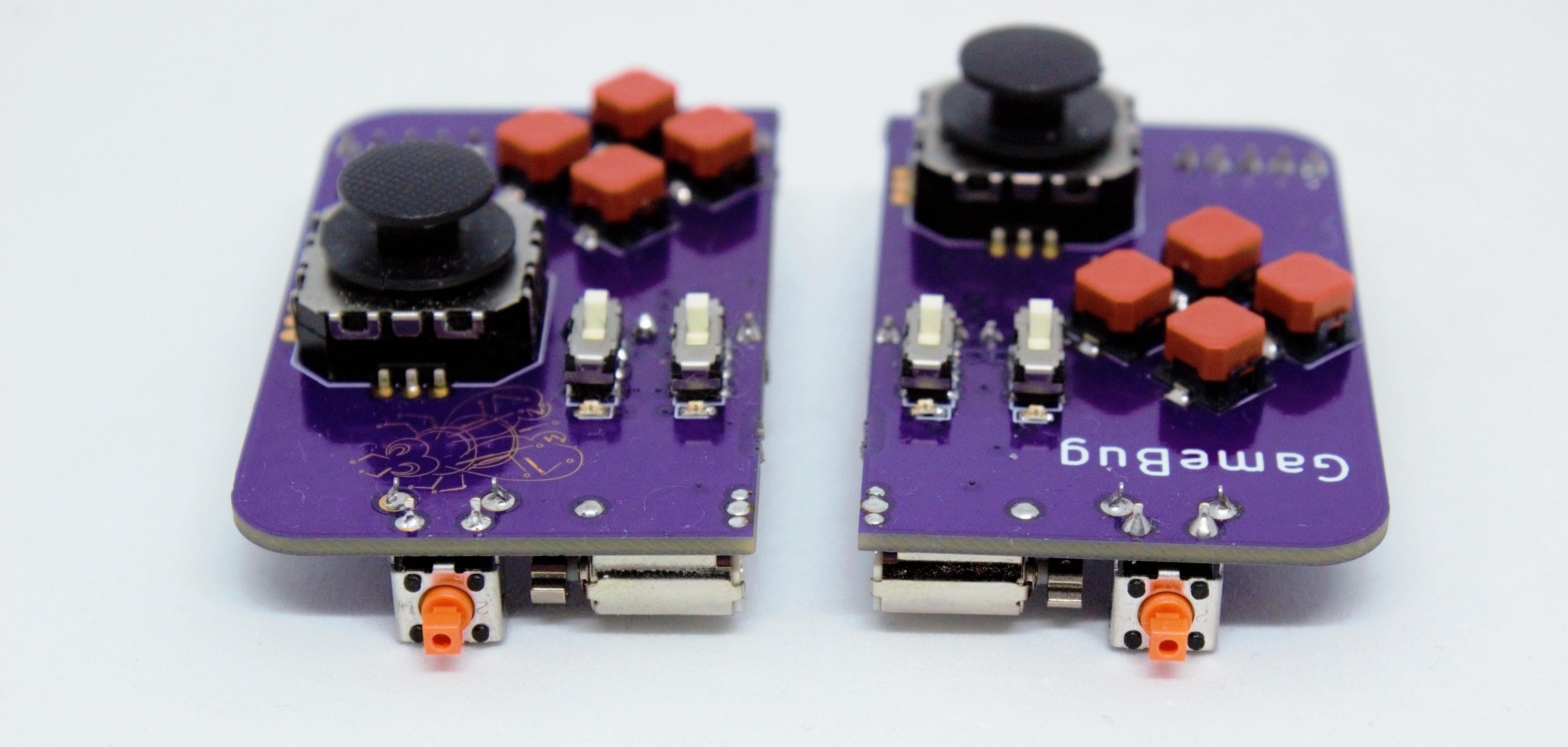
What’s more fun than playing video games? Designing your own video game hardware, of course! If you’ve followed these pages long enough you’ll have seen dozens of great examples of homebrew hardware, and perhaps been inspired to try such a project yourself. This often starts with assembling the basic bits onto a solderless breadboard, which is fine for programming but not so great for testing: squeezing pushbuttons into your breadboard works for basic debugging, but is not very user-friendly or reliable. A better solution can be found in [Dimitar]’s GameBug: a set of breadboard-compatible joypad-like controllers.
The GameBug’s design excels in its simplicity: a miniature analog joystick, four buttons arranged in a diamond pattern, a shoulder button and two sliding switches are sitting on a neat purple PCB. On the bottom are two rows of pin headers to ensure a snug fit on your solderless breadboard. There’s even a little vibrating motor for haptic feedback.
Interfacing with the GameBug is simplified by the integrated readout electronics. A Schmitt trigger-based debounce circuit ensures clean signals from all the pushbuttons, while a motor driver chip provides stable current to the haptic feedback system. An RGB LED can be used as yet another user feedback device, or simply for decorative lighting.
The modern world as we know it simply would not exist if not for the mind of Sir Isaac Newton. His synthesis of differential calculus and pioneering research on the nature of gravity and light are bedrocks of the scientific method. However in his later years, Newton's interests were admittedly drawn towards a decidedly non-scientific subject, alchemy. Does that investigation invalidate Newton's earlier achievement, asks theoretical physicist and philosopher, Carlo Rovelli in the excerpt below. His new book of correspondence and musings, There Are Places in the World Where Rules Are Less Important than Kindness: And Other Thoughts on Physics, Philosophy and the World, Rovelli explores themes spanning from science to history to politics and philosophy.
In 1936 Sotheby’s puts up for auction a collection of unpublished writings by Sir Isaac Newton. The price is low, £9,000; not much when compared to the £140,000 raised that season from the sale of a Rubens and a Rembrandt. Among the buyers is John Maynard Keynes, the famous economist, who was a great admirer of Newton. Keynes soon realizes that a substantial part of the manuscript writings deal with a subject that few would have expected Newton to be interested in. Namely: alchemy. Keynes sets out to acquire all of Newton’s unpublished writings on the subject, and soon realizes further that alchemy was not something that the great scientist was marginally or briefly curious about: his interest in it lasted throughout his life. “Newton was not the first of the Age of Reason,” Keynes concludes, “he was the last of the magicians.”
In 1946 Keynes donated his unpublished Newtoniana to the University of Cambridge. The strangeness of Newton in alchemical guise, seemingly so at odds with the traditional image of him as the father of science, has caused the majority of historians to give the subject a wide berth. Only recently has interest in his passion for alchemy grown. Today a substantial amount of Newton’s alchemical texts have been put online by researchers at Indiana University and are now accessible to everyone. Their existence still has the capacity to provoke discussion, and to cast a confusing light over his legacy.
Newton is central to modern science. He occupies this preeminent place because of his exceptional scientific results: mechanics, the theory of universal gravity, optics, the discovery that white light is a mixture of colors, differential calculus. Even today, engineers, physicists, astronomers and chemists work with equations written by him, and use concepts that he first introduced. But even more important than all this, Newton was the founder of the very method of seeking knowledge that today we call modern science. He built upon the work and ideas of others — Descartes, Galileo, Kepler, etc — extending a tradition that goes back to antiquity; but it is in his books that what we now call the scientific method found its modern form, immediately producing a mass of exceptional results. It is no exaggeration to think of Newton as the father of modern science. So, what on earth does alchemy have to do with any of this?
There are those who have seen in these anomalous alchemical activities evidence of mental infirmity brought on by premature aging. There are others who have served their own ends by attempting to enlist the great Englishman among critics of the limitations of scientific rationality.
I think things are much simpler than this.
The key lies in the fact that Newton never published anything on alchemy. The papers that show his interest in the subject are extensive, but they are all unpublished. This lack of publication has been interpreted as a consequence of the fact that alchemy had been illegal in England since as early as the fourteenth century. But the law prohibiting alchemy was lifted in 1689. And besides, if Newton had been so worried about going against laws and conventions, he would not have been Newton. There are those who have portrayed him as some kind of demonic figure attempting to glean extraordinary and ultimate knowledge that he wanted to keep exclusively for himself, to enhance his own power. But Newton really had made extraordinary discoveries, and had not sought to keep those to himself: he published them in his great books, including the Principia, with the equations of mechanics still used today by engineers to build airplanes and edifices. Newton was renowned and extremely well respected during his adult life; he was president of the Royal Society the world’s leading scientific body. The intellectual world was hungry for his results. Why did he not publish anything based on all those alchemical activities?
The answer is very simple, and I believe that it dispels the whole enigma: he never published anything because he never arrived at any results that he found convincing. Today it is easy to rely on the well-digested historical judgment that alchemy had theoretical and empirical foundations that were far too weak. It wasn’t quite so easy to reach this conclusion in the seventeenth century. Alchemy was widely practiced and studied by many, and Newton genuinely tried to understand whether it contained a valid form of knowledge. If he had found in alchemy something that could have withstood the method of rational and empirical investigation that he himself was promoting, there can be no doubt that Newton would have published his results. If he had succeeded in extracting from the disorganized morass of the alchemical world something that could have become science, then we would surely have inherited a book by Newton on the subject, just as we have books by him on optics, mechanics and universal gravity. He did not manage to do this, and so he published nothing.
Was it a vain hope in the first place? Was it a project that should have been discarded even before it began? On the contrary: many of the key problems posed by alchemy, and quite a few of the methods it developed, in particular with reference to the transformation of one chemical substance into another, are precisely the problems that would soon give rise to the new discipline of chemistry. Newton does not manage to take the critical step between alchemy and chemistry. That would be down to scientists of the next generation, such as Lavoisier, to achieve.
The texts put online by Indiana University show this clearly. It is true that the language used is typically alchemical: metaphors and allusions, veiled phrases and strange symbols. But many of the procedures described are nothing more than simple chemical processes. For example, he describes the production of “oil of vitriol” (sulfuric acid), aqua fortis (nitric acid) and “spirit of salt” (hydrochloric acid). By following Newton’s instructions, it is possible to synthesize these substances. The very name that Newton used to refer to his attempts at doing so is a suggestive one: “chymistry.” Late, post-Renaissance alchemy strongly insisted on the experimental verification of ideas. It was already beginning to face in the direction of modern chemistry. Newton understands that somewhere within the confused miasma of alchemical recipes there is a modern science (in the “Newtonian” sense) hidden, and he tries to encourage its emergence. He spends a great deal of time immersed in it, but he doesn’t succeed in finding the thread that will untie the bundle, and so publishes nothing.
Alchemy was not Newton’s only strange pursuit and passion. There is another one that emerges from his papers that is perhaps even more intriguing: Newton put enormous effort into reconstructing biblical chronology, attempting to assign precise dates to events written about in the holy book. Once again, from the evidence of his papers, the results were not great: the father of science estimates that the beginning of the world happened just a few thousand years ago. Why did Newton lose himself in this pursuit?
History is an ancient subject. Born in Miletus with Hecataeus, it is already fully grown with Herodotus and Thucydides. There is a continuity between the work of historians of today and those of antiquity: principally in that critical spirit that is necessary when gathering and evaluating the traces of the past. (The book of Hecataeus begins thus: “I write things that seem to me to be true. For the tales of the Greeks are many and laugh‑ able as they seem to me.”) But contemporary historiography has a quantitative aspect linked to the crucial effort to establish the precise dates of past events. Furthermore, the critical work of a modern historian must take into account all the sources, evaluating their reliability and weighing the relevance of information furnished. The most plausible reconstruction emerges from this practice of evaluation and of weighted integration of the sources. Well, this quantitative way of writing history begins with Newton’s work on biblical chronology. In this case too, Newton is on the track of something profoundly modern: to find a method for the rational reconstruction of the dating of ancient history based on the multiple, incomplete and variably reliable sources that we have at our disposal. Newton is the first to introduce concepts and methods that will later become important, but he did not arrive at results that were sufficiently satisfactory, and once again he publishes nothing on the subject.
In both cases we are not dealing with something that should cause us to deviate from our traditional view of the rationalistic Newton. On the contrary, the great scientist is struggling with real scientific problems. There is no trace of a Newton who would confuse good science with magic, or with untested tradition or authority. The reverse is true; he is the prescient modern scientist who confronts new areas of scientific inquiry clear-sighted, publishing when he succeeds in arriving at clear and important results, and not publishing when he does not arrive at such results. He was brilliant, the most brilliant—but he also had his limits, like everyone else.
I think that the genius of Newton lay precisely in his being aware of these limits: the limits of what he did not know. And this is the basis of the science that he helped to give birth to.