North Korean hackers are using ransomware to attack healthcare providers, feds warn

State-sponsored North Korean hackers have been targeting healthcare providers since at least May 2021, according to the US government. The FBI, the Cybersecurity and Infrastructure Security Agency (CISA) and the Department of the Treasury have issued a joint advisory warning healthcare organizations about the attackers' MO. Apparently, they've been using a ransomware called Maui to encrypt healthcare organizations' computers and then demanding payment from the victims to get their networks unlocked. The agencies' warning contains information about Maui, including its indicators of compromise and the techniques the bad actors use, which they got from a sample obtained by the FBI. 

The agencies said the attackers locked up healthcare providers' electronic health records services, diagnostics services, imaging services and intranet services, among others. In some cases, the attacks kept the providers out of their systems and disrupted the services they provide for prolonged periods. 

According to the agencies' advisory, the malware is manually executed by a remote actor once it's in the victim's network. They "highly discourage" paying ransom, since that doesn't ensure that the bad actors will give victims the keys to unlock their files. However, the agencies admit that the attackers will most likely continue targeting organizations in the healthcare sector. "The North Korean state-sponsored cyber actors likely assume healthcare organizations are willing to pay ransoms because these organizations provide services that are critical to human life and health," they said.

The agencies are now urging healthcare providers to employ mitigation techniques and to prepare for possible ransomware attacks by installing software updates, maintaining offline backups of data and concocting a basic cyber incident response plan. For those wondering what happens to the funds North Korea gets from operations like this: Earlier this year, a United Nations report revealed that the country has been using cryptocurrency stolen by state-sponsored hackers to fund its nuclear and ballistic missile programs. 

Healthcare providers have been a prime target for ransomware-using bad actors for quite a while now, especially since the pandemic started. In 2020, FBI and CISA issued a joint advisory warning hospitals and healthcare providers that they're in danger of being targeted by a ransomware attack. Russian-speaking criminal gang UNC1878 and other attackers targeted healthcare organizations in the height of the pandemic, giving some victims no choice but to comply with their demands as they struggled to save people's lives.
Rivian says it's still on track to produce 25,000 vehicles despite production woes

Moreso than most automakers, Rivian has had a tough 2022. At the start of the year, the company, blaming inflation and component shortages, raised the base price of its quad-motor R1T pickup truck by a whopping $12,000. And while it went on to quickly backtrack, the decision led to a shareholder lawsuit

Despite those early woes, Rivian says it’s still on track to produce 25,000 vehicles in 2022. The company reiterated the prediction in a statement it shared on Wednesday. Rivian said it built 4,401 R1T trucks, R1S SUVs and Amazon delivery vans at its factory in Normal, Illinois and delivered 4,467 vehicles during fiscal Q2.

“Supply chain and production are ramping,” Rivian CEO RJ Scaringe tweeted after the announcement. “We just announced production of 4,401 vehicles for Q2 bringing our cumulative total since start of production to 7,969 — keeping us on track to reach our year-end goals.”

Supply chain and production are ramping! We just announced production of 4,401 vehicles for Q2 bringing our cumulative total since start of production to 7,969 — keeping us on track to reach our year-end goals. Thank you to our team & suppliers.

— RJ Scaringe (@RJScaringe) July 6, 2022

While 4,401 vehicles is a modest tally, it is an improvement for Rivian. In the first three months of the year, the startup built 2,553 cars. Just as noteworthy is that the company managed to scale production while facing many of the same issues that have slowed its competition. On Saturday, Tesla announced its first quarter-over-quarter production decline in two years. In Q2, the company saw a 15 percent drop in manufacturing volume due to ongoing parts shortages and multiple COVID-19 shutdowns at its critical Shanghai Gigafactory.

Increasing production capacity will be critical to Rivian’s survival. In addition to an approximately 71,000 vehicle preorder backlog, the company has a 100,000 van order it needs to fulfill for minority owner Amazon. Late last year, Rivian announced it would build a second factory in Georgia, but that facility won’t be operational until sometime 2024. Until then, the startup is dependent on its single factory in Normal, which it says will eventually produce 200,000 vehicles annually.

Horizon Forbidden West’s latest PS5 update adds a ‘Balanced’ 40Hz graphics mode

Horizon Forbidden West was already one of the best-looking games on PlayStation 5, and now developer Guerrilla Games has found a way to make it look even better. With Forbidden West’s latest update, the studio has added a 40Hz “Balanced” rendering mode and support for both variable refresh rate (VRR) and high refresh rate (HFR).

VRR is a feature that’s relatively new to console gaming. It syncs your TV’s refresh rate to the frame rate of the game you’re playing, thereby helping to eliminate screen tearing whenever there’s a drop in performance. Meanwhile, the new Balanced setting promises to give you the best of Forbidden West’s existing Performance and Fidelity modes by offering a happy medium between the two.

Highly-requested features incoming... Introducing Variable Refresh Rate (VRR), High Refresh Rate (HFR) and our new "Balanced" Graphics Mode supporting 40Hz.

🗒️ Read the full Patch Notes here: https://t.co/4ls0b3Par6#HorizonForbiddenWestpic.twitter.com/RDBlUmIEzD

— Guerrilla (@Guerrilla) July 6, 2022

If you’re curious about how you get “balanced” graphics from rendering a game at 40Hz, here’s how the math works. At 30Hz, it takes 33.33 milliseconds for your console to display a new frame. By contrast, at 40Hz and 60Hz, it renders a new frame every 25 and 16.66 milliseconds, respectively. So while it might seem counterintuitive, 40 fps is precisely halfway between 30 fps and 60 fps in terms of update speed. Ratchet & Clank: Rift Apart also offers a 40 fps mode, and when Insomniac first introduced the feature, Digital Foundry called it “a potential game-changer” for console gaming.

Outside of those improvements, patch 1.17 includes the usual assortment of bug fixes, with some designed to address glitches that could stop you from finishing the game. You can read the entire changelog on Reddit.

Extreme sports Apple Watch could feature an expansive 2-inch display

Apple’s long-rumored extreme sports Series 8 Watch could ship with the company’s largest smartwatch display to date. According to Bloomberg’s Mark Gurman, the forthcoming wearable features a screen that measures almost 2 inches diagonally and has a 410 by 502 resolution. Compared to the display on the 45mm Series 7, the largest smartwatch Apple sells at the moment, the new model would offer about seven percent more screen real estate. Gurman says the company could use the extra space to show additional fitness metrics or more information on watch faces at one time.

Corroborating Bloomberg’s reporting is a recent tweet from display analyst Ross Young who said the Series 8 lineup would include a model with a 1.99-inch display. Outside of a larger screen, Gurman says the new variant will feature a more shatter-resistant screen, a higher capacity battery and a studier case made from metal more robust than aluminum. It will also include the fever detection feature he previously reported was coming to the entire Series 8 family, as well as better tracking capabilities for activities like hiking and swimming. What it won’t include is a faster processor: Apple’s upcoming S8 chipset reportedly features the same capabilities as its S7 and S6 predecessors.

If Apple follows its usual release cadence, the tech giant will likely announce the wearable at its iPhone event in the fall. Gurman previously said the company was working on a “deluge” of products it plans to announce over the next year, including a successor to the original HomePod.

Elaborate hack of 'Axie Infinity' tied to fake LinkedIn job offer

Axie Infinity was the prime example of crypto gaming last year, when its play-to-earn formula helped it reach up to 2.7 million daily active users last November. But that all came crashing down in March, when hackers stole $625 million from the Ethereum-linked Ronin sidechain powering the game. Now, it turns out, the source of that hack came from an unlikely source: A fake job offer from LinkedIn. 

As The Block reports (via The Verge) based on two sources, the hackers infiltrated Axie Infinity owner Sky Mavin's network by sending a spyware-filled PDF to one employee. That person thought they were accepting a high-paying job from another firm, but it turns out that company never existed. According to the US government, North Korean hacker group Lazarus was behind the attack. 

“Employees are under constant advanced spear-phishing attacks on various social channels and one employee was compromised," Sky Mavis noted in a post-mortem blog post following the hack. "This employee no longer works at Sky Mavis. The attacker managed to leverage that access to penetrate Sky Mavis IT infrastructure and gain access to the validator nodes.”

Axie Infinityspun back up last week, and it's still relying on the Ronin sidechain, albeit with stricter security measures. The company raised its validator nodes to 11 in April, up from 9 previously, which makes it more difficult for attackers to gain control of the network. (Lazarus gained access to 5 nodes to achieve its hack, including one from the Axie DAO [Decentralized Autonomous Organization].) And it's also implementing a "circuit-breaker" system to flag large withdrawals. 

While this hack was clearly meticulously planned and required a significant amount of technical skill, it ultimately hung on a classic vulnerability: social engineering. 

Grab 'The Matrix Awakens' Unreal demo before it's delisted on July 9th

Time is running out to download Epic Games’ The Matrix Awakens. The free open-world interactive demo made with Unreal Engine 5 will be removed from the PlayStation and Xbox stores on July 9th. Luckily, players can still access the game an unlimited amount of times once it’s downloaded. The tie-in experience to The Matrix Resurrections debuted last year, and was one of the first examples of what Epic’s next generation game engine can do. UE5 has since been released to the wider developer community.

While The Matrix Awakens isn’t a full game, it’s still a memorable introduction to UE5’s immersive visuals and natural lighting. Players are essentially given free rein to roam through the titular Matrix and soak in the visual effects. The game was written by Lana Wachowski, the co-writer and director of The Matrix trilogy films, and features performances by both Carrie-Anne Moss and Keanu Reeves.

If you’ve already dipped your toe into the world of The Matrix Awakens and are interested in experiencing more games using UE5, a number of new titles have been announced, including a new Tomb Raider game, ARK 2, the upcoming Witcher game and Black Myth: Wukong. You can check out gameplay footage from The Matrix Awakens (available on PlayStation 5 or Xbox Series X/S console) below.

Pocket Radio Powered By Tiny Microcontroller

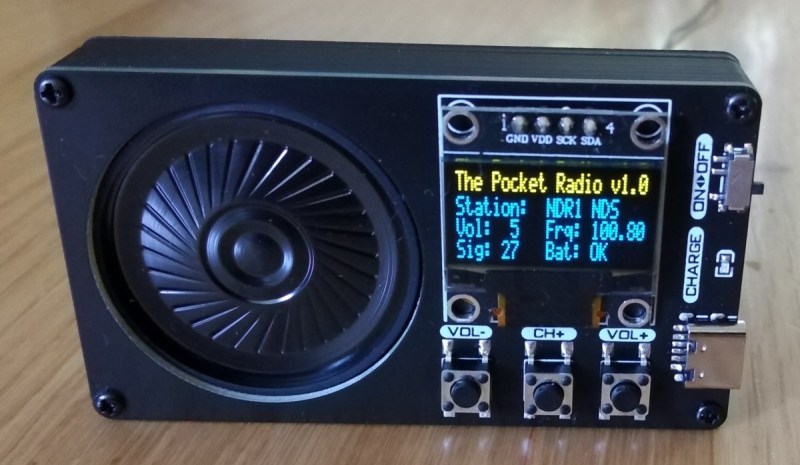
Before the days of MP3 players and smartphones, and even before portable CD players, those of us of a certain age remember that our cassette players were about the only way to take music on-the-go. If we were lucky, they also had a built-in radio for when the single tape exhausted both of its sides. Compared to then, it’s much easier to build a portable radio even though cassettes are largely forgotten, as [wagiminator] shows us with this radio design based on an ATtiny.

The build is about as compact as possible, with the aforementioned ATtiny 402/412 as its core, it also makes use of an integrated circuit FM tuner,  an integrated audio amplifier with its own single speaker, and a small OLED display. The unit also boasts its own lithium-polymer battery charger and its user interface consists of only three buttons, plenty for browsing radio stations and controlling volume.

The entire build fits easily in the palm of a hand and is quite capable for a mobile radio, plus all of the schematics and code is available on the project page. While it doesn’t include AM capability, just the fact that FM is this accessible nowadays when a few decades ago it was cutting-edge technology is quite remarkable. If you’re looking for an even smaller FM receiver without some of the bells and whistles of this one, take a look at this project too.

Hack a Day 06 Jul 21:00
arduino  attiny  audio  code  fm  oled  radio  radio hacks  schematics  speaker  

Netflix says a 'Stranger Things' stage play and spin-off series are on the way

The otherworldly dust has settled on season four of Stranger Things, which just wrapped up with a blockbuster pair of episodes. While The Duffer Brothers, who created the show, have one more season of the Netflix megahit to make, they're looking ahead to future projects.

Matt and Ross Duffer have set up a new production company as part of their partnership with Netflix. Fittingly enough, it's called Upside Down Pictures. The studio, which will be run by Ozark and Orphan Black producer Hilary Leavitt, will “aim to create the kind of stories that inspired the Duffers growing up — stories that take place at that beautiful crossroads where the ordinary meets the extraordinary, where big spectacle co-exists with intimate character work, where heart wins out over cynicism,” Netflix said.

The company and the Duffers also revealed some of the projects they have in the pipeline. For one thing, they're working on a stage play set in the world of Stranger Things. Emmy- and Tony-award winner Stephen Daldry, known for his work on The Crown and Billy Elliot, will direct the play. A live-action Stranger Things spin-off series is also in the works.

Intriguingly, Netflix is taking another stab at adapting the classic manga and anime series Death Note with the help of the Duffers. Unlike the poorly received 2017 movie, this will be a live-action show.

Also in the works under the wing of Upside Down Pictures are a series from Dark Crystal: Age of Resistance creators Jeffrey Addiss and Will Matthews and an adaption of Stephen King and Peter Straub‘s The Talisman. The production company and Netflix have teamed up with Steven Spielberg’s Amblin Entertainment and Paramount Television for the latter series.

Stranger Things is easily one of Netflix's biggest successes. Fans have already collectively viewed more than a billion hours of Stranger Things 4 alone. After Squid Game, it's only the second season of a Netflix show to hit that milestone within 28 days of release.

As such, it's not too much of a surprise that Netflix wants to expand the Duffers' remit to (hopefully) work their magic on more shows and movies. The company is having a rough year and is in desperate need of more big hits to draw in new subscribers and keep existing ones on board.

GGWave Sings the Songs of Your Data

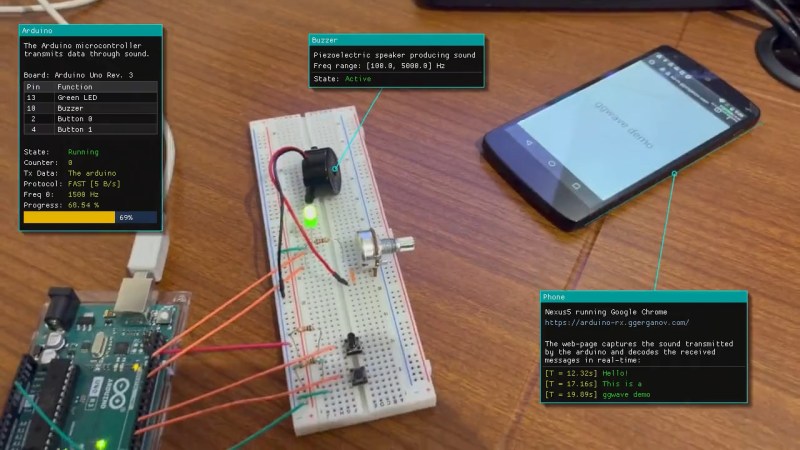
We’re suckers for alternative data transmission methods, and [Georgi Gerganov]’s ggwave made us smile. At its core, it’s doing what the phone modems of old used to do – sending data encoded as different audio tones. But GGwave does this with sophistication!

It splits the data into four-bit chunks, and uses 16 different frequency offsets to represent each possible value. But for each chunk, these offsets are added to one of six different base frequencies, which allows the receiving computer to tell which chunk it’s in. It’s like a simple framing concept, and it makes the resulting data sound charmingly like R2-D2. (It also uses begin and end markers to be double-sure of the framing.) The data is also sent with error correction, so small hiccups can get repaired automatically.

What really makes ggwave shine is that it’s ported to every platform you care about: ESP32, Arduino, Linux, Mac, Windows, Android, iOS, and anything that’ll run Python or JavaScript. So it’ll run in a browser. There’s even a GUI for playing around with alternative modulation schemes. Pshwew! This makes it easy for a minimalist microcontroller-based beeper button to control your desktop, or vice-versa. An ESP32 makes for an IoT-style WiFi-to-audio bridge. Write code on your cell phone, and you can broadcast it to any listening microcontroller. Whatever your use case, it’s probably covered.

Now the downside. The data rate is slow, around 64-160 bits per second, and the transmission is necessarily beepy-booopy, unless you pitch it up in to the ultrasound or use the radio-frequency HackRF demo. But maybe you want to hear when your devices are talking to each other? Or maybe you just think it’s cute? We do, but we wouldn’t want to have to transmit megabytes this way. But for a simple notification, a few bytes of data, a URL, or some configuration parameters, we can see this being a great software addition to any device that has a speaker and/or microphone.

Oh my god, check out this link from pre-history: a bootloader for the Arduino that runs on the line-in.

Hack a Day 06 Jul 19:30

'Forspoken' is delayed again, this time to January 24th

For the second time this year, Square Enix is delaying Forspoken. Following a delay that pushed the title from its original May 24th release date, the upcoming action RPG from Final Fantasy XV studio Luminous Productions was scheduled to hit PlayStation 5 and PC on October 11th, 2022. It will now instead come out on January 24th, 2023, the publisher announced on Wednesday.

“As a result of ongoing discussions with key partners, we have made the strategic decision to move the launch date of Forspoken to January 24, 2023,” Square Enix said on Twitter. “All game elements are now complete, and development is in its final polishing phase.”

The delay comes on the same day Sony announced the release date for God of War: Ragnarok. The latest project from the company’s Santa Monica studio will arrive on PS5 and PS4 on November 9th. With Forspoken pushed back to 2023, Sony’s fall release schedule now only includes Ragnarok and The Last of Us Part I – the latter is due on September 2nd. The last time we got an extended look at Forspoken was during a hands-off preview Square Enix held at the end of last year. The publisher promised to show off more of the fantasy game later this summer.

An update on #Forspoken. pic.twitter.com/sRLvXX2kjS

— Forspoken (@Forspoken) July 6, 2022