Wacom has unveiled one of its most advanced drawing tablets yet for creatives, the $3,500 Cintiq Pro 27. It has an all-new compact design, a 26.9-inch, 120Hz 4K reference touch display and all-new Pro Pen 3 that's adjustable for weight, balance, button layout and thickness.
The Cintiq Pro 27 is actually smaller than the Cintiq Pro 24, thanks to the significantly slimmer bezels. Wacom also moved the ExpressKey buttons to the back left and right sides, but they're located on the grips to make them easy to find and use.
While previous models effectively required an external monitor to view accurate colors, the new multi-touch display is effectively a reference monitor itself. It uses a true 10-bit and not a dithered 8-bit 4K panel, delivering 99 percent of the Adobe RGB gamut and 98 percent of the DCI-P3 (HDR) gamut. It also runs at 120Hz for smooth and responsive drawing and has a peak brightness of 400 nits, just enough to display HDR content. It's even Pantone SkinTone validated, meeting the Pantone standard for the full range of human skin tones.
The faster refresh allows the new Pro Pen 3 to track twice as quickly as previous models. And the pen itself is customizable, giving users the ability to change the size, weight, center of gravity and even the button layout via swappable parts. The battery-free electro-magnetic resonance tech offers 8,192 levels of pressure and ships with five standard and five felt-tip nibs.
The Ergo Stand supports 20 degrees of screen rotation along with tilting functions, but it's not included in the price and costs $500. However, the display also supports VESA mounts if you prefer to go that route. The Cintiq Pro 27 is now available for $3,500 from Wacom and select retailers — a lot of money to be sure, but more reasonable as a professional tool.
A few years ago, Samsung had major battery issues when several faulty Galaxy Note 7 phones had exploding batteries. The devices were recalled, and the company spent a lot of time over the following years outlining all the rigorous battery tests it did to ensure it didn’t happen again.
Now, YouTuber Mrwhosetheboss, as well as others, have noticed batteries in Samsung phones are swelling up at a disproportionately high rate. This usually affects older devices, but some are only a couple of years old – the 2020-era Galaxy Z Fold 2, for instance.
Samsung hasn’t formally responded yet, but battery swelling isn't a new problem, nor one unique to Galaxy phones. As lithium batteries age, their increasingly flawed chemical reactions can produce gas that inflates battery cells. Many companies suggest you keep device batteries at a roughly 50 percent charge if you won't use it for extended periods.
$1.5 billion is available to fund charging stations along highways.
The Bipartisan Infrastructure Law earmarked $5 billion in funding over five years to help states install chargers along highways, and that process just took an important step forward. The Department of Transportation has approved EV charging plans for all 50 states, Washington DC and Puerto Rico. The proposals cover 75,000 miles of highways.
The biggest change with iPadOS 16 may be Stage Manager, a totally new multitasking system that adds overlapping, resizable windows to the iPad. The latest iPadOS 16 developer beta can run Stage Manager on several older devices: It'll work on the 11-inch iPad Pro (first generation and later) and the 12.9-inch iPad Pro (third generation and later). However, there is one notable missing feature for the older iPad Pro models – Stage Manager will only work on the iPad's built-in display. You won't be able to extend your display to an external monitor.
Intel's 13th-gen Core chips, AKA Raptor Lake, have landed. The company's new top-end chip, the Core i9-13900K, sports 24 cores (eight performance cores and 16 efficiency cores) and can reach up to a 5.8GHz Max Turbo frequency. Last year's i9-12900K offered 16 cores and a maximum speed of 5.2 GHz. Intel claims the new 13900K is 41 percent better for multi-threaded work, like video encoding. If you skipped last year's chips or are running even older Intel hardware, the 13th-gen CPUs look like the update you've been waiting for.
Set to debut on its upcoming flagship EX90 electric SUV, Volvo's new radar system monitors both the cabin and trunk, to prevent a car from being locked while anyone is inside. The idea is to guard against situations where pets or children may be inadvertently trapped inside a car on a hot day, with the car surfacing reminders if it recognizes there are occupants inside when being locked. Volvo says the multiple radars in the trunk, in the car's overhead console and in roof-mounted reading lamps can detect "sub-millimeter" movements.
Apple, of all companies, delivering the most competitively priced smartwatch you can buy in 2022? Apple’s starter smartwatch offers a comprehensive suite of health and fitness tracking tools, emergency features and snappy performance. As long as you’re not extremely clumsy or impatient, you won’t miss features like the hardier screen, dust resistance or the always-on display found on the more expensive models.
The chain is also piloting AI that tells kitchen staff what to cook.
Chipotle's tortilla-making robot is moving to a real restaurant. In October, the machine will start cooking tortilla chips in Fountain Valley, California. Feedback from customers and workers will help the company decide on a national rollout. Artificial intelligence will influence some human cooks, too. Chipotle is piloting a demand-based cooking system that uses AI to tell staff what and when to cook based on forecasts for how much they'll need.
With the X-H2S, Fujifilm has a new flagship camera. It features a new 26.2-megapixel stacked sensor that delivers shooting speeds up to 40 fps in electronic shutter mode. At the same time, it has the most advanced video features of any APS-C camera, with up to 6.2K video. It also offers in-body stabilization, a high-resolution EVF, CFexpress support and more. The main drawback: The autofocus still isn’t quite as fast as rival cameras.
Arduino have released the latest version of their Integrated Development Environment (IDE), Version 2.0 and it is a big step up from the previous release, boasting plenty of new features to help you to develop your code more easily.
As the de-facto way for beginners to get into programming hardware, more experienced users have sometimes complained about what they see as the over-simplistic IDE — even lacking relatively basic features such as autocomplete. The new version provides this, and much more besides.
The press-release from Arduino offers a few clues to the main features, but the real detail is tucked away in a range of new tutorials, designed to get you up to speed with the new look.
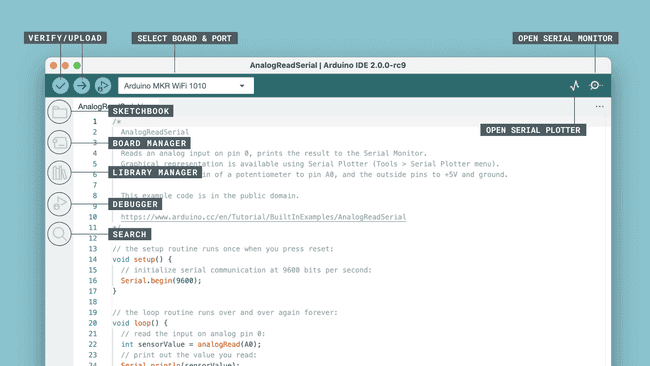
The main screen is organised differently, to show off the new capabilities and to make development faster and easier. The new “Remote Sketchbook” has been integrated closely with the Arduino Cloud, to allow for easy switching between computers during development. V2.0 will pick up any Cloud sketches automatically, while computers using the previous versions of the IDE can still access the sketches via the Web Editor as before.
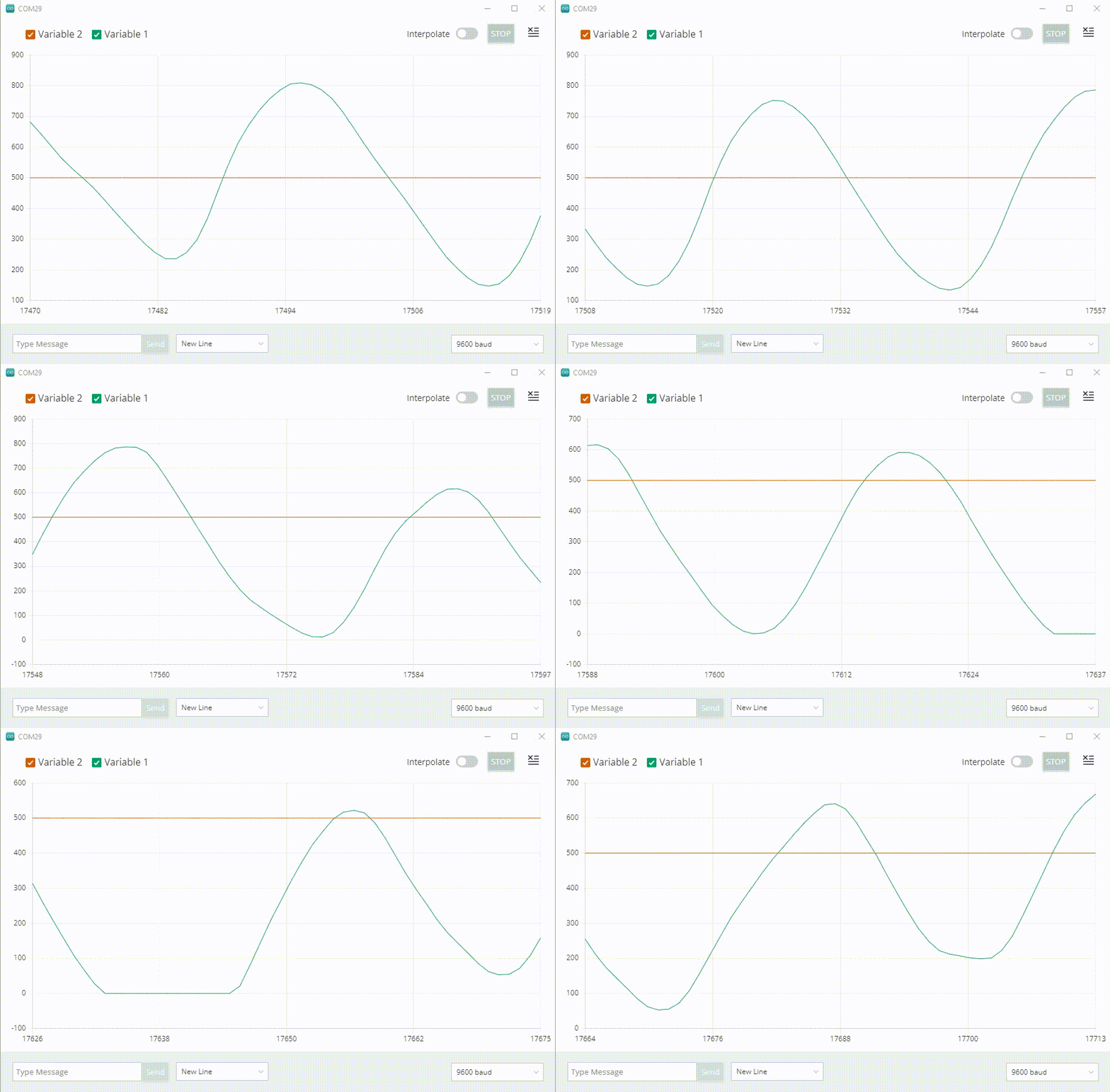
The Serial Plotter can now be used at the same time as the text Serial Monitor, rather than having to choose one or the other. In addition, there is a host of new Debug functionality for those devices that support it. This works with the usual In-Circuit Emulators (such as the Atmel ICE), but also natively with newer Arduino boards like the Arduino Zero without any additional hardware. The debugger gives you access to powerful features like Breakpoints, Step-Into and Step-Over to really understand what your code is doing.
Installation is straightforward, and will automatically pull in any libraries and sketches that you created in previous versions of the Arduino software to ease the transition.
There’s a lot to like in the new IDE, but we expect it will take a little while to discover and use all the new features effectively. Some of them are carry-overs from the “Arduino Pro IDE” that we covered a few years ago, but it’s great to see the software evolve and improve over time.
Have you tried new new IDE yet? What are your thoughts on how it compares to the older version, or other development environments? Let us know in the comments.
One of Shark's higher-end robot vacuums is on sale at Amazon, and you may want to check it out if you're looking for a model with a clean base. The Shark IQ RV1001AE robot vacuum is currently listed for $300, and the deal is only available today. That's half off the model's original retail price of $600 and just a dollar more than its all-time low on the website. The RV1001AE vacuum features powerful suction that can clean both bare floors and carpets, as well as a self-cleaning brush roll that can remove pet and human hair on its own. No more balls of tangled hair getting stuck and preventing the vacuum from being able to clean efficiently.
The machine cleans the floor row by row, and its IQ navigation capability means it can map your whole home so that you can select specific rooms to clean. If it runs out of battery, it can even go back to its dock, recharge and pick up from where it left off. When you want to the robot to start cleaning, you can get it to move by controlling it with your voice through Alexa and Google Assistant. And yes, the vacuum is also connected to the company's app, which you can use to schedule cleanings for your whole house or for certain rooms at specific hours of the day. The robot empties its bin into the clean base once it's done, and that bagless base can hold up to 45 days' worth of dirt.
In case you'd rather get a model you can manually use — maybe your pet is deathly afraid of robot vacuums or maybe you personally want to make sure no corner gets missed — Shark has another two models on sale at Amazon. The Shark IZ363HT has a self-cleaning brush roll, as well, and is listed for $230 at 34 percent off. Meanwhile, the Shark IZ483H is currently on sale for $300, or $200 off its regular price. It has a self-cleaning brush roll, a removable hand vacuum and a 120-minute battery life on a single charge.
Software Development Tool Trends for Embedded Hardware
It is said that a person who only has a hammer everything looks like a nail. Having the right tool for the right job is crucial for effectiveness and efficiency in any skilled profession. Embedded system development is no different. That said, until fairly recently, tools aimed at embedded development have lacked the refinement and modern feature sets found in the development tools aimed at desktop, web, and mobile developers.
Russia has removed all iOS apps from VK, the second largest tech company in Russia, The Verge has reported. That includes not just the VK social media app that's the fifth most popular in Russia, but others like Mail.ru and VK Music. The move was made in response to UK sanctions against the Russian government.
VK confirmed that "some VK applications are blocked by Apple, so they are not available for download and update in the App Store," according to a (Google translated) press release. "Their core functionality will be familiar and stable... [but] there may be difficulties with notifications and payments. VK will continue to develop and support applications for iOS."
These apps are being distributed by developers majority-owned or majority-controlled by one or more parties sanctioned by the UK government. In order to comply with these sanctions, Apple terminated the developer accounts associated with these apps, and the apps cannot be downloaded from any App Store, regardless of location.
Apple confirmed that it removed the apps and shut down VK's developer accounts. "These apps are being distributed by developers majority-owned or majority-controlled by one or more parties sanctioned by the UK government," a spokesperson told The Verge. "In order to comply with these sanctions, Apple terminated the developer accounts associated with these apps, and the apps cannot be downloaded from any App Store, regardless of location. Users who have already downloaded these apps may continue to use them."
Earlier this week, the UK government imposed sanctions on Russian oligarchs over the sham referendums held in Ukraine. Included in the list are executives from Gazprombank, a Russian bank with ties to VK. "Today’s sanctions will target those behind these sham votes, as well as the individuals that continue to prop up the Russian regime’s war of aggression," said UK foreign secretary James Cleverly in a statement.
Russia's Ministry of Digital Affairs told state media site RT that it's investigating the reasons for the removal. The apps are still available on Google Play — Engadget has reached out to Google to see if it plans to follow Apple's lead.
Earlier this year, Apple halted sales of all its products in Russia in response to the Ukraine invasion, while also limiting Apple Pay and pulling apps from outlets like RT and Sputnik. Last year, a Russian law went into effect that required Samsung, Apple and other manufacturers to pre-install Russian apps like VK and Yandex on devices sold there.
Deezer can now help you find songs that suddenly start playing in your head in the middle of the night. The music streaming service has upgraded its in-app SongCatcher feature so that it can now identify a track just by humming or even whistling parts of it. Once the service identifies a track, it will show you an information page with its title, artist and single/album cover where you can play the song, add it your playlist or queue and add it to your favorites.
The company says it's the only music streaming service with an in-app track recognition feature that includes humming and whistling, but it's worth noting that you can do the same within Google search. I tester Deezer's new feature and compared it with Google's and found that the latter is a bit better at recognizing my off-key humming. Google was even able to easily ID the more obscure parts of some Japanese pop songs.
For Deezer, I sometimes had to hum the more recognizable parts of a track, such as its chorus, even if they're enormous hits. I'm talking songs like Lady Gaga's Always Remember Us This Way, Ariana Grande's Thank U, Next and Lil Nas X's Industry Baby. If you're a subscriber, though, it's the more convenient option, seeing as you can directly add tracks to your playlists. To ID songs by humming, you simply have to go to Search, then tap on "What's this song" to launch SongCatcher and choose "Sing Now."
Maybe I was just extra out of tune while testing Deezer — nobody has ever called me a good singer. The good news is that the feature could become much better at identifying tracks over time. Alexandra Leloup, VP Core Product at the company, explained: "As we keep improving the algorithm, the feature will become faster and even more accurate when it comes to recognizing songs across our 90 million track library."
Polestar's first electric SUV will get its official unveiling on October 12th a range target of 372 miles and an optional Performance Pack, the Swedish company announced. The Polestar 3 will launch with premium features like an air suspension, active dampers and torque vectoring, putting it up against other SUV EVs like the Mercedes-Benz EQS, Rivian R1S and Tesla Model X. Like those models, it'll be manufactured in the US at Volvo's factory in Charleston, South Carolina.
The company, co-owned by Volvo and Chinese parent Geely, revealed a fair bit of information about the Polestar 3. That includes a new glimpse from the back showing similar (but upside down) taillights to the Polestar 2. Polestar previously showed off the design from the side in June (below).
Polestar
The Polestar 3 will come with a rear-biased dual-motor powertrain similar to the one on the Polestar 2, with electric torque vectoring via a dual clutch system on the rear motor. The ride will be controlled by an adaptive dual-chamber air suspension and active dampers as standard, letting drivers switch between comfort and firm suspension dynamics. The dampers will adjust to suit road conditions "once every two milliseconds," Polestar said.
The optional Performance Pack will deliver 510 horsepower and 671 pound-feet of torque (compared to 670 horsepower for the Model X). It also includes Polestar Engineered chassis tuning for the active dampers and air suspension, along with interior details like gold seat belts.
Previously, the company has said that it's shooting for a 372-mile range on the European WLTP cycle (so considerably less in EPA terms). It'll also include a semi-autonomous driving system for highway driving, enabled by by NVIDIA tech and a lidar sensor — Volvo is likely to use similar tech on its next-gen EX90 SUV set to launch on November 9th. Rumors have pegged the Polestar 3's price at somewhere between $75,000 and $111,000 at launch.
32-channel LED Driver with CAN FD Light Delivers Integrated Solution for Dynamic Automotive Lighting
New linear current regulator L99LDLH32 from STMicroelectronics delivers a convenient, integrated solution for dynamic automotive lighting controlled using the lightweight CAN FD Light protocol.
Logitech is today announcing a quartet of products in its Designed for Mac series of wireless accessories. The first headline item is the MX Mechanical Mini (for Mac), an Apple-favoring variation on the existing MX Mini which launched earlier this year. Fundamentally, it’s the same product as before, offering a refined twist on the mechanical tenkeyless keyboards currently en vogue. Naturally, you’ll get macOS-specific keycaps, and it’s available in a pair of more Mac-friendly colors: Space Gray or Pale Gray.
Next up is a Mac-specific version of the company’s flagship MX Master 3S mouse, again in Space Gray or Pale Gray. That carries over all of the same features as the existing 3S, and if we’re being honest, there’s little reason for this to exist as a separate model. After all, the standard 3S is a universal model, and it can already be customized with Mac-specific shortcuts in the macOS version of Options+, Logitech’s app for accessory tweaking. But if you’re looking for consistency in your color choices, then if the prices are the same, then there’s also little option not to choose this one.
Logitech
The other major launch is for the Lift for Mac which, like the above, is a Mac-hued version of its existing vertical mouse. Logitech says that the 57-degree angle of attack places your mitt in a natural handshake position for better comfort. At the same time, the company is rolling out a new color for its K380 wireless keyboard, this time in Blueberry. You can also pick up the accompanying mouse in that same hue, should you wish to go all matchy matchy with your purple M1 iMac.
All four products are available to buy this month from Logitech’s official website and, most likely, your retailer of choice. The MX Mechanical Mini will set you back $150, while the MX Master 3S is marked up at $100, with the Lift costing $70, and the blueberry K380 is $40.