Build A Low Power SMS Based Vehicle Tracking System with A9G GSM+GPS Module and Arduino
A GPS tracker is one of the most simple and interesting projects in the field of electronics, and for one of our projects we needed to track the position of a vehicle, so we started looking for circuits on the internet and were very surprised to find out that there were not a lot of modules available online that can do both GSM and GPS at the same time.
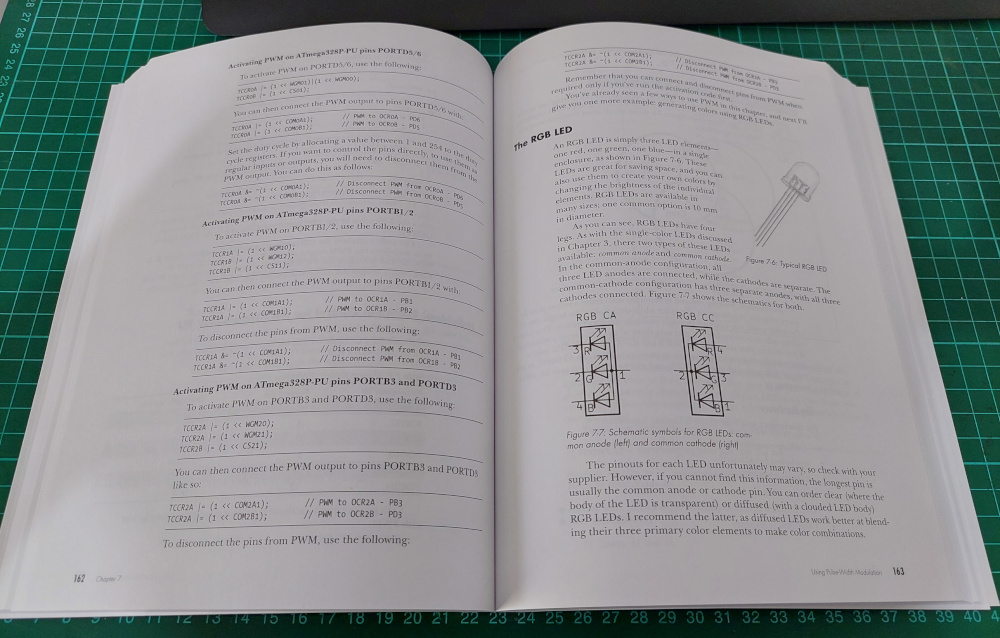
After many years working with and teaching others about the Arduino development platform, it became apparent that there needed to be a useful guide to get people started in the world of AVR microcontrollers – used in Arduino and other development environments. The great people at No Starch Press agreed and we are now proud to have published “AVR Workshop – A Hands-On Introduction with 60 Projects“.
AVR Workshop is written for several groups of people:
Those of you who have used an Arduino but now want to learn how to harness the underlying AVR microcontrollers without the layer of Arduino abstraction.
Anyone interested in electronics and wanting to start with using microcontrollers.
Students who are going to learn how to use AVR microcontrollers in their coursework.
People tasked with making devices based around 8-bit AVR microcontrollers and don’t know where to start
AVR users who would like a neat reference on using popular devices with their microcontrollers and don’t have all day to scour the Internet for tested, quality resources.
You. Yes, you. Learning is for a lifetime, so why not get started with the world of electronics and microcontrollers? Or give a copy to someone who enjoys learning about technology?
Anyone can use this book. You don’t need any previous experience in electronics, programming, or making things. AVR Workshop will take you step-by-step from the beginning including installation of the required software, explain electronics when required, teach you the required coding and walk you through examples including sixty projects enabling you to harness popular 8-bit Microchip AVR microcontrollers.
Once you’ve worked through the book – you will have the knowledge, experience and confidence to branch out on your own and build complex projects, work with other Microchip AVR microcontrollers – and find success in this fascinating field. You will also have a useful reference tool that you can refer to when making your own devices.
Unlike other books or resources found online, I don’t hide any details from you in order to simplify things. Important functions aren’t hidden away in software libraries – instead you’ll learn how to control the microcontroller down to the register level to control all sorts of useful devices. Instead of relying on others – you’ll learn how to write your own libraries, so you can make your own parts and devices easier to work with.
You don’t need to spend a fortune, in fact I’ve written AVR Workshop to be as economical as possible for you, the reader. The required software is small, free to download and can operate on Linux, MacOS or Windows using machines that date back almost ten years. You don’t need any cloud-based tools or the latest i7 or M2-based computer… almost any will do.
AVR Workshop is printed using a convenient lie-flat technology, so you can have the book open to your side and not worry about the pages flapping about and losing your position while working on your projects. All the required code is included in the book, however you can also download them along with a list of parts and supplier information from the book’s website.
The Microchip AVR series of 8-bit microcontrollers are, in my opinion, an inexpensive and most approachable way of learning about electronics and microcontrollers – and open up a whole new world of creativity or even the pathway to a career in technology. A copy of AVR Workshop is the best guide to start anyone in this world.
To learn more about AVR Workshop, you can review the table of contents, download a sample chapter, code and parts list and order copies for yourself and others from the No Starch Press online store. Orders from No Starch Press also include a free electronic copy so you can get started immediately.
The Moore School stood ready as people began to arrive by train and trolley. John and Pres, as well as the engineers and deans and professors of the university, wore their best suits and Army officers were in dress uniform with their medals gleaming. The six women wore their best professional skirt suits and dresses.
Kay and Fran manned the front door of the Moore School. As the scientists and technologists arrived, some from as far as Boston, the two women welcomed them warmly. They asked everyone to hang up their heavy winter coats on the portable coat racks that Moore School staff had left nearby. Then they directed them down the hall and around the corner to the ENIAC room.
Just before 11:00 a.m., Fran and Kay ran back to be in the ENIAC room when the demonstration began.
As they slid into the back of the room, everything was at the ready. At the front of the great ENIAC U, there was space for some speakers, a few rows of chairs, and plenty of standing room for invited guests and ENIAC team members. Across the room, Marlyn, Betty, and Jean stood in the back and the women smiled to each other. Their big moment was about to begin. Ruth stayed outside, pointing late arrivals in the right direction.
The room was packed and was filled with an air of anticipation and wonder as people saw ENIAC for the first time.
Demonstration Day started with a few introductions. Major General Barnes started with the BRL officers and Moore School deans and then presented John and Pres as the co-inventors. Then Arthur came to the front of the room and introduced himself as the master of ceremonies for the ENIAC events. He would run five programs, all using the remote control box he held in his hand.
The first program was an addition. Arthur hit one of the but-tons and the ENIAC whirled to life. Then he ran a multiplication. His expert audience knew that ENIAC was calculating it many times faster than any other machine in the world. Then he ran the table of squares and cubes, and then sines and cosines. So far, Demonstration Day was the same as the one two weeks earlier, and for this sophisticated audience, the presentation was pretty boring.
But Arthur was just getting started and the drama was about to begin. He told them that now he would run a ballistics trajectory three times on ENIAC.
He pushed the button and ran it once. The trajectory “ran beautifully,” Betty remembered. Then Arthur ran it again, a version of the trajectory without the punched cards printing, and it ran much faster. Punched cards actually slowed things down a little bit.
Then Arthur pointed everyone to the grids of tiny lights at the top of the accumulators and urged his attendees to look closely at them in the moments to come. He nodded to Pres, who stood against the wall, and suddenly Pres turned off the lights. In the black room, only a few small status lights were lit on the units of ENIAC. Everything else was in darkness.
With a click of the button, Arthur brought the ENIAC to life. For a dazzling twenty seconds, the ENIAC lit up. Those watching the accumulators closely saw the 100 tiny lights twinkle as they moved in a flash, first going up as the missile ascended to the sky, and then going down as it sped back to earth, the lights forever changing and twinkling. Those twenty seconds seemed at once an eternity and instantaneous.
Then the ENIAC finished, and darkness filled the room again. Arthur and Pres waited a moment, and then Pres turned on the lights and Arthur announced dramatically that ENIAC had just completed a trajectory faster than it would take a missile to leave the muzzle of artillery and hit its target. “Everybody gasped.”
Less than twenty seconds. This audience of scientists, technologists, engineers, and mathematicians knew how many hours it took to calculate a differential calculus equation by hand. They knew that ENIAC had calculated the work of a week in fewer than two dozen seconds. They knew the world had changed.
Climax complete, everyone in the room was beaming. The Army officers knew their risk had paid off. The ENIAC engineers knew their hardware was a success. The Moore School deans knew they no longer had to be worried about being embarrassed. And the ENIAC Programmers knew that their trajectory had worked perfectly. Years of work, effort, ingenuity, and creativity had come together in twenty seconds of pure innovation.
Some would later call this moment the birth of the “Electronic Computing Revolution.” Others would soon call it the birth of the Information Age. After those precious twenty seconds, no one would give a second look to the great Mark I electromechanical computer or the differential analyzer. After Demonstration Day, the country was on a clear path to general- purpose, programmable, all- electronic computing. There was no other direction. There was no other future. John, Pres, Herman, and some of the engineers fielded questions from the guests, and then the formal session finished. But no one wanted to leave. Attendees surrounded John and Pres, Arthur and Harold.
The women circulated. They had taken turns running punched cards through the tabulator and had stacks of trajectory printouts to share. They divided up the sheets and moved around the room to hand them out. Attendees were happy to receive a trajectory, a souvenir of the great moment they had just witnessed.
But no attendee congratulated the women. Because no guest knew what they had done. In the midst of the announcements and the introductions of Army officers, Moore School deans, and ENIAC inventors, the Programmers had been left out. “None of us girls were ever introduced as any part of it” that day, Kay noted later.
Since no one had thought to name the six young women who programmed the ballistics trajectory, the audience did not know of their work: thousands of hours spent learning the units of ENIAC, studying its “direct programming” method, breaking down the ballistics trajectory into discrete steps, writing the detailed pedaling sheets for the trajectory program, setting up their program on ENIAC, and learning ENIAC “down to a vacuum tube.” Later, Jean said, they “did receive a lot of compliments” from the ENIAC team, but at that moment they were unknown to the guests in the room.
And at that moment, it did not matter. They cared about the success of ENIAC and their team, and they knew they had played a role, a critical role, in the success of the day. This was a day that would go down in history, and they had been there and played an invaluable part.
In September, SpaceX sent a letter to the Department of Defense, asking the Pentagon to take over paying for the expenses related to Ukraine's use of its Starlink satellite internet. According to CNN, SpaceX told the department that continuing to provide the Ukranian government with access to Starlink would cost the company over $120 million for the rest of 2022 and almost $400 million over the next 12 months. "We are not in a position to further donate terminals to Ukraine, or fund the existing terminals for an indefinite period of time," the company wrote. Now, company chief Elon Musk seems to have backtracked on the decision to ask the Pentagon for assistance and wrote on Twitter that SpaceX will "keep funding [the] Ukraine [government] for free" even though Starlink is still losing money.
The hell with it … even though Starlink is still losing money & other companies are getting billions of taxpayer $, we’ll just keep funding Ukraine govt for free
Musk confirmed what he said in his tweet to The Financial Times and added that SpaceX will continue funding Ukraine's access to Starlink's satellite internet "indefinitely."
When news about the letter came out, Musk defended his company's position and clarified that SpaceX is not asking the Pentagon to pay for previous expenses. He explained that SpaceX simply can't fund the existing system in Ukraine and regularly send thousands of new terminals to replace the ones routinely destroyed by the Russian forces at the same time. Musk added that the "burn" for keeping the Starlink system running in the country is $20 million a month, since it's had to "defend against cyberattacks and jamming," as well.
Earlier this month, The Times reported that Ukrainian troops grappled with Starlink outages that led to "catastrophic" loss of communication on the frontline. Musk responded that the piece "falsely claims that Starlink terminals [and] service were paid for, when only a small percentage have been." Based on SpaceX's letter that CNN had obtained, though, around 85 percent of the 20,000 terminals in Ukraine at the time were fully or partially funded by the US, the UK, Poland and other outside sources.
The Pentagon confirmed after knowledge of the letter became public that it's been discussing payments with SpaceX but that it's also been looking at potential alternatives. Sabrina Singh, the Pentagon's deputy press secretary, said in a statement: "There's not just SpaceX, there are other entities that we can certainly partner with when it comes to providing Ukraine with what they need on the battlefield."
Razer, you may recall, recently teased a 5G handheld device that's focused on cloud gaming. The company took the opportunity at RazerCon to formally announce the system, which it calls the Razer Edge — yep, Razer finally went there with its branding.
The Edge has a 6.8-inch AMOLED screen with a refresh rate of 144Hz and a Full HD+ resolution of 2,400 x 1,080. Razer claims the display has 87 percent more pixels than competitors’ devices. The Steam Deck’s screen, for instance, has a 1,280 x 800 resolution. The Edge's Gorilla Glass touchscreen also has a 288Hz sampling rate, which should make it pretty darn responsive.
Razer worked with Qualcomm and Verizon on this device. It runs on the Snapdragon G3x Gen 1 Gaming Platform, which was developed exclusively for the Edge. The device has a 3Ghz octa-core Kryo CPU and an Adreno GPU, along with active cooling and six air vents. Razer says early benchmarking shows that the Snapdragon G3x Gen 1 delivers two to three times the speeds of typical mobile platforms, such as the Snapdragon 720G.
Razer
The device has a 5,000mAh capacity battery, as well as 8GB of LPDDR5 RAM and 128GB of storage. On the audio front, there are two-way speakers with Verizon Adaptive Sound and a pair of digital microphones. There's a webcam too — you'll have the option to livestream your gameplay.
The Edge is comprised of an Android 12 tablet housed inside the new Razer Kishi V2 Pro controller. The latter has the same analog triggers as the Kishi V2, along with microswitches, programmable buttons and what Razer claims is an "ultra-precise" D-pad. What makes the Kishi V2 Pro different is that it has HyperSense haptic feedback and, blissfully, a 3.5mm headphone jack. Together, the tablet and controller weigh 400.8 grams, which is a bit less than a pound.
As for the games, the Edge, which will only be available in the US at the outset, will come with launchers for Epic Games, Xbox Cloud Gaming and Nvidia GeForce Now preinstalled. You'll also be able to access remote play services such as Steam Link, Moonlight and Parsec.
Razer
Since this is a cloud gaming-focused device, connectivity is key. Razer says the Edge has WiFi 6E that performs on an "uncongested" 6GHz channel and has multi-gig bandwidth support for fast download and upload speeds. When you're on the go, you'll be able to connect to cloud gaming services through 5G as long as you have the right model.
The 5G version of the Razer Edge is a Verizon exclusive. Pricing and exact availability will be confirmed later, but it should be out in January, around the same time as the WiFi model. That version will run you $400 and it'll be available from Razer's website and RazerStore locations. You can reserve one for a refundable deposit of $5. Razer hasn't revealed pricing or availability for the standalone Kishi V2 Pro controller.
That's not an insignificant price for the WiFi model, and it's likely that the 5G version will cost more, but the specs seem solid for the money. It seems like an option worth considering for on-the-go cloud gaming if you'd rather not slot your phone into a controller and you don't want to lug a Steam Deck around.
The Razer Edge isn't the only handheld device focused on cloud gaming. Logitech's $350 G Cloud Gaming Handheld, which doesn't have WiFi 6 or 6E support, will be available next week. Other notable manufacturers are turning their attention to cloud gaming as well. Google this week announced three Chromebooks from Acer, ASUS and Lenovo that are designed for streaming games.
Razer
The Edge was far from Razer's only product announcement at RazerCon. Along with the Kraken Kitty V2 Pro wired headset (featuring swappable bunny, bear and cat ears with Chroma RGB lighting) and some other gear, the company showed off its Hammerhead HyperSpeed earbuds.
The earbuds feature Chroma RGB, active noise cancellation, Bluetooth 5.2 and 2.4GHz connectivity (via a USB-C dongle you can plug into your console or other device) to minimize latency. Razer claims you'll get up to 30 hours of total battery life, factoring in top ups from the charging case. Hammerhead HyperSpeed is available in PlayStation- and Xbox-braded variants. The earbuds cost $150 and they will be available in November.
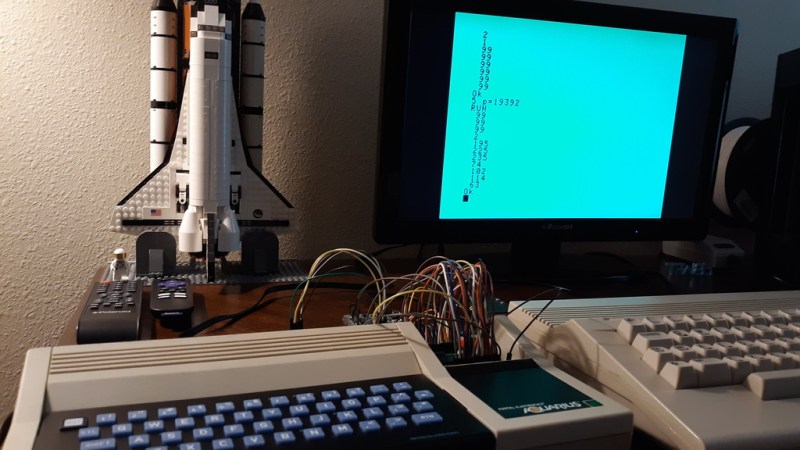
In case you weren’t around in the 80s, or you happened to blink, you may have missed the Mattel Aquarius computer. [Nick Bild] has a soft spot in his heart for the machine though and built the Aqua cartridge to make the Aquarius into a more usable machine.
Originally equipped with a mere 4 KB of RAM and a small, rubbery keyboard, it’s not too surprising that the Aquarius only lasted five months on the market. [Nick] decided on the cartridge slot to beef up the specs of this little machine given the small number of expansion ports on the device. Adding 32 KB of RAM certainly gives it a boost, and he also designed an SD card interface called Aqua Write that connects to the Aqua cartridge for easily transferring files from a more modern machine.
The Aqua Write uses an Arduino Mega 2560 to handle moving data between the SD card and the system’s memory. This is complicated somewhat because a “PLA sits between the Z80 and data bus that XORs data with a software lock code (initialized to a random value on startup).” [Nick] gets around this by running a small program to overwrite the lock code to zero after startup.
The Apple Store workers who'd been planning to unionize since at least early this year have come long way from using encrypted chats to organize in secret. In June, an Apple Store in Maryland became the first location to unionize in the US. Now, another retail location in Oklahoma City has voted in favor of unionization, becoming the second Apple Store in the US to organize officially. According to The Wall Street Journal, the group is calling itself the Penn Square Labor Alliance, because the store is located at Oklahoma City's Penn Square Mall.
Around 100 employees are eligible for union membership in the store. Based on the information released by the National Labor Relations Board, 56 of those workers voted in favor of forming a union, while 32 voted against. The group is now planning to join the Communications Workers of America, which also represents workers from companies like AT&T and Verizon. Charity Lassiter, an employee at the Oklahoma City store and a member of the organizing committee, told The Journal: "Now that we've won the election, it is our hope that management will come to the table so that we may collectively work towards building a company that prioritizes workers over profit and encourages employees to thrive."
Meanwhile, an Apple spokesperson told the publication in a statement: "We believe the open, direct and collaborative relationship we have with our valued team members is the best way to provide an excellent experience for our customers, and for our teams. We're proud to provide our team members with strong compensation and exceptional benefits."
Previous reports indicate that Apple has been finding ways to dissuade workers to unionize. Just a few days ago, Bloomberg reported that the tech giant is offering its employees new perks, such as additional health benefits and funding for educational opportunities. However, the tech giant will reportedly withhold those benefits from unionized members who'll now have to negotiate for them. Back when talks about worker's organizing efforts started heating up, the company reportedly armed its managers with anti-union talking points. Employees formally accused the tech giant of union busting, and the NLRB found merit in the claims that Apple surveilled staff, limited access to pro-union fliers and help captive audience meetings to deliver its anti-union messaging. A hearing is scheduled to take place in December before an NLRB judge unless all parties involved agree on a settlement.
Trevor Milton, the founder and former executive chairman of Nikola, has been found guilty on three counts of fraud for misleading the electric vehicle company’s investors about its business and technology.
In total, he was found guilty on one count of securities fraud and two counts of wire fraud. He was acquitted on one charge of securities fraud. His sentencing has been scheduled for January 27th. He faces up to 20 years in prison.
Milton was indicted by a federal grand jury on the charges last year, with prosecutors citing numerous alleged lies, including many made on Twitter, in podcast interviews and other media appearances. Prosecutors alleged he had lied about “nearly all aspects of the business” in an effort to boost the stock of the EV maker.
The SEC began investigating the company in 2020, after Hindenburg Research publicly accused Nikola of staging an “elaborate ruse” to mislead the public about the status of its electric semi, Nikola One. While the company had published a video purporting to show the truck “cruising on a road at a high rate of speed,” Hindenburg said the truck had actually been “towed to the top of a hill on a remote stretch of road and simply filmed it rolling down the hill.” The company ultimately paid $125 million to settle civil charges with the SEC in 2021.
During the trial, Milton’s defense lawyer argued that the video was merely “special effects” and that “it’s certainly not a crime to use special effects.” But prosecutors raised several other false claims by Milton, who was extremely active on Twitter. According to The Times, prosecutors said Milton also lied about having “binding contracts with trucking companies” that in reality were cancelable reservations for vehicles. Prosecutors also cited Milton's claims about making “green hydrogen” when the company had not yet produced any.
"Currently less than 3% of what people around the world see in Facebook’s Feed are posts with links to news articles," a Meta spokesperson told Engadget. "And as we said earlier this year, as a business it doesn’t make sense to over invest in areas that don't align with user preferences." The company pointed out that its users are spending more time watching videos, especially short-form ones, and that they want to see less news and political content on Facebook.
The mid-April timeline for winding down Instant Articles support will give publishers six months to reassess their Facebook strategies. After that, when you tap a link to a news article on Facebook's mobile apps, you'll be taken to publishers' own websites.
Meta noted that since it debuted Instant Articles, the mobile web experience has broadly improved due to faster internet speeds and more powerful devices. As such, it suggested that these upgrades have rendered Instant Articles unnecessary for many people who access text-based stories. However, you may soon find that some articles take longer to appear on your screen, depending on the page load of publishers' websites.
Google effectively made a similar switch last year when it no longer made its AMP format worthwhile for news publishers. The company said it would stop prioritizing news articles that use the format in its search rankings.
When you think of esports, Tetris likely doesn’t come to mind. Let alone NES Tetris played on original hardware. Yet, this weekend at the Portland Retro Gaming Expo a new Classic Tetris World Champion (CTWC) will be crowned, and it’ll likely be the most hotly contested, highest-viewed tournament in the game’s almost 35-year history.
Classic Tetris has seen an explosion of interest in the last few years but it’s fast approaching a crossroads. It needs to either professionalize or accept its destiny as a curious, if cozy, corner of the gaming world.
The trouble is, even the top players aren’t sure a professional league is realistic. “Do I think this could become a viable esport? Absolutely not.” Fractal161, a competitor with a very real chance of winning this weekend’s World Championships, told Engadget.
The annual event in Portland remains the game’s most prestigious tournament, but for the rest of the year, Classic Tetris fans can be found at CTM – Classic Tetris Monthly – a more informal, but arguably more important competition for the game.
“CTM was created by a streamer called Friday Witch in December 2017, and it was more just a casual kind of community thing.” Keith “vandweller” Didion, CTM’s current organizer and perennial host told Engadget. He took over the tournament organization in October 2018.
— Classic Tetris Monthly (@MonthlyTetris) July 29, 2022
Since then, CTM has gone from barely scraping together enough players for a bracket, to hundreds of players competing in multiple skill levels every single month. The original concept was one 16-player tournament, but that meant anyone that wasn’t good enough would never get to play. “When I took it over my kind of pledge to the community was everybody who submitted a qualifier will get to play” Didion said.
Both CTWC and CTM offer prize pools but they are modest in comparison to the seven-figure worlds of something like Fortnite. If you win CTWC outright, you’ll take home $3,000 with the rest of the $10,000 purse being divided between the next 15 placements. CTM, on the other hand, typically rewards the top eight placements, but the purse is entirely user contributed, so it varies month to month. Typically the pool reaches around $3,500 with half that going to the overall winner.
“I think for a lot of top players, since we're all kids, we see this as a lot of money. Regardless of whatever it ends up being.” Fractal added. This may be so, but once these players are old enough to start having to pay their own rent or insurance premiums, that perspective is likely to change.
The fact that CTM’s purse relies on donations might present a problem longer term: “We have someone called ShallBeSatisfied that contributes $1,000 - $2,000 in the month. So you have this other person dogwatchingtetris, the same thing there. This individual ScottGray76, he contributes a good amount on a monthly basis.” Didion said. In short, the financial incentive of playing in CTM lies broadly in the hands of a few individuals.
Right now, CTM effectively runs at a loss. Didion certainly doesn’t pay himself. There is some income from Twitch and YouTube but that’s used to pay community members for restreaming games and other contributions they make. “We are starting to explore sponsorships and things like that. But I'm not very good at it. So I'm trying to bring in people that know more than I do, or are just better at that kind of stuff than me,” he added.
Classic Monthly Tetris
As Didion explains, so far there’s only been one from an enthusiastic fan who reached out asking if they could sponsor last month’s tournament for $100. “Sure. Let's do it. I'm excited by that just because that's how I want the sponsorships to be, like something I care about, or people in our community.”
Didion obviously cares deeply about the community he’s built and competitive NES Tetris generally. Even his players think he should be more open to making it profitable. “He says that he runs this at a loss and that's just ridiculous to me.” Fractal said. “I think that he is entitled to a share of the prize pool, if he desired, this is standard for lots of tournaments.”
This is where the next, slightly more delicate issue comes in. CTWC aims for absolute authenticity: All games are played in person (bar the pandemic years) on original NES consoles plugged into CRT televisions. The game is played exactly how it was the day it launched.
With CTM, Didion’s unwavering commitment to making the game accessible means he doesn’t have the luxury of making sure everyone has their own NES and CRT and copy of the game. The tournament happens exclusively online, so he has to allow competitors to play with what they have. Standardizing would be a massive expense.
What’s more, In 1989, when NES Tetris was released, level 29 was most likely designed to be the end of the game. The speed increases so much it’s unplayable earning it the name “killscreen.” Today’s players have mastered techniques to carry on well past level 29 and that requires light modifications to the game for the score to display correctly as the original never expected anyone to accumulate more than 999,999 and thus it cannot display a number higher than that.
Likewise, CTM is where many world records are broken. With players now able to go on almost indefinitely, and new records harder to achieve, not all spectators are enjoying the marathon matches according to Fractal. “I've heard a lot of testimonials about how they don't really watch the killscreen anymore because it's just not fun. I think it's different when you catch it live personally.” Didion agrees. “I think for this esport to grow I don't think that we can continue to have endless chase downs, post killscreen.”
With the game effectively playable forever, matches have gone from a place where records are broken to sometimes, feeling like a broken record. To address this, and make matches more exciting, CTM has modified the game for its highest bracket so that at level 49 it doubles in speed – something known as “double killscreen.”
Other small changes have been added too. Early matches were really just two people playing Tetris at the same time, with the victor being whoever recorded the highest score. More recently, CTM has added the ability for games to use the same random number “seed.” This ensures both players get the exact same pieces in the same order making it a true like-for-like showdown.
It’s these modifications that could pose the real issue for CTM’s growth as an esport. The use of emulators generally has always been something of a legal gray area when using copyrighted games. Modifying and distributing ROMs is a slightly darker shade of gray (no money is changing hands for the ROMs in CTM). Nintendo is famously aggressive against any fan versions of its games being made available online, but ironically, the bigger barrier might be The Tetris Company itself.
Formed by Alexey Pajitnov, the creator of Tetris, in 1996, the Tetris Company holds the worldwide rights to both the game and the brand. Didion described the company’s relationship with the community as “mostly benign neglect,” while Fractal is said it had a history of “somewhat aggressive takedowns.” The Tetris Company, for its part, is a major sponsor of CTWC and is actively encouraging new ways to play the game via Tetris Effect Connected on modern consoles.
Ironically, a lot of the challenges competitive NES Tetris faces – clunky old hardware, glitches in the game and a true online multiplayer mode are theoretically solved by Tetris Effect Connected’s Classic Score Attack mode. It’s essentially a modern yet faithful reproduction of NES Tetris playable on Xbox and PC. It supports native two-player battle modes and was even developed with a legendary player from the Classic Tetris scene - Greentea.
I asked Fractal why players don’t migrate over to the “official” version that could still be used for CTM competitions. “mainly we're all comfortable with the status quo, so there's no big incentive to change,” he told me over Discord. “and the negative feedback loop of nobody wanting to play because there's nobody to play against.”
In many ways, this sums up the paradox neatly. Authenticity appears to be crucial to the lure of the game. Despite some practical concessions from CTM to make NES Tetris more accessible and interesting to watch, the original game with all its hidden quirks and secrets is as much a part of it as the scoring and gameplay is.
But this need for authenticity is also what’s preventing Classic NES Tetris from being able to grow into itself as an evolving esport. CTM’s loyal host does see some ways around this. “There could be a team element to it in the future. If we were to continue, and this would allow the teams to market themselves or their franchises as owners of these teams, I don't know.”
He had toyed with building “characters” around the players, similar to other sports. “One of the problems is everybody's so young, so they haven't been around long enough to have stories you're just like, ‘Oh, I was born in Michigan and now I'm 16.’ Okay, all right, great.” But it’s clear that whatever happens next and however it evolves, Didion will likely be the person making it happen.
Right now, the community CTM has created appears to be far more special and interesting to everyone involved than any financial incentive. It’s hard not to get the feeling that it’s less about preserving the integrity of NES Tetris, as it is about keeping this collaborative, genuinely connected community as it is, without letting the pressures of professional play or the looming specter of Mountain Dew-style sponsorships from taking that away.
Or in Fractal’s case, good friends and questionable fried chicken is all you need. “I'm not going to CTWC to win the prize pool. I'm going to hang out with a bunch of people that I only know online. And go to Raising Cane’s with like a bunch of people who really love Raising Cane’s for some reason.”