The Morning After: Bono finally apologizes for that free iTunes U2 album

Once upon a time, back in 2014, U2 gave away an album's worth of songs to every iTunes user in the world. And a lot of people were not happy. The blowback was so intense that Apple had to release a special tool to remove it. And it was all Bono’s fault, as he explained in an interview with The Guardian over the weekend.

When Bono approached Tim Cook, along with Eddy Cue and Phil Schiller about the idea, he was met with some incredulity. "Are you talking about free music?" Cook said.

In Bono’s words: "'No,' I said, 'I don’t think we give it away free. I think you pay us for it and then you give it away free, as a gift to people.'" Cook was apparently not convinced, asking if it would be distributed only to U2 fans, and the singer replied: “I think we should give it away to everybody.” No, Bono, no!

– Mat Smith

The Morning After isn’t just a newsletter – it’s also a daily podcast. Get our daily audio briefings, Monday through Friday, by subscribing right here.

The biggest stories you might have missed

Pokémon Scarlet and Violet hands-on

Some major revamps are coming to the hit series.

Nintendo

The next Pokemon games feature a fully open-world design, pulling together what players experienced in Legends Arceus and the Wild Area in its predecessor Sword and Shield. There are lots of changes we noted during our hands-on preview. While you’re exploring, if you don’t feel like directing combat yourself, you can bring out your lead Pokémon to find items or auto-battle other nearby monsters (with the fight taking place off-screen). Even the gyms themselves have gotten an update, with the trials that you need to pass in order to battle Brassius (the leader of the Artazon gym) taking place around town instead in a single room or building. Pokémon Scarlet and Violet officially go on sale for the Nintendo Switch on November 18th.

Continue reading.

Elon Musk’s Neuralink delays event to November 30th

Musk didn't share a reason for the delay.

Neurolink

Neuralink has delayed its upcoming “show-and-tell” event by a month. On Sunday morning, Elon Musk tweeted that the showcase would take place on November 30th, instead of October 31st as was originally announced back in August. Musk did not provide a reason for the delay. The last time Neuralink held an event, it showed a monkey playing Pong with its mind. Since then, however, the company has seen most of its co-founders leave.

Continue reading.

Apple's head of hardware design is leaving the company after three years

Evans Hankey replaced the famous Jony Ive in 2019.

Apple's main replacement for Jony Ive is leaving. The company has confirmed to Bloomberg that industrial design head Evans Hankey is departing after three years. There's no named replacement as of this writing, but Hankey will reportedly remain in her position for six months as part of the transition. Bloomberg's sources claim Gary Butcher, a former designer and currently Airbnb's design VP, is returning to Apple.

Continue reading.

Amazon’s Echo is half off right now

The Echo Show 5 has also dropped to $35.

If you somehow don’t have an Alexa-powered speaker already – and still want one – Amazon has cut the price of its Echo Show 5, down to $35. We gave Amazon’s spherical smart speaker a score of 89 when it came out in 2020. Since then, it has remained one of our favorites in the category.

Continue reading.

Google's Pixel 6a falls to a new all-time low of $299

Though the Pixel 6a may not be top of mind now that the Pixel 7 is out, it only came out in July and is still a darn good budget phone. You can now grab one at Amazon for just $299, for a savings of $150 (33 percent), the lowest price we've seen by far. It appears to be part of a mini sale, as Google has also discounted the Pixel Buds Pro by 25 percent and a bunch of Nest routers by up to 45 percent. And on top of all that, B&H Photo Video also has the Google Nest Audio on sale for half price.

Shop Google Pixel and Nest products

The Pixel 6a is a top mid-range smartphone pick. It offers the same Tensor chip as the Pixel 6 and 6 Pro, while giving you the purest Android experience possible. At the same time, you get excellent camera quality for the price, thanks to the two 12-megapixel rear cameras and 8-MP front sensor delivering bright, colorful pictures and video. It also comes with a distinctive design, sharp 6.1-inch OLED screen covered with Gorilla Glass 3, long-lasting battery, IP67 water/dust protection and more. It does have a slower 60Hz refresh rate than the Pixel 6/6 Pro models, less storage and no wireless charging, but it's still a real steal at $299.

Meanwhile, Google's Pixel Buds Pro are one of our preferred sets of true wireless earbuds, having earned a review score of 87 earlier this year. They offer effective active noise cancellation (ANC), responsive on-ear controls, a solid seven hours of continuous playback time with ANC on (and up to 11 or so hours with it off), and a powerful bass-forward sound that works especially well with hip-hop and modern pop tracks. At the $200 full price they have some serious competition, but are a very solid deal at at the $150 sale price

If you're in the market for Google Nest routers, Amazon has you covered there two. The AC2200 models (not the new WiFi 6a models) are on sale in a variety of configurations, including the router only, extender only, and router with one and two extenders. As a reminder, the extenders also double as smart speakers with Google Assistant. They're on sale from $99 to $199, with the best deals (up to 45 percent) on the router and extender combos. 

Finally, if it's a nice smart speaker you're looking for, Google's Nest Audio is down to just $50 at B&H Photo Video. The speaker has an unassuming yet attractive design, plus great audio quality that's made even better if you pair two of them together and use them in stereo mode. Since you can get two for the price of one right now, that might be a good option. 

Follow @EngadgetDeals on Twitter and subscribe to the Engadget Deals newsletter for the latest tech deals and buying advice.

Bono says you can blame him for that free iTunes U2 album

Remember back in 2014 when U2 gave away an album's worth of songs to every iTunes user in the world? And it turned out that a large number of them didn't want said album anywhere near their music library — to the point that Apple had to release a special tool to remove it? That was completely my bad, U2 lead singer Bono wrote in an article for The Guardian

When Bono approached Tim Cook, along with Eddy Cue and Phil Schiller about the idea, he was met with some incredulity. "Are you talking about free music?" Cook said, according to Bono. "But the whole point... is to make sure musicians get paid."

"'No,' I said, 'I don’t think we give it away free. I think you pay us for it and then you give it away free, as a gift to people. Wouldn’t that be wonderful?'" Bono wrote.

"Tim Cook raised an eyebrow. 'You mean we pay for the album and then just distribute it?' I said, 'Yeah, like when Netflix buys the movie and gives it away to subscribers.' Tim looked at me as if I was explaining the alphabet to an English professor. ‘But we’re not a subscription organization,'" Cook said in the excerpt. "'Not yet,' I said. ‘Let ours be the first.’ Tim was not convinced. ‘And this is just to people who like U2?' ‘Well,’ I replied, ‘I think we should give it away to everybody. It’s their choice whether they want to listen to it."

It was clearly a humbling lesson for the band when they realized that many people not only didn't want to listen to it, but didn't want it there in the first place.

"As one social media wisecracker put it, ‘Woke up this morning to find Bono in my kitchen, drinking my coffee, wearing my dressing gown, reading my paper.’ Or, less kind, ‘The free U2 album is overpriced.’ Mea Culpa," he wrote. "'I take full responsibility. Not [U2 manager] Guy O, not Edge, not Adam, not Larry, not Tim Cook, not Eddy Cue. I’d thought if we could just put our music within reach of people, they might choose to reach out toward it. Not quite.'"

Bono also recalled a happier tie-up with Apple on the iPod, which feted its 21st anniversary just yesterday. It was U2 that convinced Steve Jobs to let them be in those famous iPod silhouette ads for the first time, and also talked him into building the U2 edition iPod in black with a red click wheel — marking the first time it wasn't white. Amusingly, they also asked Jobs for some Apple stock, even a symbolic amount — which he refused, in his typical direct style. "'Sorry,'" said Steve, according to Bono. "'That’s a dealbreaker.'"

DIY Arduino Hearing Test Device

Hearing loss is a common problem for many – especially those who may have attended too many loud concerts in their youth. [mircemk] had recently been for a hearing test, and noticed that the procedure was actually quite straightforward. Armed with this knowledge, he decided to build his own test system and document it for others to use.

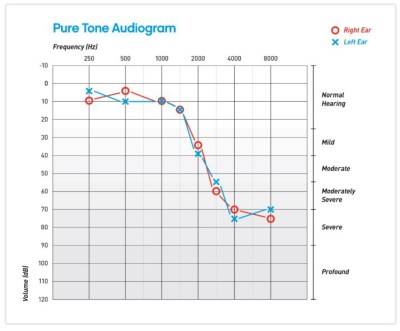
Resultant audiogram from the device showing each ear in a different color

By using an Arduino to produce tones of various stepped frequencies, and gradually increasing the volume until the test subject can detect the tone, it is possible to plot an audiogram of hearing threshold sensitivity.  Testing each ear individually allows a comparison between one side and the other.

[mircemk] has built a nice miniature cabinet that holds an 8×8 matrix of WS2812 addressable RGB LEDs.  A 128×64 pixel OLED display provides user instructions, and a rotary encoder with push-button serves as the user input.

Of course, this is not a calibrated professional piece of test equipment, and a lot will depend on the quality of the earpiece used.  However, as a way to check for gross hearing issues, and as an interesting experiment, it holds a lot of promise.

There is even an extension, including a Class D audio amplifier, that allows the use of bone-conduction earpieces to help narrow down the cause of hearing loss further.

There’s some more information on bone conduction here, and we’ve covered an intriguing optical stimulation cochlear implant, too.

Apple’s next Mac Pro could feature an M2 chip with up to 48 CPU cores

Among the new computers Apple plans to announce in the coming months is an M2 variant of the Mac Pro, according to Bloomberg’s Mark Gurman. Writing in his latest Power On newsletter, Gurman reports the company has been testing a version of its high-end desktop that features a chipset with a 24-core CPU and 76-core GPU, as well as 192GB of memory. He predicts Apple will ultimately let customers choose between two different chipsets when configuring the Mac Pro. For the moment, Gurman has taken to calling those the “M2 Ultra” and “M2 Extreme.”

“My belief is that the Mac Pro will be offered with options for 24 and 48 CPU cores and 76 and 152 graphics cores — along with up to 256 gigabytes of memory,” he writes. Gurman adds those chips will be “at least twice or four times as powerful as the M2 Max,” a processor Apple has yet to announce. To put those core counts in perspective, the base M2 features 8 CPU cores and 10 GPU cores. Meanwhile, the unannounced M2 Max is expected to feature 12 CPU cores and 38 GPU cores.

Before the new Mac Pro arrives, Gurman expects Apple to announce updated versions of the 14- and 16-inch MacBook Pro, as well as a new Mac mini. According to him, Apple’s latest high-end laptops will feature the company’s new M2 Pro and M2 Max chips, while the Mac mini will ship with the same M2 silicon found in its 2022 MacBook Air. Gurman notes Apple has also internally tested an M2 Pro variant of the Mac mini, though he doesn’t mention if the company plans to release that version of the computer. Those devices should arrive sometime in the coming months.

Amazon’s Echo is half off right now

If you missed the chance to pick up an Echo during Amazon’s recent Prime Day sales event, the retailer has discounted the smart speaker to its lowest price ever. This weekend, you can buy the Echo for $50, or half off its usual $100 price. We gave Amazon’s spherical smart speaker a score of 89 when it came out in 2020. Since then, it has remained one of our favorites in the category.

Buy Amazon Echo at Amazon - $50

The Echo sounds great for its small size, outperforming similarly priced smart speakers like the Nest Audio and HomePod mini. It’s also versatile thanks to Amazon’s decision to include both Bluetooth connectivity and a 3.5mm audio jack. What’s more, the 50 percent discount makes it affordable to buy two speakers for a stereo pair and get even better sound.

Buy Echo Show 5 at Amazon - $35Buy Echo Show 8 at Amazon - $70

If you want a smart display, Amazon has also discounted the Echo Show 5 and Echo Show 8. The two devices are currently priced at $35 and $70, respectively. For the former, that represents a nearly 60 percent discount, while the latter is a more modest 46 percent off at the moment. In 2021, Engadget awarded the Echo Show 5 and Echo Show 8 scores of 85 and 87, praising the devices for their minimalist designs, excellent displays and solid sound quality. In the case of both devices, our review found that competing options from the likes of Google offered more intuitive user interfaces. That may be still true, but it’s less of a potential deal breaker when the Echo Show 5 and Echo Show 8 are discounted by as much as they are currently.

Follow @EngadgetDeals on Twitter and subscribe to the Engadget Deals newsletter for the latest tech deals and buying advice.

Elon Musk’s Neuralink delays show-and-tell event to November 30th

Neuralink has delayed its upcoming “show & tell” event by a month. On Sunday morning, Elon Musk tweeted that the showcase would take place on November 30th, instead of October 31st as was originally announced back in August. Musk did not provide a reason for the delay.

Neuralink show & tell now on Nov 30

— Elon Musk (@elonmusk) October 23, 2022

The last time Neuralink held an event, it showed a monkey playing Pong with its mind. Since then, the company has seen most of its co-founders leave, and rumors circulate that Musk has been contemplating investing in a rival brain chip company. Moreover, the fact that Neuralink has yet to secure regulatory approval from the Food and Drug Administration to begin human trials suggests the company finds itself at an inflection point. Whatever it has to show next month may therefore be critical to its future, so it’s not surprising the company thinks it needs more time to prepare.

Beats Studio Buds drop to a new low of $90 at Amazon

If you’re looking for a solid and affordable pair of wireless earbuds, look no further than the Beats Studio Buds. Normally priced at $149.95, they’re currently 40 percent off on Amazon, making them $89.95 at the moment. That’s a new all-time low price for one of the more compelling pair of earbuds you can buy right now. What’s more, the discount applies to all five color options, including the newer moon grey and ocean blue variants.

Buy Beats Studio Buds at Amazon - $89.95

Engadget’s resident audio expert Billy Steele awarded the Beats Studio Buds a score of 84 in 2021, calling them the best Beats earbuds for most people. He found they were comfortable and offered solid sound quality and active noise cancellation. The inclusion of IPX4 water-resistant housing made them a good fit for gym use, as well.

Apple users will appreciate that the Beats Studio Buds come with the company’s H1 chipset inside. It makes pairing the earbuds with an iPhone and other Apple devices fast and easy. Switching between those devices is seamless, as well. Thankfully, the Beats Studio Buds also support Android’s Fast Pair and Find My Device features, making them a good purchase regardless of your preferred mobile operating system. In recent years, Beats has done a lot to tweak its signature audio profile. The Studio Buds produce well-tuned mids and highs with bass that doesn’t overwhelm everything else. Our main gripe with them is that their case doesn’t support wireless charging.

If you’ve had your eye on other Beats products, Amazon has discounted the brand’s entire lineup, including the Beats Fit Pro and Beats Studio3 headphones. The former are currently 20 percent off, matching their previous all-time low price. We like the Beats Fit Pro earbuds for their solid sound quality, strong active noise cancellation and comfortable design.

Follow @EngadgetDeals on Twitter and subscribe to the Engadget Deals newsletter for the latest tech deals and buying advice.

The Wire retracts reporting on Meta citing 'certain discrepancies'

After nearly three weeks of escalating rhetoric, The Wire is retracting its reporting on Meta. On Sunday, the nonprofit publication said it had discovered “certain discrepancies” with the material that had informed its reporting on the social media giant since October 6th. “The Wire believes it is appropriate to retract the stories,” the outlet said, pointing to the fact it could not authenticate two emails that were critical to its previous coverage of Meta. One of the emails The Wire said it could not verify includes a message the outlet had attributed to Meta spokesperson Andy Stone.

“Our investigation, which is ongoing, does not as yet allow us to take a conclusive view about the authenticity and bona fides of the sources with whom a member of our reporting team says he has been in touch over an extended period of time,” The Wire said. “We are still reviewing the entire matter, including the possibility that it was deliberately sought to misinform or deceive The Wire.”

Before Sunday’s retraction, The Wire claimed Meta gave Amit Malviya, an information technology official with India’s ruling BJP party, the power to remove posts from Instagram, an assertation Meta has consistently disputed. Rather than backing down after the company shared a comprehensive rebuttal on October 12th, The Wire kept publishing stories that claimed Meta was misleading the public, culminating in an October 15th article that featured a screen recording the outlet claimed showed proof of the original takedown request that kicked off the entire saga. One day later, Meta said an internal investigation found the video showed a Workspace account created on October 13th, suggesting someone made the account to back up The Wire’s reporting.

Meta did not immediately respond to Engadget’s request for comment. Amid all the back and forth, Instagram eventually reinstated the post that prompted The Wire’s investigation in the first place.

Hitting the Books: The early EVs that paved the way for GM's Ultium success

General Motors has been in business for more than a century, but in its 112 years, the company has never faced such challenges as it does in today's rapidly electrifying and automating industry. The assembly line jobs from Detroit's heyday have been replaced by legions of automated industrial arms, almost as quickly as the era of internal combustion engines has been supplanted by EVs. Since 2014, it's been Mary Barra's job as CEO of GM to help guide America's largest automaker into the 21st century. 

In Charging Ahead: GM, Mary Barra, and the Reinvention of an American Icon, author and Bloomberg automotive journalist, David Welch, recounts Barra's Herculean efforts to reinvent a company that has been around since horses still pulled buggies, reimagine the brand's most iconic models and bring EVs to the masses — all while being a woman in the highest echelons of a male dominated industry. In the excerpt below, Welch examines some of GM's earliest electric initiatives, like the popular but short-lived EV1 or the loss leader Bolt, without which we likely wouldn't have many of Ultium-based vehicle offerings. 

HarperCollins

Taken from Charging Ahead by David Welch. Copyright © 2022 by David Welch. Used by permission of HarperCollins Leadership, a division of HarperCollins Focus, LLC.


Battery-powered cars had captured the imagination of wealthy, tech-minded drivers. Tesla was the first to tap into that, becoming a hot brand in the process. Its cars began stealing customers away from the likes of Mercedes-Benz and BMW. But in 2017, when Barra was weighing up her own plug-in play, EVs were still only about 1 percent of car sales. They were still too expensive for most consumers and even at fat prices, they lost money. EVs sold by Tesla, GM, and Nissan could take hours to charge and only Tesla models could go more than 300 miles on a charge.

GM had been working on electric batteries and developing vehicles that would run on them. In no way was Barra flat-footed. But spending billions on cars with an uncertain group of buyers was seen as speculative and risky. Internally at major car companies, there were still voices saying that EVs were a costly science project. They assumed Tesla would run out of cash one day and carmakers could carry on as they always had.

Internally, GM was weighing uncertain demand for EV sales against the risk that Tesla and Germany’s Volkswagen group and even Ford would capture the buyers who made the switch. That threatened to completely reset customer loyalties and shake up the industry. Tesla already sold most of the electric vehicles on the market. Elon Musk threatened to upend the auto industry the way Apple’s iPhone did to ’90s mobile phone kingpins Nokia, Motorola, Ericsson, and Siemens. GM’s future hinged not only on Barra’s courage to make a move, but also on her being wise enough to get the timing right.

Caution was understandable. At the time, Tesla was by far the top seller of electric vehicles with 100,000 sold globally and losses of about $2 billion on sales of its Model S sedans and Model X SUVs. Those Teslas typically sold for more than $100,000 apiece, which is triple the price of the average gasburning family SUV. With Tesla’s $100,000 cars losing money the challenge for companies to make a buck selling EVs was daunting.

GM knew it all too well. In the 1990s, the company had sold the famous EV1, an aerodynamic two-seater priced at $34,000 that was leased to EV enthusiasts from 1996 to 1999. That was an expensive car back then. GM spent $1 billion developing it and would lose more money selling the vehicles, said [then-GM CEO G. Richard] Wagoner in an interview. I remember seeing a presentation for the car at the Detroit Auto Show in 1997. GM’s then vice chairman, Harry Pearce, talked about electric cars like the EV1 and also about hybrids that ran on gasoline engines and electric motors. For GM, it was a display of what the company’s engineers could do and a glimpse of the future, he told me. But it would be decades before it would be a real business.

The EV1 would bring GM serious credibility with environmentalists, but after leasing 1,100 of them, the company lost a lot of money. A few Hollywood actors like Ed Begley Jr. leased one and promoted it as often as he could. Francis Ford Coppola had one, and when GM ended the program and demanded that lessees return the cars, he refused to give it up and kept it. The company crushed all the cars that it had leased after retrieving them, which then made GM a pariah with the same environmentalists who loved the car.

The economics of electric cars weren’t very good twenty years later. Chevrolet started selling the Bolt in 2016 and lost a whopping $9,000 on every one of the $38,000 plug-in cars it sold. Before that, GM sold the Volt plug-in hybrid, which uses a gasoline engine and an electric motor in tandem to get forty-two miles per gallon. The Volt lost even more. Those nasty numbers would drive serious resistance to electric cars inside GM and at other major carmakers, too.

One big reason GM sold the Bolt was to meet government regulations. In California and a dozen coastal states that followed its lead, automakers had to sell electric vehicles or other super-efficient cars like hybrids to be able to sell their profitable gas guzzlers. Selling green vehicles earned ZEV credits. GM could also buy ZEV credits from Tesla, which many automakers did. But that just meant that they were helping fund Musk’s effort to eat their lunch.

In the EV race, Tesla already had the advantage of a tremendous amount of investor patience for Musk’s losses. Even though Tesla lost $2 billion that year, his company’s market capitalization ended 2017 with a total value of $52 billion. That was just $4 billion less than GM’s even though Barra brought in near record profits that year. In other words, the market would continue to fund Musk’s money-losing operation, but Barra had to fund her own vehicle development with profits from the very gas guzzlers she was seeking to replace.

That put GM and the mainstream car companies under pressure from three sides. Shareholders wanted profits from pickup trucks and sport utility vehicles. But in the car market, Tesla was stealing buyers, gaining a technological advantage in battery development, and building an Apple-like brand for making the cars of tomorrow. Meanwhile, governments were putting the squeeze on with new clean-air rules.