Walnut Case Sets This Custom Arduino-Powered RPN Calculator Apart from the Crowd
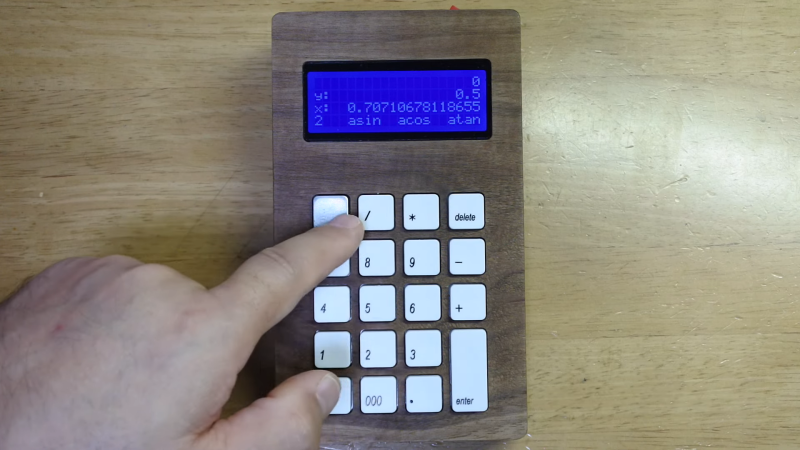
How many of us have an everyday tool that’s truly unique? Likely not many of us; take a look around your desk and turn out your pockets, but more often than not, what you’ll find is that everything you have is something that pretty much everyone else on the planet could have bought too. But not so if you’ve got this beautiful custom RPN calculator in a wooden case.

This one comes to us from [Shinsaku Hiura], who generally dazzles us with unique mechanical clocks and displays. This calculator solves a more practical problem — the dearth of RPN calculators on the market with the correct keyboard feel, specifically with the large keys and light touch he desired. Appropriately, the build started with a numeric keypad, which once liberated of its USB interface was reverse-engineered to figure out how the matrix was wired. Next up, a custom PCB to connect the keypad to an Arduino and a 20×4 LCD display was milled up, while a test case was designed and printed to check fitment. The final case was milled from a block of solid walnut and fitted with an acrylic window, for a sharp look with clean lines and pleasing colors.

As for the calculator itself, the demo below shows it going through its paces. The code is clever because it leverages the minimal number of keys available by hiding all the scientific and engineering functions behind a “secret silver key” that was once the equals key and obviously not needed in RPN. Hats off to [Shinsaku] for a handsome and unique addition to his desk.

Twitter warns employees that layoffs are happening Friday

Twitter will reportedly begin laying off workers on Friday, only a week after Elon Musk officially took control of the website. Around half of the company's staff members will lose their jobs, according to internal messages seen by The New York Times and The Washington Post. That's consistent with the previous reports that came out earlier this week.

Musk didn't waste much time in making personnel changes after taking over Twitter. His first act was to dismiss then-CEO Parag Agrawal and other members of the leadership team. Several other executives have left the company over the last week. In an email sent to staff members, Twitter said that it has to "go through the difficult process of reducing [its] global workforce on Friday" and that the move "is unfortunately necessary to ensure the company's success moving forward."

Twitter's offices will be closed on Friday, and all employees are asked to stay home and wait for an update regarding their fate. Those who get to keep their jobs will receive an email with the subject line "Your Role at Twitter" via their work emails. Twitter will contact people getting laid off through their personal emails with the next steps to take.

Since Twitter is now a privately held entity, it doesn't ostensibly have to answer to shareholders anymore. However, the company still needs to improve the bottom line. It's on the hook for roughly $1 billion a year in interest payments on the debt Musk saddled the company with when he bought it. In the three months to June 30th, Twitter posted a net loss of $270 million. So, it needs to make more money and/or reduce costs, and to do so pretty swiftly.

Some major advertisers are skittish about the new regime and Twitter is trying to diversify its sources of revenue. Musk plans to charge $8 per month for Twitter Blue, which verified users will need to pay for to retain their blue checkmark. The service will offer new features, according to Musk, with subscribers seeing fewer ads and the ability to include longer videos in tweets. Reports suggest the Twitter Blue may go up from $5 to $8 per month as soon as Monday. The company is also reportedly working on a plan to offer paid video posts, which it may use to monetize adult content.

Mariella Moon contributed to this report.

Samsung's next Odyssey Neo G9 will be the 'first' 8K ultrawide gaming monitor

Now that AMD has unveiled Radeon RX 7900 GPUs that can output 8K video at high refresh rates, gamers will need displays that can handle them — and Samsung is happy to oblige. The company has teased a new generation of its Odyssey Neo G9 that will supposedly be the first 8K ultrawide gaming monitor. You won't see a full launch until CES in January, but you'll need a DisplayPort 2.1-capable video card to help that screen reach its potential. We'd also add that AMD bills the 8K as "horizontal only," so you may not get as many vertical pixels as you might like.

Other high-res DisplayPort 2.1 monitors are coming from Acer, ASUS, Dell and LG starting in early 2023. AMD unfortunately didn't share more details.

This will likely be an expensive monitor when the previous-gen Odyssey Neo G9 currently sells for $2,200 with 'just' a 5,120 x 1,440 resolution and a 240Hz refresh rate. However, the bigger cost may be the PC attached to that 8K panel. On top of one of the new Radeons, you'll need a CPU that won't create a bottleneck for the graphics hardware.

There's also the question of content. Even many recent games can struggle at 8K, and older titles won't benefit much. Do you really need to play CS:GO at that resolution? AMD has promised that some games will run well on its cards with the help of upscaling, such as Assassin's Creed Valhalla, Death Stranding, Modern Warfare 2 and Uncharted, but it's not clear how well native 8K will perform just yet. Samsung's monitor may be more of an investment in the future than instant gratification.

AMD's first RDNA3 GPUs are the Radeon RX 7900 XTX and 7900 XT

Now that NVIDIA has kicked off the latest video card wave with the insanely powerful RTX 4090, all eyes are on AMD to see how it will respond. Today, the company announced the Radeon RX 7900 XTX and RX 7900 XT, two confusingly named GPUs powered by its new RDNA3 architecture. On stage during its Las Vegas launch event, AMD CEO Dr. Lisa Su claimed the new hardware offers a 54 percent increase in performance per watt over the previous GPUs. She also emphasized that AMD is focused on delivering complex performance with reasonable power usage, a clear knock against NVIDIA's power-hungry (and PSU cable-melting) RTX 4090.

Developing...

Amazon freezes hiring at its corporate offices

Amazon is joining the ranks of tech companies freezing their recruitment plans. Engadget has obtained a memo from Senior VP Beth Galetti (since published) revealing that the company will "pause" hiring at its corporate offices for a few months. The internet giant will still replace departing employees and hire new people in "targeted places," Galetti wrote but there won't be any significant expansion in the near future.

As with other companies, Amazon attributed its freeze decision to an "unusual macro-economic environment." The firm doesn't want to spend too much money growing its workforce in difficult financial conditions, to put it another way. Galetti added that Amazon still wants to hire a "meaningful number" of corporate workers in 2023, but that the online shopping giant will track the economy and adjust as it "makes sense."

Amazon had no further comment. It hired aggressively during the height of the pandemic to keep up with a spike in online sales, but ran into trouble this year due to both a return to in-person shopping and mounting costs. The company posted a $2 billion loss during its second quarter (April through June) and cut 99,000 jobs, many of them warehouse workers. It also cancelled the launch of some facilities. In early October, it temporarily halted corporate hires for its retail business.

The pause comes weeks after Meta reportedly suspended all hiring, and months after big names like Apple, Google and NVIDIA have slowed their pursuits. Some companies are making additional cuts — Lyft just confirmed that it's laying off 700 workers, or about 13 percent of its workforce, after cutting 60 positions in July.

Here's what you need to know about Netflix's Basic with Ads plan

By the time you read this article, Netflix will have started rolling out its new “Basic with Ads” plan. After years of resisting investor pressure, the company, following its first subscriber decline in a decade, announced this past April it would begin offering an ad-supported tier. Here's everything you need to know about the company's latest offering.

How is Basic with Ads different from other Netflix plans?

Besides featuring ads (more on that in a moment), the tier will limit you to streaming content at 720p. Additionally, you won’t be able to watch every title in Netflix’s library, and you won’t be able to download shows and films for offline viewing.

How much does the plan cost?

In the US, Basic with Ads is priced at $7 per month.

How many ads will I see?

According to Netflix, Basic with Ads subscribers can expect to see an average of four to five minutes of advertisements per hour of content. Initially, the company plans to play spots that are between 15 and 30 seconds long, though you’ll see them both before and during shows and films. The company will employ “broad” targeting, using criteria like your country and genre preference to inform the ads it shows you

Where is the plan available?

Starting this week, the Basic with Ads plan is available in 12 countries: the US, UK, Australia, Brazil, Canada, France, Germany, Italy, Japan, Mexico, South Korea and Spain. The company expects to launch the tier in more countries over time. 

How do I switch to the new plan?

On either your computer or phone, visit the Netflix website and sign into your existing account. Click or tap on “Account,” and then “Change plan.” There, you’ll see the option to select from any one of the company’s four currently available tiers. Once you confirm you want to switch to the Basic with Ads plan, Netflix will move you over to it at the start of your next billing cycle.

Netflix's ad-supported plan isn't working on Apple TV devices

If you're an Apple TV user who was considering switching to Netflix's new ad-supported plan, it might be best to hold off for now. The more budget-friendly version of the service (the "Basic with ads" tier) currently isn't supported on Apple TV devices, including the new Apple TV 4K unit.

“Basic with ads plan support on tvOS is not available at launch but coming soon," Netflix told Variety. As spotted by 9to5Mac, a Netflix support page notes that you'll only be able to watch Netflix on Apple TV if you're subscribed to the Basic, Standard or Premium tiers. Otherwise, you'll need to access Netflix through a different device.

Netflix didn't explain why the Basic with ads plan doesn't work on Apple TV as yet, but it seems a bit of an oversight. It originally planned to start offering that $7 per month tier in early 2023, but it moved the timeline up to this month. It wanted to get out of the gate before Disney+ launches its ad-supported plan in December.

As of today, Netflix's ad-supported plan is live in the UK, UK, Australia, Brazil, Canada, France, Germany, Italy, Japan, Mexico, South Korea and Spain. It became available in Canada and Mexico on Tuesday. Beyond the inclusion of ads, the plan has some other downgrades from Netflix's higher tiers, such as video resolution maxing out at 720p (the same as the ad-free Basic plan), some content being unavailable and a lack of offline viewing.

Substack adds a chat feature to make it more of a social space

Substack users now have another way to interact with their favorite writers, podcasters and video makers. The platform now has a chat feature, where creators can hang out with their subscribers and perhaps forge deeper links with their communities. "Chat is a community space reimagined specifically for writers and creators— it’s like having your own private social network where you make the rules," Substack said in a clear dig at Twitter.

The feature is only available through Substack's iOS app for now. You won't be able to chat with your favorite Substack writers and podcasters on the web or Android just yet, but chat will eventually be available there.

The company noted that creators can decide the tone and topic of chat threads. They can switch the chat function off and reactivate it whenever they like, and they can decide whether to open it up to everyone or only paid subscribers.

Today we are launching Chat, a new space for writers and creators to host conversations with their subscribers.

Try Chat now: https://t.co/3CxbGAwtGtpic.twitter.com/2OBHJ5Hb8o

— Substack (@SubstackInc) November 3, 2022

The first time that a creator starts a chat, a notification email will go out to all of their subscribers. That seems a little spammy, but at least it's a one-time thing. After that, readers will be alerted to a new chat thread only if they have push notifications switched on.

Creators have a few moderation options, according to an FAQ. They can turn off replies in a chat thread, delete replies and stop subscribers from posting images (readers can flag and hide explicit images as well). Creators can also ban users from chat threads and comments. However, it doesn't seem that there's a way for a writer to appoint trusted moderators to handle that stuff on their behalf for the time being.

Substack pointed out that many newsletter writers have taken to the likes of Discord, Slack and Telegram to chat with their subscribers. Its developers have been working with a group of writers over the last few months to simplify things with an in-house chat option. However, writers may not be willing to give up on external platforms until Substack has more robust chat moderation options. This marks just the beginning of the chat feature and other social functions on the platform, as Substack says more updates are on the way.

Hey T-Mobile, nobody wants your suitcase

Have you ever wanted to use your luggage as a workstation? No? Don't tell T-Mobile that, then. The provider and Samsara have unveiled a smart carry-on suitcase, the "Un-carrier On" (sorry about the pun), whose stand-out feature is the ability to double as a desk. Like a handful of other bag makers, T-Mobile thinks you'll rest your laptop on your baggage while you finish a must-send work email. That strikes us as potentially uncomfortable if the case sits on your lap, especially if you have to stare at T-Mobile's eye-searing magenta — did we mention that's the only color option?

There are some practical features. T-Mobile claims this is the only carry-on suitcase with wireless charging for your phone, and there's USB-C charging if you prefer cables. You can track the case when it invariably gets sent to the wrong airport, and an eight-bag packing set (with conspicuous T-Mobile branding, of course) keeps your toothpaste safely away from your shirts.

The limited edition Un-carrier On will ship later in November, or just in time for that Thanksgiving family visit you may or may not be dreading. However, the scariest part is the price — T-Mobile is asking $325. That's a lot to pay for a carrier promo on wheels, even if the functionality might come in handy at the gate. You might want to slip an item tracker into a conventional carry-on instead.

Astronauts will 3D print part of a human knee in space

Bioprinted body parts could prove vital to future medical treatments, and scientists are going to great lengths to test it — in a very literal sense. NASA, Redwire and the Uniformed Services University of the Health Sciences Center for Biotechnology (4DBio3) are sending a new 3D printer to the International Space Station, Redwire's BioFabrication Facility, to bioprint a human knee meniscus in orbit and study the result on Earth. Ideally, this will lead to treatments for the meniscal injuries that US soldiers all-too-frequently face.

Redwire hopes to 3D print whole organs in space, although it characterizes this as a "long-term" goal. The company is also using NASA's Advanced Plant Habitat for a project to identify genes for space-friendly plants. Another investigation will use a NASA furnace to create and demo passive cooling for electronics in low gravity.

The BFF printer will fly to the ISS aboard a supply rocket launching as soon as November 6th from NASA's Wallops Island spaceport. The mission will carry three extra payloads.

This isn't NASA's first spaceborne 3D printer. Last year, NASA carried a Redwire printer to the ISS to demonstrate printing lunar soil. That technology could one day help Moon colonists build habitats without carrying an abundance of supplies from Earth. The bioprinter is more immediately practical, of course. If the research pans out, doctors could replace damaged body parts without resorting to donations or inorganic implants.