The end of another week is upon us, which means it's time for another round up of the best deals on some of the tech we've tested and recommend. A few discounts are still around from last week's President's Day sale, and new savings have popped up as well. If you're in the market for Apple gadgets, quite a few are seeing decent discounts, including the iPad Mini, iPad Air and the 15-inch MacBook Air. Multiple Anker charging accessories are on sale, as are a few of our favorite Logitech peripherals. We got an exclusive $30 discount from Thermoworks on their popular instant-read thermometer, and 8BitDo's Famicom-inspired keyboard is 20 percent off at Woot. Here are the best deals from this week that you can still get today.
This article originally appeared on Engadget at https://www.engadget.com/xbox-controllers-are-on-sale-for-44-each-plus-the-rest-of-the-weeks-best-tech-deals-181825056.html?src=rss
Picture the scene: you've had an enjoyable day of playing around in mixed reality using Apple's Vision Pro headset. Once you're done for the night, you carefully pack the Vision Pro away while leaving the battery pack connected and soft front cover attached. But when you wake up to begin a new day of work while wearing the $3,500 headset, you spot a problem: a hairline crack has formed on the front cover glass.
That's a problem that at least a few users have encountered, according to a handful of reports on Reddit. It's unclear how many units have been affected, though MacRumorssuggests it's a small number. The issue occurred on Engadget's review unit as well.
The cause of the problem is not yet known. But the similar appearance of the cracks and apparently small number of impacted units suggests that it's down to a manufacturing flaw. Engadget has contacted Apple for comment.
If Apple doesn't officially recognize the issue as a manufacturing defect, it may not cover the crack under the device's warranty. That's reportedly been the case for some of the affected users. As such, they're been put on the hook for $300 to repair the cover glass if they have AppleCare coverage. Otherwise, the cost is a stinging $800.
As MacRumors notes, Apple often offers special repair programs for recognized hardware issues, but that's only likely to happen if there are enough reports to warrant the company fully investigating the matter and identifying a common problem. Still, this gives more credence to the maxim that maybe you shouldn't buy a first-generation Apple product.
This article originally appeared on Engadget at https://www.engadget.com/some-apple-vision-pro-units-reportedly-developed-a-similar-hairline-crack-on-the-front-glass-173701528.html?src=rss
Apple’s newest iPad mini is on sale for $120 off. You can get the 256GB version of the 6th-generation iPad mini (2021) for $529 on Amazon — a record low. If that’s more storage than you need, you can also get the 64GB model (usually $500) is $100 off.
Apple refreshed the iPad mini in 2021 with an “all-screen” Liquid Retina design, ditching the Home button and aligning the mini-tablet with the larger iPad Air’s modern design language. The iPad mini has an 8.3-inch display that supports TrueTone and covers the P3 color gamut. It has a 2266 x 1488 resolution (326 ppi).
This model runs on the A15 Bionic chip, also found in the iPhone 13 series. This tablet eschews Face ID for a Touch ID sensor on its power and sleep button. The iPad mini has a USB-C port for versatile charging and data transfers, and it works with the second-generation Apple Pencil for scribbling notes or digital sketching. Apple estimates up to 10 hours of battery life, which can vary depending on how you use it.
Photo by Valentina Palladino / Engadget
Apple will reportedly update its entire iPad lineup this year, and the latest rumors point to a possible late 2024 launch for a new iPad mini. If those reported plans pan out, this model may only be the newest for another six to eight months.
If you want a full-sized tablet, Walmart has the 5th-generation (10.9-inch) iPad Air for $120 off, too. You’ll pay only $449 for the 64GB variant. This model runs on an M1 chip with a 2360 x 1640 resolution (264 ppi) and an estimated 10 hours of battery life.
This article originally appeared on Engadget at https://www.engadget.com/the-256gb-ipad-mini-is-120-off-and-down-to-a-record-low-price-173024101.html?src=rss
Bluetooth trackers are handy little devices that can help you find things you've misplaced. If you're deep in the Apple ecosystem (or at least have an iPhone), AirTags are perhaps your best choice. If you've been meaning to pick some up, there's some good news for you as a four-pack of AirTags is on sale. The pack has dropped by $20 to $79. That's close to the lowest price we've seen for them, so it's a solid deal.
It's easy to set up an AirTag with your iPhone or iPad as it's a one-tap process. Once you've done that and attached an AirTag to an item, you'll be able to keep track of that alongside your family and friends in the Mind My app. AirTags don't store location data or history and their communications with the Find My network are encrypted and anonymous, Apple says.
You can play a sound on the AirTag's built-in speaker to help you find a misplaced item (useful for, say, a remote that's fallen down the side of a couch), and you can ask Siri for help finding your things. If you have a recent iPhone (11 or later), you'll be able to make use of a second-gen Ultra Wideband chip that powers precision finding — this will give you pinpoint directions to your AirTag once you're within range.
If you've lost an item away from home, you can put its accompanying AirTag into Lost Mode. This means you'll be notified whenever it pops up in the Find My network. In other words, when it is picked up by one of the hundreds of millions of Apple devices in the Find My network. The AirTag is a rugged little thing (it's IP67 water and dust resistant and the replaceable battery lasts over a year), which should give you some time to find your missing item.
To make sure it's securely fastened to your item, you might want to pick up some AirTag accessories. These enable you to attach an AirTag to various fabrics, keys or anything with a strap. There are also cases with adhesive mounts, meaning you can stick an AirTag to just about anything.
The latest Apple HomePod speaker is on sale for $285 at B&H Photo, which is $14 less than buying from Apple directly. This isn't the largest cash discount we've seen, and Apple previously bundled the device with a $50 gift card during Black Friday. But deals of any kind on the home speaker have been uncommon since it arrived in early 2023, so this modest drop still represents the lowest price we've seen in the last few months. The discount applies to both the black and white versions of the speaker.
We gave the second-generation HomePod a score of 84 in our review last year. It'll make the most sense if you're a particularly dedicated Apple user who prioritizes audio quality. It still works easily with other Apple devices and services, from iPhones to Apple TVs to Apple Music, and we generally find it to sound richer and clearer than competing smart speakers from Amazon and Google. As a smart home device, it's compatible with Matter and Thread on top of Apple's own HomeKit protocol, so you can use it to control a growing range of security cameras, thermostats, plugs and other smart home accessories. It also has built-in temperature and humidity sensors, and its included mics do well to pick out your voice through noise.
To be clear, this is still a pricey and relatively niche device. Speakers like the Sonos Five and Sonos Era 300 cost more but offer louder and more dynamic sound quality, while the Sonos Era 100 may be a better value if you want to conserve a little more cash. Apple's own HomePod Mini has nearly all of the same smart home features if that's your main concern, while Google Assistant and Alexa users should still look to Google's Nest Audio or an Amazon Echo device. The HomePod has its own issues, too: Siri isn't the most capable voice assistant, there's no Bluetooth audio, you can't customize its EQ and you need a workaround to control Spotify via voice. Rumors of a touchscreen-enabled HomePod have also floated around over the past year. All that said, if you're all-in on Apple, this is a decent chance to save on the company's highest-end home speaker.
This article originally appeared on Engadget at https://www.engadget.com/the-second-gen-apple-homepod-is-down-to-285-in-a-rare-sale-153431326.html?src=rss
Every gram counts in commercial flight. Material scientists from Kobe University have discovered “nanospheres” that are near-invisible silicone crystals. The particles can reflect light thanks to very large and efficient scattering, research published in the ACS Applied Nano Matter journal details. The result could mean covering a surface in vibrant color while only adding 10 percent of the weight of painting an aircraft for the same effect.
Minoru and Hiroshi’s discovery focuses on structural rather than pigment color to exhibit and maintain hues. The former absorbs wavelengths while reflecting those the human eye picks up. Structural colors, on the other hand, are intense and bright as light interacts with micro- and nanostructures. While the headline commercial benefits are for planes, the paint could have many more uses simply for its brightness.
Final Fantasy 7 Rebirth takes the characters and world reintroduced with Remake and does a better job at scaling it all up. Instead of playing in a single metropolis, Midgar, this time, it’s a world tour. There’s also an expanded roster of playable characters, almost doubling Remake’s total, each with a unique play style, once again. But does Aerith survive?
The Xiaomi 14 Ultra is the latest Leica-branded smartphone, featuring a second-gen one-inch camera sensor. Xiaomi is finally catching up with the competition by picking up Sony’s newest mobile camera sensor, the LYT-900. The Xiaomi 14 Ultra has a slight edge on rival phones with the same sensor, with its faster main variable aperture at up to f/1.63, beating the Oppo Find X7 Ultra’s f/1.8 — on paper, at least.
Pick the parts you want and install them yourself.
Framework is selling its cheapest modular laptop. It has dropped the price of its B-stock Factory Seconds systems (which are built with excess parts and new components). As such, it’s now offering a Framework Laptop 13 barebones configuration for under $500 for the very first time. The 13-inch machine comes with an 11th-gen Intel Core i7 processor with Iris Xe graphics. So the CPU should be sufficient for most basic tasks and some moderate gaming. However, you’ll need to add RAM, storage, a power supply, an operating system and (probably) even a Wi-Fi card.
This article originally appeared on Engadget at https://www.engadget.com/the-morning-after-nanosphere-paint-could-reduce-a-planes-co2-emissions-121433976.html?src=rss
Google Pay was largely replaced by Google Wallet back in 2022, but it has still been operating in several countries, including the US. Now, the search giant has announced that Pay will be discontinued stateside on June 4, 2024 in a push to simplify its payment apps. After that, it will only be available in Singapore and India due to the "unique needs in those countries," Google wrote in a blog.
As part of the deprecation, Google will be removing peer-to-peer (P2P) payments, managing your balance and "find offers and deals." For the latter, it recommends using the new deals destination on Search. Users will still be able to transfer their Google Pay (GPay) balance to a bank account after June 4, 2024 using the Google Pay website.
Google Wallet has now largely replaced GPay, with five times as many users in 180 countries, the company said. That's because it can handle more than just payments — on top of credit and debit cards, it stores transport passes, state IDs, driver's licenses, virtual car keys and more.
Google's payment system has been a mess over the years. It started off as Google Wallet, which was launched in 2011. At the time, it was a tap-to-pay system that came out years ahead of Apple Pay (2014), supported by Mastercard and retailers like Macy's.
Meanwhile, Android Pay came out in 2015, then that was integrated with Google Wallet in 2018 and rebranded as Google Pay. In addition, the company originally had a Google Wallet card (killed in 2016) that was effectively a prepaid debit card usable with any retailers that accepted Mastercard. Now everything is back under the Google Wallet umbrella — unless the company changes its mind again.
This article originally appeared on Engadget at https://www.engadget.com/google-pay-is-shutting-down-in-the-us-later-this-year-105720968.html?src=rss
Meta is currently testing a couple of capabilities for Threads, which Instagram head Adam Mosseri describes as some of the "most requested" features for the social network. One of these experimental features is the ability to save drafts. Users will be easily able to save a post they've typed as a draft that they can edit and publish later by swiping down on their mobile device's display. When there's a draft saved, the app's menu at the bottom of the screen highlights the post icon. At the moment, though, they can only save one draft, and it's unclear if Meta has plans to give users the ability to save more.
In addition to drafts, Meta is also testing an in-app camera. It opens the mobile phone's camera from within Threads itself, so that users can more easily share photos and videos from their phone. Meta chief Mark Zuckerberg made a post on the service with a photo he says was taken with the new in-app camera the company is testing.
Meta told us that these are initial tests for the experimental features, which means they could undergo a lot of changes before they get a wide release, and are only available for a small number of people. Over the past month, Meta also started testing a bookmarking feature for Threads that allows users to save posts they can refer to later. The company is experimenting with its version of trending topics on Threads, as well, along with the ability to make cross-posts between Threads and Facebook.
This article originally appeared on Engadget at https://www.engadget.com/the-latest-experimental-threads-features-let-you-save-drafts-and-take-photos-in-app-094535111.html?src=rss
Panasonic's powerful full-frame mirrorless camera, the S5 II, is on sale at Amazon and B&H Photo Video at the lowest price we've seen yet. You can grab one with an 85mm f/1.8 prime lens for as little as $1,796, a savings of $800 over buying both separately — effectively giving you a discount on the camera and a free lens to boot.
As I wrote in my review, the 24-megapixel S5 II was already a great value at $2,000 thanks mainly to its strength as a vlogging camera. It's the company's first model with a phase-detect autofocus system that eliminates the wobble and other issues of past models.
Panasonic also brought over its new, more powerful stabilization system from the GH6. And it has the video features you'd expect on a Panasonic camera, like 10-bit log capture up to 6K, monitoring tools and advanced audio features. With the generous manual controls and excellent ergonomics, it's an easy camera to use. It also comes with a nice 3.68-million dot EVF and sharp rear display that full articulates for vlogging.
For photos, it's reasonably fast and great in low light, thanks to the dual native ISO system. Other features include dual high-speed SD card slots and solid battery life, particularly for video. The main downside is noticeable rolling shutter, but that shouldn't be a dealbreaker for most users — particularly at that price.
This article originally appeared on Engadget at https://www.engadget.com/pansonics-powerful-lumix-s5-ii-is-800-off-with-a-prime-lens-084816863.html?src=rss
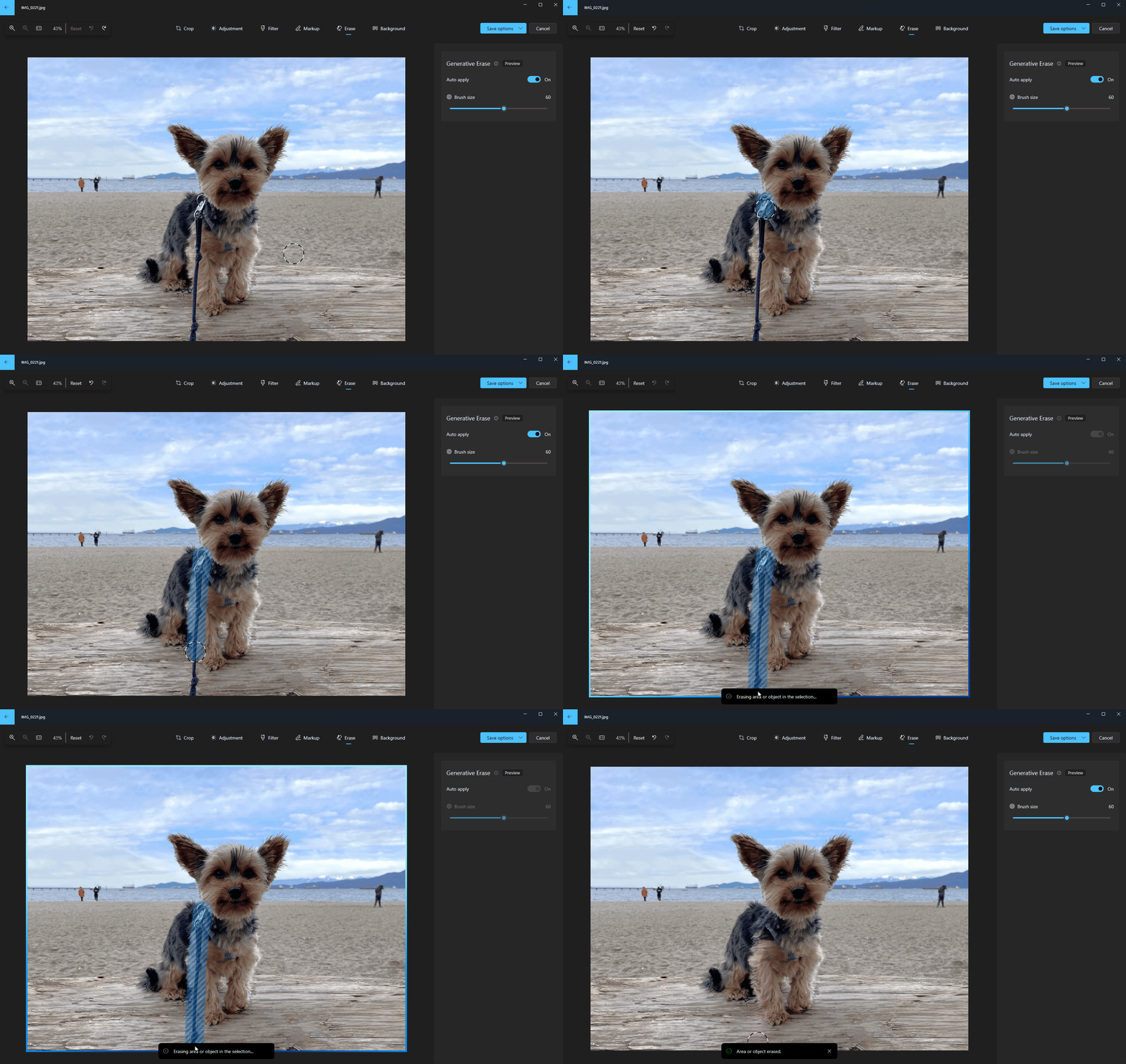
Microsoft has announced a generative-AI powered eraser for pictures, which gives you an easy way of removing unwanted elements from your photos. Windows Photos has long had a Spot Fix tool that can remove parts of an image for you, but the company says Generative erase is an enhanced version of the feature. Apparently, this newer tool can create "more seamless and realistic" results even when large objects, such as bystanders or clutter in the background, are removed from an image.
If you'll recall, both Google and Samsung have their own versions of AI eraser tools on their mobile devices. Google's used to be exclusively available on newer Pixel phones until it was rolled out to older models. Microsoft's version, however, gives you access to an AI-powered photo eraser on your desktop or laptop computer. You only need to fire up the image editor in Photos to start using the feature. Simply choose the Erase option and then use the brush to create a mask over the elements you want to remove. You can even adjust the brush size to make it easier to select thinner or thicker objects, and you can also choose to highlight more than one element before erasing them all.
At the moment, though, access to Generative erase is pretty limited. It hasn't been released widely yet, and you can only use it if you're a Windows Insider through the Photos app on Windows 10 and Windows 11 for Arm64 devices.
Microsoft
undefinedThis article originally appeared on Engadget at https://www.engadget.com/microsoft-is-giving-windows-photos-a-boost-with-a-generative-ai-powered-eraser-061851854.html?src=rss