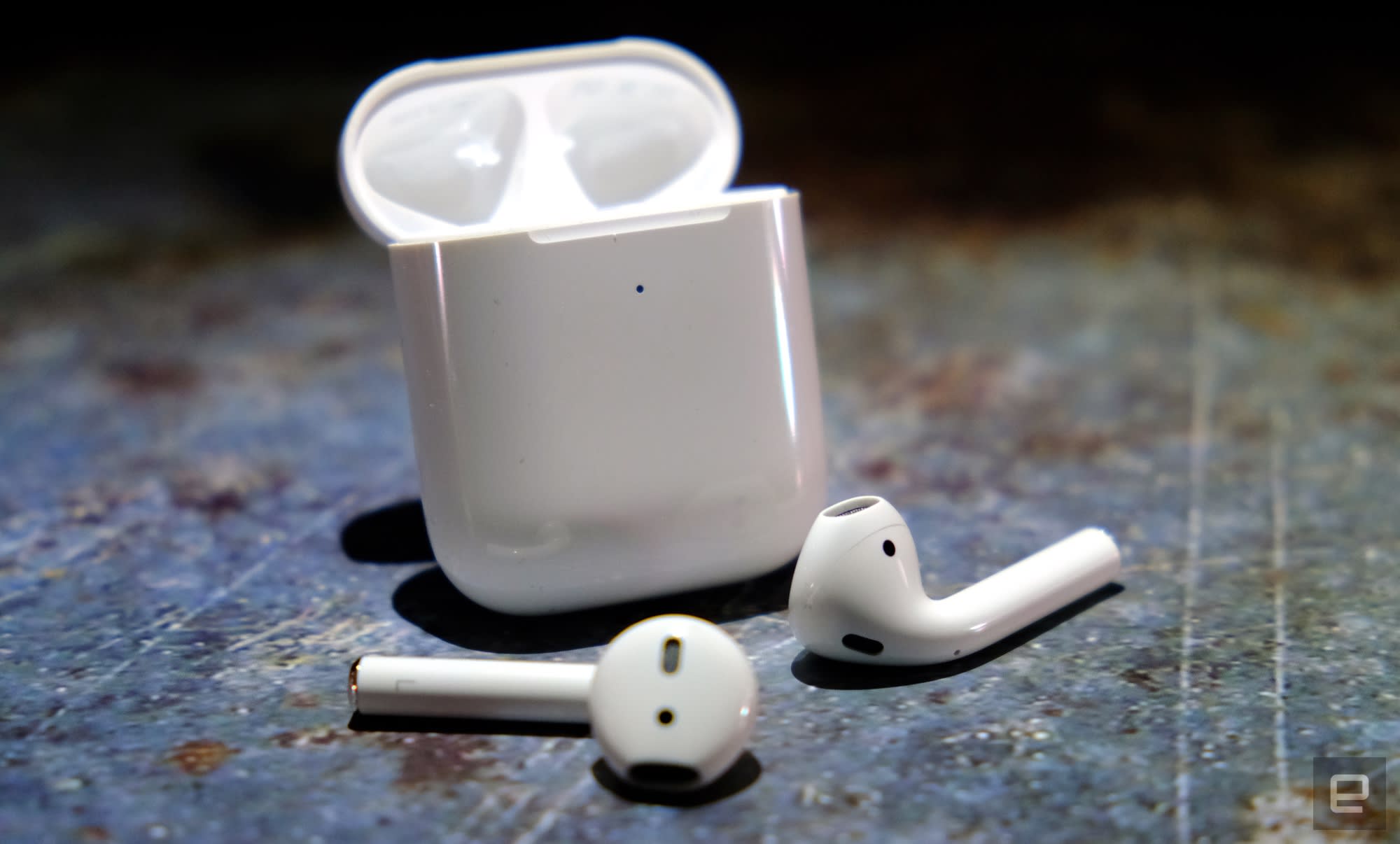
If you have Apple devices on your shopping list for this holiday season, you may be able to save on some of them if you pick them up during Amazon's October Prime Day. The online retailer has knocked down the prices of many Apple gadgets, including AirPods, iPads, MacBooks and more. Since Apple stuff is always in high demand, it's not a bad idea to cross these items off your list early if you can so you're not left gift-less and searching for a last-minute replacement. Here are the best deals on Apple gadgets we found for the Prime Day Early Access Sale.
AirPods Pro (2nd gen)
Apple's second-generation AirPods Pro at $15 off and down to $235 for this October Prime Day. That's the best price we've seen since launch, and we gave them a score of 88 for their improved sound, excellent Transparency Mode and solid ANC.
The original AirPods are down to $90. While they're a bit outdated at this point, these are still decent earbuds that we liked for their improved wireless performance and good battery life.
The latest Apple TV 4K has dropped to $109. While on the expensive side, it's a set-top box that Apple lovers will appreciate. We gave it a score of 90 for its speedy performance, Dolby Vision and Atmos support and much improved Siri remote.
The previous-generation MacBook Air with the M1 chipset is on sale for a new low of $799. Although the latest model is outfitted with the M2 chip, this version remains a solid, speedy laptop. We gave it a score of 94 for its impressive performance, excellent keyboard and trackpad and fanless design.
The 10.2-inch iPad is down to $269. We gave it a score of 86 for its improved performance, excellent battery life, better front-facing camera and increased base storage.
The latest Apple Watch is on sale for $349, or $50 off its normal price. That's the cheapest we've seen the Series 8 since launch, and we like that it's very much like the Series 7, but with added features like car crash support and an added skin temperature sensor.
You can pick up the Apple Watch SE for only $199 right now. If you've never had a wearable before, this is the Apple Watch to get. We gave it a score of 88 for its comfortable design and responsible performance.
Apple's latest iPad Air with the M1 chipset is on sale for $519. We gave it a score of 90 for its extremely fast performance, improved front camera and excellent battery life.
Apple's latest iPad mini is $100 off and down to $399 right now. We consider it to be the best small tablet you can get, and it earned a score of 89 from us for its refined design, Center Stage cameras, solid performance and good battery life.
Apple's 12.9-inch iPad Pro with the M1 chipset is cheaper than ever with a starting price of $899. This version earned a score of 87 from us for its excellent performance, gorgeous screen and new Center Stage cameras.
This might be your best chance to save money on a 2021 iPad Pro. Ahead of its Prime Early Access Sale, Amazon has discounted the 256GB 12.9-inch model by 25 percent to $899. The more affordable 11-inch iPad Pro is also on sale. However, it appears Amazon only has stock of the 512GB variant. After a 23 percent discount, the 11-inch model is $849, down from $1,099. The promotion applies to both Silver and Space Gray colorways across both 11-inch and 12.9-inch models.
The iPad Pro is one of the most powerful tablets you can buy at the moment. Engadget awarded the 2021 model a score of 87, praising the device for its speedy M1 processor and mini-LED screen that makes watching HDR content an absolute joy. At the time, it felt like iPadOS wasn’t a perfect match for the iPad Pro's powerful hardware, but with iPadOS 16 on the way and new multitasking features like Stage Manager part of the release, the tablet is about to become more capable.
One thing to keep in mind is that Apple may refresh the iPad Pro later this month. Persistent rumors suggest the company plans to introduce a model that features an M2 processor, MagSafe charging and a handful of other upgrades. For that reason, you may want to wait if you want to buy the most powerful iPad possible. However, if you’re mainly interested in getting the most value for your money, then it’s hard to go wrong with the current M1 model.
Apple will more widely adopt USB-C across its product portfolio over the next few years, according to Bloomberg’s Mark Gurman. Writing in his latest Power On newsletter, Gurman says he expects the company to transition all of its wireless earbuds, including the recently refreshed AirPods Pro, to the charging standard by 2024. Additionally, Apple could refresh accessories like the Magic Mouse with USB-C – and a more intuitive design, one would hope – as early as next year.
The reported shift would put most of Apple’s products in compliance with the European Union’s upcoming USB-C mandate. Earlier this week, the European Parliament voted to make the port the common charging standard across the bloc. Once enacted, the legislation will make it so that any new phones, tablets and headphones released in the EU will need to feature USB-C for charging by the end of 2024. The mandate will extend to laptops in the spring of 2026.
In May, Gurman reported that Apple had begun testing USB-C iPhones ahead of the EU adopting the proposed legislation. At the time, he warned that if the company were to proceed with the change, “it wouldn’t occur until 2023 at the earliest.” He now says the iPhone 15 line “is essentially a lock” to receive USB-C next fall.
However, Apple’s switch to USB-C may be short-lived. Gurman expects the company to transition the iPhone and iPad “entirely” to inductive charging “at some point in the next few years.” He notes the company may see the technology as a way to get around the EU’s legislation since it doesn’t cover wireless charging.
Of course, if you’ve been following the Apple rumor mill for long enough, you’ll know that a portless iPhone is something the company has reportedly been thinking about ever since it removed the headphone jack from the iPhone 7 in 2016. Since then, however, Qi charging has created a few problems for Apple – including, most notably, the high-profile cancelation of AirPower in 2019.
The fates of Apple and Taiwanese semiconductor manufacturer TSCM have grown inextricably intertwined since the advent of the iPhone. As each subsequent generation of iPhone hurtled past the technological capabilities of its predecessor, the processors that powered them grew increasingly complex and specialized — to the point that, today, TSCM has become the only chip fab on the planet with the requisite tools and know-how to actually build them. In his new book, Chip War: The Fight for the World's Most Critical Technology, economic historian Chris Miller examines the rise of processor production as an economically crucial commodity, the national security implications those global supply chains might pose to America.
The greatest beneficiary of the rise of foundries like TSMC was a company that most people don’t even realize designs chips: Apple. The company Steve Jobs built has always specialized in hardware, however, so it’s no surprise that Apple’s desire to perfect its devices includes controlling the silicon inside. Since his earliest days at Apple, Steve Jobs had thought deeply about the relationship between software and hardware. In 1980, when his hair nearly reached his shoulders and his mustache covered his upper lip, Jobs gave a lecture that asked, “What is software?”
“The only thing I can think of,” he answered, “is software is something that is changing too rapidly, or you don’t exactly know what you want yet, or you didn’t have time to get it into hardware.”
Jobs didn’t have time to get all his ideas into the hardware of the first-generation iPhone, which used Apple’s own iOS operating system but outsourced design and production of its chips to Samsung. The revolutionary new phone had many other chips, too: an Intel memory chip, an audio processor designed by Wolfson, a modem to connect with the cell network produced by Germany’s Infineon, a Bluetooth chip designed by CSR, and a signal amplifier from Skyworks, among others. All were designed by other companies.
As Jobs introduced new versions of the iPhone, he began etching his vision for the smartphone into Apple’s own silicon chips. A year after launching the iPhone, Apple bought a small Silicon Valley chip design firm called PA Semi that had expertise in energy-efficient processing. Soon Apple began hiring some of the industry’s best chip designers. Two years later, the company announced it had designed its own application processor, the A4, which it used in the new iPad and the iPhone 4. Designing chips as complex as the processors that run smartphones is expensive, which is why most low- and midrange smartphone companies buy off-the-shelf chips from companies like Qualcomm. However, Apple has invested heavily in R&D and chip design facilities in Bavaria and Israel as well as Silicon Valley, where engineers design its newest chips. Now Apple not only designs the main processors for most of its devices but also ancillary chips that run accessories like AirPods. This investment in specialized silicon explains why Apple’s products work so smoothly. Within four years of the iPhone’s launch, Apple was making over 60 percent of all the world’s profits from smartphone sales, crushing rivals like Nokia and BlackBerry and leaving East Asian smartphone makers to compete in the low-margin market for cheap phones.
Like Qualcomm and the other chip firms that powered the mobile revolution, even though Apple designs ever more silicon, it doesn’t build any of these chips. Apple is well known for outsourcing assembly of its phones, tablets, and other devices to several hundred thousand assembly line workers in China, who are responsible for screwing and gluing tiny pieces together. China’s ecosystem of assembly facilities is the world’s best place to build electronic devices. Taiwanese companies, like Foxconn and Wistron, that run these facilities for Apple in China are uniquely capable of churning out phones, PCs, and other electronic. Though the electronics assembly facilities in Chinese cities like Dongguan and Zhengzhou are the world’s most efficient, however, they aren’t irreplaceable. The world still has several hundred million subsistence farmers who’d happily fasten components into an iPhone for a dollar an hour. Foxconn assembles most of its Apple products in China, but it builds some in Vietnam and India, too.
Unlike assembly line workers, the chips inside smartphones are very difficult to replace. As transistors have shrunk, they’ve become ever harder to fabricate. The number of semiconductor companies that can build leading-edge chips has dwindled. By 2010, at the time Apple launched its first chip, there were just a handful of cutting-edge foundries: Taiwan’s TSMC, South Korea’s Samsung, and — perhaps — GlobalFoundries, depending on whether it could succeed in winning market share. Intel, still the world’s leader at shrinking transistors, remained focused on building its own chips for PCs and servers rather than processors for other companies’ phones. Chinese foundries like SMIC were trying to catch up but remained years behind.
Because of this, the smartphone supply chain looks very different from the one associated with PCs. Smartphones and PCs are both assembled largely in China with high-value components mostly designed in the U.S., Europe, Japan, or Korea. For PCs, most processors come from Intel and are produced at one of the company’s fabs in the U.S., Ireland, or Israel. Smartphones are different. They’re stuffed full of chips, not only the main processor (which Apple designs itself), but modem and radio-frequency chips for connecting with cellular networks, chips for WiFi and Bluetooth connections, an image sensor for the camera, at least two memory chips, chips that sense motion (so your phone knows when you turn it horizontal), as well as semiconductors that manage the battery, the audio, and wireless charging. These chips make up most of the bill of materials needed to build a smartphone.
As semiconductor fabrication capacity migrated to Taiwan and South Korea, so too did the ability to produce many of these chips. Application processors, the electronic brain inside each smartphone, are mostly produced in Taiwan and South Korea before being sent to China for final assembly inside a phone’s plastic case and glass screen. Apple’s iPhone processors are fabricated exclusively in Taiwan. Today, no company besides TSMC has the skill or the production capacity to build the chips Apple needs. So the text etched onto the back of each iPhone — “Designed by Apple in California. Assembled in China”—is highly misleading. The iPhone’s most irreplaceable components are indeed designed in California and assembled in China. But they can only be made in Taiwan.
There weren't a lot of surprises in store at today's Google event in Brooklyn — after all, the company started teasing its Pixel 7 and Pixel 7 Pro smartphones, the Pixel Watch and the Pixel Tablet months ago. Regardless, we now have all the details on Google's latest hardware, all of which you can pre-order now in advance of the October 14th launch date (with the exception of the Pixel Tablet, which Google still says will launch sometime in 2023). In the meantime, here's what you need to know about these new phones and watch.
The Pixel 7
Google
Just like last year's Pixel 6, the Pixel 7 is priced at $599, making it a phone that should give you a great bang for your buck. The display is just a tiny bit smaller than last year's model, at 6.3 inches, but it has the same 1,080 x 2,400 resolution. Also like last year, there are two camera modules on the back: a 50-megapixel standard camera and a 12-megapixel ultrawide option. The front-facing camera got a nice upgrade, though — it's a 12-megapixel shooter with bigger pixels and a wider field of view than last year's model. It can also be used to unlock your phone, but there's still an under-display fingerprint sensor if you prefer.
As expected, the new Tensor G2 chip is on board here, enabling a handful of notable features as well as improving overall performance. For example, the Pixel 7 has a new feature called Photo Unblur, which uses the chip's AI smarts to do exactly what it says — make your blurry photos more legible. You can even do this to older photos in your Google Photos library, so you can touch up old memories that you might have shot on other phones or cameras. It also powers the Super Res Zoom features so you can shoot 2x photos that come in at a full 12.5-megapixel resolution, a trick that Google's had around for a while now. But as usual, the results will probably be better this year than before.
From a design perspective, the Pixel 7 largely keeps the look from last year's model, with the prominent camera bar on the back. It comes in three colors (snow, obsidian and lemongrass) and the aluminum body is made from 100 percent recycled material.
The Pixel 7 Pro
Sam Rutherford/Engadget
Of the two new phones, the Pixel 7 Pro is probably the more exciting thanks to its three-lens camera system on the back. Both the 12-megapixel ultrawide camera and the 48-megapixel telephoto camera have been upgraded; the telephoto camera has the same Quad Bayer PD technology as the main 50-megapixel sensor. What this means is that, combined with the aforementioned Tensor G2 chip, the Pixel 7 Pro's Super Res Zoom capabilities should be significantly improved.
The camera itself has a 5x optical zoom compared to the main camera, and the high resolution sensors mean you can pull a 10x zoom picture here at 12.5-megapixels. Overall, Google says you can zoom in as far as 30x if you want — we'll have to review this phone before we can say how good these shots look in reality, but it'll be fun to see just how well this camera can perform in the wild. The ultrawide camera also has a new macro photography mode, thanks to the wider field of view and autofocus feature.
Video shooting has also been upgraded, as all the cameras on the Pixel 7 Pro (and the Pixel 7, for that matter) can shoot 4K video at 60 fps. There's also a new Cinematic Blur feature that automatically blurs the background in videos to make your subject pop more, not unlike what you can do with photos in portrait mode.
As for the rest of the hardware, the Pixel 7 Pro sports the same 6.7-inch screen as the Pixel 6 Pro. Like last year, it supports variable refresh rates up to 120Hz, compared to the 90Hz the Pixel 7 tops out at. Naturally, it also has the same Tensor G2 chip as the Pixel 7; the Pro does come with 12GB of RAM, compared to the 8GB in the standard model. It comes standard with 128GB of storage, but you can step up to 256GB or 512GB if you're going to shoot a ton of video or otherwise save a lot of content on it.
At long last, the Pixel Watch
Cherlynn Low / Engadget
The Pixel Watch has been rumored for years, and we finally know a lot more about it ahead of its launch next week. It comes in a single 41mm size case, but you can get it in three stainless steel finishes (silver, black and gold). As for other customization features, Google says it'll launch with 20 different bands and 19 different watch faces. It has a Gorilla Glass 5 crystal on top, a haptic crown and a second side button, the same essential controls you'll find on the Apple Watch.
Unsurprisingly, there's a lot of Fitbit integration here for activity and health tracking. Notably, the Pixel Watch continuously tracks your heart rate every single second, and it also has an ECG app and can track your sleep quality overnight. GPS means it can track activities like running without your phone, and Google says there are a total of 40 different exercise modes you can use to log different workouts.
Google says the Pixel Watch will last up to 24 hours with its always-on display, and it can be fast-charged to 50 percent in only 30 minutes. The basic model costs $349, while the LTE-capable Pixel Watch costs $50 more. While the Pixel Watch is naturally designed with Pixel phone users in mind, it'll work with any phone running Android 8.0 or higher. You'll also get six free months of Fitbit Premium and three months of YouTube Music Premium.
A quick update on the Pixel Tablet
Google
After a very brief tease earlier this year at I/O, Google gave us a little more detail on the upcoming Pixel Tablet. Unlike the other devices announced, the Pixel Tablet won't arrive until sometime in 2023. Unsurprisingly, we know it'll use the Tensor G2 chip found in Google's latest smartphones, but we didn't get any other spec details. We did, however, learn a bit about it's design. Google’s vice president of product management Rose Yao told Engadget that the company developed a new “nano-ceramic coating” that she said is inspired by “the feel of porcelain" for the Pixel Tablet. She said it feels like the coating on a Le Creuset dutch oven, with tiny pieces of ceramic embedded in the tablet's recycled aluminum frame. Ultimately, this should make for a device that has a good grippy feel.
Another neat feature we saw for the first time is the Pixel Tablet's docking station, which essentially turns the device into a Nest Hub. This magnetic stand holds and charges the Pixel Tablet and also provides it with improved speakers for a better audio experience, whether that's listening to tunes or making video calls. Unsurprisingly, it also has a photo frame feature, again similar to the Nest Hub.
There's no word on release date or pricing yet, so we'll have to be patient; hopefully we'll hear more about the Pixel Tablet early in 2023. But, it wouldn't surprise me if we have to wait until May for the next I/O conference to get all the details on this device.
After some stops and starts, Google is returning to tablets, but with a smart home twist. The company first teased the upcoming Pixel Tablet at I/O this year, saying the device would be launching in 2023. Though that date is still at least months away, Google was eager to share more details at its hardware launch event today.
Google’s vice president of product management Rose Yao said during the keynote that the company thinks of the tablet as part of its Pixel portfolio of products, and that it didn’t feel complete without a “large screen device”. That might be confusing if you recall the ill-fated Pixel Slate and Pixelbook, which were “large screen” Pixel-branded devices.
Like other Pixel gadgets, the tablet will be a canvas for Google’s own expression of Android. And as the company already hinted at its developer conference this year, the tablet will be powered by the same Tensor G2 chip that’s in the flagship phones. Since this is still just a tease, the company is still keeping details like screen size, resolution, RAM and more under wraps.
Google is ready, however, to share more about the Pixel Tablet’s design. It looks similar to older phones like the Pixel 3, with a rounded rectangle shape and a matte-ish glass back. In fact, Yao said the company developed a new “nano-ceramic coating” that she said is inspired by “the feel of porcelain.”
In an interview with Engadget, Yao said the best way to think about this finish is to imagine the coating on a Le Creuset dutch oven. She said that the Pixel Tablet’s coating should feel similarly durable and premium, and that it’s basically embedding tiny pieces of ceramic onto the device’s frame, which is made of recycled aluminum. This creates what she said is a “soft matte finish” with a “grippy feel” that should alleviate what her team believed was a pain point of tablets: “They’re really big devices that are kind of slippery.”
The Pixel Tablet will also run Android, complete with Material You personalization and big screen-friendly features like split screen and stylus support. When I asked for more information about stylus support, Yao said “We'll talk about the more next year,” though she added that “you can use a third-party stylus.”
The fact that the Pixel Tablet is powered by Tensor, which Yao said is the first time Google is bringing its own processor to a different type of product than a phone, enables a few different things.
“I have so many stories I want to share about what that means,” Yao said. But she can’t at the moment, besides alluding to speech recognition, video calls, photo editing and image processing as areas to look out for.
She also shouted out the Assistant, which will be able to “work seamlessly between a tablet and the phone” thanks to Tensor. But not just that, Google wants you to think of its tablet as a place for an always-listening Assistant, much like you would with a Nest speaker. Yao said that her team observed how people used tablets and learned that “tablets are homebodies.” According to her, most tablets are home 80 percent of the time and are only active for a small portion of the time.
Another thing Yao said was that though tablets tended to remain in people’s homes, they “don’t really have a home at home.” They’re often left in drawers or by charging outlets, and can either be forgotten or get in the way. To make a tablet that’s “truly useful 24-7” and that would “bring together the best of Pixel and home,” Yao said her team made a charging speaker dock.
The base doesn’t just charge the device, Yao said it also “unlocks a ton of new experiences and makes the tablet helpful all the time.” Her favorite feature is the photo frame, which is similar to that on the Nest Hub smart display. But the Pixel Tablet also has front and rear cameras, making it useful for video calls.
Yao said the angle “is just really perfect for me,” though based on the pictures Google has shown so far it appears the camera might shoot at an unflattering upwards angle. She also confirmed that the base won’t allow for adjustable angles, so if you don’t like the position you likely won’t be able to change it.
“I really think it's one of the most versatile tablets on the market,” Yao said, adding “We'll talk more next year.” While Google still hasn’t shared information like screen size and pricing, we’ll likely find out more closer to launch.
Follow all of the news from Google's Pixel 7 event right here!
Every year Apple has a surprise or two in store for its device lineup, and for 2022 one of those twists is the iPhone 14 Plus. That's because instead of continuing to make a mini version of the basic iPhone, Apple has finally created a more affordable big-screen option starting at $899 for anyone who doesn't need or want to shell out for a $1,099 iPhone 14 Pro Max.
That said, we've already taken a big look at the vanilla iPhone 14. So in lieu of rehashing what is essentially the same phone but with a bigger display, this review is going to focus on the most important components along with what's different on this year's new Plus model.
The basics
Packing a 6.7-inch OLED screen with a 2778 x 1284 resolution, the iPhone 14 Plus is the same size as the Pro Max, but with a much lighter body (203 grams vs 240 grams). In fact, due to things like its triple rear cameras and heavy stainless steel frame, the iPhone 14 Pro actually weighs a tiny bit more (206 grams) than the 14 Plus, despite having a significantly smaller screen.
Sam Rutherford/Engadget
The iPhone 14 Plus has the same basic features as the standard iPhone 14. You get a more playful selection of colors (blue, purple, midnight, starlight and red) than the Pro line, but lose out on some more sophisticated tech such as Apple's Dynamic Island, the new A16 Bionic chip or a dedicated telephoto camera. Instead, you get an A15 Bionic processor (the same as last year's models), just two rear cameras (including the 12MP main sensor from the iPhone 13 Pro), and a new 12MP TrueDepth selfie cam in front.
The phone still feels premium though, and has more than enough performance to handle anything you can throw at it. And as another perk for all the butterfingered folk out there, the iPhone 14 and 14 Plus have a new mid-frame that makes it easier to replace front and back glass panels in the event of an accident.
Sam Rutherford/Engadget
Just don't try to carry over the physical SIM card from your previous phone, because like the rest of the iPhone 14 line, the Plus only works with eSIMs. This change shouldn't be a huge deal because Apple has supported eSIMs on its phone for years. But for those who haven't made the switch, just remember to save time to contact your carrier in order to convert your physical card into a virtual one.
Display
The most obvious advantage of the iPhone 14 Plus’ increased dimensions is its ability to fit a bigger screen, and over the course of about a week, using it has been a delight. When displaying HDR content, Apple says peak brightness can go as high as 1,200 nits. Meanwhile, using a light meter, I found that our review unit actually exceeded its claimed typical brightness of 800 nits, hitting just shy of 825 nits. And because it's an OLED panel, you get superb contrast and bright colors.
Sam Rutherford/Engadget
Honestly, every now and then I find myself pleasantly surprised that a phone with a screen this big and vibrant is as light as it is. That weight reduction makes it just a little bit easier to hold than the Pro Max or similar big-screen phones while watching movies. The one downside to that is because the iPhone 14 and 14 Plus still feature 60Hz panels, display aficionados may more easily notice that fast action or UI animations don't look quite as smooth as they might on an iPhone or iPad with a 120Hz ProMotion screen.
Battery life
The other big upgrade on the iPhone 14 Plus over the standard model is battery life, which is simply awesome. A lot of device makers talk about making handsets that can last multiple days, but in my experience, the iPhone 14 Plus is one of the few that actually delivers. Even with me going through standard setup, running a slate of benchmarks, watching a handful of YouTube videos and plowing through a bunch of levels in Ustwo's charming tactics game Desta, I still finished the day with more than 45 percent juice left. That meant even with moderate use, I didn't have to worry about recharging until going to sleep the following night.
Sam Rutherford/Engadget
And while I'm primarily an Android user, I also want to commend the excellent standby times you get with iPhones. Typically I'm used to phones losing between three and five percent battery overnight, but on the iPhone 14 Plus, I'm looking at one, maybe two percent. I know that doesn't sound like a ton, but it really goes to show how efficient Apple's handsets are. And in our standard video rundown test, the iPhone 14 Plus lasted a whopping 21 hours and 17 minutes, which is the second longest time we've seen from any phone this year, only behind the OnePlus 10T's mark of 22:59.
Cameras
Unlike the Pro line, the iPhone 14 Plus only gets two rear cameras: a 12MP primary shooter and a 12MP ultra-wide with a 120-degree field of view. In daytime shots, the iPhone captured rich, punchy colors and lots of detail that doesn't leave much room for critique. However, if I'm really nitpicking, I did notice that when compared to the Pixel 6 Pro, the iPhone 14 Plus occasionally overexposed some shots, which resulted in slightly more washed-out colors and a bit less dynamic range.
Sam Rutherford/Engadget
Meanwhile in low light, the iPhone 14 Plus almost matched the performance of Google's Night Sight mode on the Pixel 6 Pro, capturing bright images with good detail. In one shot at night of Grogu (aka baby Yoda), the iPhone 14 Plus captured a lovely golden glow from nearby lights. Unfortunately, that effect was somewhat exaggerated as evidenced by the Pixel 6 Pro's image, which looks more balanced while also featuring slightly sharper details on Grogu's robe and the plants in back.
I think the biggest upgrade to the iPhone 14 Plus' general photo experience, though, is the Photonic Engine. Low light photo processing is up to two and a half times faster, which means there's less waiting around between shots, and more importantly, there's also a smaller chance you’ll miss out on capturing that magic moment.
Apple's improved camera experience carries over to the iPhone 14's 12MP front-facing camera as well. That's because thanks to the addition of a true autofocus system (instead of a fixed focus distance like on a lot of other phones), you can take sharper selfies with way less effort. And for someone like me who doesn't have a tried-and-tested selfie-taking posture like our resident selfie queen Cherlynn Low does, this makes it a lot easier to grab a decent looking shot when I do.
Wrap-up
Now I know that the addition of a slightly larger basic iPhone to the line is far from a game changer. But, the introduction of the iPhone 14 Plus really fleshes out the lineup. Previously, if you wanted an iPhone with a big screen, you had no choice but to shell out for the Pro Max model, which costs over $1,000. But with the 14 Plus, you can get the same size screen without having to pay for fancy features you might not want or need. As a bonus, its thermal management is even better than the standard model, so you almost never have to worry about getting sweaty hands.
Sam Rutherford/Engadget
I'm still a little bummed that it seems like the Mini line had to die to make way for the Plus, because then the iPhone family would have a truly great range of sizes and prices. I should also point out that Google offers a similarly sized screen and a dedicated telephoto lens for the same price in the Pixel 6 Pro (and soon, the Pixel 7 Pro, probably). But I know asking longtime Apple users to switch OSes is pointless. So for all the iPhone fans who just want a familiar device with a bigger screen and outstanding battery life, well then you're in luck because the 14 Plus is your new champion.
The European Parliament has voted to make USB-C the common charging standard in the EU. All mobile devices with up to 100W power delivery (including phones, tablets and earbuds) sold in the region will have to come with a USB-C charging port by the end of 2024. Laptops will need to make the switch by spring 2026. Products that come to market before these deadlines won't be affected.
The regulation is meant to reduce e-waste by letting people use existing chargers to power new devices. It's also intended to eliminate technological "lock-in" that keeps users tied to one manufacturer's proprietary formats. The vote similarly sets expectations for fast charging support — devices will offer at least the 18W from USB-C's Power Delivery specification.
The EU has long called for a common charger, and helped whittle down the variety of connectors by pushing for standards like micro-USB. However, the Union claims that voluntary efforts didn't lead to "concrete results" for users. That led to a formal legislative proposal in September last year.
It's no secret that the requirement will primarily affect Apple, which has stuck to proprietary Lightning ports on iPhones and some other devices despite a broader industry move to USB-C. We've asked Apple for comment and will let you know if it responds, although it claimed in 2020 that the charger requirement would "stifle innovation." This won't limit sales of current Lightning-equipped products like the iPhone 14 lineup or second-gen AirPods Pro, but it will force the company to switch to USB-C in the future. Multiple rumors have suggested Apple is already testing USB-C iPhones that might arrive in 2023, and the entry-level iPad might use the port this fall.
There are concerns about the long-term impact of the measure. While Parliament rapporteur Alex Agius Saliba said the law would allow the development of future "innovative charging solutions," companies would need to wait for EU approval before switching. The law also doesn't cover hardware beyond 100W, so manufacturers won't need to embrace USB-C 2.1 (with up to 240W of power delivery) for high-performance laptops. Even so, this move might be welcome if you don't want to buy new chargers and cables just to switch to another mobile platform.
Apple may have recently refreshed its AirPods lineup with the launch of the new Pro model, but its older earbuds still offer plenty of features for less money. That's been the case for the second-generation AirPods for quite a while, but with Walmart and Amazon selling them for just $79 right now, there's never been a better time to grab a pair. That works out at $80 off their normal price and $10 cheaper than they were during Black Friday 2021. Stock appears to be limited, so you may need to act quickly.
If you've not paid much attention to Apple's wireless earbuds, AirPods have become the popular buds in the space since they first came out. They pair seamlessly with and switch easily between Apple products, with your iOS device recognizing them the minute you open the case. Audio playback will also switch based on which device you're using. That means you can go from taking a call on your iPhone to listening to music from your MacBook without an issue.
Bear in mind that the model on sale today features the Lightning charging case, not the wireless one. That shouldn't pose much of an issue, but make sure you check before adding to your basket. Although it's been over three years since the second-generation AirPods debuted, these buds are a super value buy at this $79 sale price.
You may need to perform some extra legwork to connect an earlier iPad to cell networks. MacRumors has learned the company stopped activations for the Apple SIM in certain iPads as of October 1st. If you're affected, you'll have to either contact your carrier (and likely obtain a SIM card) or use an eSIM in newer tablets. This won't affect you if cell service is already enabled.
Apple included a conventional SIM with cellular versions of the iPad Air 2, iPad mini 3, iPad mini 4, 5th- and 6th-generation base iPads and the original 12.9-inch iPad Pro. An embedded version of the card was included with 9.7-inch, 10.5-inch and second-gen 12.9-inch iPad Pros. All iPads released from fall 2018 onward support eSIMs.
This decision is part of a broader trend. Apple has been shifting toward eSIMs in recent years, and went so far as to kill the SIM tray in US versions of the iPhone 14 and 14 Pro. The technology saves the cost and space of including a physical slot, and is more broadly supported than Apple SIM. Still, this could be a hassle if you planned to use cellular data on an older iPad and didn't set up the SIM until